
California Black Media
Celebrating 50 Years of Hip Hop: Legislative Black Caucus Honors West Coast Greats
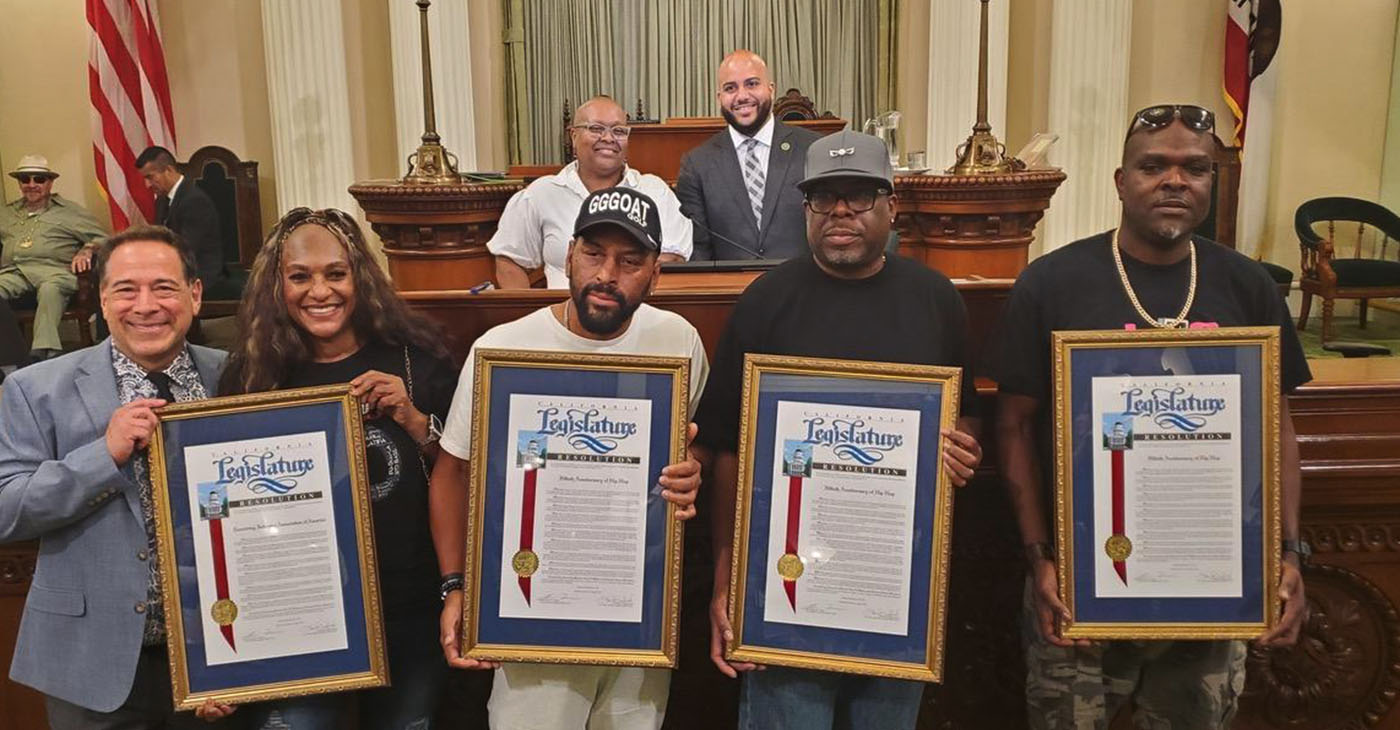
The California Legislative Black Caucus (CLBC) and the Recording Industry Association of America (RIAA) celebrated the 5oth anniversary of hip hop on Aug. 14, with a tribute to the West Coast pioneers, leaders and innovators who shaped the genre. The Bring the Peace Movement organized the rally and ceremony where speakers paid homage to the honorees.

By Antonio Ray Harvey
California Black Media
The California Legislative Black Caucus (CLBC) and the Recording Industry Association of America (RIAA) celebrated the 5oth anniversary of hip hop on Aug. 14, with a tribute to the West Coast pioneers, leaders and innovators who shaped the genre.
The Bring the Peace Movement organized the rally and ceremony where speakers paid homage to the honorees.
Juana Burns-Sperling, co-founder of Rialto/Los Angeles-based all-female hip hop group JJ FAD, told California Black Media (CBM) that the love received from state lawmakers — which included standing ovations on both the Senate and Assembly floors — was a long time in the making, but well worth the wait.
“It was amazing. It was an honor to be there to represent the West Coast and represent my group,” said Sperling, who goes by the stage name, MC JB. “When I first heard about it my thoughts were, ‘finally’ because the West Coast seems to be left out of things that are going on right now. So, the fact that our (lawmakers) were honoring us, we didn’t have to rely on other geographical areas. I was truly happy. We’re finally getting recognized.”
The rap songs Sperling, “Baby D” (Dania Birks) and “Sassy C” (Michelle Ferrens) performed were produced by world-renowned Hip Hop mogul Dr. Dre (Andre Young), and Arabian Prince (Kim Renard Nazel). They group was signed to Ruthless Records.
JJ FAD (an acronym created with the names of the original group members in 1985: Juana, Juanita, Fatima, Anna, and Dana) reached the top of the charts with their signature song, “Supersonic” in 1988.
The program organized by Jamilia Land of the Bring the Peace Movement, featured a voter registration drive and entertainment and was attended by CLBC chair Assemblymember Lori D. Wilson (D-Suisun City), Vice-Chair and Sen. Steven Bradford (D-Gardena) and other officers and members.
“At the time of its founding, hip hop was met with vitriol from politicians. However, today a host of politicians, community organizations and leaders convene to honor the pioneers and architects of the hip hop movement,” Wilson said on the Assembly floor.
Sperling was joined at the State Capitol with West Coast hip hop artists and music producers King T (Roger McBride), Kid Frost (Arturo R. Molina Jr.), Arabian Prince Mistah F.A.B.(Stanley Cox), Micheal Latt, Karega Bailey, Tinish Hollins, Greg Mack, Violet Brown, LaRussell Thomas, Greg Mack, Casual from the Hieroglyphics (Jon Owens), Disco Daddy (Michael Khalfani), filmmaker Deon Taylor, and Alonzo “Lonzo” Williams.
Mickelle “Hayón” Hellon, Leila Steinberg (who was Tupac’s manager), the Magical Rock Band, and retired legislative aid Rory Kaufman were also recognized as honorees.
Known to the West Coast hip hop community as “Grand Master Lonzo,” Williams is the innovator behind the legendary R&B/Rap group “World Class Wreckin Cru,” that found major success with the 1987 hit “Turn Off the Lights.”
“When I called my partner and Senator, Sen. Bradford, and told him we need to do something for hip hop on the West Coast I had no idea that it would end up on the Assembly and Senate floors,” Williams told CBM. “My initial plan was to do something in Compton, get all the homies and OGs together and show some love. But here we are today, and it was a great event.”
Bradford and Williams “go way back” on the music scene of Gardena, Compton, and Los Angeles. They used to promote singing groups, bands, and hip-hop dancing cliques. The artists received a warm welcome from lawmakers in both chambers; thanks to Bradford, Wilson, and Sen. Lola Smallwood-Cuevas (D- Ladera Heights).
“Steve understood what we did back in L.A. back in the day because he was a part of it but only on another level,” Williams said. “Steve was a dance promoter before he became a Compton city councilman, assemblymember, and senator. He was my competition. It just made for a great situation.”
Williams is credited with launching the careers of Dr. Dre, Ice Cube (O’Shea Jackson), D.J. Yella (Antoine Carraby) and Eazy E. (Eric Wright), formerly known as N.W.A. The group is credited with ushering in a form of hip-hop music that was coined gangster rap.
The gangster rap genre propelled the careers of Snoop Dogg (Calvin Broadus Jr.), Nate Dogg (Nathaniel Hale), DJ Quick (David Marvin Blake), Above the Law, Warren G (Warren Griffin III), Lady of Rage (Robin Yvette Allen), Yo-Yo (Yolanda Whitaker), E-40’s (Earl Stevens) little sister Suga-T (Tenina Stevens), among others.
The elements of hip hop culture first emerged in the 1970s in Morris Heights, a neighborhood in the Bronx borough of New York City. Hip-hop consists of four elements: “deejaying,” or “turntabling,” “MCing” or “rhyming,” graffiti painting, and the hip-hop dance, style, and attitude of “B-boying.”
The West Coast artists extracted the characteristics and stylings from East Coast hip hop but were able to create their own musical flavor with stories, references and imagery that reflected street life and living in urban centers, mostly in California.
Gangster rap and the “G-funk era” dominated the hip-hop scene in the late 1980s and all through the 1990s from the Los Angeles region to Oakland/San Francisco Bay Area by standouts like Too $hort (Todd Anthony Shaw).
Joel Flatow, Senior Vice President, Artist and Industry Relations, and Chief of West Coast operations for RIAA, said the accolades bestowed on the artists in Sacramento are a tribute to the innovation and foresight they brought to the culture.
“We just have a tremendous wealth of talent in this state,” Flatow added.
RIAA is a trade organization that supports and protects the rights of artists and music labels in the US.
Adding to the cultural weight to the celebration, Land and other community activists issued a proclamation, offered samplings of poetry, gave shoutouts to hip-hop history, and appealed to the audience to become politically engaged champions of peace.
“This is a time of celebration and reflection,” stated Land, who is also the co-founder of the Anti-Violence, Safety, and Accountability Project (ASAP). “We acknowledge the monumental achievements of West Coast artists and also reflect on the effect of unresolved trauma and violence in the Culture.










Activism
Oakland Post: Week of April 1 – 7, 2026
The printed Weekly Edition of the Oakland Post: Week of April 1 – 7, 2026
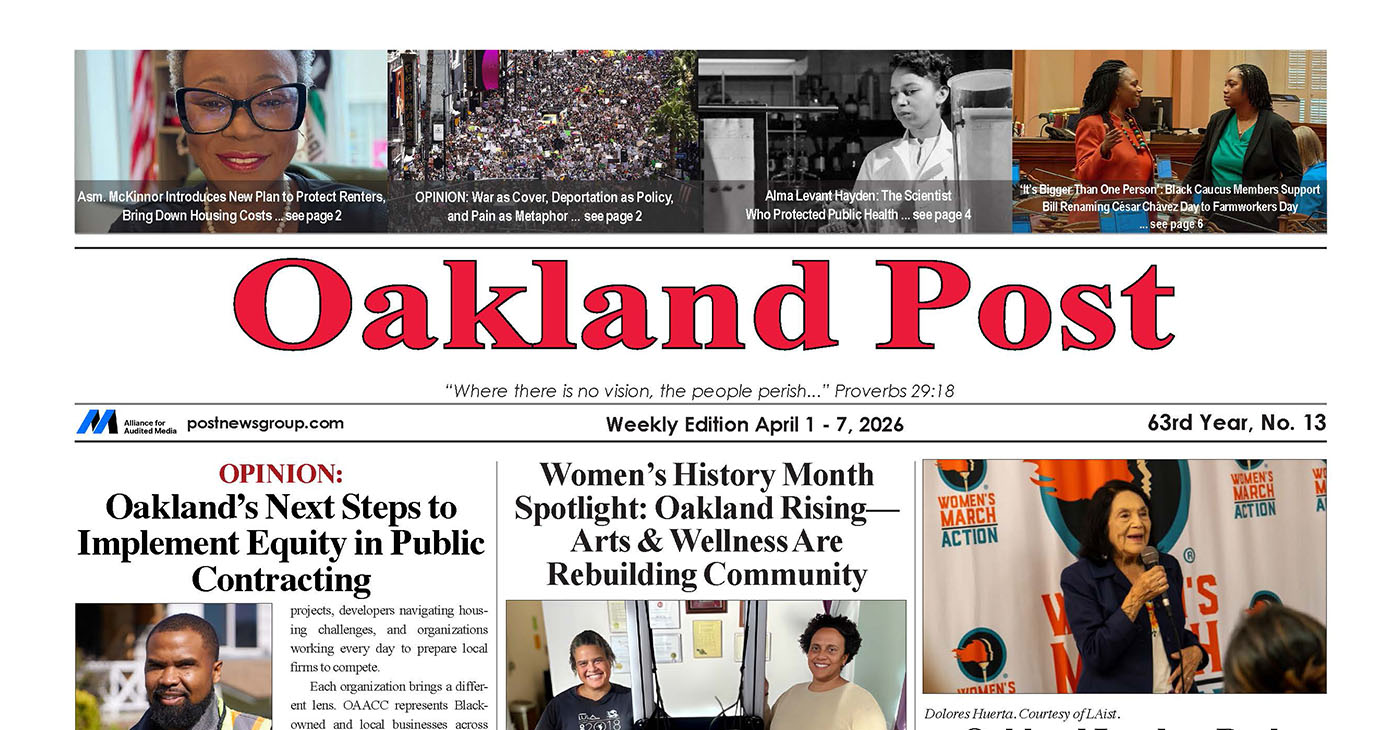
To enlarge your view of this issue, use the slider, magnifying glass icon or full page icon in the lower right corner of the browser window.
Activism
Oakland Post: Week of March 18 – 24, 2026
The printed Weekly Edition of the Oakland Post: Week of March 18 – 24, 2026
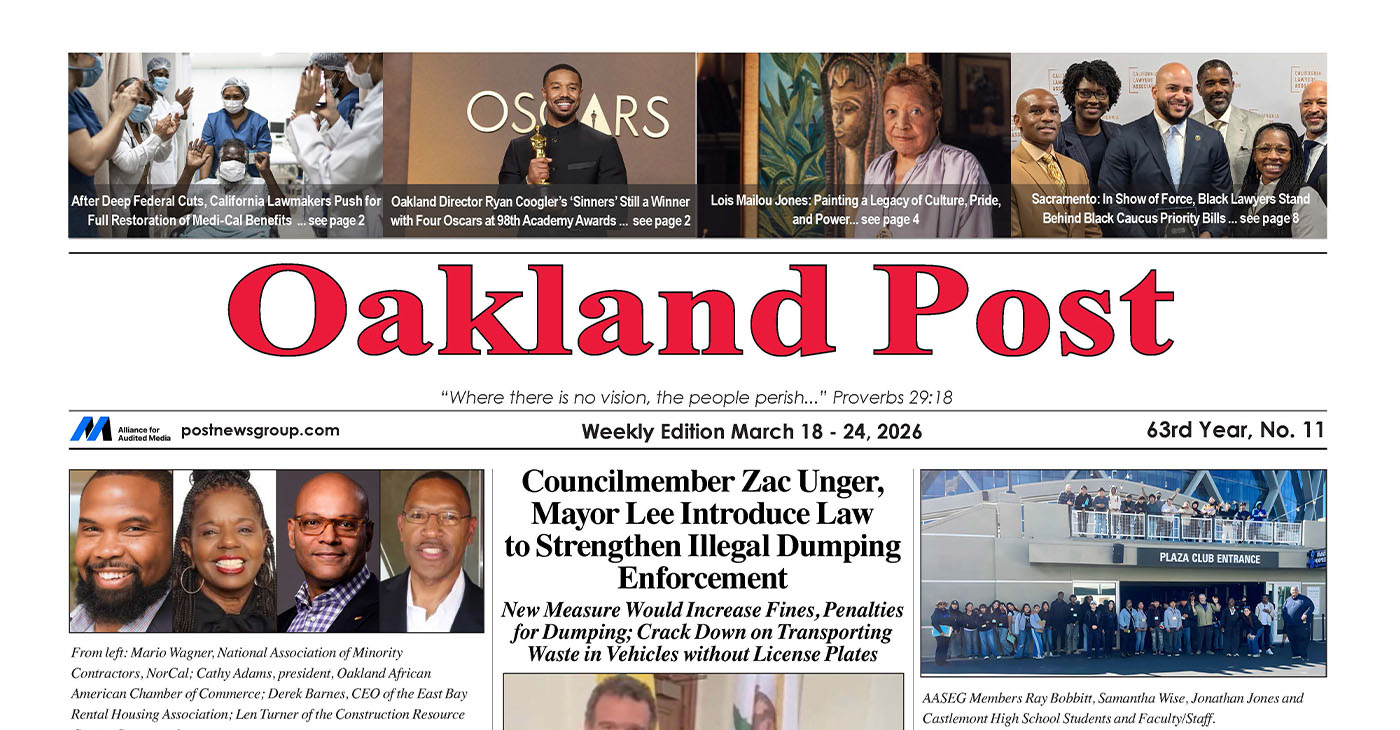
To enlarge your view of this issue, use the slider, magnifying glass icon or full page icon in the lower right corner of the browser window.
Activism
Oakland Post: Week of March 11 -17, 2026
The printed Weekly Edition of the Oakland Post: Week of March 11 – 17, 2026
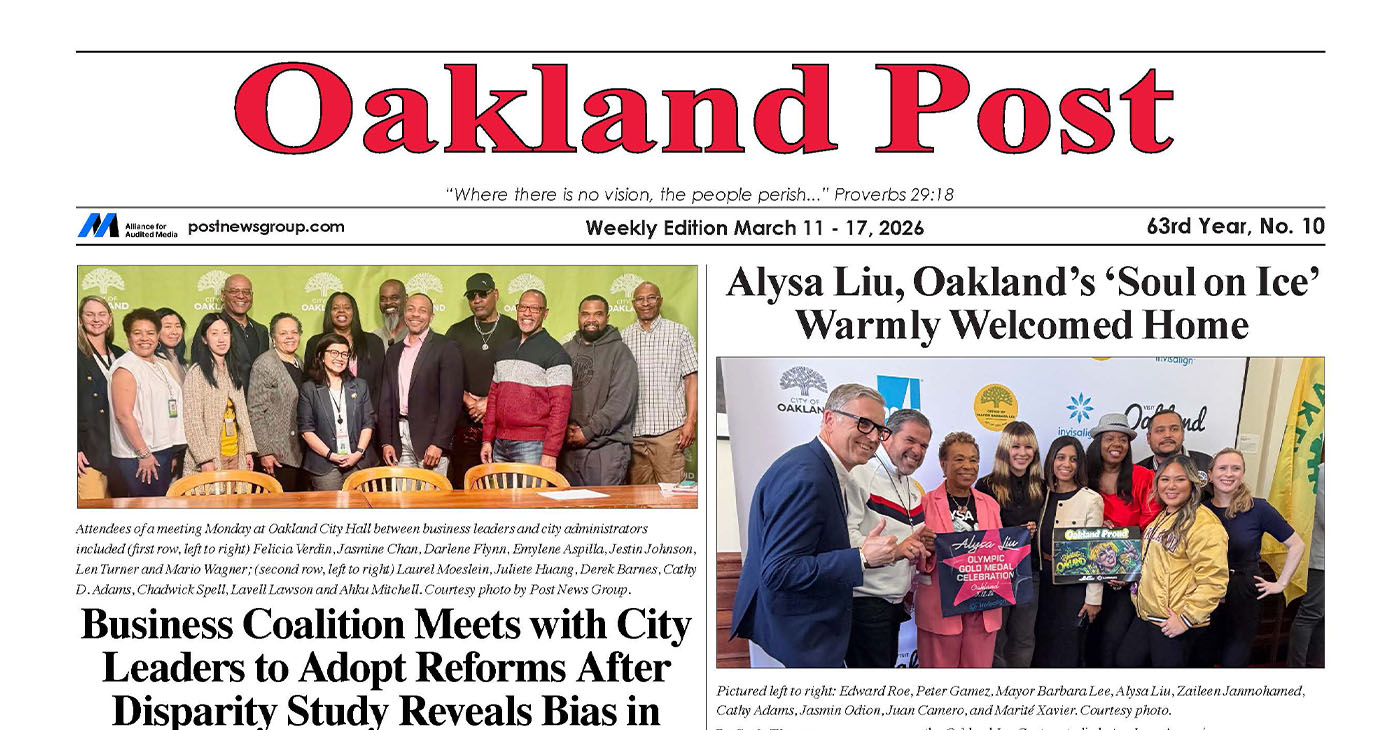
To enlarge your view of this issue, use the slider, magnifying glass icon or full page icon in the lower right corner of the browser window.

WORK FROM HOME
Home-based business with potential monthly income of $10K+ per month. A proven training system and website provided to maximize business effectiveness. Perfect job to earn side and primary income. Contact Lynne for more details: Lynne4npusa@gmail.com 800-334-0540


Oakland Post: Week of April 1 – 7, 2026

Black Artists in America, Installation Three Wraps at the Dixon Gallery and Gardens

Grief, Advocacy, and Education: A Counselor Reflects on Black Maternal Health

Future of Florida’s Black History Museum in Limbo

New Research Shows the Many Benefits of Early Learning

South Hampton K-8 Students Among Top 10 Finalists for Samsung’s ‘Solve for Tomorrow’ Competition

Cuba: No Negotiation with US on the President or Political System

Brooklyn Academy of Music Names Jamaican-Born Tamara McCaw as President

Trinidad & Tobego – U.S. Launches WhatsApp Channel for American Citizens in the Country

Oakland Post: Week of March 18 – 24, 2026

AI Innovation vs. Ethics and Environmental Impact

AI, Web3, and Digital Reparations

What If You Owned Your AI Agent?

Season 7, Episode 3 – January Reporter’s Roundtable 📱

Season 7, Episode 3 – January Reporter’s Roundtable

Reflecting on Black History Milestones in Birmingham AL

Oakland Post: Week of February 25 – March 3, 2026

Oakland Post: Week of March 4 – 10, 2026

PRESS ROOM: NBA Hall of Fame Nominee Terry Cummings Joins 100 Black Men of DeKalb County to Launch Victory & Values Initiative

Trump’s MAGA Allies are Creating Executive Order Plan to Steal the 2026 Midterms

U.S. manufacturing rebounds – how foundry services are adapting to rising demand

Poll Shows Support for Policies That Help Families Afford Child Care

Oakland Post: Week of March 11 -17, 2026
Oakland Post: Week of March 18 – 24, 2026

OP-ED: One Hundred Years of Black Workers Telling the Truth

Advancements in solar technology that are changing the way we power the world

Financial Wellness and Mental Health: Managing Money Stress in College

Woman’s Search for Family’s Roots Leads to Ancestor John T. Ward – A Successful Entrepreneur and Conductor on the Underground Railroad

COMMENTARY: Women of Color Shape Our Past and Future

PRESS ROOM: Civil Rights TV Launches in Selma as the World’s First 24/7 Civil Rights Television Network

Hyundai Ioniq 5 Parking, Safety, and 360 View #shorts

2025 Ioniq 5 New Wiper & Powerful Performance! #shorts

Electric SUV Range: Is 259 Miles Enough? #shorts

EV Charging: How Fast Can You Charge an Electric Vehicle? #shorts

Biometric Cooling… Messaging Seats…Come on! 2025 Infiniti QX80 Autograph 4WD

Charged Up: Witness the Magic of a Fully Electric Car! #shorts

Range Rover Sport PHEV Included…: See What’s Inside This Luxury SUV! #shorts

Invisible Hood View: Perfect Parking with X-Ray Vision! #shorts

AI Is Reshaping Black Healthcare: Promise, Peril, and the Push for Improved Results in California

ESSAY: Technology and Medicine, a Primary Care Point of View

Sanctuary Cities

The RESISTANCE – FREEDOM NOW

STATE OF THE PEOPLE: Freddie

ECONOMIC BOYCOTT DAY!!!!!

I told You So

-
 Activism3 weeks ago
Oakland Post: Week of March 11 -17, 2026
-
 Activism3 weeks ago
Oakland Post: Week of March 18 – 24, 2026
-
 Advice3 weeks ago
Financial Wellness and Mental Health: Managing Money Stress in College
-
 #NNPA BlackPress2 weeks ago
Brooklyn Academy of Music Names Jamaican-Born Tamara McCaw as President
-
 #NNPA BlackPress2 weeks ago
Grief, Advocacy, and Education: A Counselor Reflects on Black Maternal Health
-

 Advice4 weeks ago
Women & Wealth: Tips for Navigating Your Lifelong Financial Journey
-
 #NNPA BlackPress2 weeks ago
New Research Shows the Many Benefits of Early Learning
-
 #NNPA BlackPress2 weeks ago
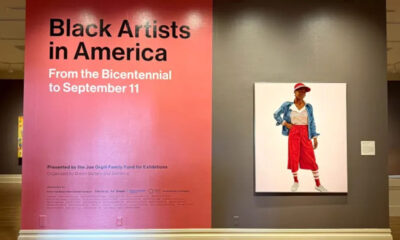
Black Artists in America, Installation Three Wraps at the Dixon Gallery and Gardens
