
Bay Area
California Cities, Counties Push New Vaccine Rules as COVID Cases Spike
Cities across California, including San Francisco, Los Angeles, San Diego and Long Beach have instituted weekly testing or proof of vaccination requirements for their employees.


Hospital workers in Los Angeles and other parts of the state have been working around the clock to contain the coronavirus Delta variant and treat patients infected by it.
According to statistics from the Los Angeles County Department of Public Health, the county’s positivity rate has steadily increased since the middle of June. Over the past two weeks, new cases, mostly involving the Delta variant, have jumped by more than 200%, according to the California Department of Public Health. Los Angeles County has seen the highest number of COVID-19 cases and deaths in the state since the pandemic began in 2020.
Dr. Jerry Abraham, an African American physician who is director of Vaccines at the Kedran Community Health Center in South Los Angeles, says the Delta variant is a lot more infectious than previous strains of the coronavirus. Abraham says he has also seen an increase in requests for testing and vaccines over the last month.
One person can infect 8 to 10 people, he said.
To arrest what could become a widespread outbreak of the deadly virus, authorities in California at the local, county and state level are beginning to institute new regulations to prevent another statewide shutdown.
Already facing criticisms and pushback from some members of state workers unions and other opponents for aggressive actions he has taken in his fight against COVID-19, Gov. Gavin Newsom remained firm and announced last week that California school employees must be vaccinated against the virus. If not, they must take a weekly test to prove they are negative. The order affects all 1,037 public school districts and private schools as well.

“We think this is a sustainable way to keep our schools open and to address the No. 1 anxiety that parents like myself have for young children,” Newsom said at a press conference. “That is knowing that the schools are doing everything in their power to keep our kids safe.”
Late last month, Newsom also announced that all state and health care employees and people who work in congregate settings public health experts deem high-risk are required to be vaccinated. That order was the first state-issued mandate of its kind in the country.
“We are now dealing with a pandemic of the unvaccinated, and it’s going to take renewed efforts to protect Californians from the dangerous Delta variant,” Newsom said at the time. “As the state’s largest employer, we are leading by example and requiring all state and health care workers to show proof of vaccination or be tested regularly, and we are encouraging local governments and businesses to do the same.”
According to CDC figures, COVID-19 cases have been steadily rising over the last 30 days due to the Delta variant surge. The Delta strain was first identified in India in 2020 and showed up in America in March. The coronavirus develops new strains as it interacts with new host bodies, unvaccinated people, and develops stronger versions. As a result, the CDC recently reversed its stance and recommended Americans wear masks indoors.
Cities across California, including San Francisco, Los Angeles, San Diego and Long Beach have instituted weekly testing or proof of vaccination requirements for their employees.
San Diego County has instituted a similar policy.
A growing number of bars and restaurants in Los Angeles and the Bay Area are requiring proof of vaccination before patrons can enter them.
Some large California companies have followed suit implementing vaccination mandates of their own. Among the first ones to take the step are Facebook, Netflix, Google, Lyft, Uber and Disney Co.
President Joe Biden has recently issued a policy that requires all federal workers and contractors to show proof of vaccination or undergo regular testing.
Yet, across the country, including some parts of California, people are aggressively protesting vaccination and mask mandates. This weekend in Los Angeles one person was hospitalized in serious condition after pro-vaccine and anti-vaccine protesters clashed during dueling rallies at City Hall in downtown Los Angeles.
In California, roughly 51% of residents are fully vaccinated. Another 10% have received at least one vaccine.
Back in south Los Angeles, Abraham told California Black Media that unvaccinated people are being hospitalized and dying while vaccinated people who get infected are showing mild symptoms.
“Vaccines are the best line of defense,” he said
Abraham’s recommendations for protecting against the coronavirus include wearing masks, social distancing, increased sanitation, limiting exposure and staying home when sick.
According to Abraham, the CDPH recommends that medical professionals prepare for giving out a third booster shot. There are expectations that 5- to 11-year-olds will be eligible for vaccination in the fall.
However, Abraham said ,at this stage he’s not sure if we’re ever going to fully defeat the coronavirus. He said it might go into remission, much like chickenpox, a disease he hasn’t dealt with in almost 20 years.
He remains hopeful but said there’s more fighting to do to get rid of the Delta variant.











Activism
At the event, 16 entities signed the EIP pledge, vowing to take steps to increase public contracting opportunities in their spheres for small and historically underutilized businesses. The pledge signees included Hub International, the Port of San Francisco, the San Francisco Public Utilities Commission, California High-Speed Rail Authority, the Port of Oakland, Robert Graham of Webcor Builders, Holder Construction, the Weitz Company, Sky Blue Builders, Hornblower, Swinerton, Luster National, Talson Solutions, Center for Community Wealth Building, and the Construction Contractors Alliance.

By Calvin Naito, Special to The Post
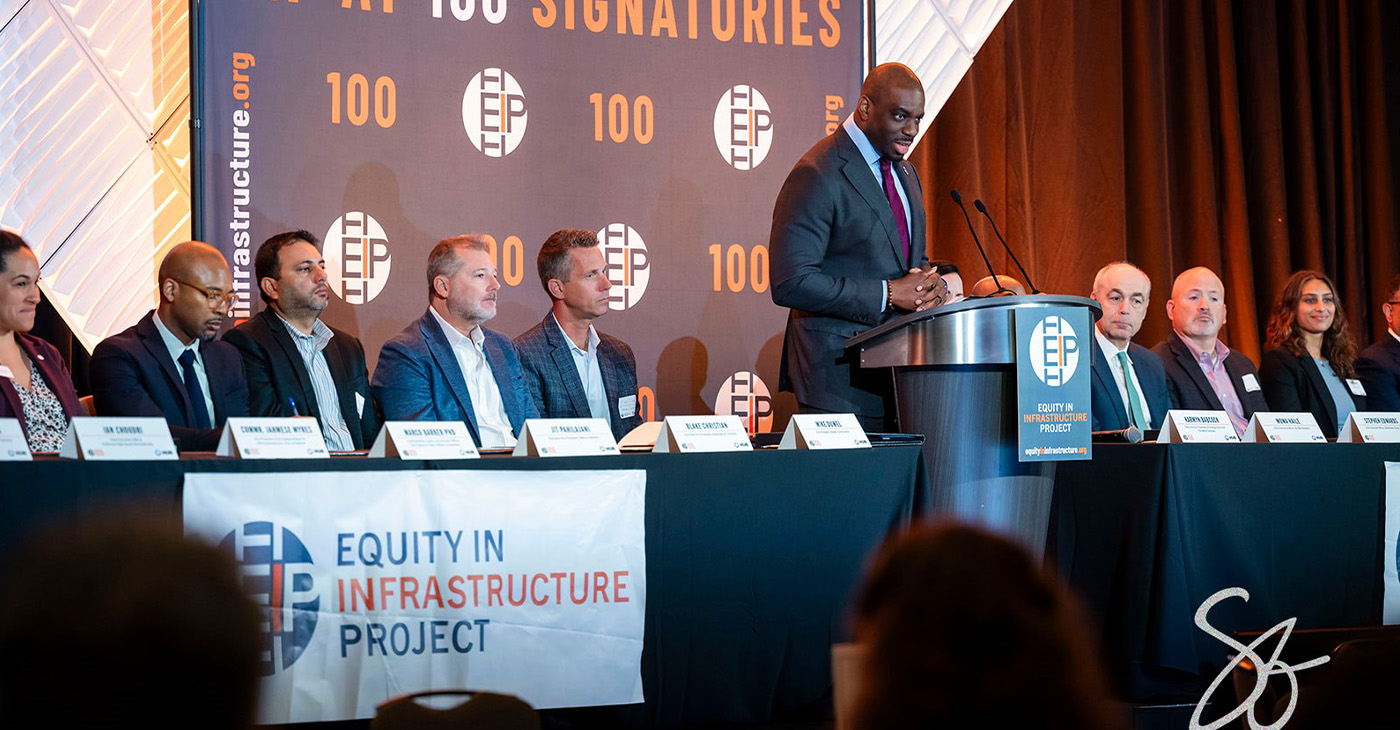
On June 4, a national nonprofit named the Equity in Infrastructure Project (EIP) – which aims to increase public construction contracting opportunities for small and historically underutilized businesses – held a day-long event in downtown San Francisco to rally supporters and build momentum to its cause.
It was attended by more than 100 individuals from public agencies, private firms, and other organizations committed to increasing contracting opportunities with governmental agencies, thereby creating more competition and lowering public costs.
The EIP event was held the Hyatt Regency San Francisco in conjunction with BuildIT, which aims to increase contracting opportunities for LGBT-owned businesses.
At the event, 16 entities signed the EIP pledge, vowing to take steps to increase public contracting opportunities in their spheres for small and historically underutilized businesses.
The pledge signees included Hub International, the Port of San Francisco, the San Francisco Public Utilities Commission, California High-Speed Rail Authority, the Port of Oakland, Robert Graham of Webcor Builders, Holder Construction, the Weitz Company, Sky Blue Builders, Hornblower, Swinerton, Luster National, Talson Solutions, Center for Community Wealth Building, and the Construction Contractors Alliance.
Following the workshop, BuildIT hosted a VIP evening reception honoring EIP, whose principals – Phil Washington, John Procari, and Rick Jacobs – accepted the award.
The event also set in motion the coalition’s efforts to implement recommendations from EIP’s “Procurement for Prosperity: A Playbook.”
The Playbook is a practical guide for public agency leaders and procurement and contracting practitioners to grow the capacity of small and first-time contractors, strengthen competition, and deliver better value for taxpayers.
Toks Omishakin, Secretary of the California State Transportation Agency (CalSTA), a long-time EIP supporter, also told attendees, “This is about commitment. This has been a life’s work. This is a tailwind moment.”
The event’s presenting sponsor was Hub International, one of the largest insurance brokerages in the nation, which was joined by partners Travelers Insurance and the State Compensation Insurance Fund.
After the pledge-signing ceremony, attendees participated in a workshop in which they examined the policies, practices, and programs needed to meet EIP goals, learned from practitioners, and identified next steps toward utilizing the Playbook.
Ingrid Meriwether, formerly of Merriwether & Williams Insurance Services (MWIS) and current president of Hub International’s Aligned Risk Management, MWIS, described the hard-fought lessons she and her MWIS team have learned over the last three decades administering contractor development programs (CDPs) for the City and County of San Francisco, Alameda County, City of Los Angeles, LA Metro, and other municipalities.
The CDPs help small and local construction firms win public infrastructure contracts with these government agencies. The program provides bonding assistance, contract financing, technical support, training, and other services to underrepresented businesses funded by public agencies who seek greater contracting participation with these firms.
Merriwether said programs like these “break down systemic barriers, create greater fairness, and save taxpayers money by enabling more competition. The contractor development programs have, cumulatively, over two decades, helped contractors access over $1 billion in bonding, supporting over $380 million in awarded contracts, and maintaining a loss ratio 250 times lower than the industry average – while saving participating municipalities more than $27 million in contracting costs as a result of enabling more competition.”
Rick Jacobs, EIP co-founder and co-chair urged attendees make plans to meet again in the near future “to continue building on this work, share progress on organizational commitments, and discuss how we can collectively advance the goals of the EIP pledge.”
For more information on the EIP and to access a copy of the Playbook, go online to https://equityininfrastructure.org/
Calvin Naito is communications manager for Equity in Infrastructure Project.

Activism
Oakland Museum Presents Landmark Retrospective Celebrating Beloved Bay Area Artist Mildred Howard
“Poetics of Memory” coincides with a year of major recognition for Howard. In 2026, she received the California Arts Council’s 50th Anniversary Award, honoring artists whose work has shaped California’s cultural and civic life, as well as the Museum of the African Diaspora’s Artist Impact Award. In 2025, she was awarded a prestigious Guggenheim Fellowship in recognition of her transformative contributions to American cultural life.

Special to The Post
The Oakland Museum of California (OMCA) opened “Mildred Howard: Poetics of Memory,” the first major museum survey of Bay Area artist Mildred Howard, on June 12.
The exhibition spans five decades of Howard’s influential work, bringing together immersive installations, found-object sculptures, archival materials, and new commissions that explore memory, identity, and power in American life.
“Poetics of Memory” coincides with a year of major recognition for Howard. In 2026, she received the California Arts Council’s 50th Anniversary Award, honoring artists whose work has shaped California’s cultural and civic life, as well as the Museum of the African Diaspora’s Artist Impact Award. In 2025, she was awarded a prestigious Guggenheim Fellowship in recognition of her transformative contributions to American cultural life.
Howard was born in San Francisco in 1945 and raised in the East Bay, where she went on to study Afro-Haitian dance, make and sell clothing, and experiment with collage and sculpture.
Her multimedia art practice emerged from these experiences, later becoming associated with West Coast conceptual art, San Francisco funk, and a vibrant community of artists like Oliver Jackson, Betye Saar, and Raymond Saunders. Since the 1970s, she has used found materials and family stories to explore memory—both individual and collective.
At OMCA, visitors enter “Poetics of Memory” through a series of intimate galleries featuring Howard’s early mixed-media pieces and sculptures, along with a large video projection of a number of her public artworks.
Together, they emphasize Howard’s interest in everyday objects as powerful carriers of individual and shared stories. Highlights include collages that remix images of the artist herself; found-object sculptures like The History of the United States with a few Parts Missing (2007) that address omissions in dominant narratives; and public works like “Locks and Keys for Harry Bridges” (2001) that transform urban space into a meditation on access and labor.
This culminates in a richly detailed “studio” environment, where works in progress, archival exhibition flyers, historic photographs of Howard and her community, postcards from fellow artists, and other materials offer insight into her creative process and daily life.
The exhibition then opens into a high-ceilinged, dramatically lit space that brings together Howard’s signature immersive installations. On one end, “Crossings” (1997/2026) – a field of hundreds of ceramic eggs leading to an ornate mirror – suggests cycles of birth, motherhood, and transition, while drawing on the emotional echoes of the Middle Passage. On the other end, “Blackbird in a Red Sky” (a.k.a. “Fall of the Blood House”) (2002) – a red glass shack bordered by a pond – also uses reflection and transparency to draw viewers into the work and prompt consideration of themes of identity and home.
Howard’s newest video installation, “Moving Stills” (2026), repurposes never-before-seen family footage she took as a teenager on a train trip to the American South. Projected onto cascading layers of translucent fabric that stretch across an entire gallery wall, the piece immerses viewers in a layered meditation on memory, migration, and time.
The “Mildred Howard: Poetics of Memory” exhibit will be on display through Oct. 11 at the Oakland Museum of California, 1000 Oak St., Oakland, CA 94612. Museum hours are Wednesday through Sunday, 11 a.m. to 5 p.m., with extended hours on Fridays to 9 p.m.
This story is sourced from the Oakland Museum of California press office.
Alameda County
Ferry Fares to Increase July 1 as Ridership Hits Record Highs
The Oakland and Alameda routes will increase from $4.90 to $5.10, the South San Francisco route will go up from $7.40 to $7.60, and the Vallejo route will increase from $9.90 to $10.

By Mike Aldax, The Richmond Standard
Starting July 1, the standard adult fare for the San Francisco Bay Ferry route between Richmond and San Francisco will increase to $5.20, up from the current $4.90.
Discounted fares for eligible passengers, including youth, seniors, people with disabilities, and Clipper START users, will rise to $2.60 from the current $2.40. Children under 5 will continue to ride for free.
The Oakland and Alameda routes will increase from $4.90 to $5.10, the South San Francisco route will go up from $7.40 to $7.60, and the Vallejo route will increase from $9.90 to $10.
The adjustments are part of a systemwide fare update approved by the agency’s Board of Directors, which is moving away from a flat 3% annual increase to route-specific pricing for the 2027 and 2028 fiscal years.
This fare update arrives as San Francisco Bay Ferry celebrates a historic May, transporting 301,270 passengers. The record-breaking figure represents an 8% increase over May 2025 and marks the third consecutive month of record-setting ridership.
Furthermore, it is the sixth month in a row that passenger numbers have exceeded pre-pandemic levels. Weekend travel has been a primary driver of this growth, with average weekend ridership seeing a 56% increase compared to pre-pandemic trends.
The agency states that the fare adjustments are necessary to ensure the long-term fiscal sustainability of public ferry services. By shifting to route-specific adjustments, the agency aims to offset rising operating costs while maintaining the high levels of service frequency and reliability.

WORK FROM HOME
Home-based business with potential monthly income of $10K+ per month. A proven training system and website provided to maximize business effectiveness. Perfect job to earn side and primary income. Contact Lynne for more details: Lynne4npusa@gmail.com 800-334-0540



Oakland Museum Presents Landmark Retrospective Celebrating Beloved Bay Area Artist Mildred Howard

Ferry Fares to Increase July 1 as Ridership Hits Record Highs

Stop the Hate Symposium Brings Oakland Together Through Dialogue, Partnership, and Community Healing

Six Months in, Probate Reform Coalition Marks Progress in Protecting Elders From Financial Abuse

A Long Time Coming: School District Kicks Off Massive $97 Million Renovation of West Oakland’s McClymonds High School

IN MEMORIAM: Oakland Dance Legend Reginald Ray-Savage, 67

UC Berkeley Named Top Public University in the U.S. and No. 7 in the World by ‘U.S. News’

NCBW-OBAC Champions Black Women Entrepreneurs at Business en Blaque Expo

Lock In Car Price: Avoid Dealer Payment Traps!

Sell Your Car: Get Offers BEFORE Visiting Dealerships!

The Conversation With Al McFarlane 6/23/26

Media Monday 6/22/26

LIVE! ASK ALMA! — TUES. 6.23.26 7PM EST

Car Buying Secrets: 4 Hidden Checks Before You Sign!

Book Review: Books for College-Bound Students

Q&A with Steven Bradford: Why He Wants Your Vote for California Insurance Commissioner

Oakland Mayor Pushes Charter Overhaul to Clarify Roles in City Government, Increase Accountability and Improve Service Delivery

The Ladies of Delta Sigma Theta Hold Day of Advocacy at the Capitol in Sacramento

OPINION: The Fire of Oakland’s Justin Jones

California Launches Free Diaper Program for Newborns Statewide

How Is AI Affecting California? The State Wants You to Share Your Story

Rep. Kamlager-Dove Introduces Bill to Protect Women in Custody After Reports Detailing Miscarriages and Neglect

More and More, Black Californians Are Worried About Rising Costs of Housing, Energy, Food and Gas

Coming to Orinda: A Lecture on Finding the Strength to Heal and Move Past Fear With Divine Love

Asm. Jackson Bill Requiring Anti-Hate Speech Training for Calif. Public Officials Sent to “Suspense File”

After 10-Year Wait, Fillmore Heritage Center Reopens in San Francisco

Oakland Post: Week of May 20 – 26, 2026

Oakland Post: Week of May 27 – June 2, 2026

Oakland Post: Week of June 3 – 9, 2026
The Conversation With Al McFarlane 6/23/26
Media Monday 6/22/26
LIVE! ASK ALMA! — TUES. 6.23.26 7PM EST
Car Buying Secrets: 4 Hidden Checks Before You Sign!

Is This 550 HP Charger Worth YOUR Money? AutoNetwork Review

Celebrating Juneteenth – Frederick Douglass on education and resistance

LIVE! — ASK ALMA! — TUES. 6.19.26 7PM EST

Hyundai Ioniq 5 Parking, Safety, and 360 View #shorts

2025 Ioniq 5 New Wiper & Powerful Performance! #shorts

Electric SUV Range: Is 259 Miles Enough? #shorts

EV Charging: How Fast Can You Charge an Electric Vehicle? #shorts

Biometric Cooling… Messaging Seats…Come on! 2025 Infiniti QX80 Autograph 4WD

Charged Up: Witness the Magic of a Fully Electric Car! #shorts

Range Rover Sport PHEV Included…: See What’s Inside This Luxury SUV! #shorts

Invisible Hood View: Perfect Parking with X-Ray Vision! #shorts
-
 Art3 weeks ago
After 10-Year Wait, Fillmore Heritage Center Reopens in San Francisco
-
 Activism3 weeks ago
Oakland Post: Week of June 3 – 9, 2026
-
 #NNPA BlackPress3 weeks ago
5 Cleveland Police Officers Injured, Gunfire Erupts During East Side Pursuit
-

 #NNPA BlackPress3 weeks ago
2026 World Cup is Here and Atlanta is Ready For It
-

 Arts and Culture3 weeks ago
COMMENTARY: Black Music is the Sound of Black Freedom: Let Us Reclaim Both This Juneteenth
-
 #NNPA BlackPress3 weeks ago
COMMENTARY: Using Art, Healing, And Community to Transform Mental Health Dialogue
-

 Art3 weeks ago
Oakland Director Boots Dazzles Once Again in ‘I Love Boosters’
-

 #NNPA BlackPress3 weeks ago
Venus Williams Calls a Sabalenka Exit a Tragedy
