
Entertainment
Book Review-“The Parker Sisters: A Border Kidnapping”

Your neighbors said they’d keep an eye on your house for you this summer.
They’d get the mail in, and grab the newspaper while you were on vacation. They’d do everything for you – and, as in the new book “The Parker Sisters: A Border Kidnapping” by Lucy Maddox, you should be glad if they watch your children, too.
Along the border between Pennsylvania and Maryland , Thomas McCreary “earned a reputation” as slave catcher, did jail time in 1849 for kidnapping, and was mistrusted by many, Black and white.
Still, he’d managed to find work as a mail carrier in both states, which may’ve given him opportunity to observe the comings-and-goings of Elizabeth and Rachel Parker, two free Black children.
Elizabeth, somewhere around 10 years old, was a headstrong, “difficult” child who’d left (or been kicked out of) her family’s home years before and had worked and lived with a series of white families.
The latest was near-destitute; Maddox hypothesizes that Elizabeth ’s presence in the Donnelly household may have been on purpose, so that McCreary might have an easier chance to snatch her.
Two weeks later, Elizabeth ’s older sister, Rachel, was taken in broad daylight, right in front of the family who employed her.
Rachel’s abduction, says Maddox, probably made neighbors notice that Elizabeth, who was already on her way to a slave auction in Baltimore, was gone.
The man who employed Rachel, Joseph Miller, was outraged over her kidnapping. There had been similar trouble before nearby; the Federal government and individual states had long argued over the laws governing escaped slaves, free Blacks, and slave catchers who generally lied about both.
Miller and his neighbors sprang into action and, says Maddox, “Within 24 hours, the abductions of the Parker sisters would no longer be local matters.”
Neither would they be resolved happily or quickly. Says author Lucy Maddox, Rachel and Elizabeth spent months in jail, while their legal status and identities were resolved.
In the meantime, one man lost his life and another got off “scot-free.”
I’m normally not a fan of books that offers dozens of names to keep track of, but that profuseness somehow works in “The Parker Sisters.”
That may be because Maddox explains in detail the significance of what happened by telling the history behind the laws that made this event possible (and illegal).
Readers will appreciate the story’s movement between North and South, and the clarity of explanation, even on the smallest of details. There are some big surprises in here, too – particularly in what happened to Elizabeth Parker.
On the matter of murder, Maddox is rather like a detective, which is another well-done aspect of this book. Officials tried to explain the death as a suicide, but she walks readers through events and clues to prove otherwise.
Despite all that’s appealing, and because it’s packed with a lot, this isn’t an easy book to read – but it’s worth it.
If you’re a lover of a good tale or a historian, particularly, “The Parker Sisters” is a book you’ll want to keep your eyes on.
“The Parker Sisters: A Border Kidnapping” by Lucy Maddox, c 2016, Temple University Press, $28.50; 256 pages.


Activism
Oakland Post: Week of February 11 = 17, 2026
The printed Weekly Edition of the Oakland Post: Week of – February 11 – 17, 2026

To enlarge your view of this issue, use the slider, magnifying glass icon or full page icon in the lower right corner of the browser window.
Arts and Culture
Book Review: Books on Black History and Black Life for Kids
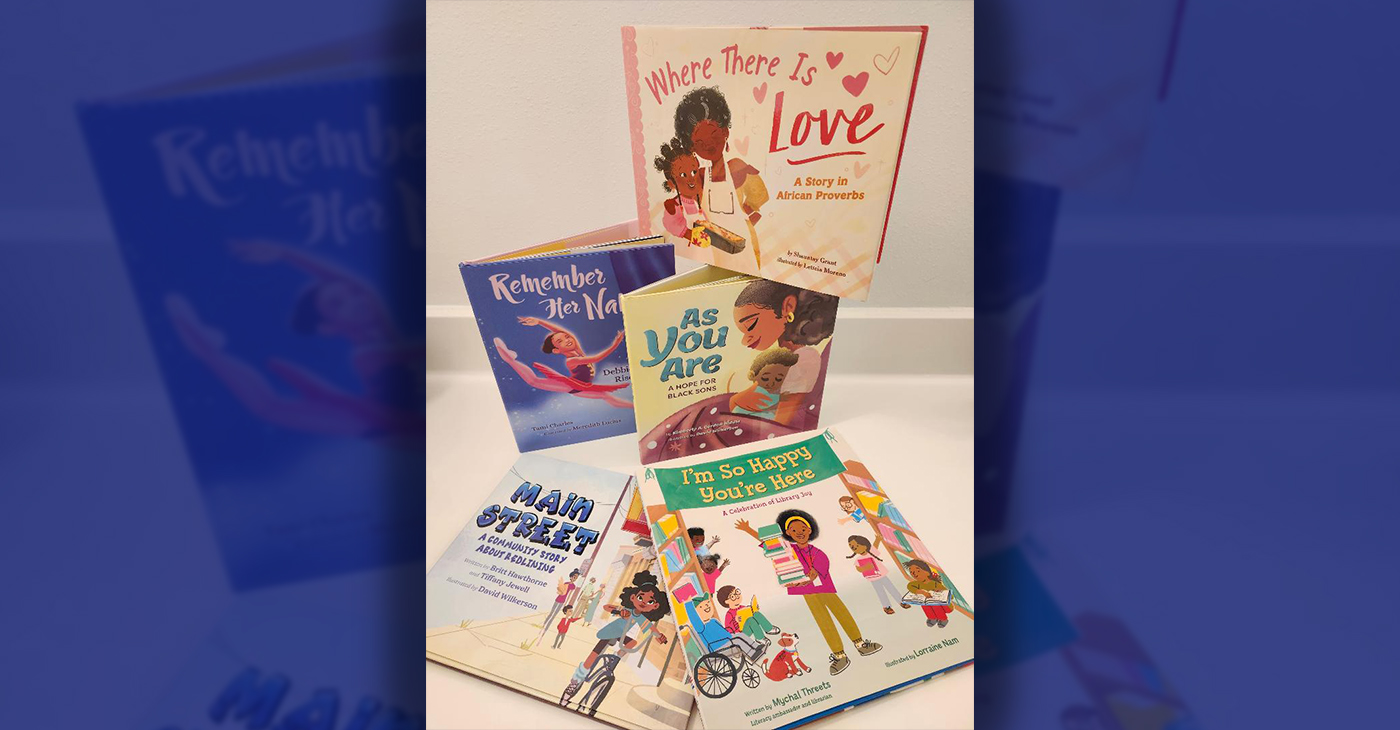
For the youngest reader, “As You Are: A Hope for Black Sons” by Kimberly A. Gordon Biddle, illustrated by David Wilkerson (Magination Press, $18.99) is a book for young Black boys and for their mothers. It’s a hope inside a prayer that the world treats a child gently, and it could make a great baby shower gift.
By Terri Schlichenmeyer
Authors: Various, Copyright: c. 2025, 2026, Publishers: Various, SRPs: $17.99-$18.99, Page Counts: Various,
Everybody in your family has stories to share.
Your parents have told you some, no doubt. Your grandparents have offered a few, too, and aunties and uncles have spun some good tales. But there’s so much more to know, so grab one of these great books and learn about Black History and Black life.
For the youngest reader, “As You Are: A Hope for Black Sons” by Kimberly A. Gordon Biddle, illustrated by David Wilkerson (Magination Press, $18.99) is a book for young Black boys and for their mothers. It’s a hope inside a prayer that the world treats a child gently, and it could make a great baby shower gift.
If someone said you couldn’t do something that you were clearly able to do, would you fight to do it anyhow? In the new book, “Remember Her Name! Debbie Allen’s Rise to Fame” by Tami Charles, illustrated by Meredith Lucius (Charlesbridge, $17.99), a young girl in the Jim Crow South is told that she can’t dance because of the color of her skin.
She didn’t listen, though, and neither did her mother, who took her daughter to Mexico, where the girl soared! This is an inspiration for any 5-to-7-year-old; be sure to check out the back-of-the-book information, if you’re an adult fan.
Do you often hear your elders say things that sound like lessons? They might be, so “Where There is Love: A Story of African Proverbs” by Shauntay Grant, illustrated by Leticia Moreno (Penguin Workshop, $18.99) is a book you’ll like. It’s a quick-to-read collection of short proverbs that you can say every day. Kids ages 4-to-6 will easily remember what they find in this book; again, look in the back for more information.
Surely, you love your neighborhood, which is why the tale inside “Main Street: A Community Story about Redlining” by Britt Hawthorne and Tiffany Jewell, illustrated by David Wilkerson (Penguin Kokila, $18.99) is a book for you.
Olivia’s neighborhood is having a block party, but she’s sad when no one shows up. That’s when she learns that “the government” is discriminating against the people and businesses near where she lives. So, what can she and her neighbors do? The answer might inspire 6-to-8-year-old kids to stand up to wrongs they see, and to help make their neighborhoods stronger and safer.
And finally, if a kid wants a book, where can they go to find it? In “I’m So Happy You’re Here: A Celebration of Library Joy” by Mychal Threets, illustrated by Lorraine Nam (Random House, $18.99) is a good introduction to the best of what a library has to offer. The freedom to walk into a library and borrow a book is the theme here, as is the sheer happiness of being welcomed, no matter who you are. This is an easy book for kids as young as two and as old as five to enjoy.
On that note, if you want more, head to that library, or a nearby bookstore. They’ll be glad to see you. They’ve got stories to share.
Activism
Art of the African Diaspora Celebrates Legacy and Community at Richmond Art Center
Now in its 29th year, Art of the African Diaspora is the Bay Area’s longest-running exhibition of its kind. Its roots stretch back to 1989, when artist and educator Marie Johnson Calloway founded Colors of Black, a salon for African American artists. That gathering inspired artists Jan Hart-Schuyers and Rae Louise Hayward to establish The Art of Living Black at the Richmond Art Center in 1996.
By Carla Thomas
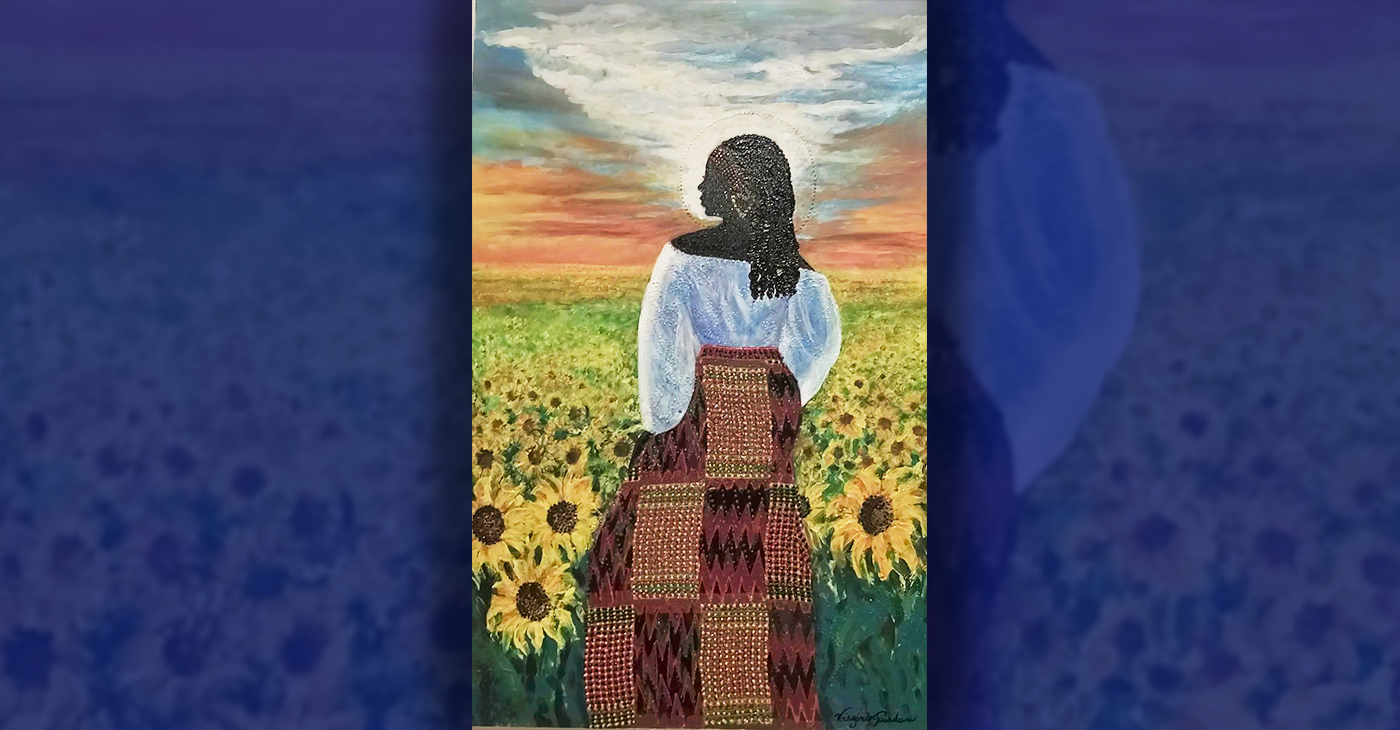
The 2026 Art of the African Diaspora exhibition is on display at the Richmond Art Center (RAC) through March 14. The one-room gallery bursts with more than 100 works – paintings, photographs, sculptures, and mixed-media pieces – each affirming the power, beauty, and vitality of cultural expression across the African diaspora.
Now in its 29th year, Art of the African Diaspora is the Bay Area’s longest-running exhibition of its kind. Its roots stretch back to 1989, when artist and educator Marie Johnson Calloway founded Colors of Black, a salon for African American artists. That gathering inspired artists Jan Hart-Schuyers and Rae Louise Hayward to establish The Art of Living Black at the Richmond Art Center in 1996. Their vision was to showcase the creativity of emerging and established Black artists, bridging communities and widening access to audiences historically excluded from mainstream art spaces.
Over the decades, that founding vision has expanded and evolved, carried forward by artists, family members, and the Richmond Art Center after the loss of Hart-Schuyers and Hayward. In 2018, a new generation of artists formed a steering committee to organize the event; a year later, the exhibition was renamed Art of the African Diaspora to embrace the broader global connections of people of African descent.

The new name reflects not only a broader cultural lens but also an empowered community network that supports artists across the Bay Area. As part of this year’s programming, RAC will host ‘Art of the African Diaspora: Public Art in Our Communities,’ a free panel on Sat., Feb. 21, from 12 to 1:30 p.m. Artists Kristine Mays, James Moore, and Malik Seneferu will join arts administrator Denise Pate for a conversation on the impact and process of public art. The discussion will be moderated by longtime arts advocate and producer Flo Wiley.
Each panelist brings a distinctive voice to the conversation. Mays, known for her ethereal wire sculptures that capture movement and spirit, has exhibited internationally and is represented in collections ranging from the Smithsonian to the Crocker Art Museum.
Sculptor and painter James Moore creates abstract metal works and colorful field paintings that explore movement, balance, and emotion. His recent public art installations include large-scale pieces in Richmond’s Shields-Reid Park. Malik Seneferu, a self-taught San Francisco native, has built a large body of work celebrating African American life through vibrant murals and expressive figurative art.
Representing the institutional side, Denise Pate oversees public arts investments as director of Community Investments at the San Francisco Arts Commission, advancing racial and cultural equity through funding and advocacy. Together, these artists and administrators will trace how public art emerges, from concept to community collaboration, and why it matters.
The Art of the African Diaspora exhibition runs through March 14 at the Richmond Art Center, 2540 Barrett Ave., Richmond. The center is open Wednesday through Saturday from 10 a.m. to 4 p.m. Admission and programs are free and open to the public.

WORK FROM HOME
Home-based business with potential monthly income of $10K+ per month. A proven training system and website provided to maximize business effectiveness. Perfect job to earn side and primary income. Contact Lynne for more details: Lynne4npusa@gmail.com 800-334-0540


Oakland Post: Week of February 11 = 17, 2026

Rising Optimism Among Small And Middle Market Business Leaders Suggests Growth for California

Discrimination in City Contracts

COMMENTARY: The National Protest Must Be Accompanied with Our Votes

Congresswoman Simon Votes Against Department of Homeland Security, ICE Funding

Post Newspaper Invites NNPA to Join Nationwide Probate Reform Initiative

Community Celebrates Turner Group Construction Company as Collins Drive Becomes Turner Group Drive

New Bill, the RIDER Safety Act, Would Support Transit Ambassadors and Safety on Public Transit

Trump’s White House Pushes to Control California Wildfire Recovery

Gov. Newsom, AG Bonta to Local Law Enforcement: You Have Authority to Investigate Federal Agents

Dorothy Lee Bolden: Uniting Domestic Workers

Cracking Down on Human Trafficking, California DOJ Announces 120 Arrests

COMMENTARY: The Biases We Don’t See — Preventing AI-Driven Inequality in Health Care

California Launches Study on Mileage Tax to Potentially Replace Gas Tax as Republicans Push Back

Book Review: Books on Black History and Black Life for Kids

OP-ED: AB 1349 Puts Corporate Power Over Community

Protecting California’s Black Moms and Babies: Policies and Programs Struggle to Fix Deep-Rooted Maternal Health Inequities

Why Peace on Earth Begins with Birth, a Q&A with Midwife Nikki Helms

Jefferson County (AL) Democrats Open Qualifying for 2026 Primary Elections

Skater Emmanuel Savary Sharpens Routines for the 2026 U.S. Championships

COMMENTARY: With Gratitude and Praise for 2026

Life Expectancy in Marin City, a Black Community, Is 15-17 Years Less than the Rest of Marin County

From Civil Rights to ICE Raids, Trump’s Unchecked Power Puts Every Community at Risk
From Civil Rights to ICE Raids, Trump’s Unchecked Power Puts Every Community at Risk

OP-ED: The Dream Cannot be Realized Without Financial Freedom

Travis Scott Teaches Us How to Give Forward

Oakland Post: Week of January 28, 2025 – February 3, 2026

Four Stolen Futures: Will H-E-B Do The Right Thing?

Newsom’s Finance Director Joe Stephenshaw Opens 2026-27 Budget Debate with Cautious Plan

Street Lines: 2025 Jeep Wagoneer S Limited 4XE

Hyundai Ioniq 5 Parking, Safety, and 360 View #shorts

2025 Ioniq 5 New Wiper & Powerful Performance! #shorts

Electric SUV Range: Is 259 Miles Enough? #shorts

EV Charging: How Fast Can You Charge an Electric Vehicle? #shorts

Biometric Cooling… Messaging Seats…Come on! 2025 Infiniti QX80 Autograph 4WD

Charged Up: Witness the Magic of a Fully Electric Car! #shorts

Range Rover Sport PHEV Included…: See What’s Inside This Luxury SUV! #shorts

Invisible Hood View: Perfect Parking with X-Ray Vision! #shorts

AI Is Reshaping Black Healthcare: Promise, Peril, and the Push for Improved Results in California

ESSAY: Technology and Medicine, a Primary Care Point of View

Sanctuary Cities

The RESISTANCE – FREEDOM NOW

STATE OF THE PEOPLE: Freddie

ECONOMIC BOYCOTT DAY!!!!!

I told You So

-
 Activism2 weeks ago
Life Expectancy in Marin City, a Black Community, Is 15-17 Years Less than the Rest of Marin County
-
 Activism2 weeks ago
Oakland Post: Week of January 28, 2025 – February 3, 2026
-
 Activism3 weeks ago
Oakland Post: Week of January 21 – 27, 2026
-

 Activism2 weeks ago
Medi-Cal Cares for You and Your Baby Every Step of the Way
-
Uncategorized2 weeks ago
Homegoing Service for Education Advocate Oscar Wright, 101
-
 Business1 week ago
California Launches Study on Mileage Tax to Potentially Replace Gas Tax as Republicans Push Back
-

 Activism1 week ago
After Don Lemon’s Arrest, Black Officials Raise Concerns About Independent Black Media
-
 Activism1 week ago
Community Celebrates Turner Group Construction Company as Collins Drive Becomes Turner Group Drive
