
Politics
Black DA to Decide Charges Against White Wisconsin Officer


In this Feb. 26, 2013 file photo, Dane County, Wisconsin, District Attorney Ismael Ozanne speaks in a Madison, Wis., court. (AP Photo/Wisconsin State Journal,M.P. King, File)
Todd Richmond, ASSOCIATED PRESS
MADISON, Wis. (AP) — The story has played out the same way in Ferguson, Missouri, New York City and Milwaukee. A white police officer kills an unarmed black man, sparking waves of protests before a white prosecutor ultimately decides not to file charges or hands the case off to a grand jury.
That narrative looks different in Wisconsin’s capital city, where a liberal biracial prosecutor will decide whether to charge a white officer in an unarmed biracial man’s death.
Black protesters have likened last month’s fatal shooting of 19-year-old Tony Robinson by police officer Matt Kenny to the killings of Michael Brown in Ferguson, Eric Garner in New York City and Dontre Hamilton in Milwaukee. Grand juries in Ferguson and New York, convened by white prosecutors, chose not to charge the officers in those cases. Milwaukee County District Attorney John Chisholm, who is white, declined to file charges in the Hamilton shooting.

The decision to press charges in the Madison case will be made by Dane County District Attorney Ismael Ozanne, a biracial Democrat who identifies as black.
Ozanne, whose mother was an activist in the South during the Freedom Summer of 1964, got his start as an assistant Dane County district attorney in 1998. Ten years later, then-Gov. Jim Doyle chose Ozanne to help lead the state Department of Corrections, where he helped implement Doyle’s early release program.
Doyle appointed Ozanne as Dane County district attorney two years later, and Ozanne was elected to the position in 2012, running on promises to reduce racial disparities. Last year, he ran unsuccessfully for state attorney general, vowing to expand programs that allow young adult offenders to clear their records by completing their sentences and connect violent offenders to mentors.
Doyle said he thinks more African-Americans should serve as prosecutors and judges, a view that factored into his decision to appoint Ozanne to his position.
“Not to say they should make decisions (based) on race, but it brings a greater sense of fairness to the system,” said Doyle, a Democrat who served as Wisconsin attorney general before he was elected governor in 2002.
He said he’s confident that Ozanne will weigh the facts in the Robinson case impartially.
“His decision isn’t to see whether all of justice is done in the world or all the wrongs have been righted or whether police behavior is appropriate or inappropriate,” Doyle said. “His decision will determine whether he thinks there’s probable cause (to support charges). You just really have to go back to the basics.”
Ozanne has cleared police in a number of officer-involved shootings since 2012, but none of those cases generated as much scrutiny as the Robinson case.
Police said Kenny shot Robinson in an apartment house near the state Capitol building on March 6. They said Robinson attacked Kenny, who was responding to calls that Robinson had attacked two other people and was running in traffic. Investigators have released no other details.
The Young, Gifted and Black Coalition staged daily peaceful protests in the week after the shooting. Demonstrators demanded that Kenny be fired and charged with homicide.
Kenny has not responded publicly.
The state Justice Department investigated the shooting and handed its findings over to Ozanne at the end of March. Ozanne has said he has no timeline for a charging decision. He didn’t return a message seeking comment.
Brandi Grayson, a spokeswoman for Young, Gifted and Black, told the city council that the city will “erupt” when the full facts emerge. Decisions not to file charges in the deaths of Brown, Garner and Hamilton all led to protests, including violent demonstrations in Ferguson.
The group said in a statement that it doesn’t expect Ozanne to charge Kenny. Grayson said in an interview that Ozanne’s racial identity doesn’t matter because he’s part of a criminal justice system that works against blacks.
“We expect him to proceed and investigate as if he was white or Asian,” Grayson said. “It doesn’t matter. He’s a representative of the system and the system is fixed. The laws are written in a way to ensure Matt Kenny won’t be indicted.”
Michael Scott, a former Madison police officer and law professor who heads the Center for Problem-Oriented Policing Inc., which advises police agencies on crime fighting techniques, said officer-involved shootings rarely result in charges against the officer.
“In highly emotional and controversial events, it’s not uncommon that the facts get lost in the emotion,” Scott said. “I don’t know what happened in that apartment. (But) as a general matter of course, it’s just a very rare case where the facts support the allegation that a police officer intentionally murdered somebody with no legal justification whatsoever.”
___
Follow Todd Richmond on Twitter at https://twitter.com/trichmond1.
Copyright 2015 The Associated Press. All rights reserved. This material may not be published, broadcast, rewritten or redistributed.
###










Business
OP-ED: Proposition 44 Would Put a Price on Trust
The danger in Proposition 44 is not only its 90 percent figure. It is that the meaning of “qualifying” spending will be worked out later. A clinic preparing a budget today may not know whether a navigator, health educator, transportation program, outreach worker, technology upgrade, or other patient-support service will be counted the way it expects. Yet the financial consequence of getting it wrong could be immediate.




Business
OP-ED: Proposition 40: It’s Time to Play Chess, Not Checkers
Proposition 40 would impose a one-time 5 percent tax on the wealth of Californians with more than $1 billion in assets. Most of that money would go toward health care, with the remainder supporting food assistance and education-related programs.


Activism
Oakland Post: Week of September 30 – October 6, 2026
The printed Weekly Edition of the Oakland Post: Week of September 30 – October 6, 2026
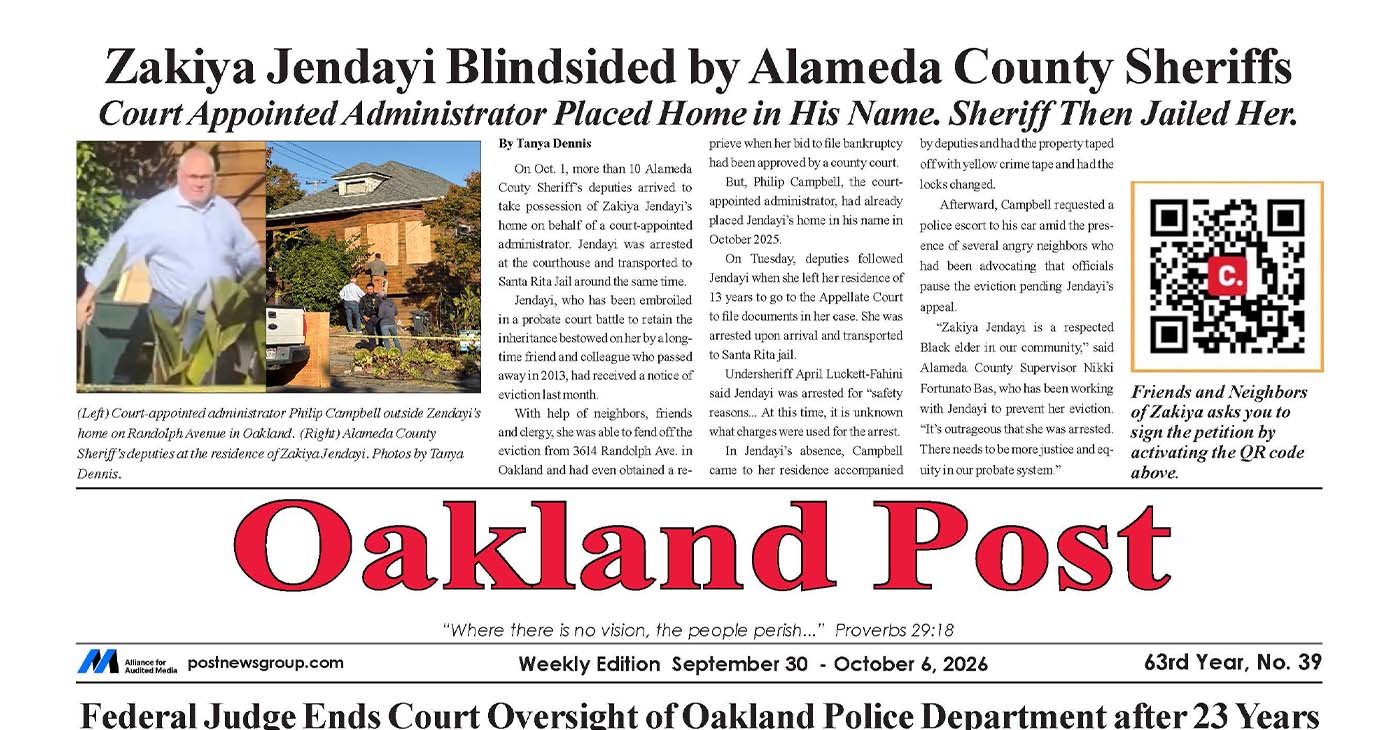
To enlarge your view of this issue, use the slider, magnifying glass icon or full page icon in the lower right corner of the browser window.


OP-ED: Proposition 44 Would Put a Price on Trust

OP-ED: Proposition 40: It’s Time to Play Chess, Not Checkers

Listening as a Lifeline: A Doula’s Witness to Black Maternal Health

New Protections for Ticket Buyers: Gov. Newsom Signs Assemblymember Isaac Bryan’s Bill

‘We Don’t Talk Trash — We Pick Up Trash!’

Zakiya Jendayi Arrested, Locked Out of Home by Sheriff’s Deputies

Oakland Post: Week of September 30 – October 6, 2026

Asm. Corey Jackson Announces Launch of 24-Hour Childcare in His District

IN MEMORIAM: The Rev. Leon “Sonny” Clark, Longtime Orange County Pastor and Community Leader, Dies at 72

Poll: Becerra Widens His Lead Over Hilton; Californians Split on Wealth Tax

From Historic Memories to New Possibilities: Oakland Celebrates Coliseum 60

County Office of Education Says OUSD Finances Are Getting Healthier, Materially Stronger

LIVE FREE Sunday Dinner Brings Faith, Fellowship and Civic Conversation to Oakland

Remembering Chauncey Bailey as Student Journalists Face Threats to Truth-Telling

BLACspace Cooperative Invites Bay Area to Experience Oakland’s Black Cultural Ecosystem Through a BLAC Map Tour + Party

Standoff for Justice: Our Homes Are Worth Fighting For

Oakland Post: Week of August 26 – September 1, 2026

Frontier Airlines’ Return to Oakland Airport Brings Flights, Jobs and Opportunity

Gubernatorial Candidate Steve Hilton Blasts California New Tire Rules; Newsom Hits Back

Chef Sharon Lee Blends Culinary Excellence, Education and Empowerment

Jackie Wright Champions Bay Area Stories, Filmmakers and Cultural Institutions

Misnamed ‘Parent’ PAC Seeks to Influence Oakland School Board Elections

Oakland Coliseum Project Opens Door for Small Businesses to Build Bigger

Big City Mayors Ask for “Yes” Vote on Housing Bond Measure; Conservatives Say “No”

Gov. Newsom’s Latest Appointees Include Sacramento Advocate for Formerly Incarcerated Students; State’s New Tech Chief

Longtime BWOPA Member Brendalyn Goodall Appointed to California Workforce Development Board

Gov. Newsom Signs Law Shielding Immigration Aid Workers From Doxing Threats

Secretary of State Shirley N. Weber Urges Californians to Vote Early as Voter ID Battle Intensifies

Oakland Post: Week of September 2 – 8, 2026

IN MEMORIAM: Dolly Parton Dead at 80 — How She Built a Legacy of Love and Earned Her Place in Black Culture

The Conversation With Al McFarlane 6/23/26

Media Monday 6/22/26

LIVE! ASK ALMA! — TUES. 6.23.26 7PM EST

Car Buying Secrets: 4 Hidden Checks Before You Sign!

Is This 550 HP Charger Worth YOUR Money? AutoNetwork Review

Celebrating Juneteenth – Frederick Douglass on education and resistance

LIVE! — ASK ALMA! — TUES. 6.19.26 7PM EST

Hyundai Ioniq 5 Parking, Safety, and 360 View #shorts

2025 Ioniq 5 New Wiper & Powerful Performance! #shorts

Electric SUV Range: Is 259 Miles Enough? #shorts

EV Charging: How Fast Can You Charge an Electric Vehicle? #shorts

Biometric Cooling… Messaging Seats…Come on! 2025 Infiniti QX80 Autograph 4WD

Charged Up: Witness the Magic of a Fully Electric Car! #shorts

Range Rover Sport PHEV Included…: See What’s Inside This Luxury SUV! #shorts

Invisible Hood View: Perfect Parking with X-Ray Vision! #shorts
-
 Community3 weeks ago
Misnamed ‘Parent’ PAC Seeks to Influence Oakland School Board Elections
-
 Activism4 weeks ago
Oakland Post: Week of September 2 – 8, 2026
-

 Activism3 weeks ago
Oakland Post: Week of September 9 – 15, 2026
-

 Community3 weeks ago
Richmond Tiny House Village Farm & Garden Set to Open Gates on Sept. 26
-

 Black History3 weeks ago
Latest Massacre in Haiti Reveals Cruelty U.S. Deportations
-

 Black History3 weeks ago
OPINION: Nolan Wells’ Death One of Several Signifying Racial Terror Lives on in U.S. South
-

 Business2 weeks ago
Mayor Lee Announces $1 Million Kaiser Permanente Grant for Pilot Program to Address Homelessness, Clean Up Public Spaces throughout Oakland
-

 Community3 weeks ago
Democratic Clubs Interview Candidates for Oakland School Board
