
Business
As the Rich Get Richer, Unions Are Poised for Comeback


The assembly line at the General Motors Fairfax plant in Kansas City, Mo. G.M. said union workers would receive profit-sharing checks that exclude the costs of recalls. (Orlin Wagner/Associated Press)
(Bloomberg) — After years of avoiding confrontation, the U.S. labor movement is reasserting itself. From the ports of Los Angeles to the car plants of Detroit, unions are demanding payback for sacrifices they say helped revive the economy.
Oil workers have walked off the job for higher wages and better working conditions. Dock workers have snarled West Coast ports. Personnel staffing oil terminals at the Port of Long Beach, California, are threatening to strike. In Detroit, union leaders girding for contract talks this year will push for the first raise veteran autoworkers have received in a decade.
Union leaders are taking advantage of a tightening labor market and favorable political environment. With middle-class wages stagnating and the rich getting richer, income inequality has become a rallying cry for Democrats and Republicans alike. Reviving opportunity for all resonates with Americans who feel left out as growth picks up and the market notches record highs.

“Employers seem to think that they can push unions, the roots of the American working class, off a cliff,” said Dave Campbell, whose union local represents oil-terminal workers at the Port of Long Beach. “Well, these corporations have made a significant miscalculation in our ability to fight back. There’s a lot of labor strife now, and they could have a major confrontation on their hands.”











Business
City Council Hearing Shines a Light on Failures of City’s Prompt Payment Policy
Oakland’s Finance and Management Committee recently held a hearing to address systemic failures in the city’s Prompt Payment Policy, which mandates that vendors be paid within 20 business days. Despite official reports claiming a 96% success rate, local business leaders and Councilmember Janani Ramachandran argue the data ignores the struggles of small firms and nonprofits. Many contractors reported waiting months or even a year for compensation, forcing some to take out loans to survive. Community leaders are now demanding greater accountability for department heads to ensure the city’s business community remains viable. Read more.



For years, many small businesses and nonprofits have not been paid on time
A City Council hearing this week shined a light on the shortcomings of the implementation of Oakland’s Prompt Payment Policy, which requires the city to pay vendors and consultants within 20 business days for work done for the city.
The hearing, led by Councilmember Janani Ramachandran at the City Council’s Finance and Management Committee on Tuesday, was a discussion of the track record of implementation of the Prompt Payment Policy, which was enacted in 2008 as part of the Oakland Municipal Code to ensure that local vendors are paid promptly and to “increase local business contracting opportunities with the city,” according to a city report.
In 2014, the ordinance was extended to cover local grant recipients.
Ensuring that this policy lives up to its promise is a crucial part of the city’s pledge in the wake of the findings of a Disparity Study in 2024 to end decades of discrimination preventing Black-owned, women-owned, and other small local businesses from obtaining contracts in their own hometown.

“Small businesses are the lifeblood of our city: timely payment is critical for small businesses and nonprofit organizations that provide direct services to our youth and young adults that are typically underfunded and rely on predictable cash flow to sustain operations,” said Ramachandran in a memo requesting a report from city staff on the implementation of the Prompt Payment Policy.
Many small businesses and nonprofits have complained loudly for years that they have not been paid on time. Though the city has produced a report that says over the past five years 96% of vendors were paid promptly, there are concerns that the report did not focus sufficiently on the treatment of small businesses and nonprofits.
In addition, the report did not cover whether subcontractors are paid promptly. A vast majority of the city’s contracts go to a handful of large “prime” contracts, and many small companies perform work as subcontractors of the larger firms.
Speakers at Tuesday’s hearing reported that small companies and nonprofits have not been paid for months or for as long as year, forcing them to take out loans or go out of business while waiting to be reimbursed for costs for employees and resources for work already completed.
City staff did acknowledge that at present the city does not track whether “prime” contactors pay their subcontractors on time.
Speaking at the hearing, Councilmember Ken Houston said that the failure to pay on time has been an issue in the city for at least 15 years.
Cathy Adams, president and CEO of the Oakland African American Chamber of Commerce and representing the Oakland Business Coalition and city’s multi-cultural chambers of commerce, said, “Our small businesses deserve to be paid on time for work they have already performed.”
“(The staff report) does not tell the whole story because the city does not track payment to subcontractors,” she said. “Our (small) businesses cannot operate on promises. They have employees to pay, insurance to maintain, suppliers to compensate, and families dependent on them. When payments are delayed, businesses suffer. Some may not survive.
“Accountability requires prime contractors to pay their subcontractors promptly with clear payment requirements written into every contract (with the city),” she said.
In a statement to the Oakland Post, Adams said, “The City must conduct a comprehensive audit of every department to identify operational failures, inadequate staffing performance, and breakdowns in management oversight.”
“Department heads must be held accountable, and employees who consistently fail to perform their responsibilities must face corrective action, including termination when warranted,” she continued. “Our businesses deserve to be paid promptly for work performed. We are not asking for special treatment; we are demanding fair treatment.”
“Under Mayor Barbara Lee’s leadership, Oakland is moving in the right direction, but we cannot allow bureaucratic failures to undermine our business community,” Adams said.


To enlarge your view of this issue, use the slider, magnifying glass icon or full page icon in the lower right corner of the browser window.
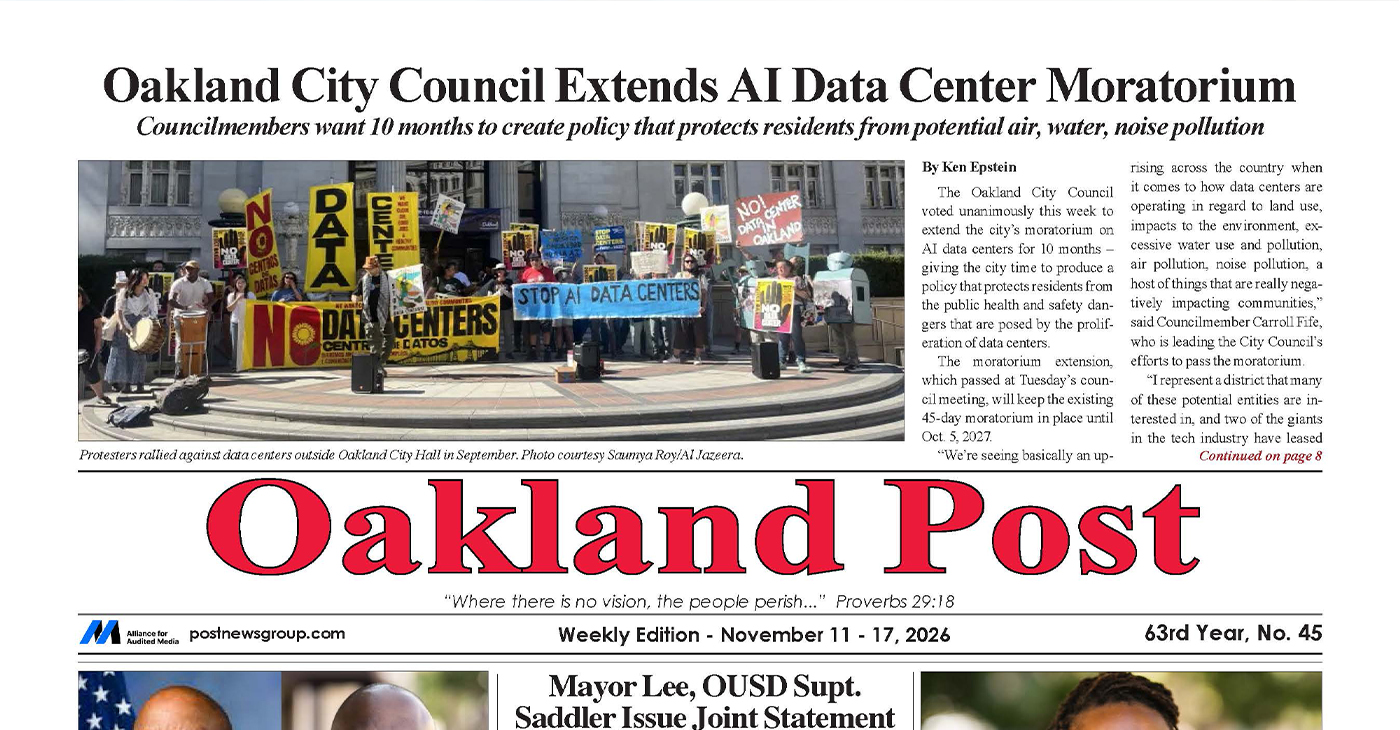
To enlarge your view of this issue, use the slider, magnifying glass icon or full page icon in the lower right corner of the browser window.



Native American Health Center Connects 140 Community Members to Career Opportunities During Native American Heritage Month

Oakland Chamber of Commerce Faces $42,000 Ethics Fine for Campaign Violation

Attorney General Bonta Serves Investigative Subpoena on Nvidia

A Record 216 Firearms Collected at East Oakland Gun Buy-Back Event

City Council Hearing Shines a Light on Failures of City’s Prompt Payment Policy

IN MEMORIAM: Claude T. Everhart, San Francisco’s First Black Deputy Mayor, Dies at 73

UC Doctors, Nurses and Community Rally to Demand ICE Out of UC Hospitals

Hypertension and Heart Disease: Doctors, Advocates and Patients Are Tackling the Leading Cause of Death for Black Californians

Marin City Is Especially Vulnerable to El Niño High Tides, Strong Winds, Flooding and Power Outages

‘We’re Committed to Delivering the Change that the American People Deserve’

Staying Ready: What Every Californian Should Know About Preparing for El Niño

Oakland Post: Week of November 18 – 24, 2026

Oakland Post: Week of November 11 -17, 2026

Alameda County Supervisor Miley to Propose Illegal Dumping Ordinance

Oakland City Council Extends AI Data Center Moratorium for 10 Months.

COMMENTARY: Valarie Bachelor and Jennifer Brouhard are Excellent School Board Members and Deserve to Be Reelected

OUSD Receives State Review of District Finances; Outlines Progress Since January

HISTORY MADE: Keisha Lance Bottoms Becomes First Black Woman Elected Governor in American History

SEIU Local 1000 and State of California Will Continue to Negotiate New Labor Contract

Golden State Valkyries Become Bay Area Legends Winning WNBA Championship on Halloween Night

COMMENTARY: Your California Living Trust Could Be Next: When Evidence Isn’t Enough

Fate of Bay Area Public Transit Hinges on Regional Transit Measure

Chase Launches Fraud & Scam Prevention Month

Mayor Barbara Lee Holds Special State of the City Address in Deep East Oakland

Democrats, Community Groups Back Measure EE to Change How Oakland Is Governed

Post News Group Nov. 3 Election Endorsements

Richmond Neighbors Put Pantry Power on the Map

From Backyard Grilling to Jack London Square: Jamale Carlyle’s Chicken Wing Success Story

It’s Time to Lose Weight Before the Holidays

Hutchinson Concedes: Ballots Still Being Counted in Oakland Board Elections

The Conversation With Al McFarlane 6/23/26

Media Monday 6/22/26

LIVE! ASK ALMA! — TUES. 6.23.26 7PM EST

Car Buying Secrets: 4 Hidden Checks Before You Sign!

Is This 550 HP Charger Worth YOUR Money? AutoNetwork Review

Celebrating Juneteenth – Frederick Douglass on education and resistance

LIVE! — ASK ALMA! — TUES. 6.19.26 7PM EST

Hyundai Ioniq 5 Parking, Safety, and 360 View #shorts

2025 Ioniq 5 New Wiper & Powerful Performance! #shorts

Electric SUV Range: Is 259 Miles Enough? #shorts

EV Charging: How Fast Can You Charge an Electric Vehicle? #shorts

Biometric Cooling… Messaging Seats…Come on! 2025 Infiniti QX80 Autograph 4WD

Charged Up: Witness the Magic of a Fully Electric Car! #shorts

Range Rover Sport PHEV Included…: See What’s Inside This Luxury SUV! #shorts

Invisible Hood View: Perfect Parking with X-Ray Vision! #shorts
-
 Commentary3 weeks ago
COMMENTARY: Valarie Bachelor and Jennifer Brouhard are Excellent School Board Members and Deserve to Be Reelected
-
 Education3 weeks ago
OUSD Receives State Review of District Finances; Outlines Progress Since January
-
 Black History3 weeks ago
HISTORY MADE: Keisha Lance Bottoms Becomes First Black Woman Elected Governor in American History
-
 Business3 weeks ago
SEIU Local 1000 and State of California Will Continue to Negotiate New Labor Contract
-
 Community3 weeks ago
Golden State Valkyries Become Bay Area Legends Winning WNBA Championship on Halloween Night
-
 Business3 weeks ago
COMMENTARY: Your California Living Trust Could Be Next: When Evidence Isn’t Enough
-
 Business4 weeks ago
Fate of Bay Area Public Transit Hinges on Regional Transit Measure
-
 Business4 weeks ago
Chase Launches Fraud & Scam Prevention Month
