
California Black Media
AG Bonta Releases Racial Data Critical for Policymakers, Law Enforcement
California Attorney General Rob Bonta said crime rates remain below historical highs, but property and violent crimes continue to have terrible effects on California communities. “Gun violence, in particular, remains a consistent and growing threat. In fact, in 2021, nearly three-fourths of all homicides in California involved a firearm,” he said. “As we confront these ongoing challenges, we must have accountability and appropriate consequences for those who break the law.”


By McKenzie Jackson | California Black Media
One hundred and ten African Americans died or suffered serious bodily injury during encounters with law enforcement officers in the Golden State over the course of the last year.
Blacks made up 16.7% of the civilians that were killed or suffered severe injuries during incidents involving the discharge of a firearm or the use of force by police officers in 2021. Of the 660 civilians, who died or were injured, 50.6% were Hispanic and 25.5% were white.
The report, however, does not indicate how many of the 149 individuals that died during the 628 incidents were Black or of any other race.
The stats were gleaned from the Use of Force Incident Report released by the California Department of Justice (DOJ) late last month.
The report was one of four annual criminal justice statistical breakdowns released to give the public, policymakers, researchers, and law enforcement statistics to support informed policy choices based on data and analysis and to help protect the safety and well-being of all Californians, according to an Aug. 25 press release from California Attorney General Rob Bonta.
“Good data,” Bonta said, “is key to good public policy.” He urged people to read the documents.
“Accurate statistics and the data in the annual crime reports are a critical part of calibrating our response, ensuring policymakers and law enforcement are able to make informed decisions,” Bonta stated.
The other reports released by the DOJ include Homicide in California, Crime in California, and Juvenile Justice in California.
The quartet of documents are available online and offer an analytical breakdown of criminal activity and related statistics such as the number of homicides reported last year, how much violent crime has increased in the state and the specificity of those crimes, a breakdown of age, race, sex of crime victims and offenders, and the various types of force used by law enforcement during encounters when an individual died or was injured badly.
The information found in the Use of Force report reveals that the types of force used by law enforcement officers against the 660 individuals included blunt impact weapons, chemical sprays, firearms, impact projectiles, vehicles, electronic control devices and their hands, feet, fists, or other body parts.
According to the DOJ, officers employing a firearm hit 233 people and missed 58 others. They used K-9 dogs on 77 people and controlled holds or takedowns on 121 others. While officers perceived that 383 civilians were armed during the incidents, 341 or 89% of them were confirmed to have been carrying weapons.
1,462 officers were reported to be involved in employing a firearm or using excessive force during incidents that resulted in death or serious injury. Fifty-eight of the officers were Black.
The Crime in California report presents an overview of the criminal justice system in California. It revealed that the violent crime rate rose 6.7%, from 437 crimes per 100,000 people to 466.2 last year. The property crime rate increased 3% and the homicide rate jumped up 9.1% while the rape incidence rate increased 8.6%. The motor vehicle theft rate rose 8.2%. The state’s burglary and arson rates dropped.
There were 153,546 violent crimes in the state in 2021. All the data are based on the number of known victims and incidents.
Bonta said crime rates remain below historical highs, but property and violent crimes continue to have terrible effects on California communities.
“Gun violence, in particular, remains a consistent and growing threat. In fact, in 2021, nearly three-fourths of all homicides in California involved a firearm,” he said. “As we confront these ongoing challenges, we must have accountability and appropriate consequences for those who break the law.”
The total number of reported civilian complaints against peace officers increased from 16,547 in 2020 to 28,617 last year. The number of complaints from civilians accusing officers of crimes — 683 — was the lowest since 1983.
There were 2,361 homicides reported in 2021, according to the Homicide Crime in California report. Of the homicides where the victim’s race or ethnicity was identified, 29.5% or 690 were Black, second only to the 47.1% or 1,102 victims who were Hispanic. The largest segment of Black victims — 38.4% or 264 — were aged 18-29. Three hundred and twenty-five of the Black victims were killed on a street or sidewalk. None were killed on school grounds.
Blacks are 5.5% of the total California population.
The Juvenile Justice in California report detailed the 19,355 juvenile arrests in California reported by law enforcement last year.
Felony arrests made up 47.2% or 9,132 of the apprehensions, with Black juveniles being 60.3%. Black juveniles were arrested for 49.0% of the felony violent offenses.
Over 70% of all juveniles, including 77.3% of the Black juveniles arrested were referred to probation departments by law enforcement.
Bonta said the DOJ is using every tool it has to prevent violence and combat crime.
“Whether it’s successfully securing federal certification of our data systems or taking guns out of the hands of dangerous individuals,” he said, “my office remains committed to doing our part to support safety and security for all Californians.”










Activism
Oakland Post: Week of March 18 – 24, 2026
The printed Weekly Edition of the Oakland Post: Week of March 18 – 24, 2026

To enlarge your view of this issue, use the slider, magnifying glass icon or full page icon in the lower right corner of the browser window.
Activism
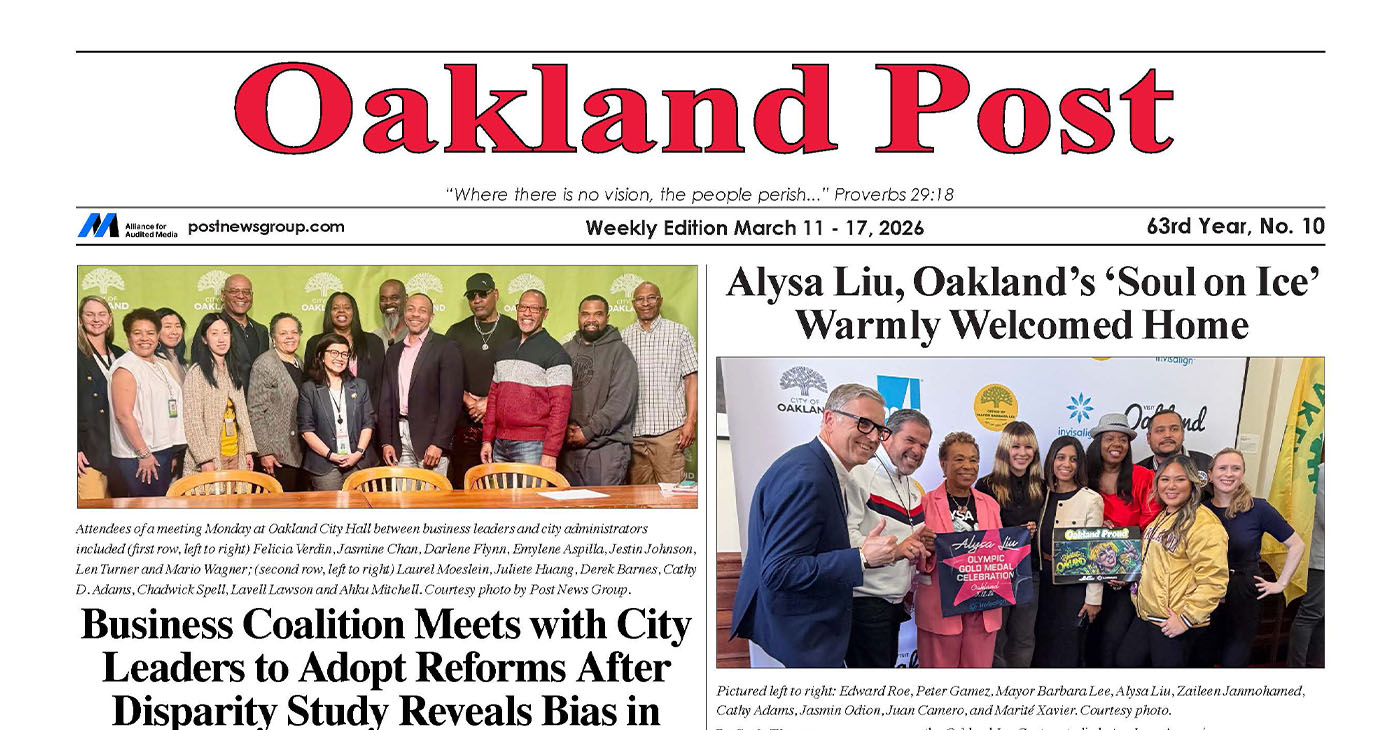
Oakland Post: Week of March 11 -17, 2026
The printed Weekly Edition of the Oakland Post: Week of March 11 – 17, 2026
To enlarge your view of this issue, use the slider, magnifying glass icon or full page icon in the lower right corner of the browser window.
Activism
Oakland Post: Week of March 4 – 10, 2026
The printed Weekly Edition of the Oakland Post: Week of March 4 – 10, 2026

To enlarge your view of this issue, use the slider, magnifying glass icon or full page icon in the lower right corner of the browser window.

WORK FROM HOME
Home-based business with potential monthly income of $10K+ per month. A proven training system and website provided to maximize business effectiveness. Perfect job to earn side and primary income. Contact Lynne for more details: Lynne4npusa@gmail.com 800-334-0540


Black Artists in America, Installation Three Wraps at the Dixon Gallery and Gardens

Grief, Advocacy, and Education: A Counselor Reflects on Black Maternal Health

Future of Florida’s Black History Museum in Limbo

New Research Shows the Many Benefits of Early Learning

South Hampton K-8 Students Among Top 10 Finalists for Samsung’s ‘Solve for Tomorrow’ Competition

Cuba: No Negotiation with US on the President or Political System

Brooklyn Academy of Music Names Jamaican-Born Tamara McCaw as President

Trinidad & Tobego – U.S. Launches WhatsApp Channel for American Citizens in the Country

Oakland Post: Week of March 18 – 24, 2026

AI Innovation vs. Ethics and Environmental Impact

AI, Web3, and Digital Reparations

What If You Owned Your AI Agent?

Season 7, Episode 3 – January Reporter’s Roundtable 📱

Season 7, Episode 3 – January Reporter’s Roundtable

AI, Media, and Power | Part 2, Real-World Impacts and Tradeoffs

Oakland Post: Week of February 11 – 17, 2026

Reflecting on Black History Milestones in Birmingham AL

CITY OF SAN LEANDRO STATE OF CALIFORNIA PUBLIC WORKS DEPARTMENT ENGINEERING DIVISION NOTICE TO BIDDERS FOR ANNUAL STREET OVERLAY/REHABILITATION 2019-21 – PHASE III

Oakland Post: Week of February 18 – 24, 2026

Oakland Post: Week of February 25 – March 3, 2026

PRESS ROOM: NBA Hall of Fame Nominee Terry Cummings Joins 100 Black Men of DeKalb County to Launch Victory & Values Initiative

Trump’s MAGA Allies are Creating Executive Order Plan to Steal the 2026 Midterms

U.S. manufacturing rebounds – how foundry services are adapting to rising demand

OP-ED: One Hundred Years of Black Workers Telling the Truth

Chase Oakland Community Center Hosts Alley-Oop Accelerator Building Community and Opportunity for Bay Area Entrepreneurs

Oakland Post: Week of March 4 – 10, 2026

Poll Shows Support for Policies That Help Families Afford Child Care

Advancements in solar technology that are changing the way we power the world

PRESS ROOM: Civil Rights TV Launches in Selma as the World’s First 24/7 Civil Rights Television Network

Woman’s Search for Family’s Roots Leads to Ancestor John T. Ward – A Successful Entrepreneur and Conductor on the Underground Railroad

Hyundai Ioniq 5 Parking, Safety, and 360 View #shorts

2025 Ioniq 5 New Wiper & Powerful Performance! #shorts

Electric SUV Range: Is 259 Miles Enough? #shorts

EV Charging: How Fast Can You Charge an Electric Vehicle? #shorts

Biometric Cooling… Messaging Seats…Come on! 2025 Infiniti QX80 Autograph 4WD

Charged Up: Witness the Magic of a Fully Electric Car! #shorts

Range Rover Sport PHEV Included…: See What’s Inside This Luxury SUV! #shorts

Invisible Hood View: Perfect Parking with X-Ray Vision! #shorts

AI Is Reshaping Black Healthcare: Promise, Peril, and the Push for Improved Results in California

ESSAY: Technology and Medicine, a Primary Care Point of View

Sanctuary Cities

The RESISTANCE – FREEDOM NOW

STATE OF THE PEOPLE: Freddie

ECONOMIC BOYCOTT DAY!!!!!

I told You So

-
 Activism4 weeks ago
Oakland Post: Week of March 4 – 10, 2026
-
 #NNPA BlackPress3 weeks ago
Woman’s Search for Family’s Roots Leads to Ancestor John T. Ward – A Successful Entrepreneur and Conductor on the Underground Railroad
-

 #NNPA BlackPress4 weeks ago
OP-ED: NNPA Launches 2026 “Leadership Matters” Video Series
-

 #NNPA BlackPress3 weeks ago
Advocates Raise Alarm Over ICE Operation, MOU and Detention Risks in Baltimore County
-

 #NNPA BlackPress3 weeks ago
COMMENTARY: Women of Color Shape Our Past and Future
-

 #NNPA BlackPress3 weeks ago
Pete Buttigieg to Join Mayor Randall Woodfin for Community Town Hall in Birmingham
-

 Activism2 weeks ago
Oakland Post: Week of March 11 -17, 2026
-

 #NNPA BlackPress4 weeks ago
PRESS ROOM: PMG and Cranbrook Horizons-Upward Bound Launch Journey Fellowship Cohort 2
