Uncategorized
A Father-Daughter Relationship Blooms Amid Philippine Flora

For many of us, perhaps even most of us, the opportunity to go to college is a way to disconnect, even if ever so slightly, from our parents.

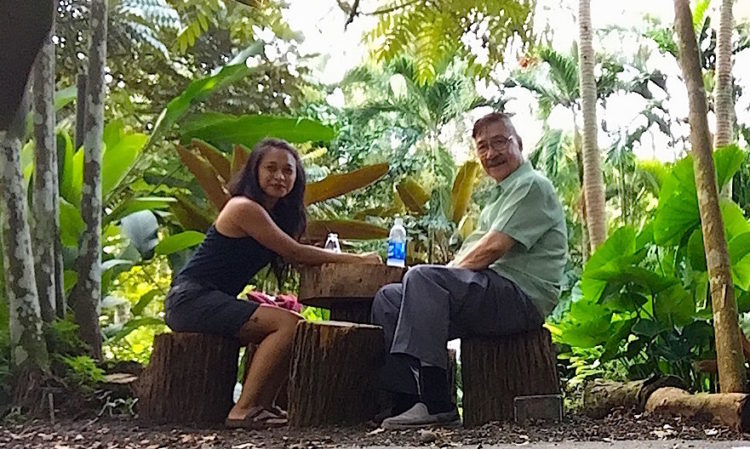
understand her dad, Hermes, and his world.
That’s not Kat Gutierrez’s story, even though at the start, it seemed as if it might be heading along that all-too-familiar course. Her time as a grad student at UC Berkeley included the opportunity to reconnect with her father in unexpected ways.
In the past year or two, Kathleen “Kat” Gutierrez, and her father, Hermes, have become collaborators as she pursues her doctoral research on the history of Philippine botany.
While growing up, she saw her father for what he was at the time, a cargo trucker from Southern California. Mostly unknown to her was her father’s past; before immigrating to the U.S., he’d been a scientist, a botanist in the Philippines. It was an era when science didn’t always win favor with the ruling elite.
He was in the middle of trying to publish research on the application of Philippine medicinal plants when things soured. He was accused of having Communist sympathies. Hermes Gutierrez and his partner, Estrella, a journalist, decided to leave the Philippines for a while to let things cool down under the government of Ferdinand Marcos. They visited his brother in Southern California and ultimately settled in for the long haul.
He was 52 when they made the move. Kat was born three years later.
“I knew so little about him and botany when I was growing up, so very little,” says Kat Gutierrez, who wrote about her reengagement with her father’s past in the Graduate Division’s GradNews. I‘d see him signing checks, and he’d put Ph.D. at the end, and I didn’t know what that was all about.
“My mom would point to this gigantic volume on the bookshelf. It was 500 pages, and said, `Your dad wrote that.’ For summertime play with my friends, we’d take these books with all these pictures of plants in them outside, and we’d try to find the plants in the books.”
Through trial and error, she came to realize that tropical flora doesn’t grow randomly in Los Angeles.
Ultimately she would leave L.A. for Berkeley, first as an undergrad (2006-10) and then as a grad student. That’s when things changed. She applied for and won a Fulbright-Hays grant to do research and training concerning the Philippines. And she found out that her father had been given a Fulbright- Hays grant in the 1960s. Unlike his daughter, Hermes spent his grant time at Harvard.
“It was then that I asked him about Harvard, asking him what his experience had been like,” Gutierrez says. “He told me it was cold, that people made fun of his accent and that it was difficult to take showers because the weather was so cold.”
Gradually Gutierrez gained clarity that her father was more than a trucking terminal dispatcher and driver.
That fact came into full resolution last summer. Hermes Gutierrez moved back to the Philippines in 2014 in an effort to reconnect to his life as a scholar. In 2018, his daughter spent the summer there working on her doctoral dissertation on Philippine botanical traditions at the end of the 19th and beginning of the 20th centuries. Her father became her mentor.
“He’d had a nice career there, but it was unfulfilled when he had to leave in 1985,” she says. “There were some scientists who stayed, and he’d figured that part of his life was done, so he didn’t talk about it. Then he went back. Some of his scientist friends are still alive, and they’ve offered him a nice community.
“Before then, the Philippines were just stories to me. And I’d been working in school-based health. But I switched back to my real passion, Southeast Asia. And as I was talking and writing this paper we just started chatting, and I was absolutely amazed. He was part of this very tight group, and they called him the American Linnaeus.”
That’s high praise. Carl Linnaeus was the Swedish botanist and zoologist who championed binomial nomenclature. He’s the guy who decided we’d break into Latin to call a dog “canis familiaris” and a redwood tree “sequoia sempervirens,” when getting technical. And while the man who is generally referred to as the American Linnaeus is Elmer D. Merrill, it was Merrill who trained Eduardo Quisumbing, who was the man who trained Hermes Gutierrez.
“It seems like a fortuitous circumstance,” Gutierrez says. “Berkeley wanted me to have a solid year in my research area. So, I went to the Philippines. He was there, having decided to kick-start his career in his 80s. Nearly every trip I brought him along. There was a lot of emotional labor involved. But it was a wonderful time. In the Philippines they treat the elderly population with more respect and reverence than in other places. And people would absolutely adore him and his storytelling.
“It was a very strong year. I almost feel like I blacked out parts of it because it went by so fast. He is very funny and honest. Sometimes he’ll tell me I have to finish up my dissertation soon `because I’m heading out.’ Other times he’ll tell me to take my time, that `I’m going to live another 10 years.’ It’s funny, but at the same time it pulls at my heartstrings.”
Gutierrez says that in following her educational leanings, she rediscovered her father. And she can’t imagine not returning to the Philippines as the writing process evolves.
“I’m trying my best in many ways to be back beside him,” she says. “I’m not kidding when I say maybe he’ll be my writing partner. He’s also finishing up his manuscript. And I’ll help him with that, too.”
His manuscript? Hermes Gutierrez lived through World War II in the Philippines, worked his way through high school and college to get his degree, and delayed getting married until he was 38 in pursuit of education. Circumstances intervened, and while he finished his dissertation, it was never published. Now he’s trying to rectify that and his daughter can help.
“My work is a small honor to him and his story,” Kat Gutierrez says.

