
Bay Area
Is the Bay Area Prepared for Major Wildfires?
As part of a Smart and Connected Communities project, funded by the National Science Foundation, the team is also developing virtual games that will help educate the public about wildfire readiness. The project is led by Kenichi Soga, the Donald H. McLaughlin Chair in Mineral Engineering and Chancellor’s Professor at Berkeley, and includes faculty collaborators from the Berkeley’s College of Engineering, College of Environmental Design and Rausser College of Natural Resources.

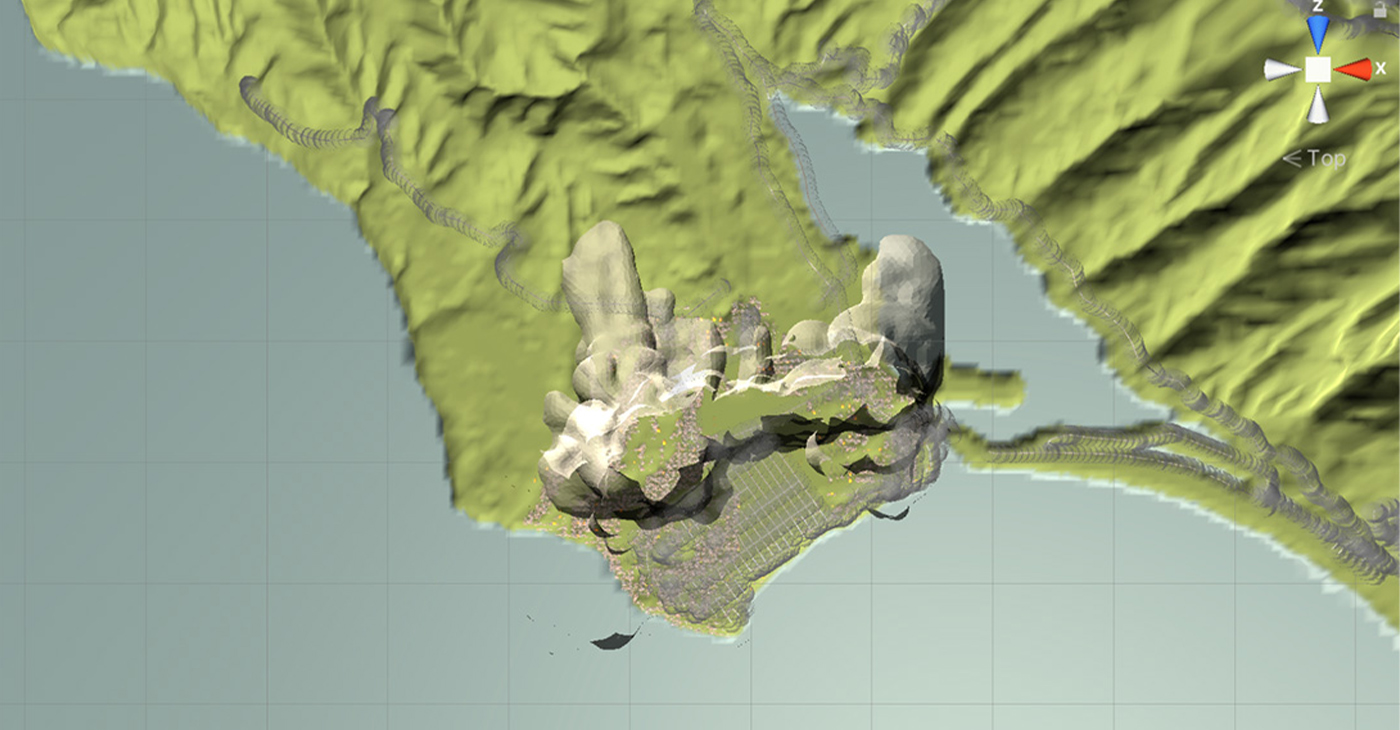
A UC Berkeley-led team is using computer simulations to stress-test the region’s disaster preparedness and creating virtual games to educate the public about wildfire safety.
By Kara Manke
UC Berkeley News
As wildfires continue to rage in LA, many San Francisco Bay Area residents are asking themselves if a similar disaster could happen here — and, with haunting photos of abandoned vehicles in the Pacific Palisades still fresh in everyone’s minds, if vulnerable communities are prepared for a rapid evacuation and firefight.
Since 2022, a team of UC Berkeley researchers, in collaboration with scientists at UC Davis and UC Santa Cruz, has been creating highly detailed models of emergency response infrastructure in two Bay Area communities to answer questions like those.
These “digital twins” of Marin and Alameda counties will include communication networks, emergency services and physical infrastructure, as well as information about how different services are operated and managed. The goal of the project is to use these models to simulate wildfire evacuations under different scenarios and identify potential weaknesses.
As part of a Smart and Connected Communities project, funded by the National Science Foundation, the team is also developing virtual games that will help educate the public about wildfire readiness. The project is led by Kenichi Soga, the Donald H. McLaughlin Chair in Mineral Engineering and Chancellor’s Professor at Berkeley, and includes faculty collaborators from the Berkeley’s College of Engineering, College of Environmental Design and Rausser College of Natural Resources.
To learn more about wildfire risk in the Bay Area and how simulations and “mini-games” can help the region prepare, UC Berkeley News spoke with Louise Comfort, project co-principal investigator, professor emerita and project scientist with the Department of Civil and Environmental Engineering.
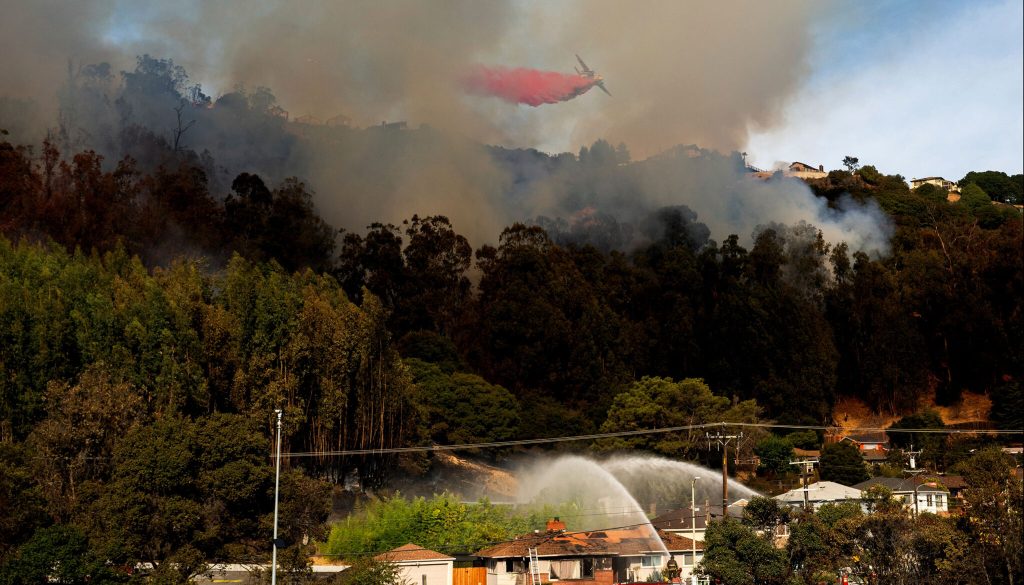
Firefighters work to contain a grass fire that broke out in the Oakland Hills on Oct. 18, 2024. Noah Berger/AP via UC Berkeley News.
UC Berkeley News: Are Bay Area communities at risk of experiencing wildfires as destructive as those currently impacting LA?
Louise Comfort: Absolutely. The Bay Area has a record of experiencing wildfire in the wildland urban interface, or areas where human development intermingles with undeveloped wildland or vegetation, approximately every 20 to 30 years. Bay Area communities have made major investments in training, preparedness and public education since the last major conflagration in 1991, but we have minor fires, such as the Keller Fire in Oakland on Oct. 20. 2024, relatively frequently. Fortunately, a well-trained Oakland Fire Department responded quickly to contain the Keller Fire, but wind-driven wildfire is a continuing threat to the region.
UC Berkeley News: Compared to L.A., does the Bay Area have any particular strengths or weaknesses when it comes to wildfire preparedness, in terms of susceptibility to severe fire, evacuation routes and communication, insurance coverage, etc.?
Louise Comfort: One strength is the emerging consensus among Bay Area cities that they need to collaborate to reduce wildfire risk, and further, that they need to engage residents in this shared task. There is a new regional agreement, formed just in March 2024, among a set of Bay Area jurisdictions to collaborate on wildfire risk reduction. It is called the East Bay Wildfire Coalition of Governments, with nine member jurisdictions and growing. This is an important step for local governments to pool knowledge, information, resources and plans to prepare for wildfires and other natural hazards to which all jurisdictions are exposed.
Bay Area cities are made vulnerable by structural limitations of their transportation network: four bridges, a BART train that runs part way around the Bay, limited roadways among the counties, and specific points of likely congestion. For example, if the Caldecott Tunnel is closed between Alameda and Contra Costa counties, or if the Richmond Bridge is blocked to the North Bay region, evacuation is quickly limited. Evacuation routes are problematic and dependent on other infrastructure systems, electrical power, communications, and gasoline distribution — all of which are vulnerable to wind-driven wildfire.
UC Berkeley News: The Smart and Connected Communities project is creating “digital twins” of two Bay Area cities to understand how they’d perform when evacuating during a natural disaster. What is a digital twin, and how will it help you understand the Bay Area’s preparedness for severe wildfire events?
Louise Comfort: A “digital twin” is a computational model of an existing urban community. It is intended to replicate technical systems of infrastructure, including road networks, water distribution systems and electrical and gasoline distribution systems. It also models how things flow through these different networks: how vehicles travel the road network, how water flows through the network of water pipes, and how electrical power and gasoline travel through their respective distribution systems. We are currently integrating these technical systems with the organizational systems that manage these functions.
The intent is to test out scenarios computationally that are too dangerous or costly to test in real time. We hope to identify the strengths and weaknesses of our present organizational, institutional, and technical infrastructures before an extreme event — wildfire, earthquake, tsunami, atmospheric river rainstorm or flooding — occurs, so we can anticipate possible scenarios for mitigating these risks or respond quickly to reduce the impact when they do.
Louise Comfort: UC Berkeley News: How do you hope to engage communities to build awareness of risks of preparation?
Louise Comfort: We have done a series of semi-structured interviews with community leaders, public managers, and administrators in public organizations, like schools, parks, and hospitals to identify networks of communication and collaboration within communities, as well as gaps in social interaction that limit full community response.
We are working with a talented team of computer scientists at UC Santa Cruz who have developed a series of “mini-games,” or simulated games that illustrate common dilemmas that people face when encountering a wildfire situation. Such simulations enable people to think through dilemmas before the wildfire occurs, identify alternatives for action in a specific context, and connect with neighbors in a shared task of enabling everyone to evacuate safely.
We hope to hold a public community meeting in late spring 2025 and invite people to come and play the games and give us feedback. We also will make the mini-games available for use in small groups, such as Fire Safe Councils, so members of a neighborhood group can play the game together and think about strategies of risk reduction for their neighborhoods.
UC Berkeley News: Could this model be applied to other disasters that threaten the Bay Area, like sea level rise, flooding or earthquakes?
Louise Comfort: Absolutely. The task is the same for any hazard — wildfire, earthquakes, flash floods, landslides — even if the specific actions may differ by hazard. It means recognizing the risk in a specific context, then determining what resources are available to an individual, household, neighborhood, municipality or county to reduce that risk. It means understanding the risk in one’s specific neighborhood and determining what options are available to manage that risk. These are practical steps that greatly increase a community’s capacity for collective action under threat.








Activism
Oakland Post: Week of September 23 – 29, 2026
The printed Weekly Edition of the Oakland Post: Week of September 23 – 29, 2026
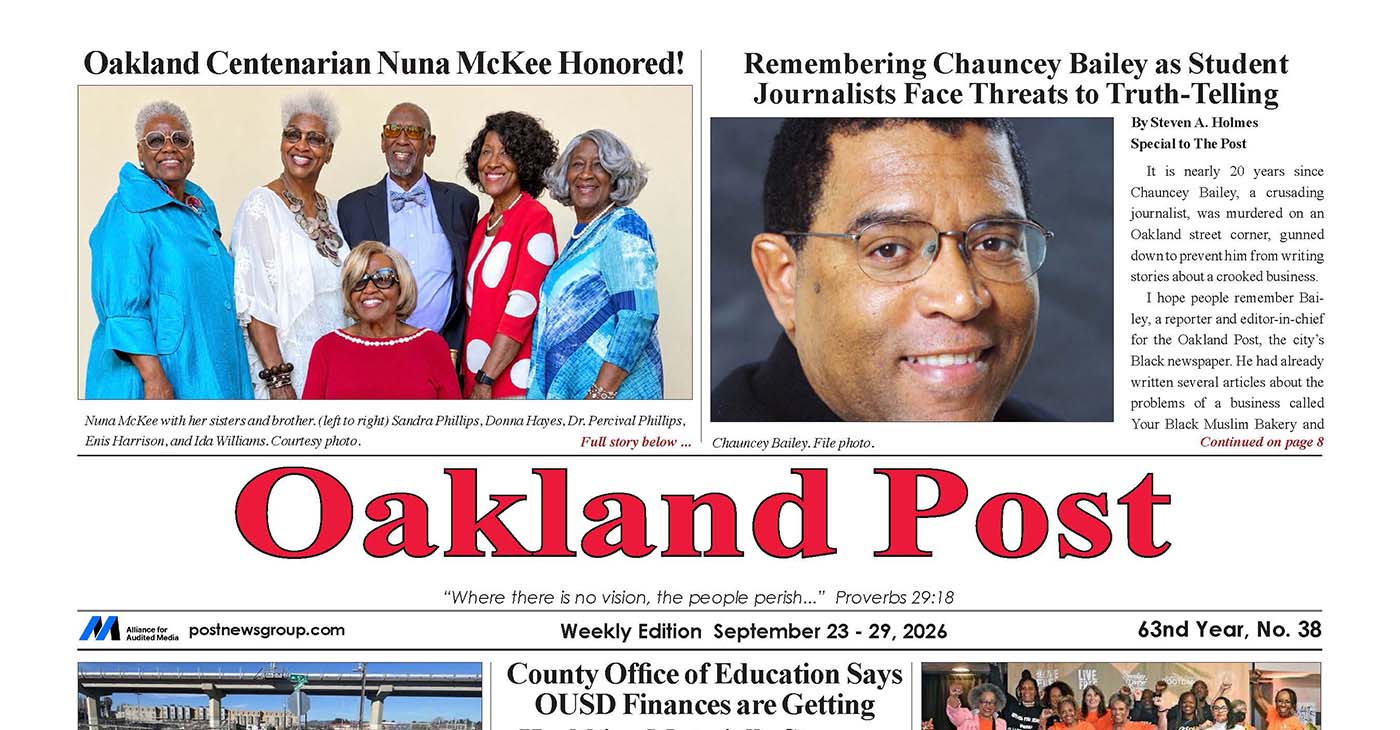
To enlarge your view of this issue, use the slider, magnifying glass icon or full page icon in the lower right corner of the browser window.
Activism
Oakland Post: Week of September 16 – 22, 2026
The printed Weekly Edition of the Oakland Post: Week of September 16 – 22, 2026
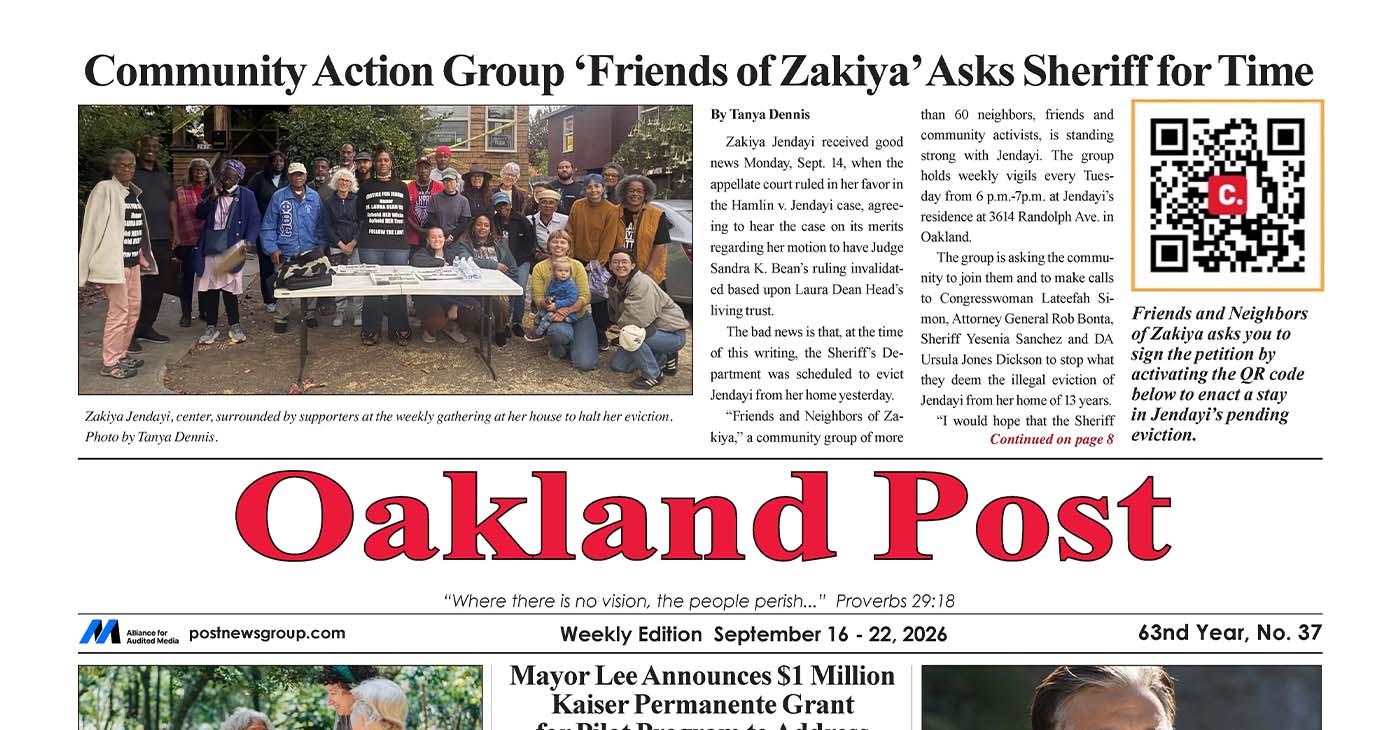
To enlarge your view of this issue, use the slider, magnifying glass icon or full page icon in the lower right corner of the browser window.
Activism
Oakland Post: Week of September 9 – 15, 2026
The printed Weekly Edition of the Oakland Post: Week of September 9 – 15, 2026

To enlarge your view of this issue, use the slider, magnifying glass icon or full page icon in the lower right corner of the browser window.



Asm. Corey Jackson Announces Launch of 24-Hour Childcare in His District

IN MEMORIAM: The Rev. Leon “Sonny” Clark, Longtime Orange County Pastor and Community Leader, Dies at 72

Poll: Becerra Widens His Lead Over Hilton; Californians Split on Wealth Tax

From Historic Memories to New Possibilities: Oakland Celebrates Coliseum 60

County Office of Education Says OUSD Finances Are Getting Healthier, Materially Stronger

LIVE FREE Sunday Dinner Brings Faith, Fellowship and Civic Conversation to Oakland

Remembering Chauncey Bailey as Student Journalists Face Threats to Truth-Telling

BLACspace Cooperative Invites Bay Area to Experience Oakland’s Black Cultural Ecosystem Through a BLAC Map Tour + Party

In Wake of Death on Doorstep, Williams Chapel Baptist Church Calls for Better Care, Funding for Unhoused

Oakland Centenarian Nuna McKee Honored!

Caribbean Nations Produce Action Plan Calling for UK Reparations Over Slavery

Oakland Post: Week of September 23 – 29, 2026

Doulas Are Helping Black California Moms Navigate Pregnancy–Even as High Mortality Rates Persist

Newsom Signs Addictive Social Media Law to Protect Kids

On Your November Ballot: Prop 38 Would Allocate $8.4 Billion to Immunology and Immunotherapy Funding

Less Affluent School Districts, Including Sacramento City, Face Threat of State Takeover

ESSAY: California Can Close Its Colorectal Cancer Gap

California Hispanic Chambers of Commerce Unveils: ‘Powering the Future’ Theme for 47th Annual Statewide Convention

Four Candidates, Including Incumbent Barbara Lee, Qualify for Oakland Mayor’s Race

Oakland Post: Week of August 12 – 18, 2026

From Blueprint to Breakthrough: Tackling Affordable Housing in Oakland

Oakland Observes Black August with Block Parties, Film Showings, Workshops

COMMENTARY: Why Local School Tax Measure G1 Will Not Be on the November Ballot

Standoff for Justice: Our Homes Are Worth Fighting For

Returning to Its Roots, the Oakland Black-Eyed Pea Festival Partners with the Freedom Farmers Market Sept. 12

Oakland Post: Week of August 26 – September 1, 2026

NPRC Scores First Advocacy Victory: David Shaw Finally Gets His Wish to ‘Go Home’

Frontier Airlines’ Return to Oakland Airport Brings Flights, Jobs and Opportunity

Gubernatorial Candidate Steve Hilton Blasts California New Tire Rules; Newsom Hits Back

Chef Sharon Lee Blends Culinary Excellence, Education and Empowerment

The Conversation With Al McFarlane 6/23/26

Media Monday 6/22/26

LIVE! ASK ALMA! — TUES. 6.23.26 7PM EST

Car Buying Secrets: 4 Hidden Checks Before You Sign!

Is This 550 HP Charger Worth YOUR Money? AutoNetwork Review

Celebrating Juneteenth – Frederick Douglass on education and resistance

LIVE! — ASK ALMA! — TUES. 6.19.26 7PM EST

Hyundai Ioniq 5 Parking, Safety, and 360 View #shorts

2025 Ioniq 5 New Wiper & Powerful Performance! #shorts

Electric SUV Range: Is 259 Miles Enough? #shorts

EV Charging: How Fast Can You Charge an Electric Vehicle? #shorts

Biometric Cooling… Messaging Seats…Come on! 2025 Infiniti QX80 Autograph 4WD

Charged Up: Witness the Magic of a Fully Electric Car! #shorts

Range Rover Sport PHEV Included…: See What’s Inside This Luxury SUV! #shorts

Invisible Hood View: Perfect Parking with X-Ray Vision! #shorts
-
 Business4 weeks ago
Frontier Airlines’ Return to Oakland Airport Brings Flights, Jobs and Opportunity
-
 Business4 weeks ago
Gubernatorial Candidate Steve Hilton Blasts California New Tire Rules; Newsom Hits Back
-
 Business4 weeks ago
Chef Sharon Lee Blends Culinary Excellence, Education and Empowerment
-

 Black History4 weeks ago
Jackie Wright Champions Bay Area Stories, Filmmakers and Cultural Institutions
-

 Community4 weeks ago
Big City Mayors Ask for “Yes” Vote on Housing Bond Measure; Conservatives Say “No”
-

 Education4 weeks ago
Gov. Newsom’s Latest Appointees Include Sacramento Advocate for Formerly Incarcerated Students; State’s New Tech Chief
-

 Business4 weeks ago
Oakland Coliseum Project Opens Door for Small Businesses to Build Bigger
-

 Community2 weeks ago
Misnamed ‘Parent’ PAC Seeks to Influence Oakland School Board Elections
