
Bay Area
New Interim Mayor Nikki Bas Takes Office, Announces Balanced Budget
“The Council made difficult but clear decisions last night,” Mayor Bas said in a statement released Thursday. “With yesterday’s budget adoption, the City of Oakland is on track to maintain our immediate fiscal health and our emergency reserves are at the required level.”

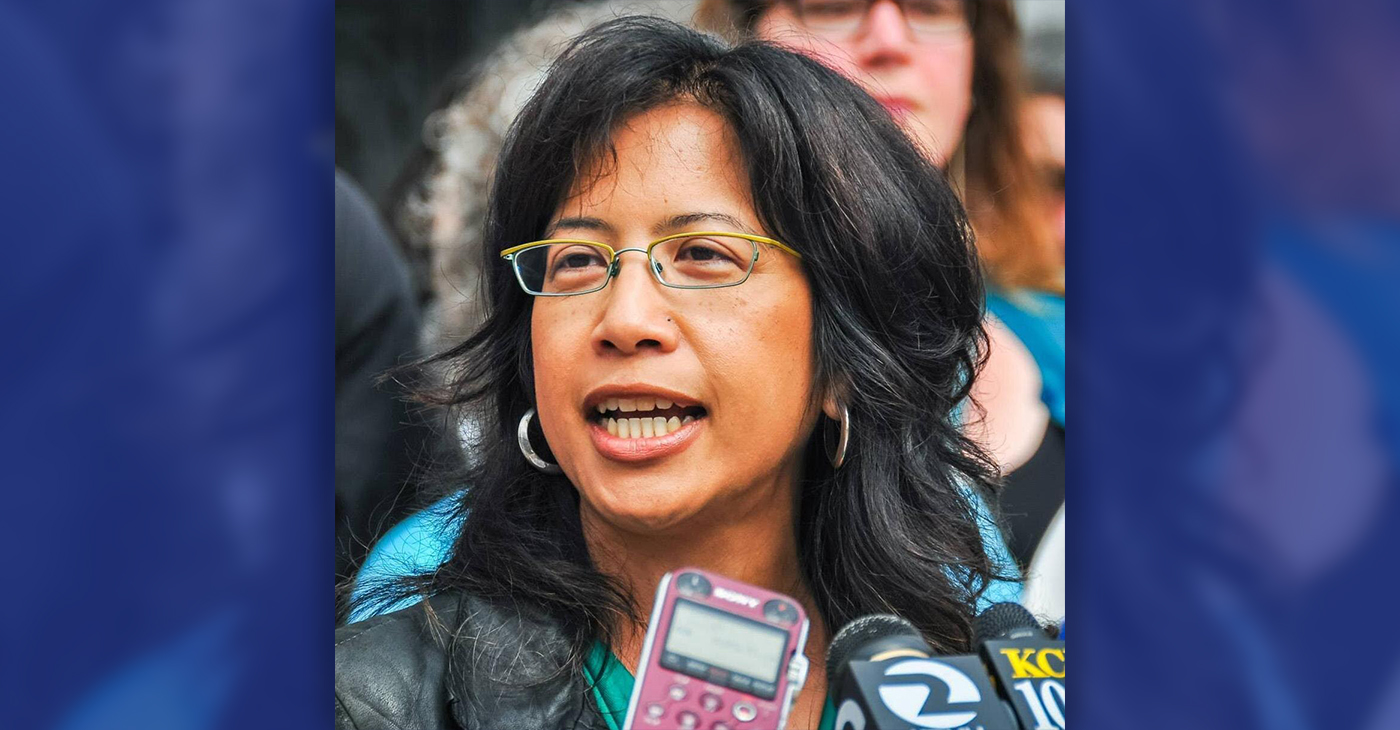
‘The Council made difficult but clear decisions,’ said Bas
Kaplan proposed for Interim District 2 Council seat
By Post Staff
Oakland City Council President Nikki Fortunato Bas was sworn in interim mayor on Wednesday and immediately sat down with City Council members to rebalance the city’s budget, closing a projected deficit and maintaining emergency financial reserves.
“The Council made difficult but clear decisions last night,” Mayor Bas said in a statement released Thursday. “With yesterday’s budget adoption, the City of Oakland is on track to maintain our immediate fiscal health and our emergency reserves are at the required level.”
“The City now seeks to move forward in strong collaboration with its Labor partners and the community-led Budget Advisory Commission toward long-term fiscal sustainability,” she said. “We all deserve to feel safe and secure, whether we’re taking our kids out to play, running our essential small businesses, parking our car on the street, or walking home at night.”
Bas took over as mayor from Sheng Thao, whose last day in office was Tuesday after losing a recall election in November.
“Thank you for choosing me to serve as your mayor. As the first Hmong American woman to become the mayor of a major American city, it has been the honor of my lifetime. I am deeply proud of the progress we created together,” Thao said.

Bas, in her final remarks as a councilmember, proposed that the City Council appoint Kaplan to replace her until the April election.
“As you know Councilmember Kaplan is retiring, she is willing to serve in this interim capacity. She is a resident of District 2 in Jack London, will not run for the seat in the special election; and I believe that she is uniquely qualified to jump in and immediately help to serve our District 2 residents, as well as key projects moving forward, and of course help lead the city’s biennial budget process,” Bas said.
At its meeting this week, the Council affirmed the City Administrator’s budget balancing actions, utilizing unrestricted and transferred funds to help fill the gap and provided direction and strategies to close the remaining need.
The proposals include finding new revenue from increased events and success at the Oakland Coliseum/Arena and other sources, making any further cuts a last resort.
They also proposed to immediately collect unpaid business taxes by doing an internal audit and strengthen controls on OPD overtime overspending.
Said Councilmember Kaplan, “It is vital to protect core public services, and the long-term fiscal solvency of our city. I am honored that the extra available funds I had previously identified have been confirmed, and are being incorporated into budget strategies, allowing Oakland to reduce cuts and restore reserves. In addition, important public serving and revenue-generating functions are being strengthened, including to reduce blight and provide safer, cleaner streets.”
Councilmember Kevin Jenkins (District 6) said, “The Fire Department, which had been preserved from cuts in July, was able to rapidly stop the Keller Fire from growing out of control, which prevented a repeat of the horrific loss of life and loss of homes that took place during the 1991 Oakland Hills Fire.”
According to a Mayor’s Office press statement, Oakland’s investments in the Oakland Police Department and the Department of Violence Prevention have yielded the fastest and most dramatic reduction in homicides in the city’s history.
The City’s deep investments in public safety over the past year continue to pay off, with homicides down 35% year-to-date and overall crime down by 34% since last year. The Public Safety Leadership team is very strong with OPD Chief Floyd Mitchell, DVP Chief Dr. Holly Joshi, OFD Chief Damon Covington, and their deputy chiefs having over a century of collective experience in Oakland.
The budget proposals preserve Oakland’s Ceasefire violence intervention strategy, prioritize OPD patrol and investigations, and continue services to improve 911 response times, with currently 71% of calls answered within 15 seconds or less — a dramatic improvement over the prior year, the press statement said.
Oakland’s investments in sidewalk repair, street paving, clearing abandoned autos, and safer conditions on our roadways are improving both safety and quality of life. The proposals restore funding for important and needed bicycle and pedestrian safety projects, street paving, and parking enforcement, the statement said.
The Council is considering a sales tax ballot measure for the April 15 special election. The proposed half-cent sales tax increase would raise approximately $29 million annually. Ongoing revenue generation and improved efficiencies would help address the City’s structural deficit in the next two-year budget.












Activism
Oakland Post: Week of September 16 – 22, 2026
The printed Weekly Edition of the Oakland Post: Week of September 16 – 22, 2026

To enlarge your view of this issue, use the slider, magnifying glass icon or full page icon in the lower right corner of the browser window.
Activism
Oakland Post: Week of September 9 – 15, 2026
The printed Weekly Edition of the Oakland Post: Week of September 9 – 15, 2026

To enlarge your view of this issue, use the slider, magnifying glass icon or full page icon in the lower right corner of the browser window.
Activism
Oakland Post: Week of September 2 – 8, 2026
The printed Weekly Edition of the Oakland Post: Week of September 2 – 8, 2026
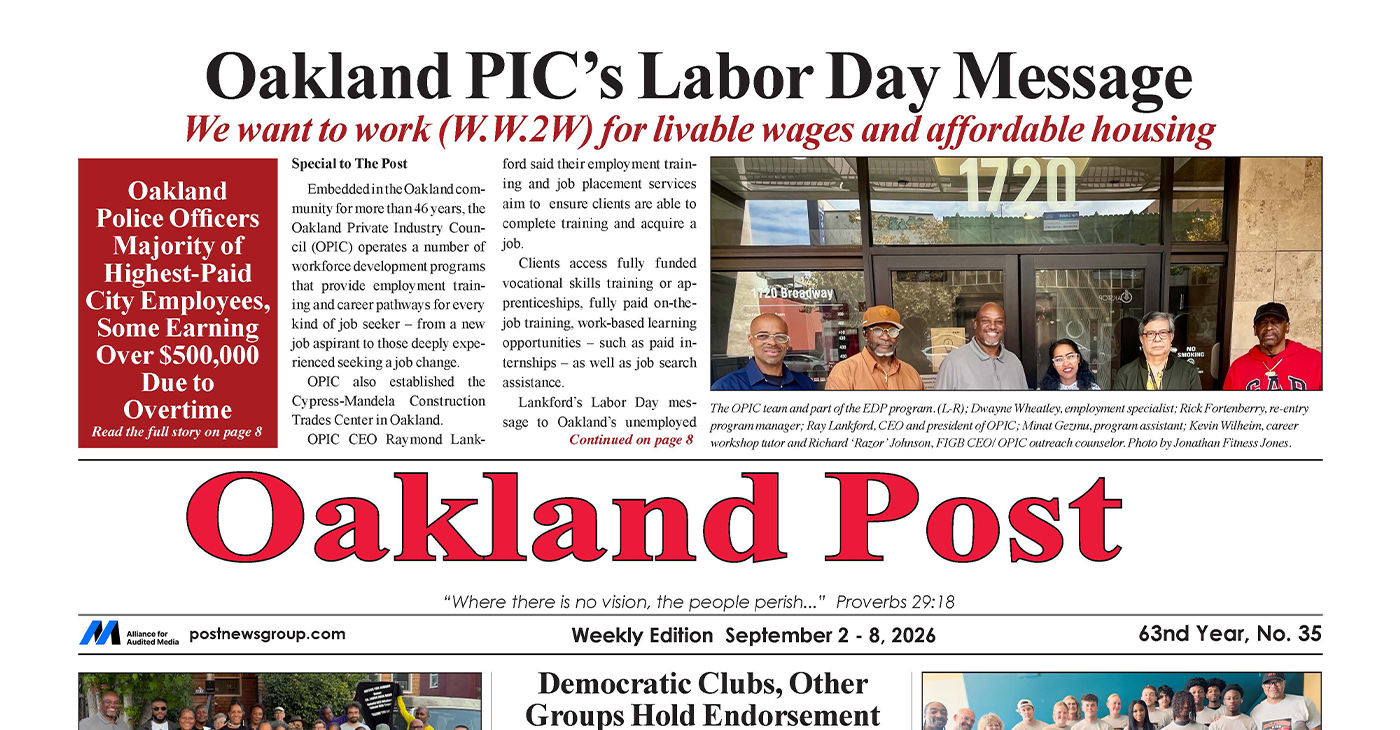
To enlarge your view of this issue, use the slider, magnifying glass icon or full page icon in the lower right corner of the browser window.



Doulas Are Helping Black California Moms Navigate Pregnancy–Even as High Mortality Rates Persist

Newsom Signs Addictive Social Media Law to Protect Kids

On Your November Ballot: Prop 38 Would Allocate $8.4 Billion to Immunology and Immunotherapy Funding

Ask California: Golden State Releases New AI Chatbot

Asm. Isaac Bryan’s Bill Banning California Police From ICE Side Jobs Reaches Newsom’s Desk

Assemblymember LaShae Sharp-Collins’s Bill Would Pause Law Enforcement’s Use of Shock Gloves Pending Study

BOOK REVIEW: ‘Laws of Solomon’ Reveals Tender Heart of Former Child Soldier

OPINION: The New American Fear – From 9-11 to AI

Passing for White, Fighting for Black America: The Courage of Walter White

Oakland People’s Arms Embargo Coalition Demands End to Military Shipments Thru Oakland

Barbara Lee Mourns Gloria Steinem, Remembers a Friendship Rooted in Equality

Event Preview: ‘Fashion v. Fascism’ – A Runway Revolution Is Coming to the Bay Area

Two Looming Threats Every Alameda County Elder Should Know About

Oakland Mayor Reads to Children at Bookout Block Party at Marcus Books Store

Tradition Comes to the Streets in 11th Annual Black-Eyed Pea Festival at the Freedom Farmers Market

Less Affluent School Districts, Including Sacramento City, Face Threat of State Takeover

ESSAY: California Can Close Its Colorectal Cancer Gap

California Hispanic Chambers of Commerce Unveils: ‘Powering the Future’ Theme for 47th Annual Statewide Convention

Four Candidates, Including Incumbent Barbara Lee, Qualify for Oakland Mayor’s Race

Oakland Post: Week of August 12 – 18, 2026

From Blueprint to Breakthrough: Tackling Affordable Housing in Oakland

Oakland Observes Black August with Block Parties, Film Showings, Workshops

COMMENTARY: Why Local School Tax Measure G1 Will Not Be on the November Ballot

Standoff for Justice: Our Homes Are Worth Fighting For

Returning to Its Roots, the Oakland Black-Eyed Pea Festival Partners with the Freedom Farmers Market Sept. 12

NPRC Scores First Advocacy Victory: David Shaw Finally Gets His Wish to ‘Go Home’

Oakland Post: Week of August 26 – September 1, 2026

Frontier Airlines’ Return to Oakland Airport Brings Flights, Jobs and Opportunity

Gubernatorial Candidate Steve Hilton Blasts California New Tire Rules; Newsom Hits Back

Chef Sharon Lee Blends Culinary Excellence, Education and Empowerment

The Conversation With Al McFarlane 6/23/26

Media Monday 6/22/26

LIVE! ASK ALMA! — TUES. 6.23.26 7PM EST

Car Buying Secrets: 4 Hidden Checks Before You Sign!

Is This 550 HP Charger Worth YOUR Money? AutoNetwork Review

Celebrating Juneteenth – Frederick Douglass on education and resistance

LIVE! — ASK ALMA! — TUES. 6.19.26 7PM EST

Hyundai Ioniq 5 Parking, Safety, and 360 View #shorts

2025 Ioniq 5 New Wiper & Powerful Performance! #shorts

Electric SUV Range: Is 259 Miles Enough? #shorts

EV Charging: How Fast Can You Charge an Electric Vehicle? #shorts

Biometric Cooling… Messaging Seats…Come on! 2025 Infiniti QX80 Autograph 4WD

Charged Up: Witness the Magic of a Fully Electric Car! #shorts

Range Rover Sport PHEV Included…: See What’s Inside This Luxury SUV! #shorts

Invisible Hood View: Perfect Parking with X-Ray Vision! #shorts
-
 Commentary4 weeks ago
Standoff for Justice: Our Homes Are Worth Fighting For
-
 Activism4 weeks ago
Oakland Post: Week of August 26 – September 1, 2026
-
 Business4 weeks ago
Frontier Airlines’ Return to Oakland Airport Brings Flights, Jobs and Opportunity
-
 Business4 weeks ago
Gubernatorial Candidate Steve Hilton Blasts California New Tire Rules; Newsom Hits Back
-
 Business4 weeks ago
Chef Sharon Lee Blends Culinary Excellence, Education and Empowerment
-

 Education4 weeks ago
Gov. Newsom’s Latest Appointees Include Sacramento Advocate for Formerly Incarcerated Students; State’s New Tech Chief
-

 Community4 weeks ago
Big City Mayors Ask for “Yes” Vote on Housing Bond Measure; Conservatives Say “No”
-

 Business4 weeks ago
Oakland Coliseum Project Opens Door for Small Businesses to Build Bigger
