
Activism
A Student-Run Group Provides Critical Support Services to Underserved Residents
Those visiting The Suitcase Clinic can get legal advice, sign up for food assistance, receive housing resources, get medical help, or enjoy a hot, fresh meal. They can also get haircuts and foot washes from the student volunteers. Nilo Golchini, executive director of the clinic, said one of the goals for most of the students working there is helping bridge the gap of trust that exists between many unhoused people and the healthcare and social welfare systems.
Part One
By Magaly Muñoz
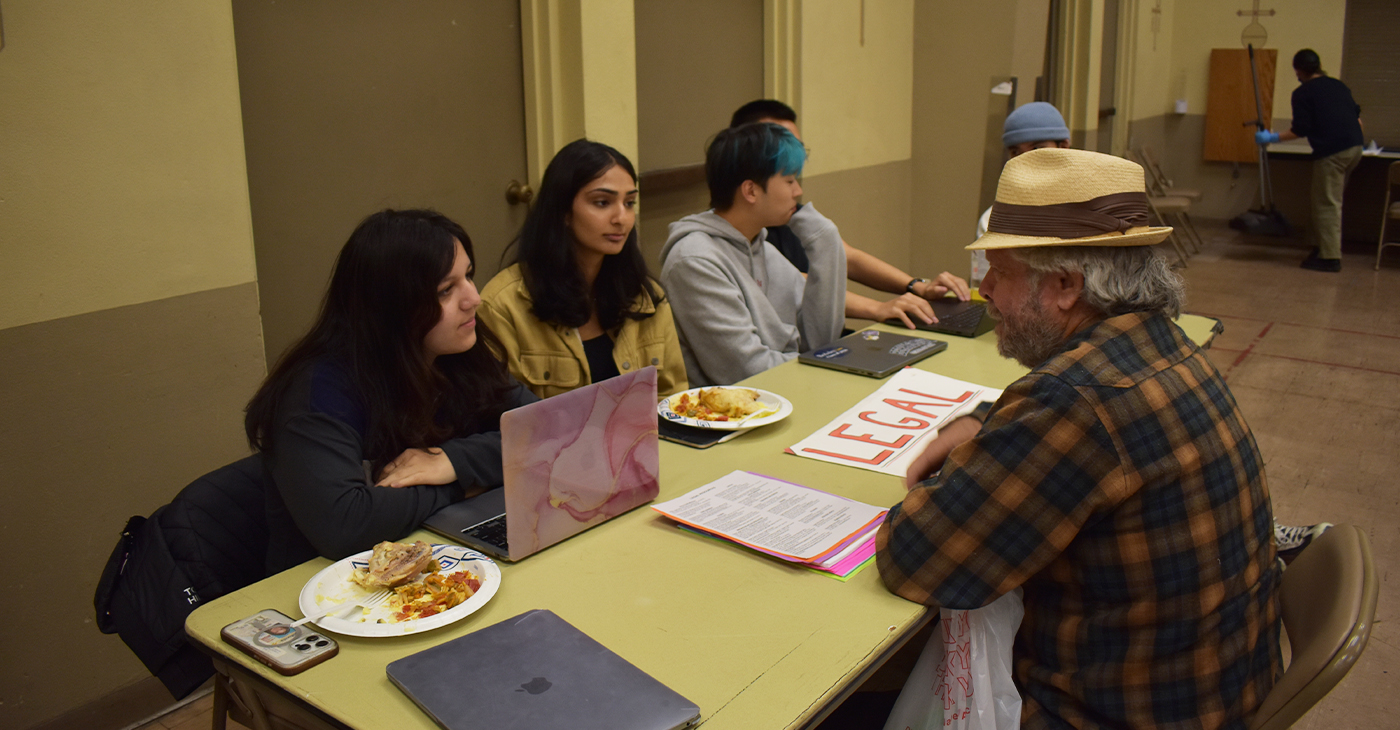
Every Tuesday evening, the dining hall of First Presbyterian Church fills up with dozens of people eating, laughing and moving from table to table, receiving much-needed services from UC Berkeley students – just a few blocks away from the university’s campus.
Individuals seeking support services can be found in this multi-stationed room on the south end of the church talking to law students, student case managers, or receiving medical attention in a corner by healthcare professionals.
This weekly event is hosted by Cal students through a volunteer-run program called The Suitcase Clinic.
The clinic, founded in 1989, was intended to offer free resources to underserved communities in Berkeley and surrounding cities. The majority of the clinic’s clientele are unhoused or low-income people looking for extra support.
Those visiting the clinic can get legal advice, sign up for food assistance, receive housing resources, get medical help, or enjoy a hot, fresh meal. They can also get haircuts and foot washes from the student volunteers.
Nilo Golchini, executive director of the clinic, said one of the goals for most of the students working there is helping bridge the gap of trust that exists between many unhoused people and the healthcare and social welfare systems.

During their tenure in the program, many of the students say they become strong advocates for homelessness rights.

Visitors of the Suitcase Clinic can receive haircuts and foot washing by student volunteers every Tuesday evening. Photo by Magaly Muñoz.
“We’re also standing in solidarity with them. So, it’s not saying, ‘I’m going to help you, but I’m also going to stand with you,’” Golchini said.
Student volunteers get extensive training prior to working directly with clients. Those interested have to take a semester-long class to become versed in areas such as outreach, intersectionality, how to interact with unhoused people, how to sign people up for social services. and more.
Volunteers then get to pick from three different clinics: General, Women’s, or Youth and LGBTQ+.
The General Clinic is the most popular among visiting residents, while Women’s and Youth/LQBTQ+ have more specialized services for attendees.
The Women’s Clinic has many of the similar services to General, but also includes nail painting, childcare, and massages.
The Youth and LGBTQ+ Clinic offers a safe space for young people navigating living on the streets, with services that include housing referrals, wellness and recreation classes and employment resources.
Golchini explained that it’s important for them to keep these clinics separate because the different demographics experience poverty and homelessness differently than those who visit the General Clinic.

Suitcase Clinic student workers posing for a photo with a frequent clinic attendee. The Clinic is open to Berkeley unhoused and low-income residents who need medical or legal service, or a hot meal. Photo by Magaly Muñoz.
“We’re able to provide spaces where people can come in and feel safe and not feel like they’re constantly worried that something’s going to happen to them,” she said.
An outreach team also visits encampments every other Saturday in the Berkeley area to provide hygiene kits and encourage people to visit the in-person clinic, if possible.
However, Golchini said engagement has been low for some time now due to a recent decision by the U.S. Supreme Court that allows cities to ban and cite people for sleeping on the streets.
She said a lot of their clientele got displaced to other cities over time, making it difficult to stay in contact with the services the Clinic was providing for them.
But that hasn’t slowed down the students at the Clinic, if anything, it has pushed them to do more for the community they serve.








Activism
Oakland Post: Week of September 16 – 22, 2026
The printed Weekly Edition of the Oakland Post: Week of September 16 – 22, 2026


To enlarge your view of this issue, use the slider, magnifying glass icon or full page icon in the lower right corner of the browser window.

Activism
Oakland Post: Week of September 9 – 15, 2026
The printed Weekly Edition of the Oakland Post: Week of September 9 – 15, 2026

To enlarge your view of this issue, use the slider, magnifying glass icon or full page icon in the lower right corner of the browser window.
Activism
Oakland Post: Week of September 2 – 8, 2026
The printed Weekly Edition of the Oakland Post: Week of September 2 – 8, 2026
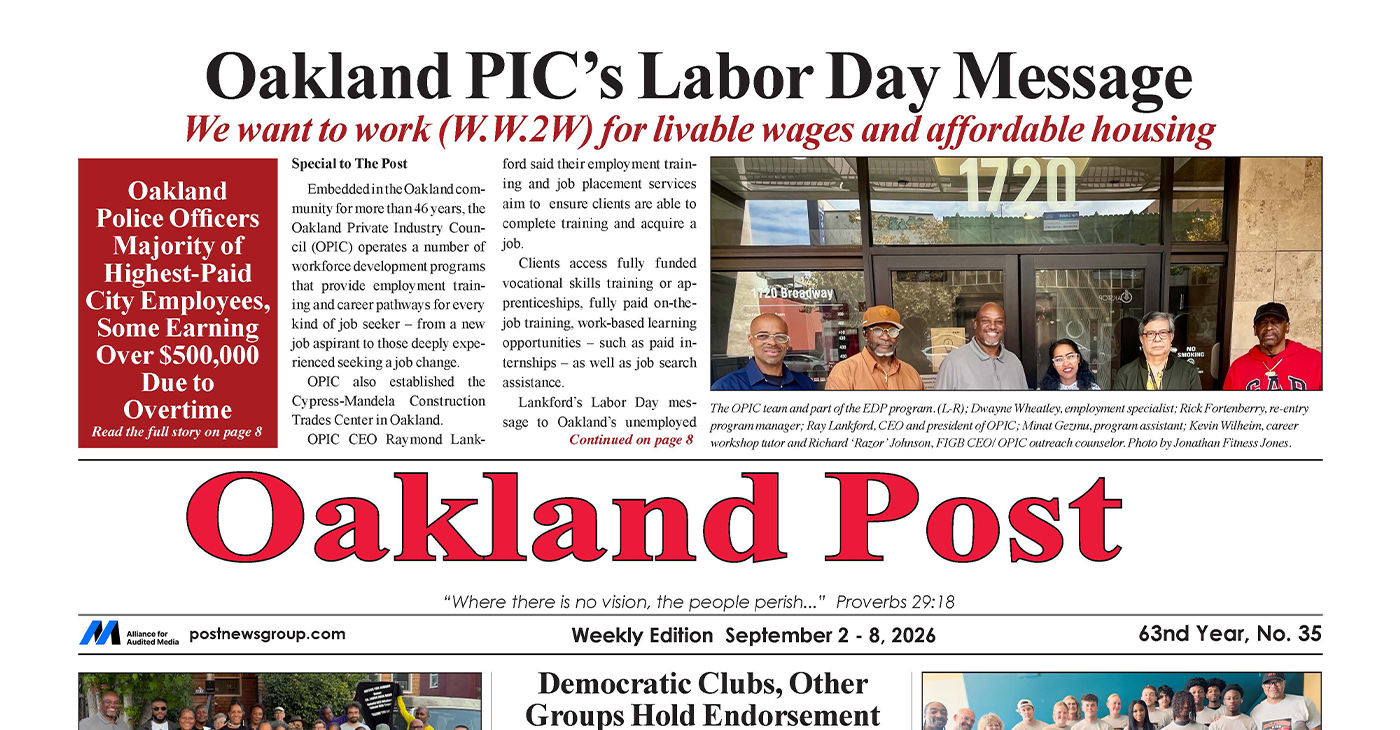
To enlarge your view of this issue, use the slider, magnifying glass icon or full page icon in the lower right corner of the browser window.



Doulas Are Helping Black California Moms Navigate Pregnancy–Even as High Mortality Rates Persist

Newsom Signs Addictive Social Media Law to Protect Kids

On Your November Ballot: Prop 38 Would Allocate $8.4 Billion to Immunology and Immunotherapy Funding

Ask California: Golden State Releases New AI Chatbot

Asm. Isaac Bryan’s Bill Banning California Police From ICE Side Jobs Reaches Newsom’s Desk

Assemblymember LaShae Sharp-Collins’s Bill Would Pause Law Enforcement’s Use of Shock Gloves Pending Study

BOOK REVIEW: ‘Laws of Solomon’ Reveals Tender Heart of Former Child Soldier

OPINION: The New American Fear – From 9-11 to AI

Passing for White, Fighting for Black America: The Courage of Walter White

Oakland People’s Arms Embargo Coalition Demands End to Military Shipments Thru Oakland

Barbara Lee Mourns Gloria Steinem, Remembers a Friendship Rooted in Equality

Event Preview: ‘Fashion v. Fascism’ – A Runway Revolution Is Coming to the Bay Area

Two Looming Threats Every Alameda County Elder Should Know About

Oakland Mayor Reads to Children at Bookout Block Party at Marcus Books Store

Tradition Comes to the Streets in 11th Annual Black-Eyed Pea Festival at the Freedom Farmers Market

Less Affluent School Districts, Including Sacramento City, Face Threat of State Takeover

ESSAY: California Can Close Its Colorectal Cancer Gap

California Hispanic Chambers of Commerce Unveils: ‘Powering the Future’ Theme for 47th Annual Statewide Convention

Four Candidates, Including Incumbent Barbara Lee, Qualify for Oakland Mayor’s Race

Oakland Post: Week of August 12 – 18, 2026

From Blueprint to Breakthrough: Tackling Affordable Housing in Oakland

Oakland Observes Black August with Block Parties, Film Showings, Workshops

COMMENTARY: Why Local School Tax Measure G1 Will Not Be on the November Ballot

Standoff for Justice: Our Homes Are Worth Fighting For

Returning to Its Roots, the Oakland Black-Eyed Pea Festival Partners with the Freedom Farmers Market Sept. 12

NPRC Scores First Advocacy Victory: David Shaw Finally Gets His Wish to ‘Go Home’

Oakland Post: Week of August 26 – September 1, 2026

Frontier Airlines’ Return to Oakland Airport Brings Flights, Jobs and Opportunity

Gubernatorial Candidate Steve Hilton Blasts California New Tire Rules; Newsom Hits Back

Chef Sharon Lee Blends Culinary Excellence, Education and Empowerment

The Conversation With Al McFarlane 6/23/26

Media Monday 6/22/26

LIVE! ASK ALMA! — TUES. 6.23.26 7PM EST

Car Buying Secrets: 4 Hidden Checks Before You Sign!

Is This 550 HP Charger Worth YOUR Money? AutoNetwork Review

Celebrating Juneteenth – Frederick Douglass on education and resistance

LIVE! — ASK ALMA! — TUES. 6.19.26 7PM EST

Hyundai Ioniq 5 Parking, Safety, and 360 View #shorts

2025 Ioniq 5 New Wiper & Powerful Performance! #shorts

Electric SUV Range: Is 259 Miles Enough? #shorts

EV Charging: How Fast Can You Charge an Electric Vehicle? #shorts

Biometric Cooling… Messaging Seats…Come on! 2025 Infiniti QX80 Autograph 4WD

Charged Up: Witness the Magic of a Fully Electric Car! #shorts

Range Rover Sport PHEV Included…: See What’s Inside This Luxury SUV! #shorts

Invisible Hood View: Perfect Parking with X-Ray Vision! #shorts
-
 Commentary4 weeks ago
Standoff for Justice: Our Homes Are Worth Fighting For
-
 Activism4 weeks ago
Oakland Post: Week of August 26 – September 1, 2026
-
 Business4 weeks ago
Frontier Airlines’ Return to Oakland Airport Brings Flights, Jobs and Opportunity
-
 Business4 weeks ago
Gubernatorial Candidate Steve Hilton Blasts California New Tire Rules; Newsom Hits Back
-
 Business4 weeks ago
Chef Sharon Lee Blends Culinary Excellence, Education and Empowerment
-

 Education4 weeks ago
Gov. Newsom’s Latest Appointees Include Sacramento Advocate for Formerly Incarcerated Students; State’s New Tech Chief
-

 Community4 weeks ago
Big City Mayors Ask for “Yes” Vote on Housing Bond Measure; Conservatives Say “No”
-

 Business4 weeks ago
Oakland Coliseum Project Opens Door for Small Businesses to Build Bigger
