
Activism
An Inside Look into How San Francisco Analyzes Homeless Encampments
Dozens of unhoused people are camped at Sixth and Jesse streets in San Francisco’s South of Market neighborhood. Tents made of tarps and blankets, piles of debris, and people lounging alongside the allies and walls of businesses are seen from all angles. These are some of the city’s hotspots. City crews have cleared encampments there over 30 times in the past year, but unhoused people always return.


By Magaly Muñoz
Dozens of unhoused people are camped at Sixth and Jesse streets in San Francisco’s South of Market neighborhood. Tents made of tarps and blankets, piles of debris, and people lounging alongside the allies and walls of businesses are seen from all angles.
These are some of the city’s hotspots. City crews have cleared encampments there over 30 times in the past year, but unhoused people always return.
But it’s normal to have tents set up again within less than 24 hours after an encampment sweep, David Nakanishi, Healthy Streets Operation Center Manager at the Department of Emergency Management, says. Sometimes there’s less people than before but often there is also no change.
“Most of the people that were in the encampments that want to go inside, we’ve gotten the majority of those [into shelter],” Nakanishi says. “Many of the people we encounter now, are those who have various reasons to not accept shelter, and some are already in shelter/housing”.
Since the ruling of Grants Pass by the US Supreme Court earlier this summer, which allows cities the authority to ban people from camping or sleeping on the streets, San Francisco has been at the head of the conversation to crack down on encampments.

Where neighboring cities in the Bay Area are clearing encampments a few days a week, San Francisco is sweeping 10 times a week, two per weekday.

David Nakanishi, Healthy Streets Operation Center Manager at the San Francisco Department of Emergency Management, makes a 311 report on an encampment in the Mission District. These reports allow smaller city teams to tackle individual spots where unhoused people frequent. Photo by Magaly Muñoz.
Considering the controversy that plagues the city around its harsh policies, the Post decided to tag along on a ride with Nakanishi to show us how he decides what encampments make it on the city’s sweep list.
Nakanishi, having over 20 years of experience in homelessness management, drives around the busiest parts of the city almost daily. He’s tasked with arranging a weekly sweeping operation schedule for city teams to engage with unhoused folks to help get them off the streets.
So what exactly is he looking out for when deciding what encampments get swept?
It depends, he says.
Locations like schools, recreational centers, senior centers, or businesses are places he tends to want to address quickly, especially schools. These are the places where the complaints are highest and access to facilities is important for residents.
He says he also takes into account 311 calls and reports made to him by city staff. On the date of publication, over 100 calls and reports were made about encampments around the city, according to San Francisco data.

Makeshift structures built from plywood and tarps are starting to pop up more throughout the city. Certain areas under freeways are not under direct authority from San Francisco, making it harder to sweep these encampments. Photo by Magaly Muñoz.
Nakanishi made a few 311 reports himself on the ride along, pulling over to take photos and describe the encampments into his 311 app. He says it helps him remember where to possibly sweep next or allows smaller teams in the city to engage quicker with individuals on the streets.
Nakanishi also looks at the state of the encampments. Are there a lot of bulky items, such as furniture, or makeshift structures built out of tarps and plywood, blocking areas of traffic? Is trash beginning to pile up and spill into the streets or sidewalks? Sites that meet this criteria tend to be contenders for encampment sweeps, Nakanishi says.
Street by street, he points out individuals he’s interacted with, describing their conditions, habits, and reasons for denying assistance from the city.
One man on 2nd St and Mission, who rolls around a blue recycling bin and often yells at passing pedestrians, has refused shelter several times, Nakanishi says.
People deny shelter for all kinds of reasons, he says. There’s too many rules to follow, people feel unsafe in congregate or shared shelters, or their behavioral and mental health problems make it hard to get them into proper services.

Inside a tent left by an unhoused man on Stevenson and 14th Street in San Francisco. The area smelled of human waste and leftover alcohol. Photo by Magaly Muñoz.
Nakanishi references another man on South Van Ness under the freeway, who city outreach have attempted to get into shelter, but his screaming outbursts make it difficult to place him without disturbing other people in the same space. Nakanishi says it might be an issue of the man needing resources like medication to alleviate his distress that causes the screaming, but the city behavioral team is in the process of outreaching him to figure that out.
In October, city outreach teams engaged with 495 unhoused people. 377 of those engaged refused shelter and only 118 accepted placements, according to city data. That number of monthly referrals is consistent throughout the entirety of 2024 so far.
Nakanishi has long advocated for the well-being of unhoused people, he explains. In 2004, he was working with the Department of Public Health and told then-Mayor Gavin Newsom that there needed to be more housing for families. Nakinishi was told it was easier to deal with individuals first and the city “will get there eventually.” 20 years later, family housing is still not as extensive as it could be, and the waiting list to get placements for families is a mile long with over 500 names.
In 2020, he was a Senior Behavioral Health Clinician at a hotel in the city during the pandemic. He says in 2021 he collaborated with DPH to provide vaccines to those staying in the makeshift hotel shelters once those became available.

Nakanishi strips apart a solo tent on Stevenson and 14th Street in San Francisco. He discards items, like tarps and cardboard, so that people cannot reuse them to make another sleeping structure. Photo by Magaly Muñoz.
Despite the constant media attention that city outreach is inhumanely treating homeless people, so much so that it has led to lawsuits against San Francisco from advocates, Nakanishi says not a lot of people are seeing the true conditions of some encampments.
He describes soiled clothing and tents, drenched in urine, and oftentimes rodents or bug infestations in places where people are sleeping. He’s asked homeless advocates- often those who are the most critical about the city’s work- who have shown up to observe the sweeps if those are conditions the city should allow people to be subjected to, but not many have answers for him, Nakanishi says.
The city’s “bag and tag” policy allows city workers to throw away items that are “soiled by infectious materials” such as bodily fluids and waste.
Sweep operations are conducted at 8am and 1pm Monday through Friday. People at the encampments are given 72 hour notice to vacate, but some don’t leave the area until the day of the sweep.
City outreach workers come out the day before and day of to offer resources and shelter to those interested. The Department of Public Works discards any trash that is left over from the sweep and washes down the area.
Nakanishi told the Post that the only time the city takes tents or personal possessions from residents is when folks become physically violent towards workers and police take the items as evidence. Other items taken are bagged and tagged in accordance with city policy.
Stories from local newspapers such as the San Francisco Standard and the Chronicle show instances of SFPD handcuffing residents while their items are thrown in the trash or disposing of personal possessions without reason.
Advocates have long been pushing for a more competent and compassionate process if the city is going to choose to continue sweeping unhouse people.
No matter the lawsuits and constant criticisms from allies, the encampment sweeps are not slowing down, even with the cold weather quickly approaching the coastal city.
Nakanishi says there aren’t a lot of large encampments left in San Francisco so now they do runs of streets in order to stretch out the sweeps as much as possible.
It’s calculated strategies and years of first hand knowledge that make this job work, “It takes dedication to the work, caring for the people and the community, and persistence, patience and sometimes good luck to make the positive changes for the people on the street,” Nakanishi says.





Activism
Oakland Post: Week of September 16 – 22, 2026
The printed Weekly Edition of the Oakland Post: Week of September 16 – 22, 2026


To enlarge your view of this issue, use the slider, magnifying glass icon or full page icon in the lower right corner of the browser window.

Activism
Oakland Post: Week of September 9 – 15, 2026
The printed Weekly Edition of the Oakland Post: Week of September 9 – 15, 2026

To enlarge your view of this issue, use the slider, magnifying glass icon or full page icon in the lower right corner of the browser window.
Activism
Oakland Post: Week of September 2 – 8, 2026
The printed Weekly Edition of the Oakland Post: Week of September 2 – 8, 2026
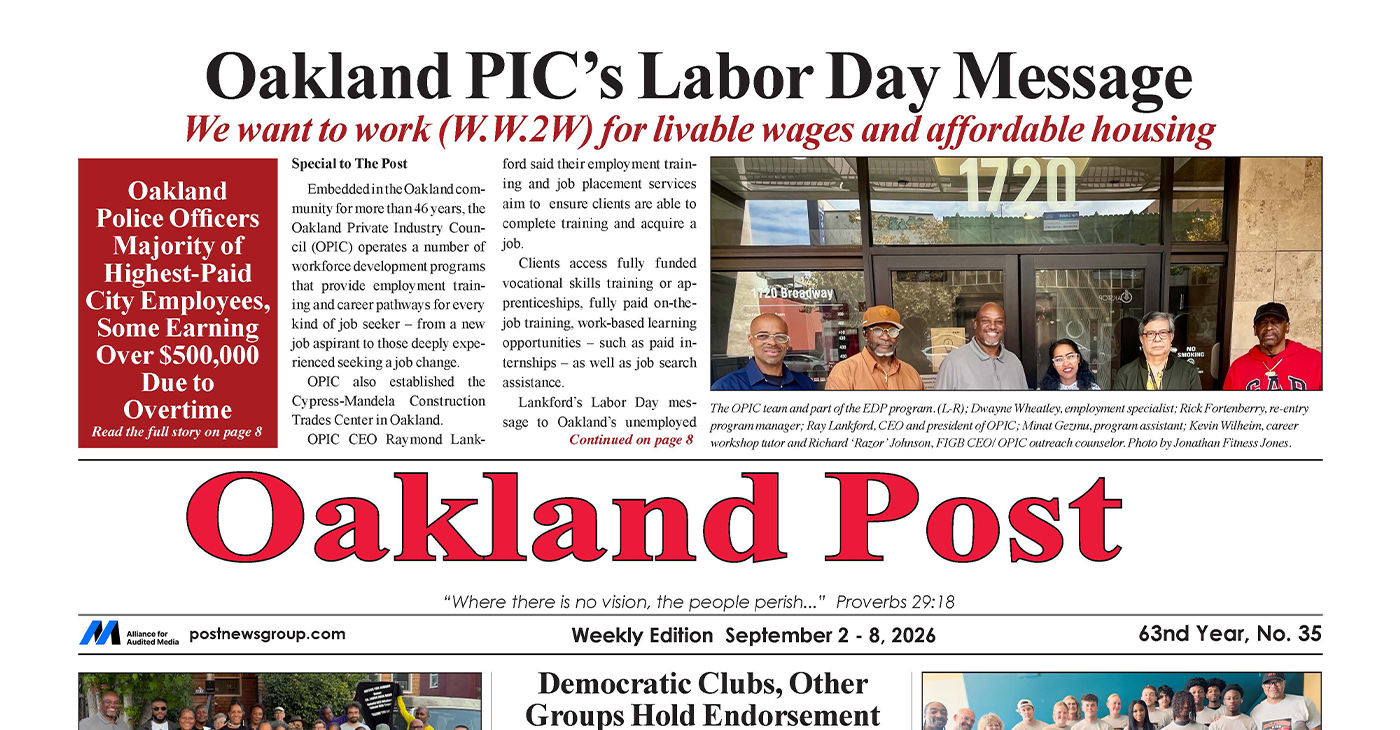
To enlarge your view of this issue, use the slider, magnifying glass icon or full page icon in the lower right corner of the browser window.



Doulas Are Helping Black California Moms Navigate Pregnancy–Even as High Mortality Rates Persist

Newsom Signs Addictive Social Media Law to Protect Kids

On Your November Ballot: Prop 38 Would Allocate $8.4 Billion to Immunology and Immunotherapy Funding

Ask California: Golden State Releases New AI Chatbot

Asm. Isaac Bryan’s Bill Banning California Police From ICE Side Jobs Reaches Newsom’s Desk

Assemblymember LaShae Sharp-Collins’s Bill Would Pause Law Enforcement’s Use of Shock Gloves Pending Study

BOOK REVIEW: ‘Laws of Solomon’ Reveals Tender Heart of Former Child Soldier

OPINION: The New American Fear – From 9-11 to AI

Passing for White, Fighting for Black America: The Courage of Walter White

Oakland People’s Arms Embargo Coalition Demands End to Military Shipments Thru Oakland

Barbara Lee Mourns Gloria Steinem, Remembers a Friendship Rooted in Equality

Event Preview: ‘Fashion v. Fascism’ – A Runway Revolution Is Coming to the Bay Area

Two Looming Threats Every Alameda County Elder Should Know About

Oakland Mayor Reads to Children at Bookout Block Party at Marcus Books Store

Tradition Comes to the Streets in 11th Annual Black-Eyed Pea Festival at the Freedom Farmers Market

Less Affluent School Districts, Including Sacramento City, Face Threat of State Takeover

ESSAY: California Can Close Its Colorectal Cancer Gap

California Hispanic Chambers of Commerce Unveils: ‘Powering the Future’ Theme for 47th Annual Statewide Convention

Four Candidates, Including Incumbent Barbara Lee, Qualify for Oakland Mayor’s Race

Oakland Post: Week of August 12 – 18, 2026

From Blueprint to Breakthrough: Tackling Affordable Housing in Oakland

Oakland Observes Black August with Block Parties, Film Showings, Workshops

COMMENTARY: Why Local School Tax Measure G1 Will Not Be on the November Ballot

Standoff for Justice: Our Homes Are Worth Fighting For

Returning to Its Roots, the Oakland Black-Eyed Pea Festival Partners with the Freedom Farmers Market Sept. 12

Oakland Post: Week of August 26 – September 1, 2026

NPRC Scores First Advocacy Victory: David Shaw Finally Gets His Wish to ‘Go Home’

Frontier Airlines’ Return to Oakland Airport Brings Flights, Jobs and Opportunity

Gubernatorial Candidate Steve Hilton Blasts California New Tire Rules; Newsom Hits Back

Chef Sharon Lee Blends Culinary Excellence, Education and Empowerment

The Conversation With Al McFarlane 6/23/26

Media Monday 6/22/26

LIVE! ASK ALMA! — TUES. 6.23.26 7PM EST

Car Buying Secrets: 4 Hidden Checks Before You Sign!

Is This 550 HP Charger Worth YOUR Money? AutoNetwork Review

Celebrating Juneteenth – Frederick Douglass on education and resistance

LIVE! — ASK ALMA! — TUES. 6.19.26 7PM EST

Hyundai Ioniq 5 Parking, Safety, and 360 View #shorts

2025 Ioniq 5 New Wiper & Powerful Performance! #shorts

Electric SUV Range: Is 259 Miles Enough? #shorts

EV Charging: How Fast Can You Charge an Electric Vehicle? #shorts

Biometric Cooling… Messaging Seats…Come on! 2025 Infiniti QX80 Autograph 4WD

Charged Up: Witness the Magic of a Fully Electric Car! #shorts

Range Rover Sport PHEV Included…: See What’s Inside This Luxury SUV! #shorts

Invisible Hood View: Perfect Parking with X-Ray Vision! #shorts
-
 Commentary4 weeks ago
Standoff for Justice: Our Homes Are Worth Fighting For
-
 Activism4 weeks ago
Oakland Post: Week of August 26 – September 1, 2026
-
 Business4 weeks ago
Frontier Airlines’ Return to Oakland Airport Brings Flights, Jobs and Opportunity
-
 Business4 weeks ago
Gubernatorial Candidate Steve Hilton Blasts California New Tire Rules; Newsom Hits Back
-
 Business4 weeks ago
Chef Sharon Lee Blends Culinary Excellence, Education and Empowerment
-

 Community4 weeks ago
Big City Mayors Ask for “Yes” Vote on Housing Bond Measure; Conservatives Say “No”
-

 Black History4 weeks ago
Jackie Wright Champions Bay Area Stories, Filmmakers and Cultural Institutions
-

 Education4 weeks ago
Gov. Newsom’s Latest Appointees Include Sacramento Advocate for Formerly Incarcerated Students; State’s New Tech Chief
