
California Black Media
Commentary: It’s Time to Address the Disproportionate Impact of the Opioid Crisis on Black Californians
The opioid crisis, once perceived as predominantly affecting rural, White communities, disproportionately impacts Black Americans. This is a result of long-standing health equity barriers, documented in both local reports and federal studies. As overdoses continue to rise statewide and fentanyl continues to wreak havoc in our communities, California policymakers must take action.


By Dr. Le Ondra Clark Harvey, Special to California Black Media Partners
The opioid crisis, once perceived as predominantly affecting rural, White communities, disproportionately impacts Black Americans. This is a result of long-standing health equity barriers, documented in both local reports and federal studies.
As overdoses continue to rise statewide and fentanyl continues to wreak havoc in our communities, California policymakers must take action. Slight declines or plateaus are not “wins.” We need proactive, comprehensive solutions that improve education, provide wraparound services, and increased access to proven treatment methods like medication assisted treatment and overdose reversal agents.
As an advocate, psychologist, and mother of two young children, today’s fentanyl crisis is difficult to process. On one hand, I understand how challenging it can be to pass meaningful policies that will save more lives — whether those of individuals injecting drugs on sidewalks or suburban teenagers poisoned by counterfeit pills they bought on Snapchat. These challenges are compounded by critical deficits, such as workforce shortages, minimal treatment beds and facilities, and a lack of culturally competent care, all of which disproportionately affect Black Californians.
I have witnessed the devastating impact of fentanyl on Black families. These deaths shatter families, destabilize communities, and perpetuate cycles of trauma and socio-economic hardship. For Black Californians specifically, grief is compounded by helplessness and frustration, knowing that more could – and should – have been done to prevent these tragedies.
As I sit in numerous health policy workgroups, task forces, and legislative hearings, I hear policymakers request more studies to better understand how vulnerable communities are impacted. This is critical, and it is not enough.
We don’t have time to waste.
Naloxone, a well-known opioid reversal medication, has saved hundreds of thousands of lives. However, as the opioid landscape evolves, so too must our response. California must adopt flexible policies that evolve with the rapidly changing drug landscape. We cannot rely on outdated, product-specific policies when the illicit drug landscape is changing faster than we can blink.
Efforts to do just that at the statewide level have been aggressively rebuffed by the Administration. Last year, Senate Bill 641, authored by Sen. Richard Roth (D-Riverside) would have expanded California’s statewide standing order for naloxone to encompass all FDA-approved opioid reversal agents. It passed out of the Legislature unanimously, yet Governor Newsom vetoed the bill.
Several months after the veto, Assemblymember Jasmeet Bains, (D-Delano), a physician who treats substance use disorder (SUD), led a sign-on letter among her colleagues calling on the California Department of Public Health to update the statewide standing order to no avail.
Fortunately, Los Angeles County has stepped up in the absence of statewide legislation being signed into law.
For decades, Dr. Brian Hurley, Medical Director of the Bureau of Substance Abuse Prevention and Control for the Los Angeles County Department of Public Health and President of the American Society of Addiction Medicine, has taken a comprehensive approach to addressing substance use disorder.
He has increased access to proven treatment models and implemented innovative initiatives to save lives. His department’s efforts have contributed to the plateau in overdose rates, and we hope to see further improvement through the expanded standing orders for the Los Angeles Unified School District and the LA County Sheriff’s Department, ensuring access to all FDA-approved reversal agents.
The time for action is now. With a united and informed approach, we can turn the tide on the devastating impact of opioid overdoses in Black communities.
About the Author
Dr. Le Ondra Clark Harvey is the Chief Executive Officer of the California Council of Community Behavioral Health Agencies and Executive Director of the California Access Coalition.










Activism
Oakland Post: Week of September 23 – 29, 2026
The printed Weekly Edition of the Oakland Post: Week of September 23 – 29, 2026
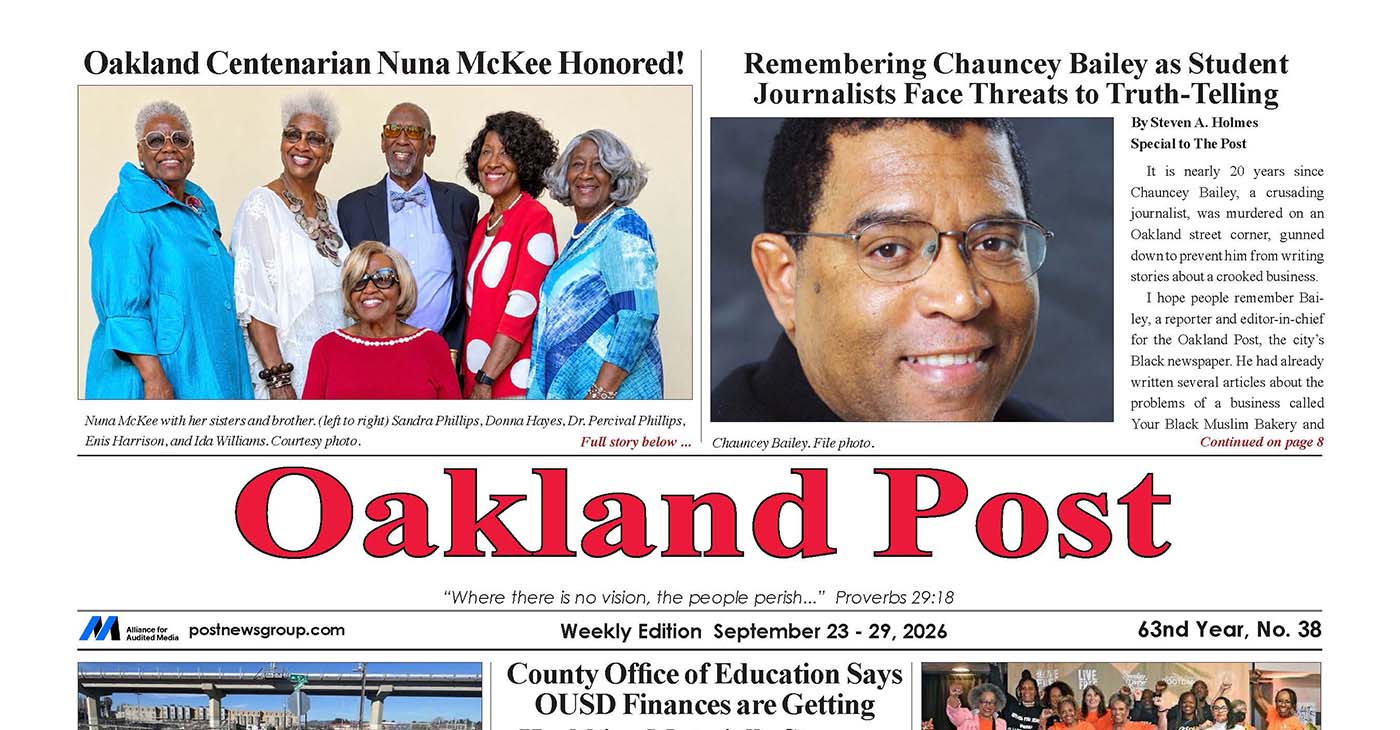
To enlarge your view of this issue, use the slider, magnifying glass icon or full page icon in the lower right corner of the browser window.
Activism
Oakland Post: Week of September 16 – 22, 2026
The printed Weekly Edition of the Oakland Post: Week of September 16 – 22, 2026

To enlarge your view of this issue, use the slider, magnifying glass icon or full page icon in the lower right corner of the browser window.
Activism
Oakland Post: Week of September 9 – 15, 2026
The printed Weekly Edition of the Oakland Post: Week of September 9 – 15, 2026

To enlarge your view of this issue, use the slider, magnifying glass icon or full page icon in the lower right corner of the browser window.



Asm. Corey Jackson Announces Launch of 24-Hour Childcare in His District

IN MEMORIAM: The Rev. Leon “Sonny” Clark, Longtime Orange County Pastor and Community Leader, Dies at 72

Poll: Becerra Widens His Lead Over Hilton; Californians Split on Wealth Tax

From Historic Memories to New Possibilities: Oakland Celebrates Coliseum 60

County Office of Education Says OUSD Finances Are Getting Healthier, Materially Stronger

LIVE FREE Sunday Dinner Brings Faith, Fellowship and Civic Conversation to Oakland

Remembering Chauncey Bailey as Student Journalists Face Threats to Truth-Telling

BLACspace Cooperative Invites Bay Area to Experience Oakland’s Black Cultural Ecosystem Through a BLAC Map Tour + Party

In Wake of Death on Doorstep, Williams Chapel Baptist Church Calls for Better Care, Funding for Unhoused

Oakland Centenarian Nuna McKee Honored!

Caribbean Nations Produce Action Plan Calling for UK Reparations Over Slavery

Oakland Post: Week of September 23 – 29, 2026

Doulas Are Helping Black California Moms Navigate Pregnancy–Even as High Mortality Rates Persist

Newsom Signs Addictive Social Media Law to Protect Kids

On Your November Ballot: Prop 38 Would Allocate $8.4 Billion to Immunology and Immunotherapy Funding

Standoff for Justice: Our Homes Are Worth Fighting For

Oakland Post: Week of August 26 – September 1, 2026

Frontier Airlines’ Return to Oakland Airport Brings Flights, Jobs and Opportunity

Gubernatorial Candidate Steve Hilton Blasts California New Tire Rules; Newsom Hits Back

Chef Sharon Lee Blends Culinary Excellence, Education and Empowerment

Jackie Wright Champions Bay Area Stories, Filmmakers and Cultural Institutions

Big City Mayors Ask for “Yes” Vote on Housing Bond Measure; Conservatives Say “No”

Gov. Newsom’s Latest Appointees Include Sacramento Advocate for Formerly Incarcerated Students; State’s New Tech Chief

Oakland Coliseum Project Opens Door for Small Businesses to Build Bigger

Misnamed ‘Parent’ PAC Seeks to Influence Oakland School Board Elections

Longtime BWOPA Member Brendalyn Goodall Appointed to California Workforce Development Board

Gov. Newsom Signs Law Shielding Immigration Aid Workers From Doxing Threats

Secretary of State Shirley N. Weber Urges Californians to Vote Early as Voter ID Battle Intensifies

From Palestine to Oakland: Seeds for Liberation Examines Shared Struggles for Freedom

IN MEMORIAM: Dolly Parton Dead at 80 — How She Built a Legacy of Love and Earned Her Place in Black Culture

The Conversation With Al McFarlane 6/23/26

Media Monday 6/22/26

LIVE! ASK ALMA! — TUES. 6.23.26 7PM EST

Car Buying Secrets: 4 Hidden Checks Before You Sign!

Is This 550 HP Charger Worth YOUR Money? AutoNetwork Review

Celebrating Juneteenth – Frederick Douglass on education and resistance

LIVE! — ASK ALMA! — TUES. 6.19.26 7PM EST

Hyundai Ioniq 5 Parking, Safety, and 360 View #shorts

2025 Ioniq 5 New Wiper & Powerful Performance! #shorts

Electric SUV Range: Is 259 Miles Enough? #shorts

EV Charging: How Fast Can You Charge an Electric Vehicle? #shorts

Biometric Cooling… Messaging Seats…Come on! 2025 Infiniti QX80 Autograph 4WD

Charged Up: Witness the Magic of a Fully Electric Car! #shorts

Range Rover Sport PHEV Included…: See What’s Inside This Luxury SUV! #shorts

Invisible Hood View: Perfect Parking with X-Ray Vision! #shorts
-
 Business4 weeks ago
Chef Sharon Lee Blends Culinary Excellence, Education and Empowerment
-
 Black History4 weeks ago
Jackie Wright Champions Bay Area Stories, Filmmakers and Cultural Institutions
-
 Community4 weeks ago
Big City Mayors Ask for “Yes” Vote on Housing Bond Measure; Conservatives Say “No”
-
 Community2 weeks ago
Misnamed ‘Parent’ PAC Seeks to Influence Oakland School Board Elections
-
 Business4 weeks ago
Longtime BWOPA Member Brendalyn Goodall Appointed to California Workforce Development Board
-
 Community4 weeks ago
Gov. Newsom Signs Law Shielding Immigration Aid Workers From Doxing Threats
-

 Activism3 weeks ago
Oakland Post: Week of September 2 – 8, 2026
-
 Featured4 weeks ago
‘Passing a Law Isn’t The Finish Line’: California Assembly Evaluates Implementation, Results
