Connect with us

Activism

Oakland Mayor Lays Out Agenda for Community Safety in State of the City Address
Published

on

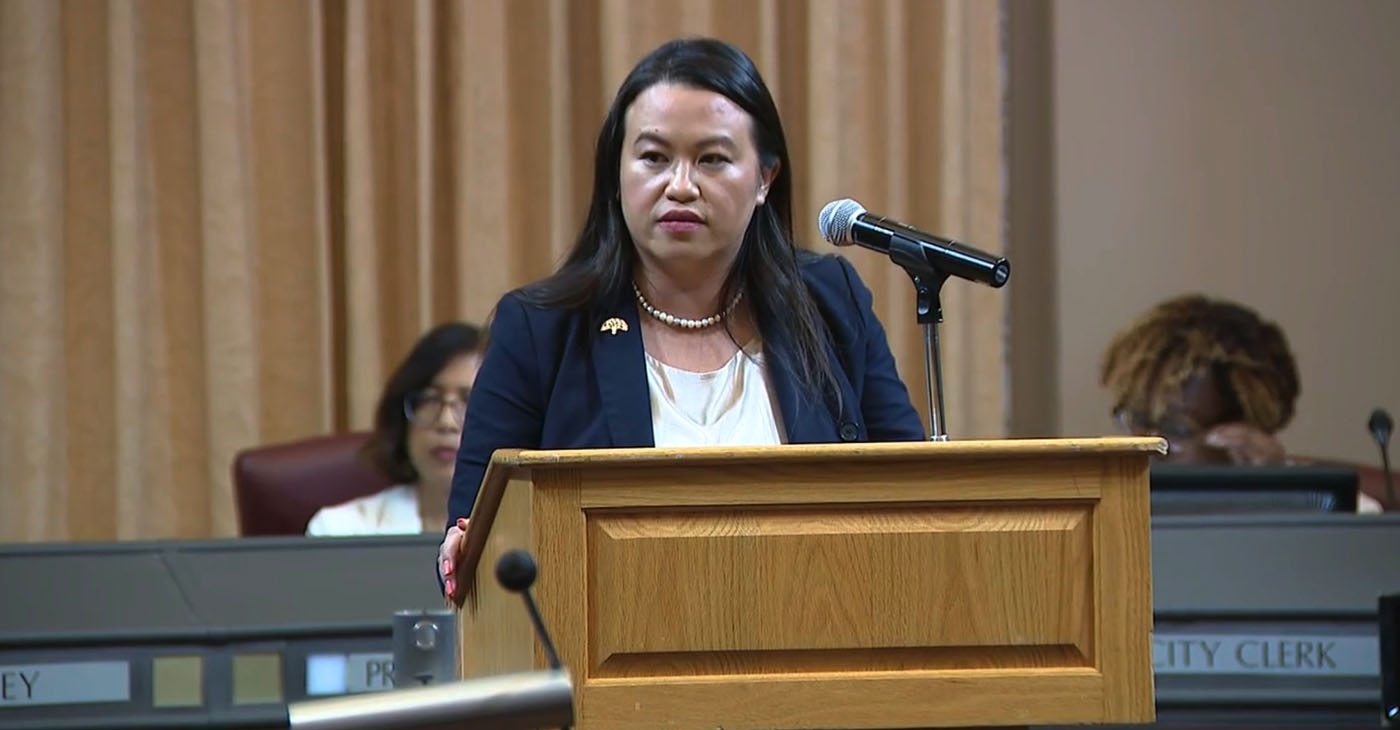
The Oakland City Council held a special meeting Tuesday afternoon at City Hall. Photo by Magaly Muñoz.

By Magaly Muñoz, Post Staff

At a special City Council meeting in City Hall Tuesday afternoon, Oakland Mayor Sheng Thao laid out her current and future plans for community safety.

For some time, public safety has been a major issue in Oakland. City leaders and business owners have been critical of the city’s lack of initiative in responding to their concerns.

Thao reflected on the initiatives she has implemented during her first ten months in office. She mentioned the increased investment in the Mobile Assistance Community Responders (MACRO) program, which sends trained mental health professionals to non-violent mental health and non-criminal situations.

She also highlighted the additional funding for six new police academies and the expansion of foot patrol police throughout the city.
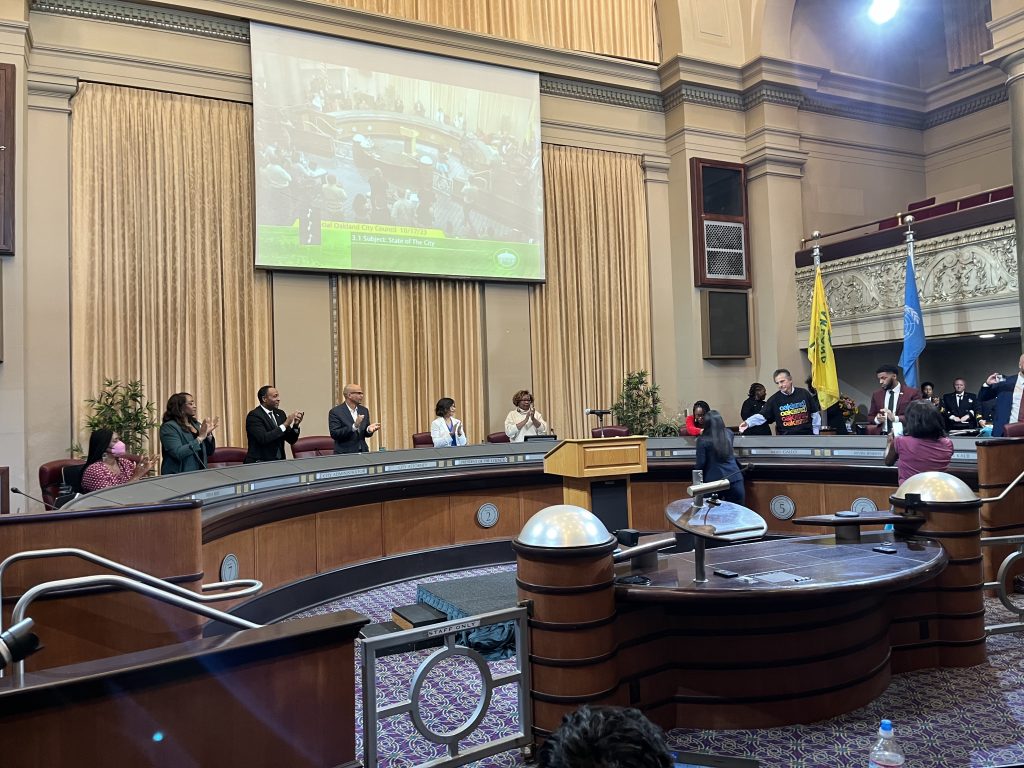
Mayor Sheng Thao several initiatives that include more community policing. Photo by Magaly Muñoz.

Mayor Sheng Thao several initiatives that include more community policing. Photo by Magaly Muñoz.

Her new efforts are to enhance 911 police dispatching, add 300 new license plate readers, and put community ambassadors, security personnel, security cameras, and other additional infrastructure in high-traffic areas of the city.

Thao said she’s been listening to the community’s concerns and understands that things like violence prevention and community safety contribute to the overall improvement of the city.

“I know we have work to do, but we can only do it if we all come together,” Thao said.

The mayor also committed to investing in homelessness and housing issues in Oakland and to collaborate with as many officials and communities as possible to combat the housing crisis.

According to a 2023 article by Business Insider, Oakland ranks among the largest cities in California with the highest cost of living, with rent averaging about $2,700 per month and four-bedroom homes priced at approximately $900,000.

One of Thao’s initiatives involves collaborating with other Bay Area mayors to place a housing measure on the November 2024 ballot to expand the construction of affordable housing throughout the region.

The plan also includes $200 million for creating affordable housing units over the next two years, $53 million in state grant funding to construct 1,000 new affordable housing units, and preservation of 134 affordable units through Oaklands’s Acquisition and Conversion to Affordable Housing program.

As businesses struggle to stay open, Thao affirmed that she’s committed to revitalizing the city’s tourism. She has partnered with Visit Oakland and Activate Oakland to reinvest in the commercial areas to promote economic recovery from the effects of the pandemic.

This plan includes launching “Five after Five,” a pilot program to allow parking in the 19th Street Garage from 5:00 p.m. to 3:00 a.m. for only $5, Thursday through Saturday, to bolster Oakland’s nightlife, concert venues, and weekend shopping.

“All of these investments we’re making in Oakland are contributing to making more businesses stick here in Oakland, more businesses expanding in Oakland, and more businesses coming to Oakland,” Thao said.

Thao took responsibility for missing out on the Organized Retail Theft Prevention Grant, stating, “I own that, the buck stops with me.” She declared that she is fast-tracking the recruitment of a grants coordinator and bringing in more grant management expertise. Additionally, she announced plans to upgrade and modernize the city’s grant management software tools.

Thao concluded her address by saying she’s “up for the challenge” to make Oakland a better place to live. Her final words were, “Let’s unite for Oakland. Let’s fight for Oakland. This is our city. This is our fight, and this is our future. Thank you all so much for joining me.”

Despite the extensive commitments Thao made in the agenda to ensure Oakland’s safety and success, people questioned her absence during the public comment, bypassing the opportunity to hear community feedback.

“You need to be here to listen; you gotta listen to what we’re saying,” Edwin Escobar said. “Hear us because we need you to do your job. People are dying; businesses are closing. This is real; the struggle is real.”

Councilmember Nikki Fortunato Bas said that the city officials have been working and will continue to work to give the community the basics, making sure that everyone from kids to seniors feel safe and that businesses feel like they have a place to thrive.

“We have to do better because we all deserve a stronger and safer, more united Oakland,” Bas said.
Magaly Muñoz

Magaly Muñoz

A graduate of Sacramento State University, Magaly Muñoz’s journalism experience includes working for the State Hornet, the university’s student-run newspaper and conducting research and producing projects for “All Things Considered” at National Public Radio. She also was a community reporter for El Timpano, serving Latino and Mayan communities, and contributed to the Sacramento Observer, the area’s African American newspaper.

Muñoz is one of 40 early career journalists who are part of the California Local News Fellowship program, a state-funded initiative designed to strengthen local news reporting in California, with a focus on underserved communities.

The fellowship program places journalism fellows throughout the state in two-year, full-time reporting positions.

A graduate of Sacramento State University, Magaly Muñoz’s journalism experience includes working for the State Hornet, the university’s student-run newspaper and conducting research and producing projects for “All Things Considered” at National Public Radio. She also was a community reporter for El Timpano, serving Latino and Mayan communities, and contributed to the Sacramento Observer, the area’s African American newspaper. Muñoz is one of 40 early career journalists who are part of the California Local News Fellowship program, a state-funded initiative designed to strengthen local news reporting in California, with a focus on underserved communities. The fellowship program places journalism fellows throughout the state in two-year, full-time reporting positions.

Activism

Diabetes in Black California: Turning the Tide from Crisis to Control

According to the Centers for Disease Control and Prevention (CDC) Behavioral Risk Factor Surveillance System data, nearly 17.9% of Black adults in California have been diagnosed with diabetes — above the national Black adult average of 16.8%, and nearly five points higher than California’s overall adult rate of 12.6% across all races. California ranks 24th out of 39 states with available data for Black adult diabetes rates.

Published

on

Dr. Khadijah Lang is a family physician with a clinic in Los Angeles who specializes in several family medical practices, including prenatal care. Lang believes in family medicine. She says it is important to treat all members of a family. Thursday, June 5, 2026. Photo by Solomon O. Smith/California Black Media.

By Charlene Muhammad, California Black Media

Crystal Lambert knew something was terribly wrong with her three-year-old granddaughter as she sped down the street trying to get her to the hospital.

“I thought she got a hold of some poison,” Lambert recalled.

Doctors found Lambert’s granddaughter had a blood sugar level over 800, diagnosing her with Diabetic Ketoacidosis(DKA), a state in which the body, starved of insulin, begins to shut down.

Lambert said she was born with a pancreas that was not fully functioning — it lacked the specialized cells required to produce insulin.

Her granddaughter survived and is five years old today.  Now, she gives herself insulin shots, asks endless questions about her condition, and runs like the spirited child she is. But the terror of that night transformed Lambert — and ultimately inspired her to launch the We Fight Back Organization, a mobile health and food access initiative serving underserved communities across California. Lambert is the executive director.

The Crisis by the Numbers

According to the Centers for Disease Control and Prevention (CDC) Behavioral Risk Factor Surveillance System data, nearly 17.9% of Black adults in California have been diagnosed with diabetes — above the national Black adult average of 16.8%, and nearly five points higher than California’s overall adult rate of 12.6% across all races. California ranks 24th out of 39 states with available data for Black adult diabetes rates.

Nationally, according to the U.S. Department of Health and Human Services, Black Americans were 24% more likely than the overall U.S. population to have diabetes in 2024. They also died from diabetes 78% more often than the general population in 2022. Black Americans are also more than twice as likely as the overall population to develop kidney failure caused by diabetes.

According to the California Health Care Foundation’s 2024 Health Disparities Almanac, Black Californians have the shortest life expectancy in the state at just 74.6 years — due in part to chronic conditions like diabetes and its devastating complications.

Leon Rock, co-founder of the African American Diabetes Association, believes statistics, though revealing, only tell part of the story.

“There are a whole bunch of Black folks that don’t tell you that they have diabetes — or don’t know,” he said.

And the disease itself, Rock is careful to note, is not what kills. “They die from the complications. That’s heart attack, that’s stroke, that’s amputations of legs, of feet. Going blind. All those complications are inherent in a system that has impacted Black folks with diabetes in California and across America.”

Crystal Lambert, creator and executive director of We Fight Back. She started the organization out of a need to learn more about diabetes on behalf of her granddaughter. Now she is looking to spread the impact of her organization to the valley. Friday, June 6, 2026. Photo by Solomon O. Smith/California Black Media.

Crystal Lambert, creator and executive director of the We Fight Back Organization, started out of a need to learn more about diabetes on behalf of her granddaughter. Now she is looking to spread her organization to the valley, on Friday, June 6, 2026 Photo by Solomon O. Smith/ California Black Media

An Information Gap Fuels the Crisis

For Rock, part of the solution is diagnosis. He says the medical and public health systems are failing Black Californians by the absence of information designed for them.

“That is the bottom line. We need good information. Information that is culturally specific,” said Rock.

Telling people to eat healthy or exercise, he added, falls short when culturally specific alternatives are not provided, and when many residents of urban communities do not feel safe exercising in some neighborhoods – or outside at night.

Dr. Khadijah Lang, a family medicine physician and president of the Golden State Medical Association, agrees that the roots of the crisis run deeper than individual behavior — and blaming patients misses the point.

“We are not genetically predisposed to diabetes,” Lang said. “But the system under which we live increases the likelihood that we will develop it.” 

What the Body Needs — What Communities Are Denied

Type 2 diabetes, which accounts for 90 to 95% of all diabetes cases, according to the CDC, develops when the body can no longer use insulin effectively to regulate blood sugar. Left unmanaged, it damages nerves, kidneys, eyes, and the cardiovascular system. The hemoglobin A1C test is a blood draw that reveals how the body has processed sugar over the previous three months — not just at the moment of the test. It is the standard tool for both diagnosis and ongoing monitoring.

That distinction matters, Lang emphasized, because patients cannot manipulate three months of blood sugar history the way they might fast for a day before a single blood draw.

“The pill is not meant to undo or control a sugar level that’s being constantly stressed,” Lang said. “It’s meant to work in conjunction with a low-carbohydrate diet and exercise.” She recommended at minimum 30 minutes of physical activity five days a week — breakable into 10-minute sessions for those who need it.

Lang stressed that education must be delivered in language people recognize and can relate to. The goal is to inform them of the choices that serve their health best, she said.

But for many Black Californians, even those informed choices remain out of reach, Lambert said.

“They need access to healthy foods and medication, too” she said.

California has made some critical policy advances. The state has expanded access to the Continuous Glucose Monitor (CGM), which has transformed diabetes care for state residents. Assembly Bill 365, introduced in 2024, proposed requiring Medi-Cal to cover the costs of CGM and other related medical equipment but it failed in the State Senate. Since then, the California Department of Health Care Services (DHCS) reports that the core Medi-Cal CGM benefit now available to eligible patients was solidified through previous budget actions and pharmacy policy updates.

These measures, while meaningful, have not closed the gap for the communities most at risk, according to advocates.

Control Through Community

Health care advocates conclude that the solution must be communal, culturally grounded, and sustained — not a fad, not a celebrity moment, not a single clinic visit. For example, observed Lang, lifestyle shaped by shared values and collective accountability can move the needle where individual prescriptions have not.

Rock is building infrastructure to match the urgency, establishing local chapters of the African American Diabetes Association across the country, with California next.

“We have to do for self, period,” he said. “Health is wealth. We have to eat to live.”

And Lambert, whose granddaughter unknowingly started all of this for her, keeps showing up.

“Diabetes advocacy is about dignity, education, prevention, and hope,” she said.

Video: Diabetes Disparity Exposed in California

This article is supported by the California Health Care Foundation 

(CHCF). Visit www.chcf.org 

Continue Reading

Activism

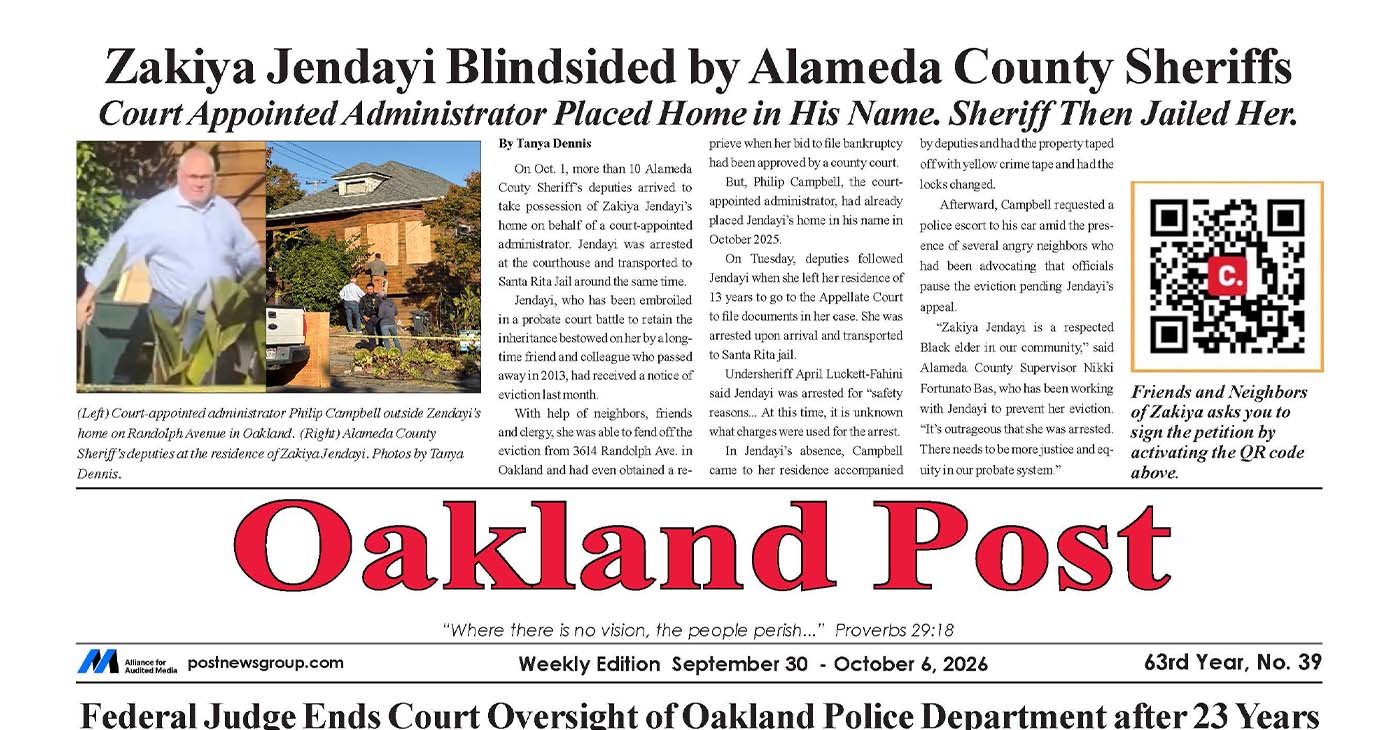
Oakland Post: Week of July 1 – 7, 2026

The printed Weekly Edition of the Oakland Post: Week of July 1 – 7, 2026

Published

on

To enlarge your view of this issue, use the slider, magnifying glass icon or full page icon in the lower right corner of the browser window.

Continue Reading

Activism

NPRC Joins National Grand Jury Proceedings Seeking Accountability, Constitutional Restoration

Organizers state that testimony will explore historical and political developments that they believe have contributed to the expansion of corporate influence over public institutions and governmental decision-making. Participants are expected to discuss concerns regarding constitutional governance, individual liberties, property rights, and the protection of vulnerable populations, including seniors and persons with disabilities.

Published

on

Photo by Billie Powers.

Special to The Post

The National Probate Reform Coalition (NPRC) has joined Toll and Roll and a growing coalition of advocacy organizations, victims, whistleblowers, and citizen groups in support of a nationally broadcast People’s Grand Jury proceeding scheduled for July 1 and July 7.

Organizers describe the event as a public forum designed to examine allegations of government abuse, judicial misconduct, legislative failures, and the erosion of constitutional protections affecting millions of Americans.

The proceedings will feature testimony from victims, families, advocates, and organizations from across the country who contend they have experienced harm through government actions, institutional neglect, and failures of oversight.

According to organizers, the People’s Grand Jury will focus on concerns involving probate courts, guardianships, conservatorships, child welfare systems, property rights, civil liberties, and what participants view as a growing disconnect between government institutions and the constitutional rights of the people they are sworn to serve.

NPRC is participating because many of the issues being examined mirror the concerns raised by advocates, victims, and families who have participated in its monthly town halls. For years, families have reported cases involving exploitation of elders, questionable guardianships, estate depletion, denial of due process, and a lack of meaningful oversight within probate court systems.

“This proceeding gives victims and advocates an opportunity to place their experiences on the public record,” said Tanya Dennis, lead facilitator of NPRC. “For too long, families have struggled to have their voices heard regarding elder abuse, probate exploitation, and government inaction. This forum allows those stories to be shared before a national audience.”

Organizers state that testimony will explore historical and political developments that they believe have contributed to the expansion of corporate influence over public institutions and governmental decision-making. Participants are expected to discuss concerns regarding constitutional governance, individual liberties, property rights, and the protection of vulnerable populations, including seniors and persons with disabilities.

In keeping with principles of transparency and fairness, invitations have been extended to legislators, members of the judiciary, law enforcement representatives, and other public officials who may wish to respond to concerns raised during the proceedings or defend actions taken by their respective institutions.

One of the primary outcomes sought by organizers is public consideration and support for the People’s Remedy and Restoration Act, a proposed legislative framework that advocates believe would strengthen oversight, increase accountability, provide remedies for victims of governmental abuse, and restore constitutional protections.

The proceedings are expected to be broadcast nationally, providing citizens throughout the United States an opportunity to observe testimony, review evidence presented, and participate in an ongoing conversation regarding government accountability and the protection of individual rights.

Advocates hope the hearings will encourage meaningful dialogue, legislative reform, and renewed public engagement in the democratic process.

Individuals, organizations, public officials, and members of the media interested in attending or obtaining access information may contact the organizers at tollandroll2025@gmail.com.

As Americans continue to debate the future of constitutional governance, judicial accountability, and the protection of vulnerable citizens, the July proceedings are expected to serve as a significant forum for public testimony and civic engagement. For more information, go to https://tollandroll.com

Continue Reading

Subscribe to receive news and updates from the Oakland Post

* indicates required

CHECK OUT THE LATEST ISSUE OF THE OAKLAND POST

ADVERTISEMENT

WORK FROM HOME

Home-based business with potential monthly income of $10K+ per month. A proven training system and website provided to maximize business effectiveness. Perfect job to earn side and primary income. Contact Lynne for more details: Lynne4npusa@gmail.com 800-334-0540

Facebook

Trending

Copyright ©2021 Post News Group, Inc. All Rights Reserved.