
Activism
How Four California Cities Are Approaching Reparations for Black Residents
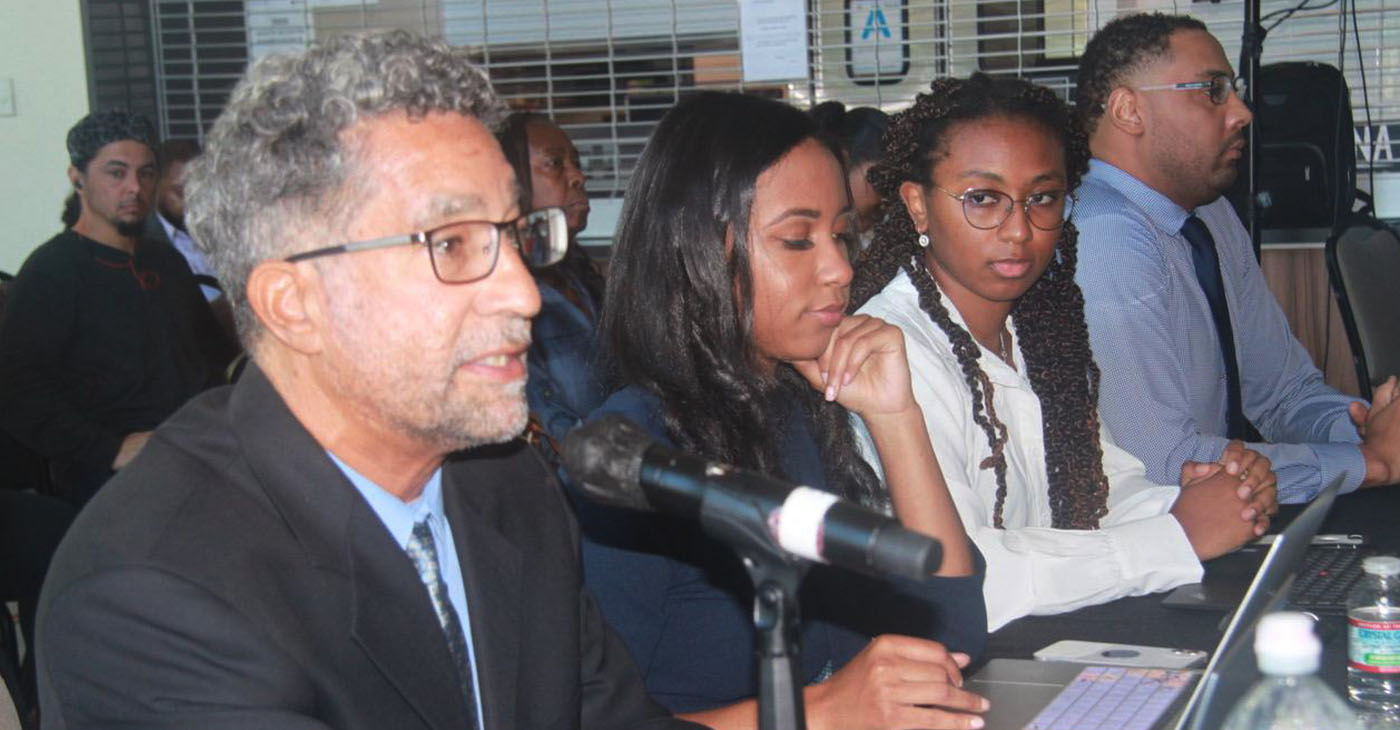
The California Reparations Task Force to Study and Develop Reparation Proposals for African Americans will hold its last in-person meeting on June 29 in Sacramento. The meeting will take place in the First Floor Auditorium of the March Fong Eu Secretary of State Building, located at 1500 11th Street. The task force will submit its final report to the California Legislature. If approved, California could become the first state to provide reparations to the descendants of enslaved Black Americans.

By Antonio Ray Harvey
California Black Media
The California Reparations Task Force to Study and Develop Reparation Proposals for African Americans will hold its last in-person meeting on June 29 in Sacramento.
The meeting will take place in the First Floor Auditorium of the March Fong Eu Secretary of State Building, located at 1500 11th Street.
The task force will submit its final report to the California Legislature. If approved, California could become the first state to provide reparations to the descendants of enslaved Black Americans.
Task force vice-chairperson Rev. Amos Brown said the state Legislature must “do the right thing” before leaving San Francisco for a speaking engagement in Jackson, Miss., to recognize the 60th anniversary of NAACP field secretary Medgar Evers assassination on June 12, 1963.
“It’s now time for some deliberate action,” said Brown, the pastor of Third Street Baptist Church in San Francisco. “If they don’t provide support action, or forms of reparations in this nation, and in this state, they will be giving credence to bigotry, racism, and inhumanity towards Black folks.”
During the past 24 months, while the state reparations task force held public hearings and listened to expert testimony to uncover historic wrongdoings and discriminatory policies against descendants of enslaved Blacks in order to determine appropriate compensation, some cities in California started their own reparations efforts.

In June 2021, the city of Los Angeles established the Reparations Advisory Commission (RAC), a seven-member task force comprised of activists, academicians, attorneys, racial justice advocates, and more. It is supported by Los Angeles’ Civil + Human Rights and Equity Department’s Office of Racial Equity.
The RAC advises the city on the formation of a reparations pilot program for Californians who are descendants of enslaved Black Americans in the Los Angeles area, according to Khansa T. “Friday Jones” Jones-Muhammad, a member of the commission. The RAC provides recommendations for the format, function, and goals of the initiative, including strategies and opportunities to seek public or private funding.
In April, RAC hosted its first in-person forum at the California African American Museum.
“African Americans in Los Angeles are overrepresented in homelessness and underrepresented in generational wealth. It is the result of a system that has denied African Americans the ability to fully exercise their God-given liberties,” said RAC Chairperson Michael Lawson at the meeting.
Lawson is the CEO and president of the L.A. Urban League.
“The closure needed is a mutual recognition of the wrongs that have been meted upon the members of the victimized community. I am grateful to everyone who joined us as we take this step forward together,” he added.
In December 2020, the San Francisco Board of Supervisors passed an ordinance establishing the 15-member San Francisco African American Reparations Advisory Committee (AARAC).
Over the course of two years, AARAC developed a San Francisco Reparations Plan that addresses institutional and city-sanctioned wrongdoings against Black communities in San Francisco.
AARAC specifically focuses on improving different aspects of Black life, including education, housing, workforce development, economic opportunities, financial stability, small businesses, access to public transit, and food security.
The committee is committed to reducing violence, addressing health disparities and preventing over-criminalization of African Americans.
In March, AARAC presented to the San Francisco Board of Supervisors more than 100 recommendations, including a proposal to pay each qualifying Black city resident a one-time lump sum reparation payment of $5 million.
In an interview with San Francisco’s KRON 4 News on March 24, Eric McDonnell, the chairperson of AARAC, stated that the recommendations are an estimation of the atrocities experienced by Black Americans.
“Our task (AARAC) was to do the appraisal, and it’s the city’s task to determine, based upon recommendations, what they decide to adopt,” McDonnell said.
In 2020, after the murder of George Floyd, San Diego established the Department of Race and Equity (DRE) to address disparities experienced by individuals in the city.
This initiative was led by San Diego City Councilmember Monica Montgomery-Steppe, who is a member of the state’s reparations task force.
Last year, the city of Sacramento began developing a municipal reparations initiative committed to “truth telling and trust building” called the Sacramento Centered on Racial Equity (SCORE) plan.
SCORE is designed to interrupt patterns and processes rooted in dominant cultural patterns that perpetuate systemic racism and racial hierarchy within the city.
Betty Williams, president of the Sacramento branch of the NAACP, praised the work SCORE has started but she wants to further expand discussions on reparations for the Sacramento Black community.
“I want an outreach team to go out in the community to ask the critical question: ‘Do you want a (reparations) task force and what should it look like?’” Williams told California Black Media.
“That’s the discussion I’ve had with Mayor (Darrell) Steinberg on how to put something like this together. It’s not just monetary. Education, housing, small business — all of those things should be part of the recommendations and of what reparations should look like for Black Sacramentans.”






Activism
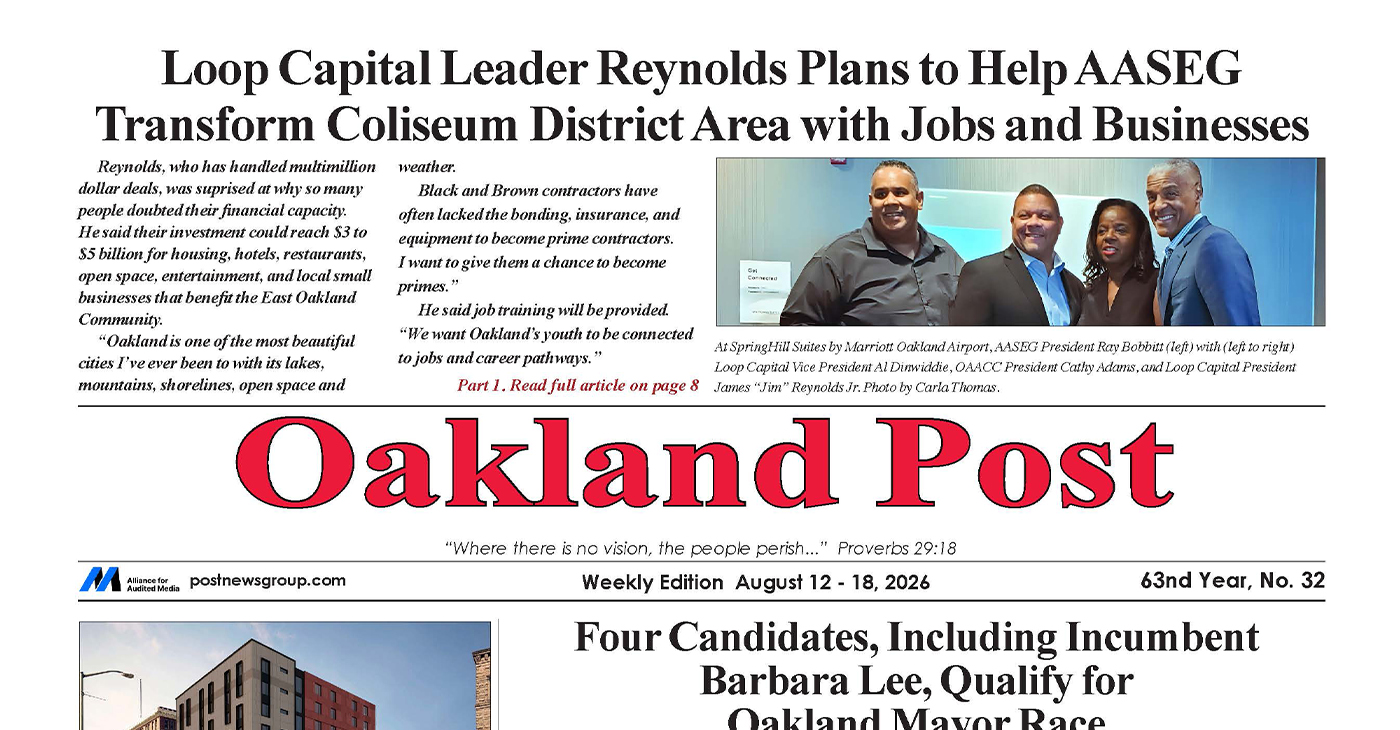
Oakland Post: Week of August 12 – 18, 2026
The printed Weekly Edition of the Oakland Post: Week of August 12 – 18, 2026
To enlarge your view of this issue, use the slider, magnifying glass icon or full page icon in the lower right corner of the browser window.
Activism
Oakland Post: Week of August 5 – 11, 2026
The printed Weekly Edition of the Oakland Post: Week of August 5 – 11, 2026
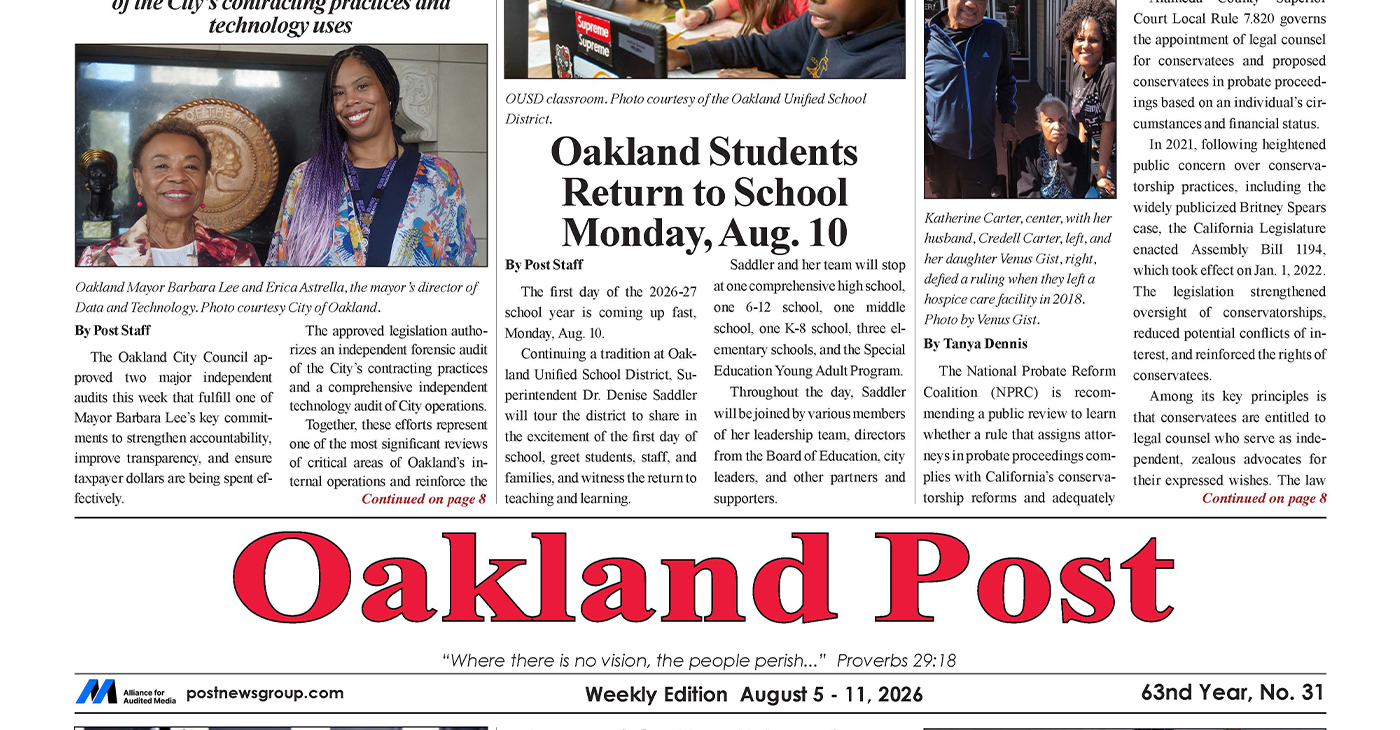
To enlarge your view of this issue, use the slider, magnifying glass icon or full page icon in the lower right corner of the browser window.
Activism
Oakland Post: Week of July 29 – August 4, 2026
The printed Weekly Edition of the Oakland Post: Week of July 29 – August 4, 2026
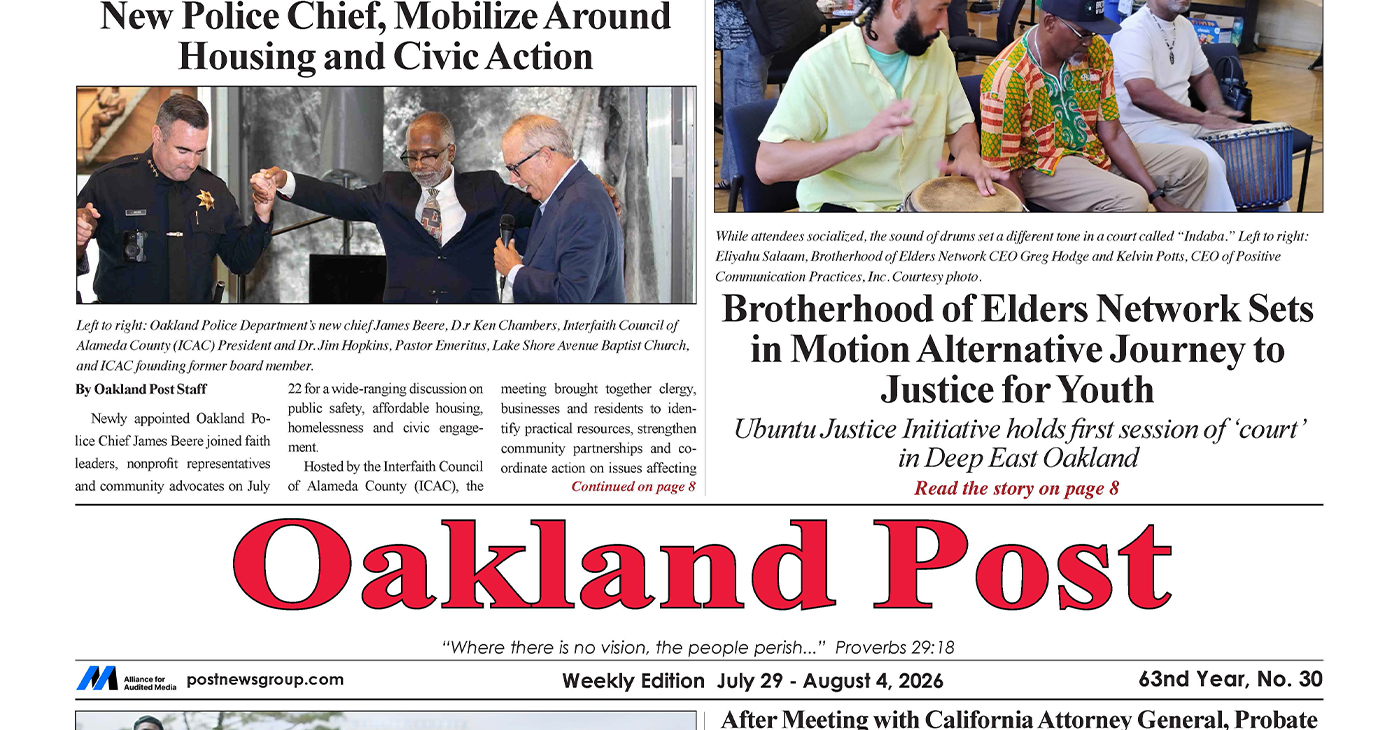
To enlarge your view of this issue, use the slider, magnifying glass icon or full page icon in the lower right corner of the browser window.

WORK FROM HOME
Home-based business with potential monthly income of $10K+ per month. A proven training system and website provided to maximize business effectiveness. Perfect job to earn side and primary income. Contact Lynne for more details: Lynne4npusa@gmail.com 800-334-0540


Four Candidates, Including Incumbent Barbara Lee, Qualify for Oakland Mayor’s Race

Oakland Observes Black August with Block Parties, Film Showings, Workshops

Oakland Post: Week of August 12 – 18, 2026

COMMENTARY: Why Local School Tax Measure G1 Will Not Be on the November Ballot

California Hispanic Chambers of Commerce Unveils: ‘Powering the Future’ Theme for 47th Annual Statewide Convention

Returning to Its Roots, the Oakland Black-Eyed Pea Festival Partners with the Freedom Farmers Market Sept. 12

Less Affluent School Districts, Including Sacramento City, Face Threat of State Takeover

From Blueprint to Breakthrough: Tackling Affordable Housing in Oakland

NPRC Scores First Advocacy Victory: David Shaw Finally Gets His Wish to ‘Go Home’

ESSAY: California Can Close Its Colorectal Cancer Gap

Car Wash Workers Cope with Lingering Impacts of ICE Raids

Misty Copeland Shapes Ballet’s Tomorrow

As Part of Your Back-to- School Checklist, Vaccinate

As Part of Your Back-to- School Checklist, Vaccinate

Congresswoman Simon Demands Investigation into Trump’s Abuse of Emergency Powers for Coal Export Terminal in West Oakland

Department of Homeland Security Demands California Secretary of State Shirley N. Weber Scrub Voter Rolls

Oakland Children’s Hospital Workers and Patients Rally for Pediatric Medical Care

New Judge Could Decide if Karmelo Anthony Gets a New Trial

“The Power to See Threats Sooner”: Gov. Newsom, Safety Officials Showcase California’s Investments in Hi-Tech Wildfire Prevention

Alpha Kappa Alpha Sorority, Inc. Celebrates New North Atlantic Regional Director

Surveillance Pricing Fight: State Senate Debates Bill Banning Retailers from Using AI to Set Prices Based on a Buyer’s Profile

Mount Zion MBC, Church of Jesus Christ of Latter-day Saints Partner to Bring 29,000 Meals to Alameda County

California Sen. Padilla Joins Colleagues to Introduce Bill Imposing Term Limits on Supreme Court Justices

Starting This Summer, California Car Buyers Can Get an Instant $3500 Off the Cost of Electric Vehicles

COMMENTARY: You Are Already Paying for the AI Boom

California Bill Would Let Abuse Victims Use Trauma as Legal Defense for Violent Crime
Less Affluent School Districts, Including Sacramento City, Face Threat of State Takeover
Car Wash Workers Cope with Lingering Impacts of ICE Raids

Fed Court to Decide Landmark First Amendment Case

Gov. Gavin Newsom Signs Law Streamlining Affordable Housing Rules

The Conversation With Al McFarlane 6/23/26

Media Monday 6/22/26

LIVE! ASK ALMA! — TUES. 6.23.26 7PM EST

Car Buying Secrets: 4 Hidden Checks Before You Sign!

Is This 550 HP Charger Worth YOUR Money? AutoNetwork Review

Celebrating Juneteenth – Frederick Douglass on education and resistance

LIVE! — ASK ALMA! — TUES. 6.19.26 7PM EST

Hyundai Ioniq 5 Parking, Safety, and 360 View #shorts

2025 Ioniq 5 New Wiper & Powerful Performance! #shorts

Electric SUV Range: Is 259 Miles Enough? #shorts

EV Charging: How Fast Can You Charge an Electric Vehicle? #shorts

Biometric Cooling… Messaging Seats…Come on! 2025 Infiniti QX80 Autograph 4WD

Charged Up: Witness the Magic of a Fully Electric Car! #shorts

Range Rover Sport PHEV Included…: See What’s Inside This Luxury SUV! #shorts

Invisible Hood View: Perfect Parking with X-Ray Vision! #shorts
-
 Featured1 week ago
Department of Homeland Security Demands California Secretary of State Shirley N. Weber Scrub Voter Rolls
-
 Business3 weeks ago
Oakland Children’s Hospital Workers and Patients Rally for Pediatric Medical Care
-
 #NNPA BlackPress2 weeks ago
New Judge Could Decide if Karmelo Anthony Gets a New Trial
-
 Environment1 week ago
“The Power to See Threats Sooner”: Gov. Newsom, Safety Officials Showcase California’s Investments in Hi-Tech Wildfire Prevention
-
 Black History2 weeks ago
Alpha Kappa Alpha Sorority, Inc. Celebrates New North Atlantic Regional Director
-
 Business3 weeks ago
Surveillance Pricing Fight: State Senate Debates Bill Banning Retailers from Using AI to Set Prices Based on a Buyer’s Profile
-
 Business3 weeks ago
Mount Zion MBC, Church of Jesus Christ of Latter-day Saints Partner to Bring 29,000 Meals to Alameda County
-
 Featured1 week ago
California Sen. Padilla Joins Colleagues to Introduce Bill Imposing Term Limits on Supreme Court Justices
