
Activism
Community Opposes High Rise Development That Threatens Geoffrey’s Inner Circle
City Council chambers were full for the May 17 Planning Commission hearing, and almost all the 40 speakers who had signed up to make presentations talked about the importance of the Inner Circle as part of Oakland and Geoffrey Pete as a stalwart community and business leader who has served the city for decades.

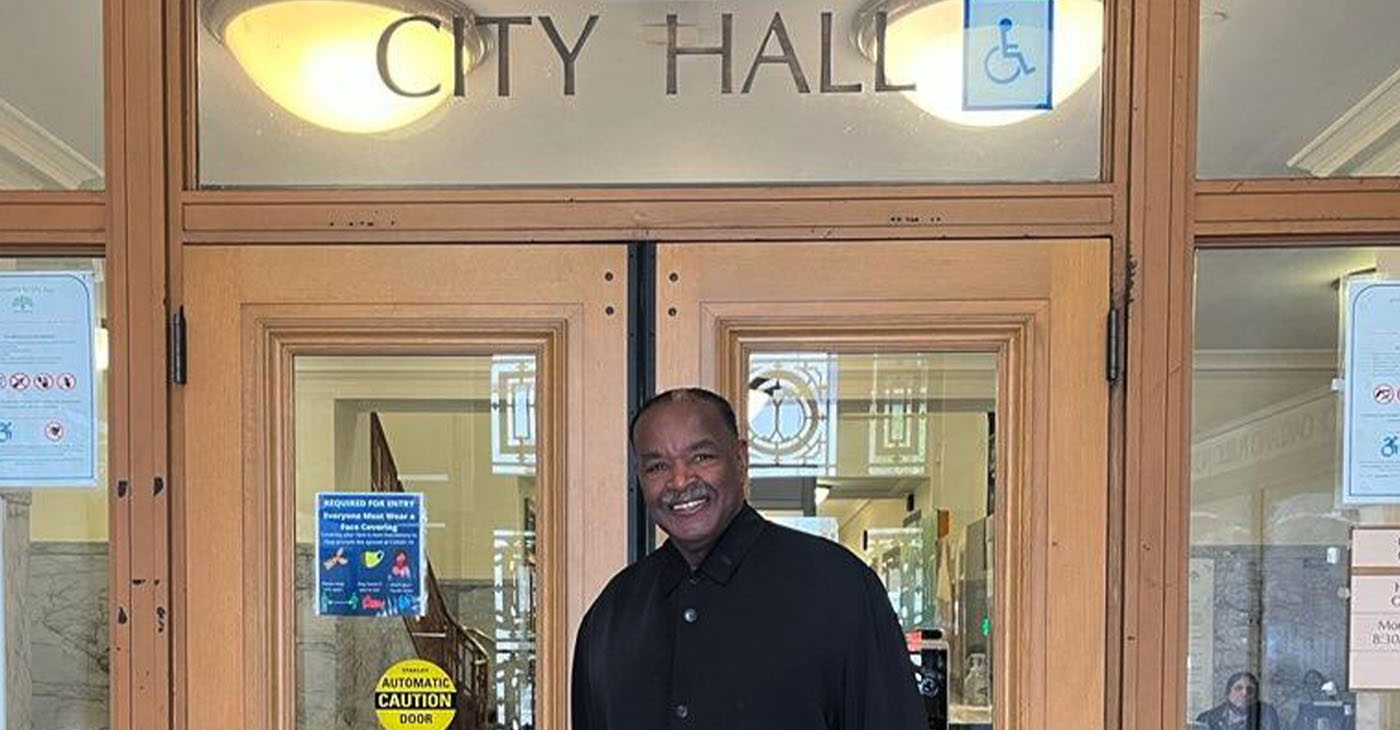
By Ken Epstein
An outpouring of community supporters – young, old, jazz lovers, environmentalists and committed Oakland partisans – spoke out at a recent Planning Commission hearing to support Geoffrey Pete and his cultural center – The Inner Circle – an historic Oakland landmark whose future is threatened by a proposed skyscraper that out-of-town-developer Tidewater Capital wants to build in the midst of the city’s Black Arts Movement and Business District (BAMBD).
City Council chambers were full for the May 17 Planning Commission hearing, and almost all the 40 speakers who had signed up to make presentations talked about the importance of the Inner Circle as part of Oakland and Geoffrey Pete as a stalwart community and business leader who has served the city for decades.
The speakers argued passionately and persuasively, winning the sympathy of the commissioners, but were ultimately unsuccessful as the Commission unanimously approved the high-rise to be built either as a residential building or office tower on Franklin Street directly behind Geoffrey’s building.
Mr. Pete has said he would appeal the decision to the City Council. He has 10 days after the hearing to file an appeal on the office building. His appeal on the residential tower has already been submitted.

Mr. Pete said the Planning Department still has not published the boundaries of the BAMBD. “Tidewater’s applications and subsequent applications should not be approved until the Planning Department fully acknowledges the existence of the BAMBD,” he said.
“This (proposed) building poses a grave danger to the historic (Inner Circle) building next to it, arguably Oakland’s most meaningful historic building,” Pete said.
“We’re here to advocate for what’s best for the African American district and community that has gotten no representation, no advocacy, as of yet,” he said. “The (commission) is guilty, the City of Oakland is guilty, and Tidewater is guilty.”
One of the first speakers was Gwendolyn Traylor, known as Lady SunRise, who directly addressed the developers.
“With all due to respect to your business, it’s not a need of this community. I would like to ask you to reconsider the location …What is being (promised) here does not add to the healing of this community,” she said.
Naomi Schiff of the Oakland Heritage Alliance emphasized that Geoffrey’s Inner Circle is a treasure of Oakland’s history.
“Our first concern is the integrity of the historic district, in particular the former Athenian-Nile Club, now Mr. Pete’s equally historic venue, which has been the location of a great number of important community events,” she said. “It would not be OK with us if the integrity of the building were damaged in any way, no matter how much insurance (the developer bought) because it is very difficult to repair a historic building once it’s damaged.”
The Inner Circle was previously owned and operated by the Athenian-Nile Club, one of the Bay Area’s largest all-white-male exclusive private membership club, where politicians and power brokers closed back-room deals over handshakes and three martini lunches.
Cephus “Uncle Bobby X” Johnson pointed out that commissioners and the city’s Planning Department have “acknowledged that you went through the entire design review process without even knowing that the Black Arts Movement and Business District existed.”
The district was created in 2016 by City Council resolution. “At the heart of the opposition to this building is the desire to further the legacy of local Black entertainment and entrepreneurship exemplified by businesses like Mr. Pete’s … a historical landmark and venue (that serves) thousands of people who listen to jazz and other entertainment and hold weddings, receptions, and memorial services,” said Uncle Bobby.
This development is taking place within a context in which the “Black population in Oakland has decreased rapidly … because of the city’s concentration on building houses that are not affordable for people who currently live in Oakland,” he said.
John Dalrymple of East Bay Residents for Responsible Development said, “This project will result in significant air quality, public health, noise, and traffic impacts. He said the city has not adequately studied the (unmitigated) impacts of this project on the Black Arts Movement and Business District.
“This project is an example of what developers are being allowed to do when they don’t have to follow the law, and they don’t have to be sensitive to our city’s culture and values,” he said. The commission should “send a signal today that we will no longer be a feeding ground for the rich.”
Prominent Oakland businessman Ray Bobbitt told commissioners, “Any decision that you make is a contribution to the systemic process that creates a disproportionate impact on Black people. Please do yourself a favor, (and) rethink this scenario. Give Mr. Pete, who is a leader in our community, an opportunity to set the framework before you make any decision.”
Though the City Council created the BAMBD, the 2016 resolution was never implemented. The district was created to “highlight, celebrate, preserve and support the contributions of Oakland’s Black artists and business owners and the corridor as a place central historically and currently to Oakland’s Black artists and Black-owned businesses.”
The district was intended to promote Black arts, political movements, enterprises, and culture in the area, and to bring in resources through grants and other funding.













Activism
Oakland Post: Week of September 16 – 22, 2026
The printed Weekly Edition of the Oakland Post: Week of September 16 – 22, 2026

To enlarge your view of this issue, use the slider, magnifying glass icon or full page icon in the lower right corner of the browser window.
Activism
Oakland Post: Week of September 9 – 15, 2026
The printed Weekly Edition of the Oakland Post: Week of September 9 – 15, 2026

To enlarge your view of this issue, use the slider, magnifying glass icon or full page icon in the lower right corner of the browser window.
Activism
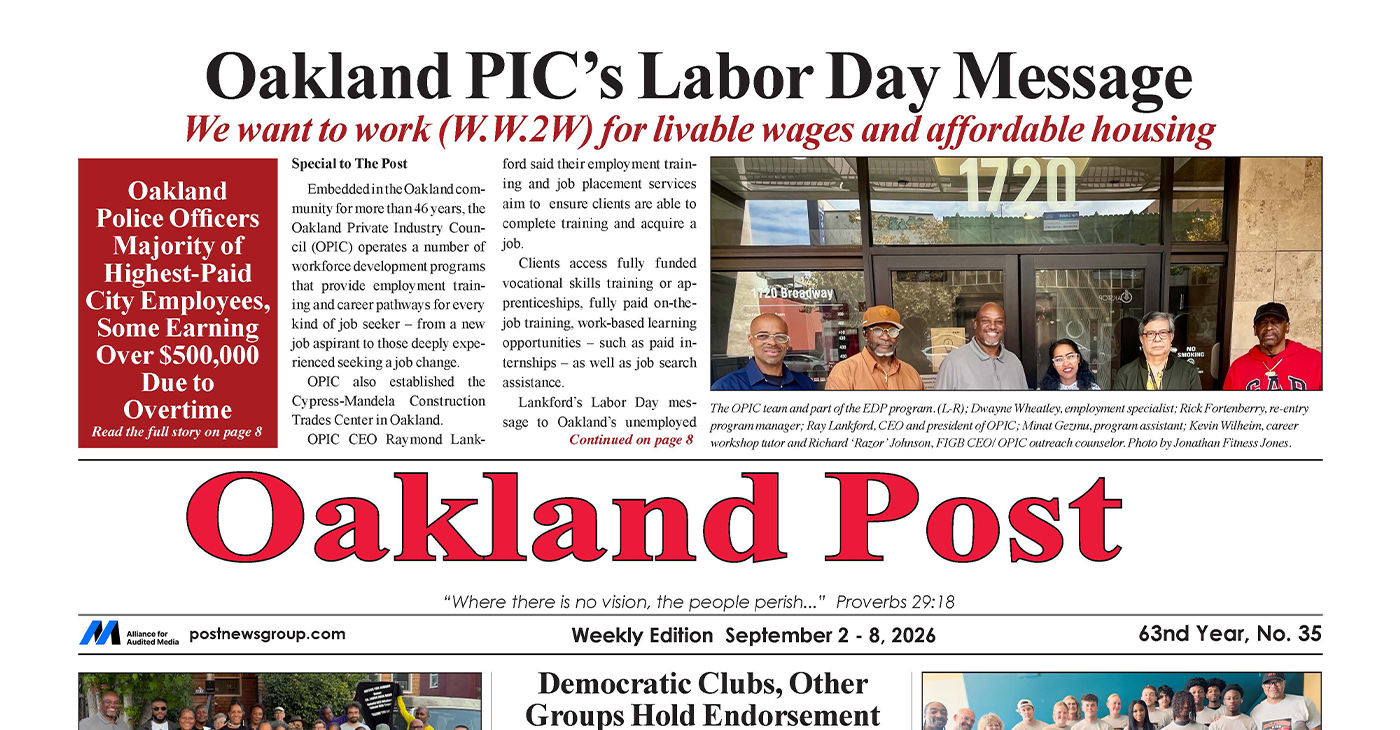
Oakland Post: Week of September 2 – 8, 2026
The printed Weekly Edition of the Oakland Post: Week of September 2 – 8, 2026
To enlarge your view of this issue, use the slider, magnifying glass icon or full page icon in the lower right corner of the browser window.



Doulas Are Helping Black California Moms Navigate Pregnancy–Even as High Mortality Rates Persist

Newsom Signs Addictive Social Media Law to Protect Kids

On Your November Ballot: Prop 38 Would Allocate $8.4 Billion to Immunology and Immunotherapy Funding

Ask California: Golden State Releases New AI Chatbot

Asm. Isaac Bryan’s Bill Banning California Police From ICE Side Jobs Reaches Newsom’s Desk

Assemblymember LaShae Sharp-Collins’s Bill Would Pause Law Enforcement’s Use of Shock Gloves Pending Study

BOOK REVIEW: ‘Laws of Solomon’ Reveals Tender Heart of Former Child Soldier

OPINION: The New American Fear – From 9-11 to AI

Passing for White, Fighting for Black America: The Courage of Walter White

Oakland People’s Arms Embargo Coalition Demands End to Military Shipments Thru Oakland

Barbara Lee Mourns Gloria Steinem, Remembers a Friendship Rooted in Equality

Event Preview: ‘Fashion v. Fascism’ – A Runway Revolution Is Coming to the Bay Area

Two Looming Threats Every Alameda County Elder Should Know About

Oakland Mayor Reads to Children at Bookout Block Party at Marcus Books Store

Tradition Comes to the Streets in 11th Annual Black-Eyed Pea Festival at the Freedom Farmers Market

Less Affluent School Districts, Including Sacramento City, Face Threat of State Takeover

ESSAY: California Can Close Its Colorectal Cancer Gap

California Hispanic Chambers of Commerce Unveils: ‘Powering the Future’ Theme for 47th Annual Statewide Convention

Four Candidates, Including Incumbent Barbara Lee, Qualify for Oakland Mayor’s Race

Oakland Post: Week of August 12 – 18, 2026

From Blueprint to Breakthrough: Tackling Affordable Housing in Oakland

Oakland Observes Black August with Block Parties, Film Showings, Workshops

COMMENTARY: Why Local School Tax Measure G1 Will Not Be on the November Ballot

Standoff for Justice: Our Homes Are Worth Fighting For

Returning to Its Roots, the Oakland Black-Eyed Pea Festival Partners with the Freedom Farmers Market Sept. 12

Oakland Post: Week of August 26 – September 1, 2026

NPRC Scores First Advocacy Victory: David Shaw Finally Gets His Wish to ‘Go Home’

Frontier Airlines’ Return to Oakland Airport Brings Flights, Jobs and Opportunity

Gubernatorial Candidate Steve Hilton Blasts California New Tire Rules; Newsom Hits Back

Chef Sharon Lee Blends Culinary Excellence, Education and Empowerment

The Conversation With Al McFarlane 6/23/26

Media Monday 6/22/26

LIVE! ASK ALMA! — TUES. 6.23.26 7PM EST

Car Buying Secrets: 4 Hidden Checks Before You Sign!

Is This 550 HP Charger Worth YOUR Money? AutoNetwork Review

Celebrating Juneteenth – Frederick Douglass on education and resistance

LIVE! — ASK ALMA! — TUES. 6.19.26 7PM EST

Hyundai Ioniq 5 Parking, Safety, and 360 View #shorts

2025 Ioniq 5 New Wiper & Powerful Performance! #shorts

Electric SUV Range: Is 259 Miles Enough? #shorts

EV Charging: How Fast Can You Charge an Electric Vehicle? #shorts

Biometric Cooling… Messaging Seats…Come on! 2025 Infiniti QX80 Autograph 4WD

Charged Up: Witness the Magic of a Fully Electric Car! #shorts

Range Rover Sport PHEV Included…: See What’s Inside This Luxury SUV! #shorts

Invisible Hood View: Perfect Parking with X-Ray Vision! #shorts
-
 Commentary4 weeks ago
Standoff for Justice: Our Homes Are Worth Fighting For
-
 Activism4 weeks ago
Oakland Post: Week of August 26 – September 1, 2026
-
 Business4 weeks ago
Frontier Airlines’ Return to Oakland Airport Brings Flights, Jobs and Opportunity
-
 Business4 weeks ago
Gubernatorial Candidate Steve Hilton Blasts California New Tire Rules; Newsom Hits Back
-
 Business4 weeks ago
Chef Sharon Lee Blends Culinary Excellence, Education and Empowerment
-

 Community4 weeks ago
Big City Mayors Ask for “Yes” Vote on Housing Bond Measure; Conservatives Say “No”
-

 Black History4 weeks ago
Jackie Wright Champions Bay Area Stories, Filmmakers and Cultural Institutions
-

 Education4 weeks ago
Gov. Newsom’s Latest Appointees Include Sacramento Advocate for Formerly Incarcerated Students; State’s New Tech Chief
