
Bay Area
Storms Bring Needed Increase to Depleted Reservoirs Across State
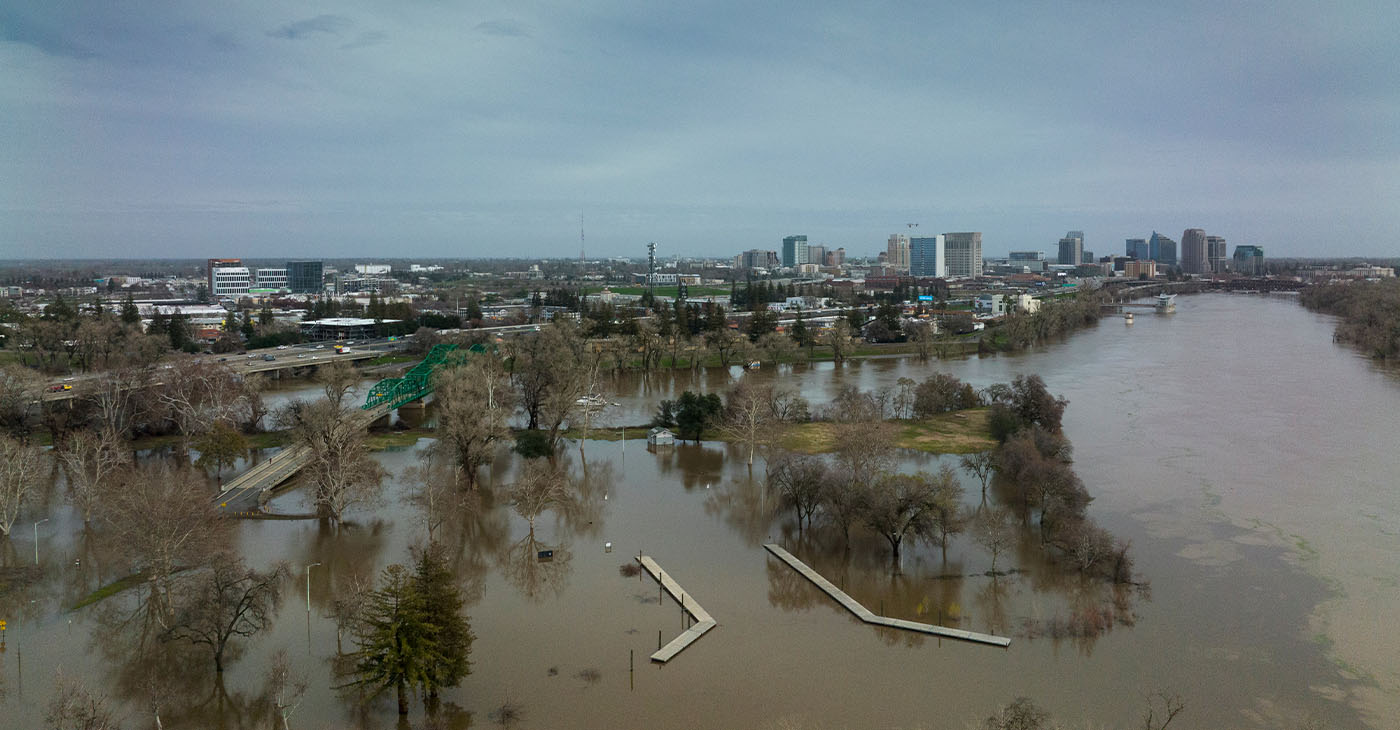
Michael Anderson, the state’s official climatologist, said river levels will continue to fluctuate after the series of storms passes, and flooding remains a risk in multiple areas, including five waterways that the water resources agency was focused on, including Bear Creek and the Pajaro, Salinas, Cosumnes, and Russian rivers.

By Thomas Hughes | Bay City News Foundation
The Sierra Nevada snowpack and California reservoirs received a huge boost from recent and ongoing storms, but not enough to end current drought conditions, officials with the state Department of Water Resources said during a briefing Wednesday.
“We’re working our way through a flood emergency but there will be underlying components of drought that will linger even when this is all done,” said Michael Anderson, the state’s official climatologist.
Anderson said the Sierra snowpack is at full seasonal levels expected by April 1 during an average year, but said it was hard to forecast how much that would fluctuate in the meantime, and excessive melting could pose further flood risks.
Two more storms are forecast to hit California in the next 10 days. Another 3 to 4 inches of rain is forecast for the Bay Area during those storms, and 2 to 3 inches on the Central Coast. Those will mark the final of a series of nine storms that hit the state starting Dec. 30.
Anderson said river levels will continue to fluctuate after the series of storms passes, and flooding remains a risk in multiple areas, including five waterways that the water resources agency was focused on, including Bear Creek and the Pajaro, Salinas, Cosumnes, and Russian rivers.
Anderson said landslides were a significant concern given the volume of rain hitting steep terrain, some of which has been burned by recent wildfires.
Water levels peaked at the Pajaro River on Tuesday morning and are now receding, according to Jeremy Arrich, manager of the department’s division of flood management. Flooding near the river forced evacuations this week.
Arrich said water levels at the Salinas River are forecast to peak sometime Friday evening and remain at peak levels through the weekend. A team of specialists was at the river to address multiple boils, which are areas near a levee that burst on the dry side and leak water.
Record flood levels were reached at Bear Creek in Merced County, Arrich said. The department has deployed 576 linear feet of muscle wall, which is a portable barrier, along with 100,000 sandbags and plastic sheeting to help combat the flooding in the area.
The Russian River is near flood stage and is expected to remain at that level for several days.
“It’s a pretty dynamic situation out there, things are changing rapidly and the flood operations center and our teams on the ground remain ready to help as needed out there and see if any other assistance is requested,” said Arrich.
Molly White, a department operations manager, said reservoirs statewide are at 84 percent of historical average, up from 81 percent on Tuesday.
“These storms are continuing across the state to help with our reservoir storage levels,” White said.
White said the Shasta and Oroville reservoirs both saw steep climbs of water levels, but are still lower than others given their historic lows prior to the storms. Shasta is at 1.9 million acre-feet and Oroville is at about 1.7 million acre-feet of water, which is 70 percent and 88 percent of their historical averages, respectively.
“Each day we are creeping closer to average conditions,” White said.
She said that’s about 2-million-acre feet at both major reservoirs at this time of year.
At other California reservoirs, Lake Sonoma is at 83 percent of its historical average levels, San Luis Reservoir is at 60 percent of its historical average, Camanche Reservoir is at 123 percent, and New Melones Lake is at 56 percent of historical levels.











Activism
Oakland Post: Week of September 23 – 29, 2026
The printed Weekly Edition of the Oakland Post: Week of September 23 – 29, 2026

To enlarge your view of this issue, use the slider, magnifying glass icon or full page icon in the lower right corner of the browser window.
Activism
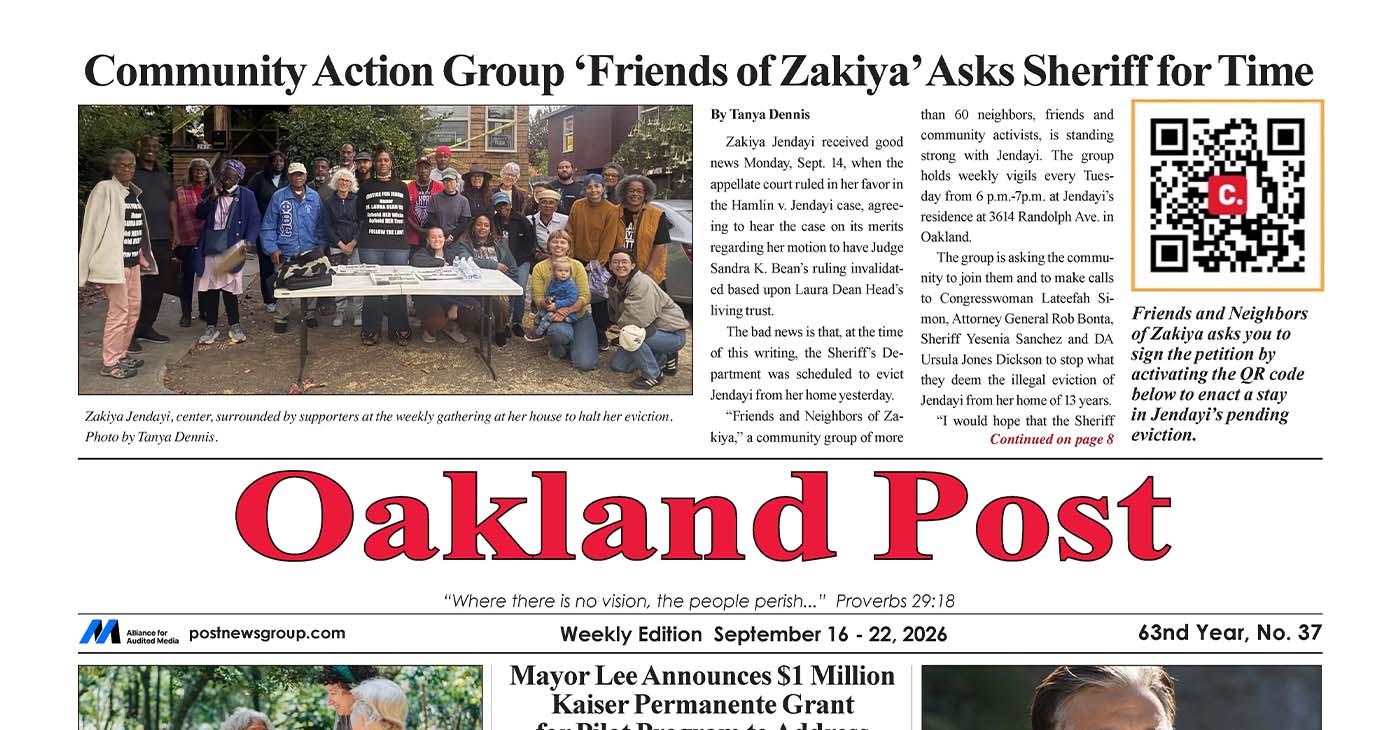
Oakland Post: Week of September 16 – 22, 2026
The printed Weekly Edition of the Oakland Post: Week of September 16 – 22, 2026
To enlarge your view of this issue, use the slider, magnifying glass icon or full page icon in the lower right corner of the browser window.
Activism
Oakland Post: Week of September 9 – 15, 2026
The printed Weekly Edition of the Oakland Post: Week of September 9 – 15, 2026

To enlarge your view of this issue, use the slider, magnifying glass icon or full page icon in the lower right corner of the browser window.



Asm. Corey Jackson Announces Launch of 24-Hour Childcare in His District

IN MEMORIAM: The Rev. Leon “Sonny” Clark, Longtime Orange County Pastor and Community Leader, Dies at 72

Poll: Becerra Widens His Lead Over Hilton; Californians Split on Wealth Tax

From Historic Memories to New Possibilities: Oakland Celebrates Coliseum 60

County Office of Education Says OUSD Finances Are Getting Healthier, Materially Stronger

LIVE FREE Sunday Dinner Brings Faith, Fellowship and Civic Conversation to Oakland

Remembering Chauncey Bailey as Student Journalists Face Threats to Truth-Telling

BLACspace Cooperative Invites Bay Area to Experience Oakland’s Black Cultural Ecosystem Through a BLAC Map Tour + Party

In Wake of Death on Doorstep, Williams Chapel Baptist Church Calls for Better Care, Funding for Unhoused

Oakland Centenarian Nuna McKee Honored!

Caribbean Nations Produce Action Plan Calling for UK Reparations Over Slavery

Oakland Post: Week of September 23 – 29, 2026

Doulas Are Helping Black California Moms Navigate Pregnancy–Even as High Mortality Rates Persist

Newsom Signs Addictive Social Media Law to Protect Kids

On Your November Ballot: Prop 38 Would Allocate $8.4 Billion to Immunology and Immunotherapy Funding

Four Candidates, Including Incumbent Barbara Lee, Qualify for Oakland Mayor’s Race

Standoff for Justice: Our Homes Are Worth Fighting For

Oakland Post: Week of August 26 – September 1, 2026

Frontier Airlines’ Return to Oakland Airport Brings Flights, Jobs and Opportunity

Gubernatorial Candidate Steve Hilton Blasts California New Tire Rules; Newsom Hits Back

Chef Sharon Lee Blends Culinary Excellence, Education and Empowerment

Jackie Wright Champions Bay Area Stories, Filmmakers and Cultural Institutions

Big City Mayors Ask for “Yes” Vote on Housing Bond Measure; Conservatives Say “No”

Gov. Newsom’s Latest Appointees Include Sacramento Advocate for Formerly Incarcerated Students; State’s New Tech Chief

Oakland Coliseum Project Opens Door for Small Businesses to Build Bigger

Misnamed ‘Parent’ PAC Seeks to Influence Oakland School Board Elections

Longtime BWOPA Member Brendalyn Goodall Appointed to California Workforce Development Board

Gov. Newsom Signs Law Shielding Immigration Aid Workers From Doxing Threats

Secretary of State Shirley N. Weber Urges Californians to Vote Early as Voter ID Battle Intensifies

From Palestine to Oakland: Seeds for Liberation Examines Shared Struggles for Freedom

The Conversation With Al McFarlane 6/23/26

Media Monday 6/22/26

LIVE! ASK ALMA! — TUES. 6.23.26 7PM EST

Car Buying Secrets: 4 Hidden Checks Before You Sign!

Is This 550 HP Charger Worth YOUR Money? AutoNetwork Review

Celebrating Juneteenth – Frederick Douglass on education and resistance

LIVE! — ASK ALMA! — TUES. 6.19.26 7PM EST

Hyundai Ioniq 5 Parking, Safety, and 360 View #shorts

2025 Ioniq 5 New Wiper & Powerful Performance! #shorts

Electric SUV Range: Is 259 Miles Enough? #shorts

EV Charging: How Fast Can You Charge an Electric Vehicle? #shorts

Biometric Cooling… Messaging Seats…Come on! 2025 Infiniti QX80 Autograph 4WD

Charged Up: Witness the Magic of a Fully Electric Car! #shorts

Range Rover Sport PHEV Included…: See What’s Inside This Luxury SUV! #shorts

Invisible Hood View: Perfect Parking with X-Ray Vision! #shorts
-
 Business4 weeks ago
Chef Sharon Lee Blends Culinary Excellence, Education and Empowerment
-
 Black History4 weeks ago
Jackie Wright Champions Bay Area Stories, Filmmakers and Cultural Institutions
-
 Community4 weeks ago
Big City Mayors Ask for “Yes” Vote on Housing Bond Measure; Conservatives Say “No”
-
 Community2 weeks ago
Misnamed ‘Parent’ PAC Seeks to Influence Oakland School Board Elections
-
 Business4 weeks ago
Longtime BWOPA Member Brendalyn Goodall Appointed to California Workforce Development Board
-
 Community4 weeks ago
Gov. Newsom Signs Law Shielding Immigration Aid Workers From Doxing Threats
-

 Activism3 weeks ago
Oakland Post: Week of September 2 – 8, 2026
-
 Featured4 weeks ago
‘Passing a Law Isn’t The Finish Line’: California Assembly Evaluates Implementation, Results
