
Activism
OPINION: Sacramento Mass Shooting Confirms What Experts Already Knew, But Media Won’t Tell
A 2020 study done as a part of the RAND Corporation’s Gun Policy in America initiative, revealed that of the 27,900 research publications on the effectiveness of gun control laws, only 123 (0.4%) were found to meet a base level of academic rigor. They also noted that the only reliable conclusion one could get from those 123 studies was that there is zero evidence that gun control laws have any effect on violence in general or gun violence specifically.

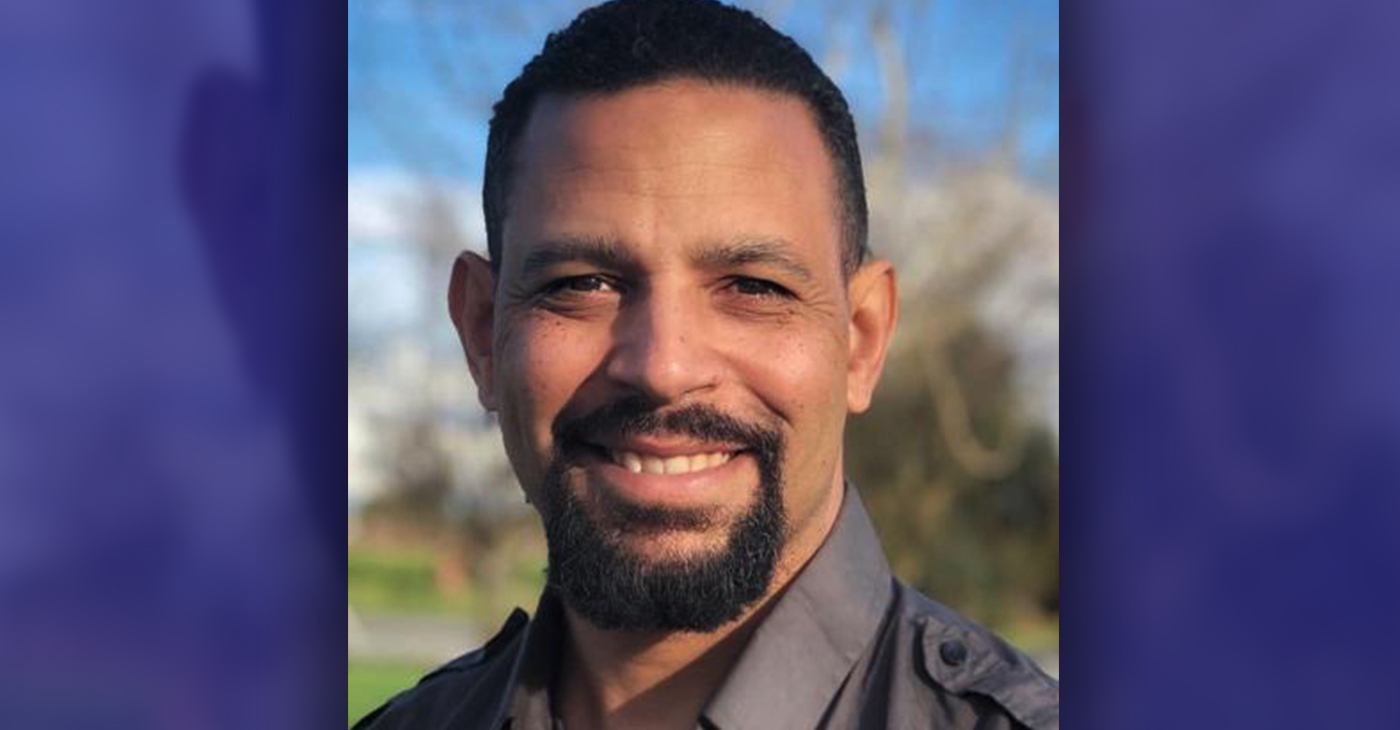
By Craig DeLuz, Special to California Black Media Partners
In the wake of the horrific mass shooting that took place in Sacramento, California, politicians and media pundits have rushed to their soapboxes to proclaim, once again, that guns are the root of all evil and the cause of the recent violent crime wave that has gripped our nation. They share with whoever will listen their prognosis for ending crime as we know it.
“We need more ‘common sense’ gun laws,” they say.
But there are a number of underlying truths that they will dare not share with the public. Because if they do, it will become clear that they and their policies are not the solution. They are, in fact, the root of the problem.
Here are just a few of those truths they will not dare share:

We do not have a gun violence problem. We have a violence problem.
Guns have been a part of the American lexicon since the very beginning. For generations, society had a healthy relationship with the Second Amendment. Firearms were given their proper respect as tools to be used to feed one’s family, defend one’s home or fight for one’s liberty.
It is only recent generations that have concluded that violence is an acceptable way to address the myriad issues confronting them. The firearm is not the cause of this. In fact, it is not even the weapon of choice.
While it is true that 77% of homicides in 2020 were committed with firearms, 92% of all violent crimes do not involve firearms. The overwhelming majority of violent offenses — including robberies, rapes and other sex crimes — almost always involve other weapons or no weapons at all. And there is no doubt that the number of instances of all these offenses are increasing.
Guns are no more the cause of this violence than cars are the cause of drunk driving.
Gun control does nothing to reduce crime in general, let alone violent crime.
There is a popular saying amongst statisticians, “There are lies, damn lies and then there are statistics.” Politicians and the media have been using all three to push their false narrative about gun control laws. They would have you believe that studies support the idea that the best way to reduce violent crime is to pass more gun laws. But nothing could be further from the truth.
A 2020 study done as a part of the RAND Corporation’s Gun Policy in America initiative, revealed that of the 27,900 research publications on the effectiveness of gun control laws, only 123 (0.4%) were found to meet a base level of academic rigor. They also noted that the only reliable conclusion one could get from those 123 studies was that there is zero evidence that gun control laws have any effect on violence in general or gun violence specifically.
The recent increase in violent crime is directly linked to “Smart on Crime” (read soft-on-crime) policies
Violent crime was at an all-time high in the early 1990s fueled by gangs and the drug trade. This led to federal, state and local initiatives aimed at stemming the tide. Tough-on-crime initiatives were enacted that included, among other things, increased policing and mandatory minimums for a number of crimes.
Crime (especially violent crime) would go on the decline for the next 20-plus years.
Then in the 2010s, several states began instituting “Smart on Crime” policies that decriminalized a number of criminal offenses and let violent criminals out of prison. That wasn’t the intention of those who supported these policies. But that is, in fact, what happened.
Case in point: Back in 2018 Smiley Martin was sentenced to 10 years in prison for punching a girlfriend, dragging her from her home by her hair and whipping her with a belt.
But, sadly, under California law, these are considered non-violent offenses, making Mr. Martin eligible for a reduced sentence under Proposition 57. So, instead of sitting in a jail cell serving the fifth year of a 10-year sentence, he was walking the streets of Sacramento with a modified automatic pistol.
This story is not the first. It is not even unique to Sacramento. Just a month earlier, three children and their chaperone were killed by their father who should have been in ICE custody. But under California’s Sanctuary State policy, David Mora Rojas, who was locked up for assaulting a highway patrol officer was released from police custody, was free to kill his children.
While the media and politicians deny the correlation and instead seek to blame guns; the increase in crime, especially violent crime, directly corresponds with the change in our criminal justice policies.
This is about race. But not in the way you think it is.
Gun control has always been about keeping “Those People” from being able to own firearms. Following the Civil War, Southern states enacted ‘Black Codes’ making it illegal for newly freed slaves to own guns. In the 1870s, California would pass laws preventing the sale of firearms and ammunition to Native Americans (then referred to as Indians.) In the 1920s, California acted again, prohibiting the sale of firearms to the “Chinese” or “Mexicans.” Then in the 1960s, California would pass the Mulford Act, eliminating the ability to openly carry loaded firearms in public as a way to disarm the Black Panther Party.
The truth is that the gun debate has always been rooted in racism. However, those who push these policies are the true victimizers.
Consider that the last gun case to be heard by the U. S. Supreme Court (McDonald v. Chicago) was brought by a Black man who simply wanted to be able to defend his home from the ravages of gang and drug violence. This underscores two very important, yet often overlooked truths:
- Policies that release habitual criminals into our neighborhoods lead to the victimization of people in those communities. These policies disproportionately impact people of color.
- Gun Control Laws only serve to restrict the ability of law-abiding citizens to own or possess firearms they may need to protect themselves and their loved ones. These laws also disproportionately affect people of color.
We are often told that young Black and Brown men are disproportionately impacted by gun violence. But it is rarely noted that young Black and Brown men are disproportionately the ones pulling the trigger. The sad fact is that people who seek to victimize others (Black, White, Latin, Asian, etc.) tend to go after people who look like them.
So, while it is noble to try and reduce the number of young Black men in our criminal justice system, we cannot ignore that in doing so, we have put Black men, women and children at risk of being their victims.
At the same time, we are limiting the ability of these very same folks to be able to defend themselves from the very danger we have put in their path.
To any objective observer, these truths are self-evident. Most of the media and political elite have proven themselves to be anything but objective observers. If we are to ever address the scourge of violence in our streets, it will only happen when we all come to grips with these and many other truths.
Craig DeLuz is president of 2ANews Corporation and hosts a daily news and political talk show “The Rundown.”





Activism
Oakland Post: Week of September 30 – October 6, 2026
The printed Weekly Edition of the Oakland Post: Week of September 30 – October 6, 2026
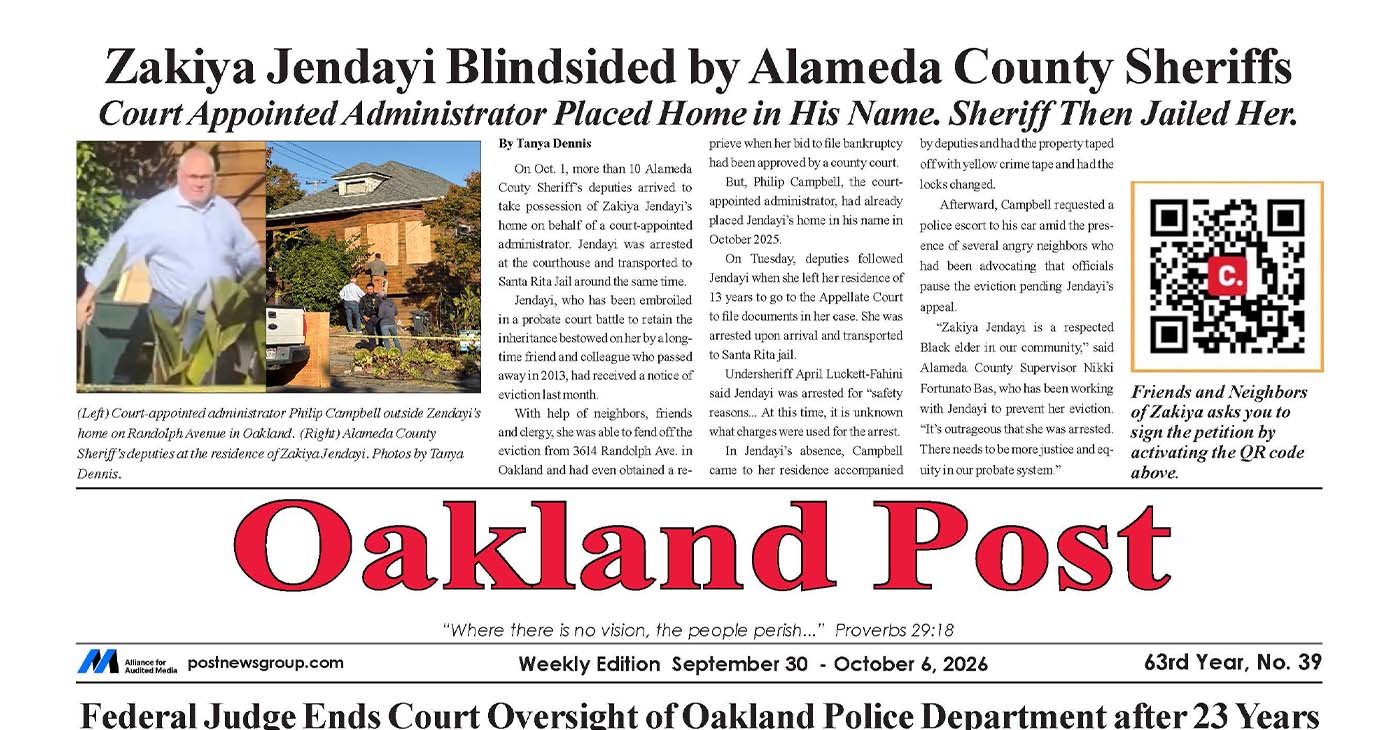
To enlarge your view of this issue, use the slider, magnifying glass icon or full page icon in the lower right corner of the browser window.
Activism
Oakland Post: Week of September 23 – 29, 2026
The printed Weekly Edition of the Oakland Post: Week of September 23 – 29, 2026

To enlarge your view of this issue, use the slider, magnifying glass icon or full page icon in the lower right corner of the browser window.
Activism
Oakland Post: Week of September 16 – 22, 2026
The printed Weekly Edition of the Oakland Post: Week of September 16 – 22, 2026

To enlarge your view of this issue, use the slider, magnifying glass icon or full page icon in the lower right corner of the browser window.



Listening as a Lifeline: A Doula’s Witness to Black Maternal Health

New Protections for Ticket Buyers: Gov. Newsom Signs Assemblymember Isaac Bryan’s Bill

‘We Don’t Talk Trash — We Pick Up Trash!’

Zakiya Jendayi Arrested, Locked Out of Home by Sheriff’s Deputies

Oakland Post: Week of September 30 – October 6, 2026

Asm. Corey Jackson Announces Launch of 24-Hour Childcare in His District

IN MEMORIAM: The Rev. Leon “Sonny” Clark, Longtime Orange County Pastor and Community Leader, Dies at 72

Poll: Becerra Widens His Lead Over Hilton; Californians Split on Wealth Tax

From Historic Memories to New Possibilities: Oakland Celebrates Coliseum 60

County Office of Education Says OUSD Finances Are Getting Healthier, Materially Stronger

LIVE FREE Sunday Dinner Brings Faith, Fellowship and Civic Conversation to Oakland

Remembering Chauncey Bailey as Student Journalists Face Threats to Truth-Telling

BLACspace Cooperative Invites Bay Area to Experience Oakland’s Black Cultural Ecosystem Through a BLAC Map Tour + Party

In Wake of Death on Doorstep, Williams Chapel Baptist Church Calls for Better Care, Funding for Unhoused

Oakland Centenarian Nuna McKee Honored!

Standoff for Justice: Our Homes Are Worth Fighting For

Oakland Post: Week of August 26 – September 1, 2026

Frontier Airlines’ Return to Oakland Airport Brings Flights, Jobs and Opportunity

Gubernatorial Candidate Steve Hilton Blasts California New Tire Rules; Newsom Hits Back

Chef Sharon Lee Blends Culinary Excellence, Education and Empowerment

Jackie Wright Champions Bay Area Stories, Filmmakers and Cultural Institutions

Misnamed ‘Parent’ PAC Seeks to Influence Oakland School Board Elections

Oakland Coliseum Project Opens Door for Small Businesses to Build Bigger

Big City Mayors Ask for “Yes” Vote on Housing Bond Measure; Conservatives Say “No”

Gov. Newsom’s Latest Appointees Include Sacramento Advocate for Formerly Incarcerated Students; State’s New Tech Chief

Longtime BWOPA Member Brendalyn Goodall Appointed to California Workforce Development Board

Gov. Newsom Signs Law Shielding Immigration Aid Workers From Doxing Threats

Secretary of State Shirley N. Weber Urges Californians to Vote Early as Voter ID Battle Intensifies

Oakland Post: Week of September 2 – 8, 2026

IN MEMORIAM: Dolly Parton Dead at 80 — How She Built a Legacy of Love and Earned Her Place in Black Culture

The Conversation With Al McFarlane 6/23/26

Media Monday 6/22/26

LIVE! ASK ALMA! — TUES. 6.23.26 7PM EST

Car Buying Secrets: 4 Hidden Checks Before You Sign!

Is This 550 HP Charger Worth YOUR Money? AutoNetwork Review

Celebrating Juneteenth – Frederick Douglass on education and resistance

LIVE! — ASK ALMA! — TUES. 6.19.26 7PM EST

Hyundai Ioniq 5 Parking, Safety, and 360 View #shorts

2025 Ioniq 5 New Wiper & Powerful Performance! #shorts

Electric SUV Range: Is 259 Miles Enough? #shorts

EV Charging: How Fast Can You Charge an Electric Vehicle? #shorts

Biometric Cooling… Messaging Seats…Come on! 2025 Infiniti QX80 Autograph 4WD

Charged Up: Witness the Magic of a Fully Electric Car! #shorts

Range Rover Sport PHEV Included…: See What’s Inside This Luxury SUV! #shorts

Invisible Hood View: Perfect Parking with X-Ray Vision! #shorts
-
 Community3 weeks ago
Misnamed ‘Parent’ PAC Seeks to Influence Oakland School Board Elections
-
 Activism4 weeks ago
Oakland Post: Week of September 2 – 8, 2026
-

 Community3 weeks ago
Richmond Tiny House Village Farm & Garden Set to Open Gates on Sept. 26
-

 Activism3 weeks ago
Oakland Post: Week of September 9 – 15, 2026
-

 Black History3 weeks ago
Latest Massacre in Haiti Reveals Cruelty U.S. Deportations
-

 Black History3 weeks ago
OPINION: Nolan Wells’ Death One of Several Signifying Racial Terror Lives on in U.S. South
-

 Business2 weeks ago
Mayor Lee Announces $1 Million Kaiser Permanente Grant for Pilot Program to Address Homelessness, Clean Up Public Spaces throughout Oakland
-

 Community3 weeks ago
Democratic Clubs Interview Candidates for Oakland School Board
