
Activism
California Reparations Task Force Elects Leadership
The newly elected leaders represent an inter-generational team, bridging the millennial and baby boomer generations, which are known for their often-conflicting worldviews.

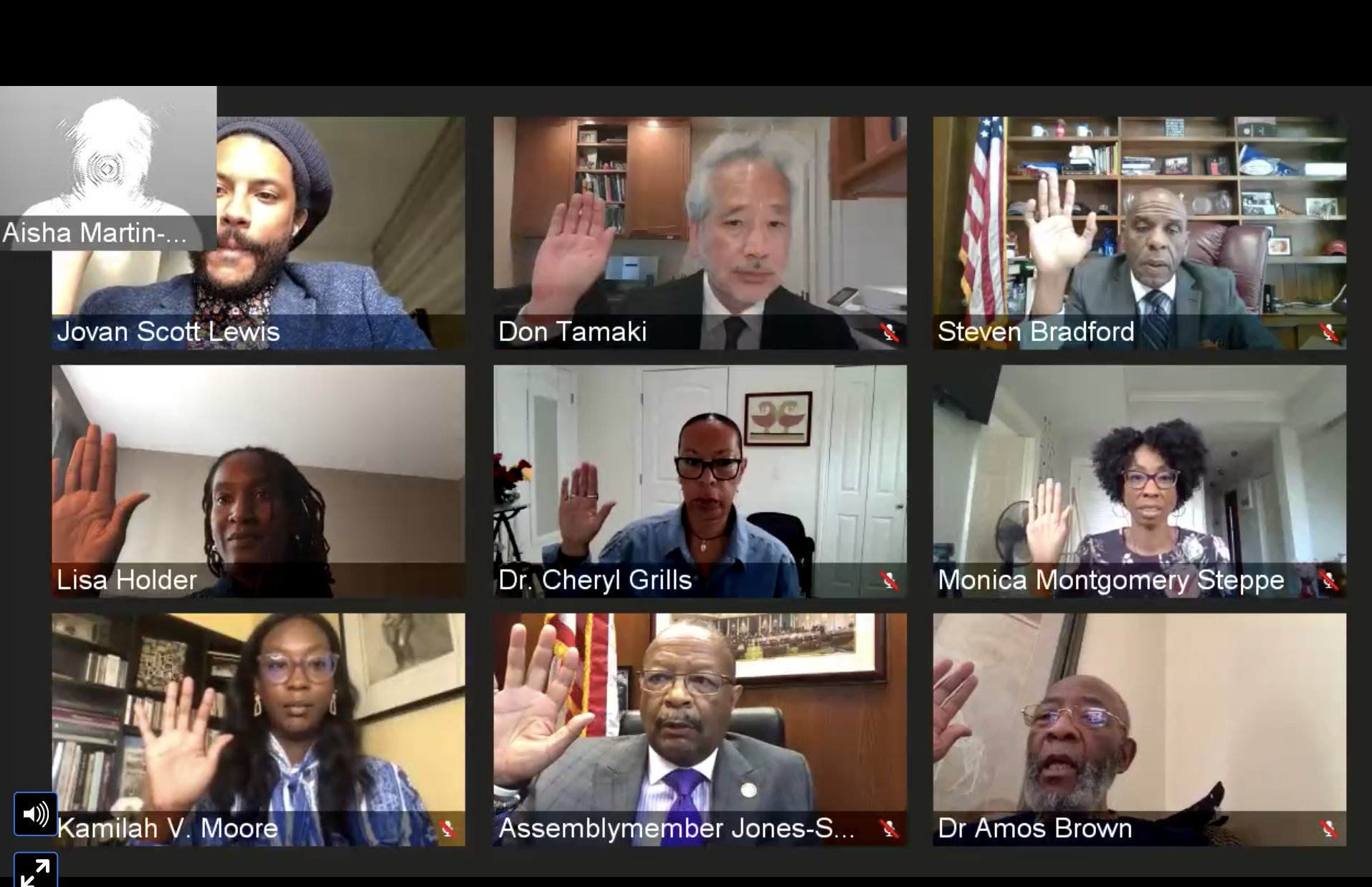
The California Task Force to Study and Develop Reparation Proposals for African Americans hosted its first public meeting June 1.
The virtual gathering marked the official launch of the first-in-the-nation initiative organized to investigate how a state engaged in and benefitted from slavery, and how it practiced or condoned racial discrimination, excluding African Americans from economic and other opportunities.
During the meeting that lasted over four hours, the nine-member task force elected Kamilah V. Moore, a Los Angeles-based activist and attorney, as its chair. The group also elected Rev. Dr. Amos Brown, pastor of Third Baptist Church in San Francisco and president of the San Francisco NAACP branch, as vice chair.
The newly elected leaders represent an inter-generational team, bridging the millennial and baby boomer generations, which are known for their often-conflicting worldviews.
Moore, who passed the California bar examination in January, intends to use her studies in domestic and international human rights to provide perspective on, “how the recommendations comport with international standards of remedy for wrongful injuries caused by the state, that includes all reparations and special members measures as understood by various international protocols laws and findings,” she said.
In her term as chairperson, Moore says she will provide expertise on, “how the state of California will offer a formal apology on behalf of the people of California for the perpetuation of gross human rights violations and crimes against humanity against Black Americans who descend from chattel slavery in the United States.”
A history buff and student of Dr. Martin Luther King, Jr., civil rights veteran Brown has dedicated more than six decades of his life to fighting for racial justice and equality.
“I’m concerned about our people and making sure that we stay on point in terms of delivering the sons and daughters of Africa what belongs to them,” said Brown.
The task force will be collaborating with the California Department of Justice to conduct research and provide recommendations for compensation based on the requirements of Assembly Bill 3121, the legislation that paved the way to set up the task force.
The reparations task force will work with renowned researchers and scholars to both quantify and qualify the damage slavery had on African Americans in California. The collaborators will conduct extensive research to examine the economic, educational, and social injustices suffered by descendants of enslaved Black people in the United States.
Kirsten Mullen and William A. Darity, Jr., co-authors of the book, “From Here to Equality: Reparations for Black Americans in the 21st Century,” will provide general guidance for ways the state needs to implement reparations.
History professor Stacy Smith will offer expertise on the impact of slavery specific to California and how racial injustices affected the descendants of enslaved Africans.
Loyola Marymount University African Studies professor Marne Campbell will lead a research team that includes students to compile a report on various federal and state laws, regulations, policies, and practices that discriminate against African Americans.
“We must be aggressive in our efforts, be honest and direct, and figure out what we need to do in California, and be an example to the rest of the nation,” said California Secretary of State Shirley Weber, who authored the bill when she was an assembly member representing the 79th District in the San Diego area.
Weber said that the inaugural meeting is a historic moment that is 400 years overdue for African Americans.
“It’s time for folks to acknowledge the harm that’s been done, the harm that continues to be done,” said Weber.
“We are here today because the racism of slavery birthed an unjust system and a legacy of racial harm and inequality that continues today in every aspect of our lives,” she said.
“We are here today not just to seek an answer to say, ‘Was there harm?’ But your task is to determine the depth of the harm, and the ways in which we are to repair that harm,” Weber said to the task force.
Besides Brown and Moore, other task force members are state Sen. Steven Bradford (D-Gardena); Assemblymember Reggie Jones-Sawyer (D-Gardena); Cheryl Grills, a clinical psychologist; Lisa Holder, a racial and social justice attorney; Jovan Lewis, a social scientist who focuses on racial and economic disparities; Monica Montgomery Steppe, a San Diego city councilmember; and Donald Tamaki, an attorney who worked on the landmark case that won reparations for Japanese internment camp victims.
The task force is scheduled to host a follow-up public meeting in July to finalize the scope of their study — and how they will move the reparations conversation forward in California.












Activism
Oakland Post: Week of September 23 – 29, 2026
The printed Weekly Edition of the Oakland Post: Week of September 23 – 29, 2026


To enlarge your view of this issue, use the slider, magnifying glass icon or full page icon in the lower right corner of the browser window.

Activism
Oakland Post: Week of September 16 – 22, 2026
The printed Weekly Edition of the Oakland Post: Week of September 16 – 22, 2026

To enlarge your view of this issue, use the slider, magnifying glass icon or full page icon in the lower right corner of the browser window.
Activism
Oakland Post: Week of September 9 – 15, 2026
The printed Weekly Edition of the Oakland Post: Week of September 9 – 15, 2026

To enlarge your view of this issue, use the slider, magnifying glass icon or full page icon in the lower right corner of the browser window.



Asm. Corey Jackson Announces Launch of 24-Hour Childcare in His District

IN MEMORIAM: The Rev. Leon “Sonny” Clark, Longtime Orange County Pastor and Community Leader, Dies at 72

Poll: Becerra Widens His Lead Over Hilton; Californians Split on Wealth Tax

From Historic Memories to New Possibilities: Oakland Celebrates Coliseum 60

County Office of Education Says OUSD Finances Are Getting Healthier, Materially Stronger

LIVE FREE Sunday Dinner Brings Faith, Fellowship and Civic Conversation to Oakland

Remembering Chauncey Bailey as Student Journalists Face Threats to Truth-Telling

BLACspace Cooperative Invites Bay Area to Experience Oakland’s Black Cultural Ecosystem Through a BLAC Map Tour + Party

In Wake of Death on Doorstep, Williams Chapel Baptist Church Calls for Better Care, Funding for Unhoused

Oakland Centenarian Nuna McKee Honored!

Caribbean Nations Produce Action Plan Calling for UK Reparations Over Slavery

Oakland Post: Week of September 23 – 29, 2026

Doulas Are Helping Black California Moms Navigate Pregnancy–Even as High Mortality Rates Persist

Newsom Signs Addictive Social Media Law to Protect Kids

On Your November Ballot: Prop 38 Would Allocate $8.4 Billion to Immunology and Immunotherapy Funding

Standoff for Justice: Our Homes Are Worth Fighting For

Oakland Post: Week of August 26 – September 1, 2026

Frontier Airlines’ Return to Oakland Airport Brings Flights, Jobs and Opportunity

Gubernatorial Candidate Steve Hilton Blasts California New Tire Rules; Newsom Hits Back

Chef Sharon Lee Blends Culinary Excellence, Education and Empowerment

Jackie Wright Champions Bay Area Stories, Filmmakers and Cultural Institutions

Big City Mayors Ask for “Yes” Vote on Housing Bond Measure; Conservatives Say “No”

Oakland Coliseum Project Opens Door for Small Businesses to Build Bigger

Gov. Newsom’s Latest Appointees Include Sacramento Advocate for Formerly Incarcerated Students; State’s New Tech Chief

Misnamed ‘Parent’ PAC Seeks to Influence Oakland School Board Elections

Longtime BWOPA Member Brendalyn Goodall Appointed to California Workforce Development Board

Gov. Newsom Signs Law Shielding Immigration Aid Workers From Doxing Threats

Secretary of State Shirley N. Weber Urges Californians to Vote Early as Voter ID Battle Intensifies

From Palestine to Oakland: Seeds for Liberation Examines Shared Struggles for Freedom

IN MEMORIAM: Dolly Parton Dead at 80 — How She Built a Legacy of Love and Earned Her Place in Black Culture

The Conversation With Al McFarlane 6/23/26

Media Monday 6/22/26

LIVE! ASK ALMA! — TUES. 6.23.26 7PM EST

Car Buying Secrets: 4 Hidden Checks Before You Sign!

Is This 550 HP Charger Worth YOUR Money? AutoNetwork Review

Celebrating Juneteenth – Frederick Douglass on education and resistance

LIVE! — ASK ALMA! — TUES. 6.19.26 7PM EST

Hyundai Ioniq 5 Parking, Safety, and 360 View #shorts

2025 Ioniq 5 New Wiper & Powerful Performance! #shorts

Electric SUV Range: Is 259 Miles Enough? #shorts

EV Charging: How Fast Can You Charge an Electric Vehicle? #shorts

Biometric Cooling… Messaging Seats…Come on! 2025 Infiniti QX80 Autograph 4WD

Charged Up: Witness the Magic of a Fully Electric Car! #shorts

Range Rover Sport PHEV Included…: See What’s Inside This Luxury SUV! #shorts

Invisible Hood View: Perfect Parking with X-Ray Vision! #shorts
-
 Community2 weeks ago
Misnamed ‘Parent’ PAC Seeks to Influence Oakland School Board Elections
-

 Activism3 weeks ago
Oakland Post: Week of September 2 – 8, 2026
-

 Community2 weeks ago
Richmond Tiny House Village Farm & Garden Set to Open Gates on Sept. 26
-

 Activism2 weeks ago
Oakland Post: Week of September 9 – 15, 2026
-

 Black History2 weeks ago
Latest Massacre in Haiti Reveals Cruelty U.S. Deportations
-

 Black History2 weeks ago
OPINION: Nolan Wells’ Death One of Several Signifying Racial Terror Lives on in U.S. South
-

 Community2 weeks ago
Democratic Clubs Interview Candidates for Oakland School Board
-
 Featured2 weeks ago
‘Ready to See These Bills Become Law’: Sen. Weber’s Package of 15 Bills Advance to Gov. Newsom’s Desk
