
Activism
San Francisco Proposes Art Installation to Honor Black Lives, History of African Americans
The sculptural figures created in all-black steel with vinyl tubing, each standing four feet high, would surround the empty pedestal where a statue of Francis Scott Key once stood. Key, who wrote the lyrics to “The Star-Spangled Banner,” was a slave owner and abolition opponent.

San Francisco, CA. – Mayor London N. Breed today announced the City of San Francisco is planning a new public art installation to honor Black lives and the history of African Americans. The installation is planned to be located in Golden Gate Park’s Music Concourse next month, in time for Juneteenth.

The installation, ‘Monumental Reckoning,’ by Bay Area sculptor Dana King, honors the first Africans stolen from their homeland and sold into chattel slavery in the New World. The installation consists of 350 sculptures representing the number of Africans initially forced onto the slave ship San Juan Bautista for a journey of death and suffering across the Atlantic in 1619. A handful of these original 350 ancestors became America’s first enslaved people.
The sculptural figures created in all-black steel with vinyl tubing, each standing four feet high, would surround the empty pedestal where a statue of Francis Scott Key once stood. Key, who wrote the lyrics to “The Star-Spangled Banner,” was a slave owner and abolition opponent. Protestors toppled the statue on Juneteenth 2020.
“The art and monuments that we choose to display in our city and the civic art that fills our public spaces must reflect the diversity of our community, and honor our history,” said Breed. “This powerful public art installation in Golden Gate Park will help us not only commemorate Juneteenth, but also serve as an example of how we can honor our past, no matter how painful, and reflect on the challenges that are still with us today.”
Monumental Reckoning would allow visitors to commune with the figures. The phrase “Lift Every Voice” would shine from atop the nearby Spreckels Temple of Music through a second, connected piece by Illuminate the Arts. These are the first three words of “Lift Every Voice and Sing”, a song written by civil rights champion James Weldon Johnson which was first performed in 1900—the same year the Spreckels Temple of Music opened.
For more than a century, Johnson’s song of unity has been sung as the Black national anthem. U.S. Representative James Clyburn is currently leading an effort to have the song named America’s national hymn.
“I’m excited to see the new monument go up in Golden Gate Park to honor Black lives and the rich history of African Americans,” said Board of Supervisors President Shamann Walton. “I think this is a perfect example of trying to right a wrong. Rather than uplifting individuals with oppressive histories, this is an opportunity to honor diversity and our community through public art.”
The installation was approved by both the San Francisco Arts Commission and the San Francisco Recreation and Park Commission’s Operations Committee this week. It is currently under review by the Planning Commission. “Lift Every Voice” will also need to be approved by the City’s Historical Preservation Committee before it can be installed. If approved, Monumental Reckoning would open to the public on June 19, or Juneteenth 2021, which commemorates the end of slavery in the U.S. The art piece would remain in place through June 20, 2023.
“The memory of African descendants deserves to be told truthfully and publicly,” said King, Monumental Reckoning’s creator. “Monumental Reckoning fulfills both objectives with the installation of 350 ‘ancestors’ who will encircle the Francis Scott Key plinth in Golden Gate Park. The ancestors stand in judgement, holding history accountable to the terror inflicted on the first group of enslaved people brought here in 1619 to the last person sold to another, all victims of chattel slavery. Even though the business of enslavement ended long ago, it still resonates generationally for African Americans and forms the bedrock from which systems of oppression proliferate today.”
Fundraising, community outreach, and ongoing support for the installation is being provided by the Museum of the African Diaspora. Creative and programming support would be provided by The Black Woman is God, which is an annual group exhibition of Black women artists curated by Karen Seneferu and Melorra Green. The project celebrates Black women as essential to building a more just society and sustainable future and reclaims space historically denied to Black women artists.
“What Dana King’s powerful installation communicates and commemorates is a sober cultural gut-punch long overdue, and I hope it’s the beginning of many such visual testaments in the public realm that venerate the origin stories of our most marginalized and disenfranchised populations,” said Ralph Remington, San Francisco’s Director of Cultural Affairs. “We almost never see images of Black people represented in our public monuments, or in the American telling of history. So, it’s no surprise that in a society rooted in white supremacy, people of color remain invisible and undervalued in our mythology, symbols, architecture and national narrative. While the City examines the historic works in our Civic Art Collection and the future of monuments in San Francisco, this installation will help build and advance a discourse about who and what we venerate in our open spaces.”
“We are incredibly proud to host this powerful piece,” said San Francisco Recreation and Park Department General Manager Phil Ginsburg. “Monumental Reckoning prompts frank discussion about the legacy of slavery, while charting a course between past, present and future. We are grateful to have these crucial conversations in Golden Gate Park—a beloved public space that belongs to everyone.”
This story was produced by the San Francisco Mayor’s office.











Activism
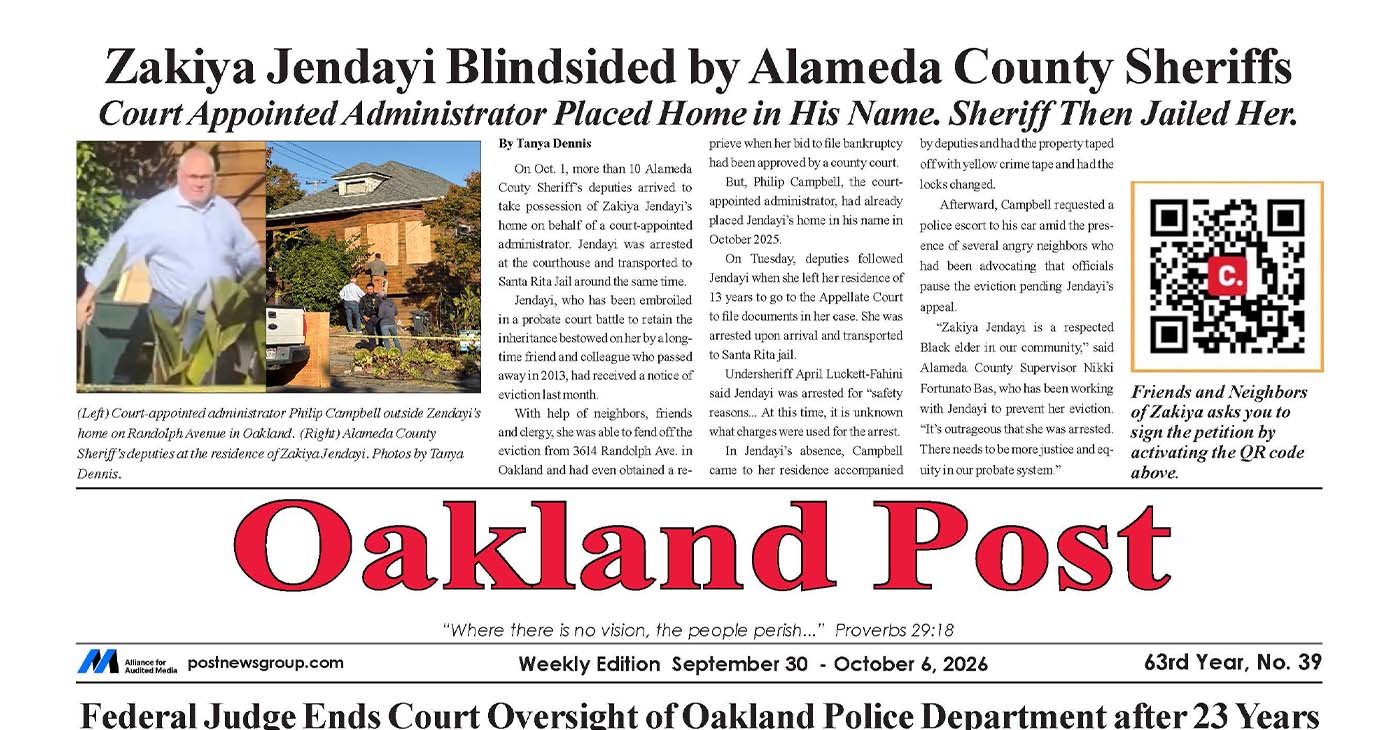
Oakland Post: Week of September 30 – October 6, 2026
The printed Weekly Edition of the Oakland Post: Week of September 30 – October 6, 2026

To enlarge your view of this issue, use the slider, magnifying glass icon or full page icon in the lower right corner of the browser window.

Activism
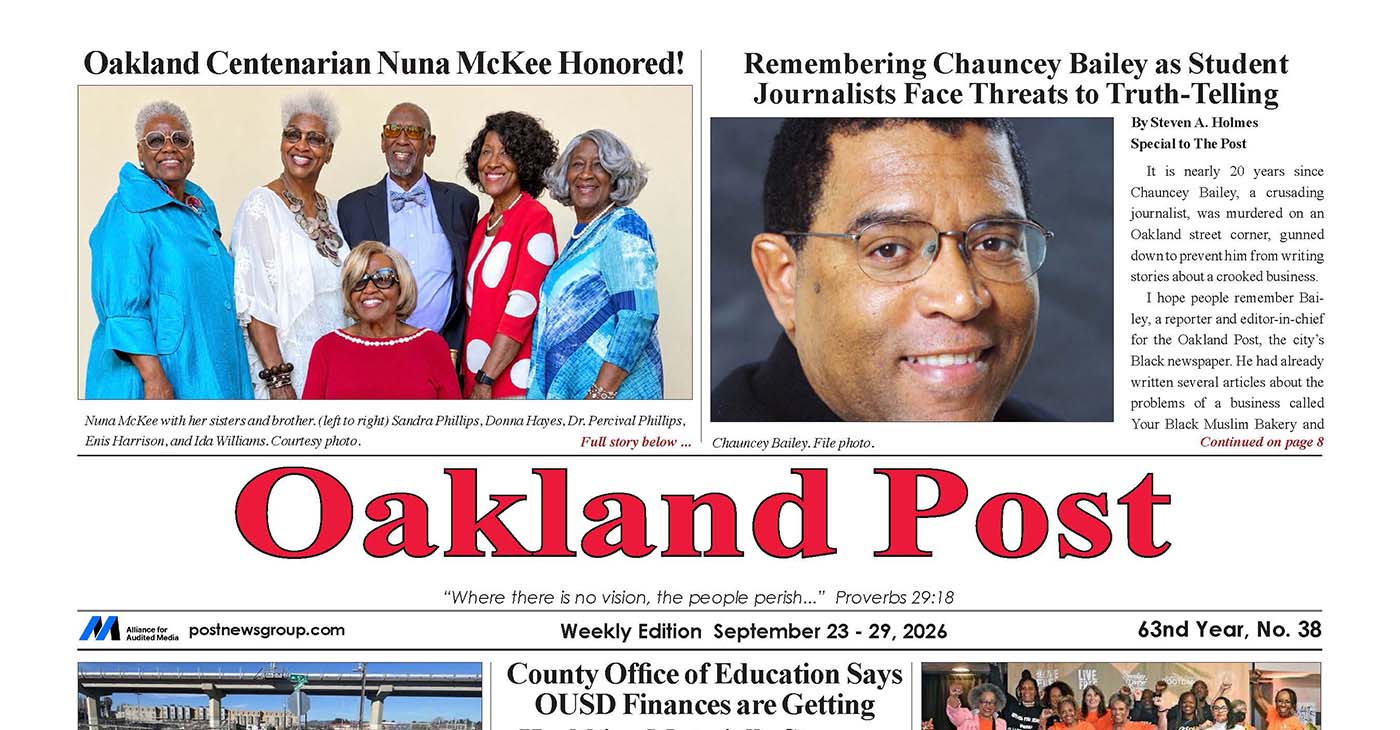
Oakland Post: Week of September 23 – 29, 2026
The printed Weekly Edition of the Oakland Post: Week of September 23 – 29, 2026
To enlarge your view of this issue, use the slider, magnifying glass icon or full page icon in the lower right corner of the browser window.
Activism
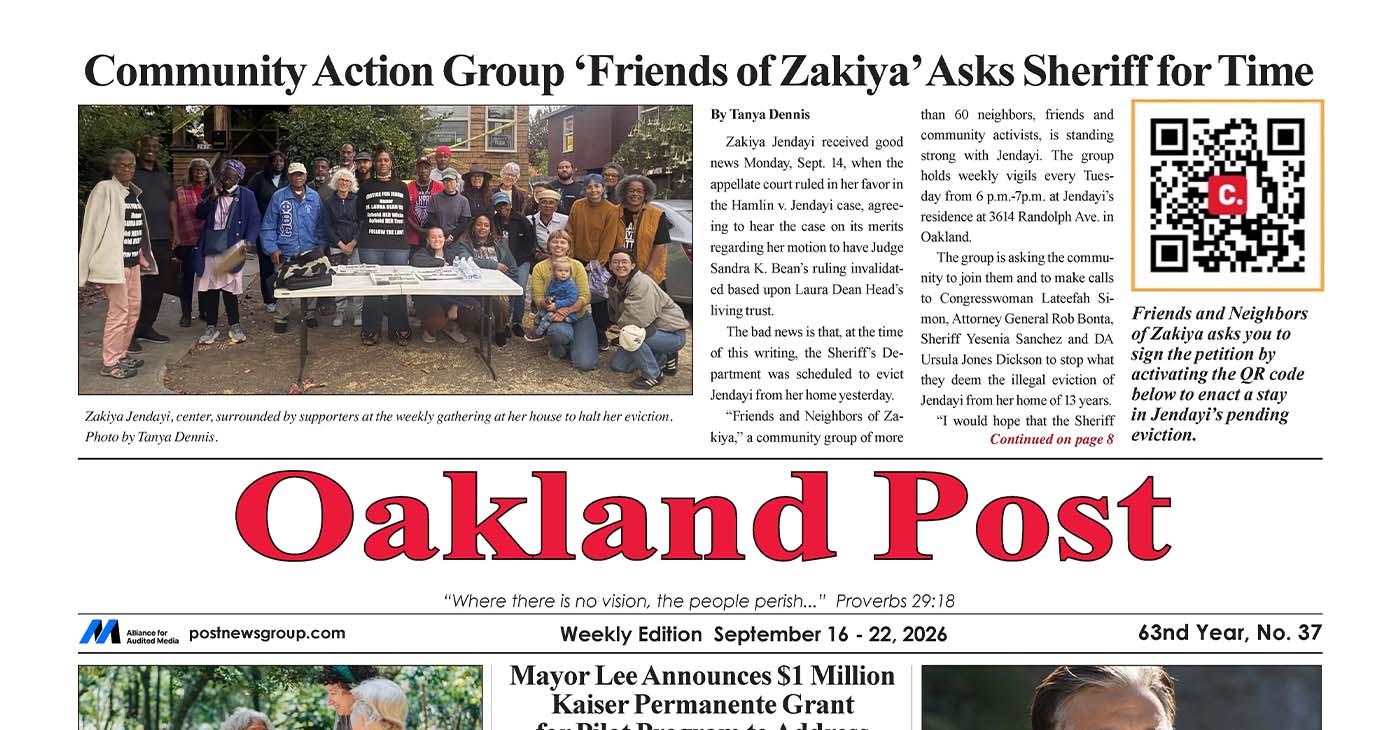
Oakland Post: Week of September 16 – 22, 2026
The printed Weekly Edition of the Oakland Post: Week of September 16 – 22, 2026
To enlarge your view of this issue, use the slider, magnifying glass icon or full page icon in the lower right corner of the browser window.


OP-ED: Proposition 44 Would Put a Price on Trust

OP-ED: Proposition 40: It’s Time to Play Chess, Not Checkers

Listening as a Lifeline: A Doula’s Witness to Black Maternal Health

New Protections for Ticket Buyers: Gov. Newsom Signs Assemblymember Isaac Bryan’s Bill

‘We Don’t Talk Trash — We Pick Up Trash!’

Zakiya Jendayi Arrested, Locked Out of Home by Sheriff’s Deputies

Oakland Post: Week of September 30 – October 6, 2026

Asm. Corey Jackson Announces Launch of 24-Hour Childcare in His District

IN MEMORIAM: The Rev. Leon “Sonny” Clark, Longtime Orange County Pastor and Community Leader, Dies at 72

Poll: Becerra Widens His Lead Over Hilton; Californians Split on Wealth Tax

From Historic Memories to New Possibilities: Oakland Celebrates Coliseum 60

County Office of Education Says OUSD Finances Are Getting Healthier, Materially Stronger

LIVE FREE Sunday Dinner Brings Faith, Fellowship and Civic Conversation to Oakland

Remembering Chauncey Bailey as Student Journalists Face Threats to Truth-Telling

BLACspace Cooperative Invites Bay Area to Experience Oakland’s Black Cultural Ecosystem Through a BLAC Map Tour + Party

Standoff for Justice: Our Homes Are Worth Fighting For

Oakland Post: Week of August 26 – September 1, 2026

Frontier Airlines’ Return to Oakland Airport Brings Flights, Jobs and Opportunity

Gubernatorial Candidate Steve Hilton Blasts California New Tire Rules; Newsom Hits Back

Chef Sharon Lee Blends Culinary Excellence, Education and Empowerment

Jackie Wright Champions Bay Area Stories, Filmmakers and Cultural Institutions

Misnamed ‘Parent’ PAC Seeks to Influence Oakland School Board Elections

Oakland Coliseum Project Opens Door for Small Businesses to Build Bigger

Big City Mayors Ask for “Yes” Vote on Housing Bond Measure; Conservatives Say “No”

Gov. Newsom’s Latest Appointees Include Sacramento Advocate for Formerly Incarcerated Students; State’s New Tech Chief

Longtime BWOPA Member Brendalyn Goodall Appointed to California Workforce Development Board

Gov. Newsom Signs Law Shielding Immigration Aid Workers From Doxing Threats

Oakland Post: Week of September 2 – 8, 2026

Secretary of State Shirley N. Weber Urges Californians to Vote Early as Voter ID Battle Intensifies

IN MEMORIAM: Dolly Parton Dead at 80 — How She Built a Legacy of Love and Earned Her Place in Black Culture

The Conversation With Al McFarlane 6/23/26

Media Monday 6/22/26

LIVE! ASK ALMA! — TUES. 6.23.26 7PM EST

Car Buying Secrets: 4 Hidden Checks Before You Sign!

Is This 550 HP Charger Worth YOUR Money? AutoNetwork Review

Celebrating Juneteenth – Frederick Douglass on education and resistance

LIVE! — ASK ALMA! — TUES. 6.19.26 7PM EST

Hyundai Ioniq 5 Parking, Safety, and 360 View #shorts

2025 Ioniq 5 New Wiper & Powerful Performance! #shorts

Electric SUV Range: Is 259 Miles Enough? #shorts

EV Charging: How Fast Can You Charge an Electric Vehicle? #shorts

Biometric Cooling… Messaging Seats…Come on! 2025 Infiniti QX80 Autograph 4WD

Charged Up: Witness the Magic of a Fully Electric Car! #shorts

Range Rover Sport PHEV Included…: See What’s Inside This Luxury SUV! #shorts

Invisible Hood View: Perfect Parking with X-Ray Vision! #shorts
-
 Community3 weeks ago
Misnamed ‘Parent’ PAC Seeks to Influence Oakland School Board Elections
-

 Activism3 weeks ago
Oakland Post: Week of September 9 – 15, 2026
-

 Community3 weeks ago
Richmond Tiny House Village Farm & Garden Set to Open Gates on Sept. 26
-

 Black History3 weeks ago
Latest Massacre in Haiti Reveals Cruelty U.S. Deportations
-

 Black History3 weeks ago
OPINION: Nolan Wells’ Death One of Several Signifying Racial Terror Lives on in U.S. South
-

 Business2 weeks ago
Mayor Lee Announces $1 Million Kaiser Permanente Grant for Pilot Program to Address Homelessness, Clean Up Public Spaces throughout Oakland
-

 Community3 weeks ago
Democratic Clubs Interview Candidates for Oakland School Board
-
 Uncategorized3 weeks ago
NBA All-Star Damian Lillard Returns Home for 15th Annual Backpack Giveaway
