
Bay Area
$28.2 Million Grant for Oakland’s ‘Better Neighborhoods, Same Neighbors’ and ‘District 6 Matters’


On June 25th the California Strategic Growth Council voted to fund Oakland’s “Better Neighborhoods, Same Neighborhoods” proposal a grant of $28.2 million.
“Led by the community for the community, the . . . proposal envisions an East Oakland with healthy surroundings, safe and accessible transportation and thriving arts and culture that builds community wealth and ensures housing is a human right for existing East Oakland residents,” said Mayor Libby Schaaf.
“Thanks to the ambitious vision and leadership of East Oakland stakeholders and the generous support of the Strategic Growth Council, these projects provide an opportunity to harness the leadership and civic power that we’ve particularly seen displayed in the past few weeks, lift up those voices that have been stifled by historic and structural racism and enact lasting transformation. . .”
The community organizations will be directly funded. There are five projects in the “Better Neighborhoods, Same Neighbors” proposal:
1. 95th and International Housing, Health and Connectivity
This project is led by the Related Companies of California and Acts Community Development Corporation and will yield 55 units of affordable housing with 25% earmarked for the homeless and includes a community health clinic on-site.
2. San Leandro Creek Urban Greenway
A 1.2 mile trail connecting to the regional Martin Luther King, Jr. Shoreline Park.
3. Community Greening
Two thousand trees planted, some sourced from the Planting Justice nursery. Oakland Parks and Recreation Foundation will partner with community organizations to provide training and paid internships for the tree planting.
4. Planting Justice Aquaponics Farm and Food Hub
Three-acre nursery will have the “largest/most productive urban aquaponics farm in the U.S.” as well as 27 living-wage jobs, a food hub, and have youth education, health/wellness, community development, and business incubation programming.
5. Higher Ground & Scraper Bike Team Bike Share and Youth Development
Bike safety and repair, and afterschool enrichment classes to youth. The Oakland Public Library and Oakland Public Works partner on “The Shed” at Martin Luther King, Jr. Branch Library.
The proposal builds on the work of East Oakland Neighborhood Initiative (EONI) which focuses on six neighborhoods: Melrose, Highland/Elmhurst, Sobrante Park, Brookfield Village/Columbia Gardens, Stonehurst, Coliseum/Rusdale/Lockwood/Havenscourt.
“Today, residents bring a wide range of backgrounds, skill sets and values creating a community poised and ready to restore [East Oakland] back to a place of peace and beauty. We have awakened, working together in an organized way ensuring revitalization for a healthier, safer, greener place to proudly call COMMUNITY!” said Resident Cynthia Arrington.
‘District 6 Matters’ from the Office of Councilmember Loren Taylor
Oakland 2020-2021 mid-cycle budget amendments were passed in partnership with the Council’s Equity Caucus which includes Councilmember Loren Taylor, Lynette Gibson-McElhaney, Larry Reid and Noel Gallo.
The budget amendments will deliver:
1. Improved educational outcomes
$7.7 million to build a public Wi-Fi network to bridge the digital divide and give Oakland youth access to the internet.
2. Wildfire prevention funding
3. Increased economic opportunities
$6 million to support small businesses in Oakland
$2 million for low-income areas in the flatlands of Dist. 6
$1 million for technical assistance for small businesses through organizations like the “Multicultural Chambers of Commerce” and the “East Oakland Entrepreneurship Forum”.
4. Greater Income security
$1 million for workforce development programs to 100 Oaklanders for new careers.
5. Evictions and Displacement prevention
$7 million for residential rent and mortgage relief to avoid displacement during COVID-19
6. Beautification and blight reduction
$500,000 to remove abandoned vehicles and illegal dumping
7. Transformed public safety system
Divested $14 million from the Oakland Police Dept., invested $1.3 million for standing up MACRO, an alternative to police response, for 911 calls related to mental health.
Added two additional police accountability investigators to “investigate police misconduct and hold police officers accountable.
“As a Black man born and raised in Oakland I am keenly aware of the history of OPD and am committed to transforming policing in this city so that my young Black kids will benefit. I am proud of the Equity Caucus for making $50 million of community investments that we know directly impact public safety. Our budget will keep our residents housed, our businesses open, our children learning, and our communities healthy and beautiful. These are all things that East Oakland needs and will transform lives and life trajectories of all Oaklanders. I strongly support the efforts already underway to stand up The Task Force for Transforming Public Safety that we funded in the Equity Caucus Budget that has a specific goal of reducing OPD’s General Fund allocation by 50%” said Councilmember Loren Taylor.
Councilmember Loren Taylor can be contacted via email at ltaylor@oaklandca.gov.




Activism
Oakland Post: Week of September 30 – October 6, 2026
The printed Weekly Edition of the Oakland Post: Week of September 30 – October 6, 2026

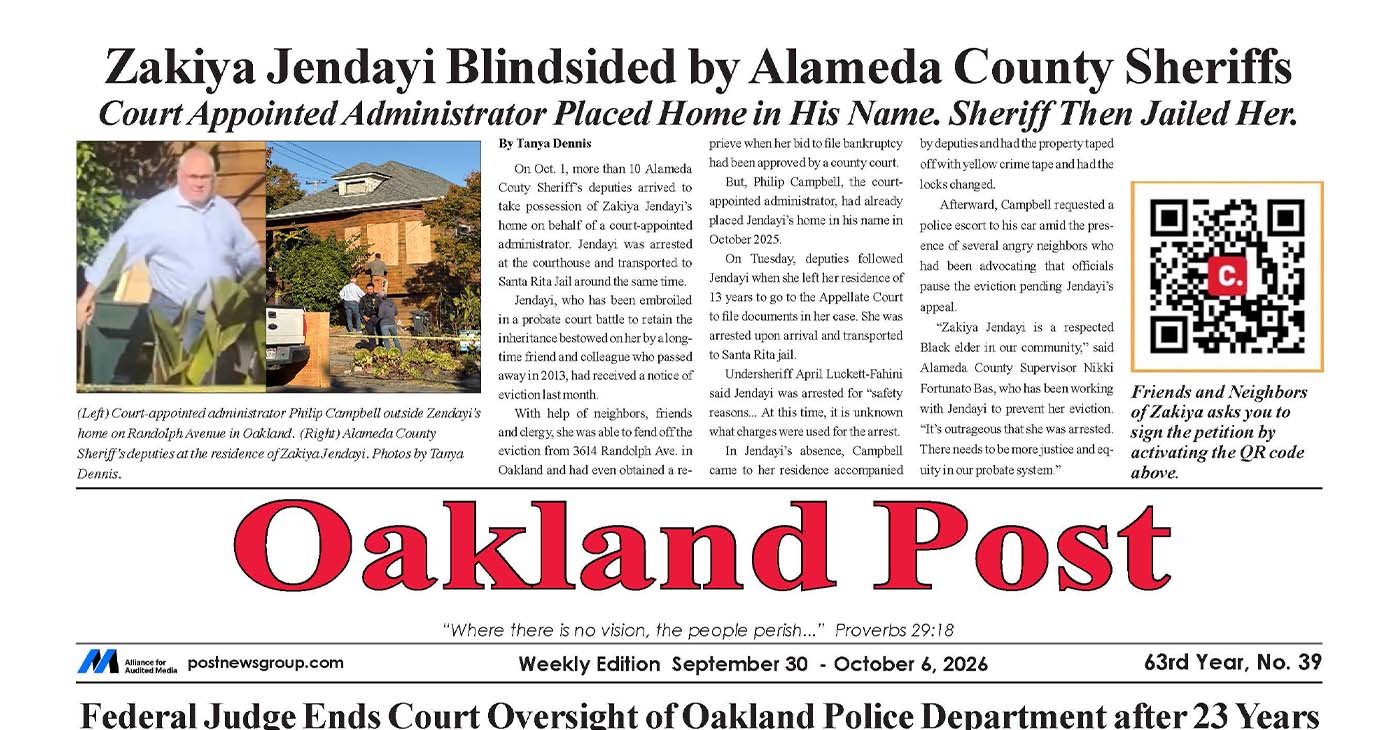
To enlarge your view of this issue, use the slider, magnifying glass icon or full page icon in the lower right corner of the browser window.


Activism
Oakland Post: Week of September 23 – 29, 2026
The printed Weekly Edition of the Oakland Post: Week of September 23 – 29, 2026

To enlarge your view of this issue, use the slider, magnifying glass icon or full page icon in the lower right corner of the browser window.
Activism
Oakland Post: Week of September 16 – 22, 2026
The printed Weekly Edition of the Oakland Post: Week of September 16 – 22, 2026

To enlarge your view of this issue, use the slider, magnifying glass icon or full page icon in the lower right corner of the browser window.


OP-ED: Proposition 44 Would Put a Price on Trust

OP-ED: Proposition 40: It’s Time to Play Chess, Not Checkers

Listening as a Lifeline: A Doula’s Witness to Black Maternal Health

New Protections for Ticket Buyers: Gov. Newsom Signs Assemblymember Isaac Bryan’s Bill

‘We Don’t Talk Trash — We Pick Up Trash!’

Zakiya Jendayi Arrested, Locked Out of Home by Sheriff’s Deputies

Oakland Post: Week of September 30 – October 6, 2026

Asm. Corey Jackson Announces Launch of 24-Hour Childcare in His District

IN MEMORIAM: The Rev. Leon “Sonny” Clark, Longtime Orange County Pastor and Community Leader, Dies at 72

Poll: Becerra Widens His Lead Over Hilton; Californians Split on Wealth Tax

From Historic Memories to New Possibilities: Oakland Celebrates Coliseum 60

County Office of Education Says OUSD Finances Are Getting Healthier, Materially Stronger

LIVE FREE Sunday Dinner Brings Faith, Fellowship and Civic Conversation to Oakland

Remembering Chauncey Bailey as Student Journalists Face Threats to Truth-Telling

BLACspace Cooperative Invites Bay Area to Experience Oakland’s Black Cultural Ecosystem Through a BLAC Map Tour + Party

Standoff for Justice: Our Homes Are Worth Fighting For

Oakland Post: Week of August 26 – September 1, 2026

Frontier Airlines’ Return to Oakland Airport Brings Flights, Jobs and Opportunity

Gubernatorial Candidate Steve Hilton Blasts California New Tire Rules; Newsom Hits Back

Chef Sharon Lee Blends Culinary Excellence, Education and Empowerment

Jackie Wright Champions Bay Area Stories, Filmmakers and Cultural Institutions

Misnamed ‘Parent’ PAC Seeks to Influence Oakland School Board Elections

Oakland Coliseum Project Opens Door for Small Businesses to Build Bigger

Big City Mayors Ask for “Yes” Vote on Housing Bond Measure; Conservatives Say “No”

Gov. Newsom’s Latest Appointees Include Sacramento Advocate for Formerly Incarcerated Students; State’s New Tech Chief

Longtime BWOPA Member Brendalyn Goodall Appointed to California Workforce Development Board

Gov. Newsom Signs Law Shielding Immigration Aid Workers From Doxing Threats

Oakland Post: Week of September 2 – 8, 2026

Secretary of State Shirley N. Weber Urges Californians to Vote Early as Voter ID Battle Intensifies

IN MEMORIAM: Dolly Parton Dead at 80 — How She Built a Legacy of Love and Earned Her Place in Black Culture

The Conversation With Al McFarlane 6/23/26

Media Monday 6/22/26

LIVE! ASK ALMA! — TUES. 6.23.26 7PM EST

Car Buying Secrets: 4 Hidden Checks Before You Sign!

Is This 550 HP Charger Worth YOUR Money? AutoNetwork Review

Celebrating Juneteenth – Frederick Douglass on education and resistance

LIVE! — ASK ALMA! — TUES. 6.19.26 7PM EST

Hyundai Ioniq 5 Parking, Safety, and 360 View #shorts

2025 Ioniq 5 New Wiper & Powerful Performance! #shorts

Electric SUV Range: Is 259 Miles Enough? #shorts

EV Charging: How Fast Can You Charge an Electric Vehicle? #shorts

Biometric Cooling… Messaging Seats…Come on! 2025 Infiniti QX80 Autograph 4WD

Charged Up: Witness the Magic of a Fully Electric Car! #shorts

Range Rover Sport PHEV Included…: See What’s Inside This Luxury SUV! #shorts

Invisible Hood View: Perfect Parking with X-Ray Vision! #shorts
-
 Community3 weeks ago
Misnamed ‘Parent’ PAC Seeks to Influence Oakland School Board Elections
-

 Activism3 weeks ago
Oakland Post: Week of September 9 – 15, 2026
-

 Community3 weeks ago
Richmond Tiny House Village Farm & Garden Set to Open Gates on Sept. 26
-

 Black History3 weeks ago
Latest Massacre in Haiti Reveals Cruelty U.S. Deportations
-

 Black History3 weeks ago
OPINION: Nolan Wells’ Death One of Several Signifying Racial Terror Lives on in U.S. South
-

 Business2 weeks ago
Mayor Lee Announces $1 Million Kaiser Permanente Grant for Pilot Program to Address Homelessness, Clean Up Public Spaces throughout Oakland
-

 Community3 weeks ago
Democratic Clubs Interview Candidates for Oakland School Board
-
 Uncategorized3 weeks ago
NBA All-Star Damian Lillard Returns Home for 15th Annual Backpack Giveaway
