
Politics
Privacy Advocates Seek More Openness on NSA Surveillance


This June 6, 2013 file photo shows the sign outside the National Security Agency (NSA) campus in Fort Meade, Md. (AP Photo/Patrick Semansky, File)
ERIC TUCKER, Associated Press
WASHINGTON (AP) — As Congress considers whether to extend the life of a program that sweeps up American phone records, privacy advocates and civil liberties groups say too much about government surveillance remains secret for the public to fully evaluate the program’s reach or effectiveness.
The disclosure two years ago of the National Security Agency’s surveillance efforts prodded the federal government to declassify reams of once-secret documents, including opinions from a secretive intelligence court laying out the program’s origins and legal underpinnings. But critics say key language from the disclosed documents remains censored, the release of information has been selective, and the ongoing trickle of once-secret memos has raised concerns about how many other potentially illuminating documents might yet remain outside the public’s reach.

“That means the public lacks information it needs to understand the significance of the powers that government already has and the significance of the powers that the government is asking for,” said Jameel Jaffer, deputy legal director of the American Civil Liberties Union.
The NSA program that collects and stores phone records is conducted under Section 215 of the USA Patriot Act. The extent of its reach remained secret until Edward Snowden, a former NSA systems administrator, disclosed details of the surveillance in 2013. Amid a public backlash, President Barack Obama has proposed that the NSA stop collecting the records in bulk and instead request them from phone companies as needed for terrorism investigations. Congress is now deciding whether to renew or modify the phone records collection when the law authorizing it expires in June. Legislation is expected to be unveiled Wednesday in the House.
Intelligence officials say the program — it collects the “to” and “from” information on phone calls but not their content — is critical to detecting terrorist plots and have sought to justify it through the ongoing declassification of materials, including from the Foreign Intelligence Surveillance Court. Among documents released are court opinions outlining how the NSA was first authorized to start collecting bulk phone and Internet records in the hunt for al-Qaida terrorists, previously classified testimony from intelligence officials and NSA analyst training materials.
The disclosures far surpass available public information on other secret programs such as targeted drone strikes against terror suspects. But there are gaps in the information that privacy advocates say prevent the public from being able to fully judge the program’s effectiveness, including the extent to which Section 215 has been construed to allow for other types of bulk collection. Knowing how the government interprets its surveillance authorities, and how broadly they reach, is critical, advocates say.
“If the government is asking for the renewal of this authority, the public has a right to know at least in general terms how the authority is being used, and right now the public doesn’t have that,” Jaffer said.
Last month, a federal judge in New York held in a public records lawsuit that the government could lawfully withhold any secret ruling regarding the use of Section 215 to collect records other than bulk phone records. The judge, William Pauley, said the government had “offered a reasoned and persuasive argument for withholding” information that should not be second-guessed. In that same case, the Justice Department last year released a couple dozen surveillance court rulings but refused to turn over unspecified others, the exact number of which it said was classified.
The government continues to pull back the curtain with periodic new disclosures, such as the Justice Department’s release in January of a 5-year-old memo that said the Commerce Department was not obligated under Section 215 to turn over confidential census data to federal law enforcement. But such disclosures, though welcomed by civil liberties groups, also hint at how much might still be unknown.
The NSA program has also highlighted broader concerns about what privacy advocates say is the federal government’s overreliance on secretive court rulings and classified legal memos. Sen. Ron Wyden, D-Ore., a member of the Senate Intelligence Committee who opposes the bulk phone records collection, said while he believed the government had released enough information about the law — albeit under pressure — for an informed debate, he was nonetheless concerned about the role of secret legal interpretations.
Though intelligence agencies should be able to conduct secret operations, he said, “they shouldn’t be following secret law.”
Stephen Vladeck, an American University law professor, said it was possible that the debate about the phone records program distracts attention from other surveillance efforts that are perhaps more secretive, such as Executive Order 12333, which authorizes foreign intelligence collection overseas without a court order. He also said he thought the government had provided substantial information about what information it was collecting, but was less forthcoming about how that information was used.
“The conversation about collection and a conversation about use are very different conversations,” he said. “And to have one without the other is to, I think, underappreciate the privacy consequences of each.”
Liza Goitein, co-director of the liberty and national security program at the Brennan Center for Justice, said it was impossible to know how much information might be out there absent a complete index of how many memos, opinions or court orders even exist.
“We shouldn’t be satisfied that we know everything” because, Goitein said, “we have no way to assess that we know everything.”
Copyright 2015 The Associated Press. All rights reserved. This material may not be published, broadcast, rewritten or redistributed.




Business
OP-ED: Proposition 44 Would Put a Price on Trust
The danger in Proposition 44 is not only its 90 percent figure. It is that the meaning of “qualifying” spending will be worked out later. A clinic preparing a budget today may not know whether a navigator, health educator, transportation program, outreach worker, technology upgrade, or other patient-support service will be counted the way it expects. Yet the financial consequence of getting it wrong could be immediate.




Business
OP-ED: Proposition 40: It’s Time to Play Chess, Not Checkers
Proposition 40 would impose a one-time 5 percent tax on the wealth of Californians with more than $1 billion in assets. Most of that money would go toward health care, with the remainder supporting food assistance and education-related programs.

Activism
Oakland Post: Week of September 30 – October 6, 2026
The printed Weekly Edition of the Oakland Post: Week of September 30 – October 6, 2026
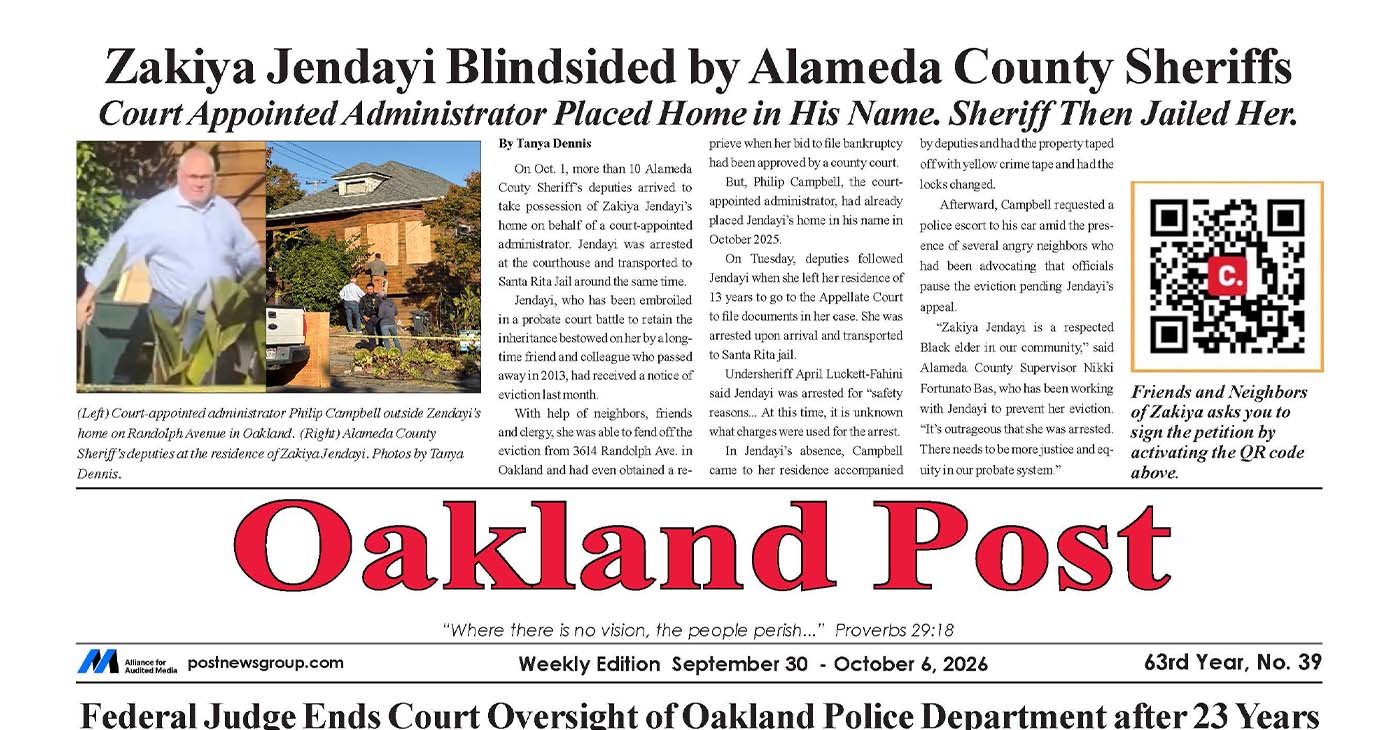
To enlarge your view of this issue, use the slider, magnifying glass icon or full page icon in the lower right corner of the browser window.



OP-ED: Proposition 44 Would Put a Price on Trust

OP-ED: Proposition 40: It’s Time to Play Chess, Not Checkers

Listening as a Lifeline: A Doula’s Witness to Black Maternal Health

New Protections for Ticket Buyers: Gov. Newsom Signs Assemblymember Isaac Bryan’s Bill

‘We Don’t Talk Trash — We Pick Up Trash!’

Zakiya Jendayi Arrested, Locked Out of Home by Sheriff’s Deputies

Oakland Post: Week of September 30 – October 6, 2026

Asm. Corey Jackson Announces Launch of 24-Hour Childcare in His District

IN MEMORIAM: The Rev. Leon “Sonny” Clark, Longtime Orange County Pastor and Community Leader, Dies at 72

Poll: Becerra Widens His Lead Over Hilton; Californians Split on Wealth Tax

From Historic Memories to New Possibilities: Oakland Celebrates Coliseum 60

County Office of Education Says OUSD Finances Are Getting Healthier, Materially Stronger

LIVE FREE Sunday Dinner Brings Faith, Fellowship and Civic Conversation to Oakland

Remembering Chauncey Bailey as Student Journalists Face Threats to Truth-Telling

BLACspace Cooperative Invites Bay Area to Experience Oakland’s Black Cultural Ecosystem Through a BLAC Map Tour + Party

Standoff for Justice: Our Homes Are Worth Fighting For

Oakland Post: Week of August 26 – September 1, 2026

Frontier Airlines’ Return to Oakland Airport Brings Flights, Jobs and Opportunity

Gubernatorial Candidate Steve Hilton Blasts California New Tire Rules; Newsom Hits Back

Chef Sharon Lee Blends Culinary Excellence, Education and Empowerment

Jackie Wright Champions Bay Area Stories, Filmmakers and Cultural Institutions

Misnamed ‘Parent’ PAC Seeks to Influence Oakland School Board Elections

Oakland Coliseum Project Opens Door for Small Businesses to Build Bigger

Big City Mayors Ask for “Yes” Vote on Housing Bond Measure; Conservatives Say “No”

Gov. Newsom’s Latest Appointees Include Sacramento Advocate for Formerly Incarcerated Students; State’s New Tech Chief

Longtime BWOPA Member Brendalyn Goodall Appointed to California Workforce Development Board

Gov. Newsom Signs Law Shielding Immigration Aid Workers From Doxing Threats

Secretary of State Shirley N. Weber Urges Californians to Vote Early as Voter ID Battle Intensifies

Oakland Post: Week of September 2 – 8, 2026

IN MEMORIAM: Dolly Parton Dead at 80 — How She Built a Legacy of Love and Earned Her Place in Black Culture

The Conversation With Al McFarlane 6/23/26

Media Monday 6/22/26

LIVE! ASK ALMA! — TUES. 6.23.26 7PM EST

Car Buying Secrets: 4 Hidden Checks Before You Sign!

Is This 550 HP Charger Worth YOUR Money? AutoNetwork Review

Celebrating Juneteenth – Frederick Douglass on education and resistance

LIVE! — ASK ALMA! — TUES. 6.19.26 7PM EST

Hyundai Ioniq 5 Parking, Safety, and 360 View #shorts

2025 Ioniq 5 New Wiper & Powerful Performance! #shorts

Electric SUV Range: Is 259 Miles Enough? #shorts

EV Charging: How Fast Can You Charge an Electric Vehicle? #shorts

Biometric Cooling… Messaging Seats…Come on! 2025 Infiniti QX80 Autograph 4WD

Charged Up: Witness the Magic of a Fully Electric Car! #shorts

Range Rover Sport PHEV Included…: See What’s Inside This Luxury SUV! #shorts

Invisible Hood View: Perfect Parking with X-Ray Vision! #shorts
-
 Community3 weeks ago
Misnamed ‘Parent’ PAC Seeks to Influence Oakland School Board Elections
-
 Activism4 weeks ago
Oakland Post: Week of September 2 – 8, 2026
-

 Activism3 weeks ago
Oakland Post: Week of September 9 – 15, 2026
-

 Community3 weeks ago
Richmond Tiny House Village Farm & Garden Set to Open Gates on Sept. 26
-

 Black History3 weeks ago
Latest Massacre in Haiti Reveals Cruelty U.S. Deportations
-

 Black History3 weeks ago
OPINION: Nolan Wells’ Death One of Several Signifying Racial Terror Lives on in U.S. South
-

 Business2 weeks ago
Mayor Lee Announces $1 Million Kaiser Permanente Grant for Pilot Program to Address Homelessness, Clean Up Public Spaces throughout Oakland
-

 Community3 weeks ago
Democratic Clubs Interview Candidates for Oakland School Board
