
Politics
New Kansas Rules Would Limit Spending of Welfare Benefits


In this April 13, 2015 photo, Kansas Republican Gov. Sam Brownback makes a point during an interview in his office in the Statehouse in Topeka, Kan. Brownback is preparing to sign welfare legislation restricting how poor families can spend cash assistance from the state. The Republican governor scheduled a Thursday, April 16, 2015, morning signing ceremony at the Statehouse. (AP Photo/John Hanna)
JOHN HANNA, AP Political Writer
TOPEKA, Kan. (AP) — A new Kansas law tells poor families that they can’t use cash assistance from the state to attend concerts, get tattoos, see a psychic or buy lingerie. The list of don’ts runs to several dozen items.
More than 20 other states have such lists. But, the one included by the Republican-dominated Kansas Legislature in a bill that GOP Gov. Sam Brownback planned to sign Thursday appears to be the most exhaustive, according to state Department for Children and Families officials.
It’s inspired national criticism and mockery from “The Daily Show.” Host Jon Stewart suggested that in accepting federal funds, Kansas should be forced to give up items like roads “paved with luxurious asphalt.”
“The list has attracted attention because it feels mean-spirited,” said Shannon Cotsoradis, president and CEO of the advocacy group Kansas Action for Children. “It really seems to make a statement about how we feel about the poor.”
It is part of a broader welfare law taking effect in July that Brownback and his allies say is aimed at moving poor families from social services into jobs.
“We want to get people off of public assistance and into private-sector employment, and we’ve had a lot of success with that,” Brownback during an interview this week with The Associated Press.
A 2012 federal law requires states to prevent benefit-card use at liquor stores, gambling establishments or adult-entertainment businesses.
At least 23 states have their own restrictions on how cards can be used, mostly for alcohol, tobacco, gambling and adult-oriented businesses, according to the National Conference of State Legislatures.
A few states — not Kansas — prohibit buying guns, according to the NCSL, and a few ban tattoos or body piercings. Massachusetts prohibits spending on jewelry, bail bonds, or “vacation services.” A 2014 Louisiana law bars card use on cruise ships, which is also on the Kansas list.
Kansas Department for Children and Families officials said that it’s difficult to track how often cash assistance is used for items on the state’s new list because recipients can use their benefits cards to obtain cash. The law will limit ATM withdrawals of cash assistance to $25 a day.
The department said it reclaimed $199,000 in cash assistance from 81 fraud cases from July through February, but said most involved questions about eligibility. The state provided $14 million in cash assistance during the same period.
A 2014 federal report said a check of eight states’ data showed transactions with benefit cards at liquor stores, casinos or strip clubs accounted for less than 1 percent of the total.
Critics question whether such restrictions can be enforced. Elizabeth Schott, senior fellow with the left-leaning Center on Budget and Policy Priorities, said enacting them simply creates an “aura of abuse.”
“Undermining support for the programs is what the restrictions do,” she said.
Phyllis Gilmore, Kansas secretary for children and families, said her state’s list is a “composite” of others and has educational value, sending the message that cash assistance should be used for necessities.
“Every dollar that is used fraudulently is a dollar that is not going to an American who is struggling,” said state Sen. Michael O’Donnell, a Wichita Republican who supported the bill.
Much of the new Kansas law codifies administrative policies enacted after Brownback took office in January 2011, so they’ll be harder to undo later.
They include a requirement that cash assistance recipients work at least 20 hours a week, be looking for work or enroll in job training. The new law also includes a much-criticized provision shortening the lifetime cap on cash assistance to 36 months from 48 months, although the state Department for Children and Families said recipients rarely bump up against the lower limit.
The number of cash assistance recipients in Kansas has dropped 63 percent since Brownback took office, to about 14,700 in February. Brownback said the decline confirms the success of his policies, but critics note that U.S. Census Bureau figures show the state’s child poverty rate remaining at about 19 percent through 2013.
Brownback said his state’s list of prohibited cash-assistance uses has become a way for the left to argue against welfare-to-work policies.
“I think you’re seeing the left trying to pillory this,” Brownback said. “They’re just trying to poke fun at it, when it’s not what the debate is really about.”
___
Online:
Text of Kansas welfare measure: http://bit.ly/1H8k7SD .
Kansas Legislature: http://www.kslegislature.org
___
Follow John Hanna on Twitter at https://twitter.com/apjdhanna
Copyright 2015 The Associated Press. All rights reserved. This material may not be published, broadcast, rewritten or redistributed.











Community
Democrats, Community Groups Back Measure EE to Change How Oakland Is Governed
Along with clearer executive responsibility, the Charter reform would also create new checks and balances, including an independent Budget and Legislative Analyst office, City Council confirmation of key appointments, expanded council hearing and subpoena authority, and give the council the ability to override a mayoral veto with six votes.

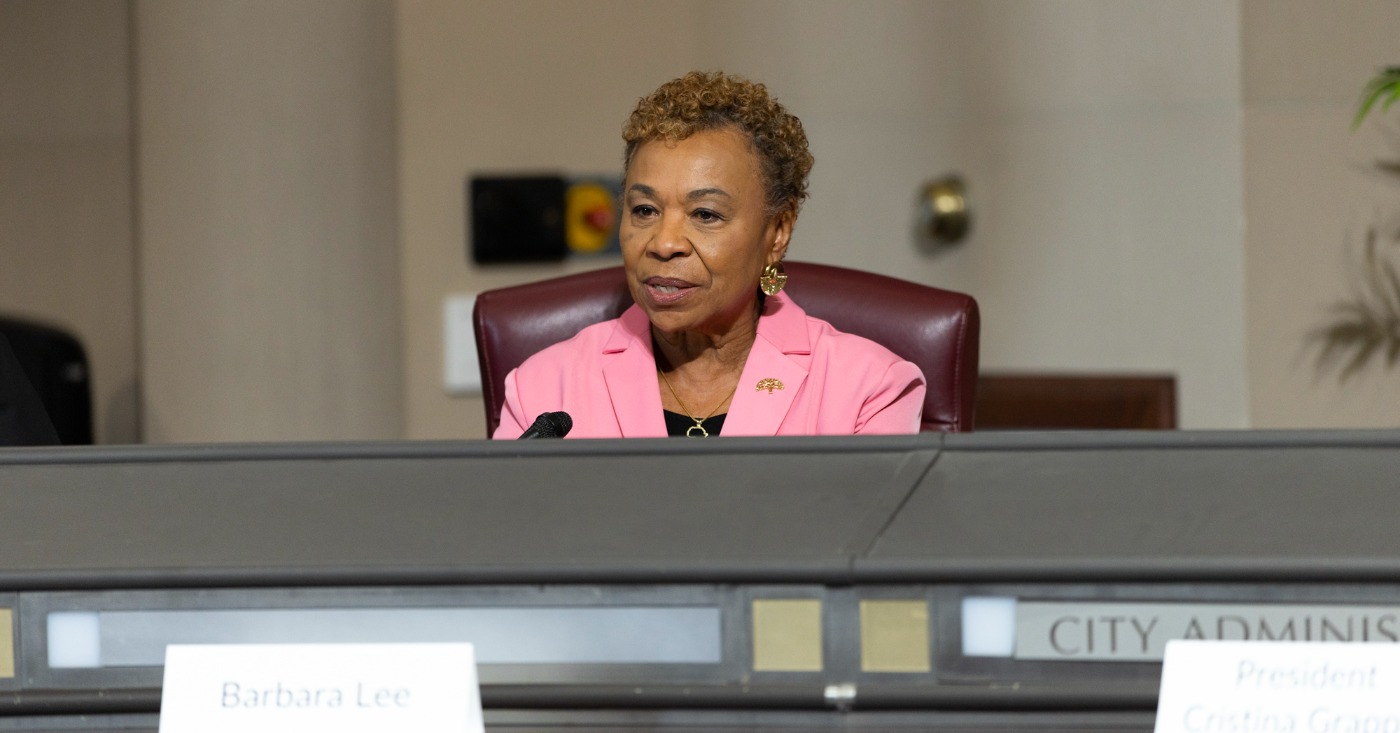
The Alameda County Democratic Party has voted to endorse Measure EE, the Oakland Charter reform measure on the November 2026 ballot. The party’s endorsement is announced alongside a broad coalition of organizations spanning labor, business, faith, and community advocacy, including Oakland Rising Action that are also supporting the measure.
Those supporters include:
- League of Women Voters of Oakland
- AFSCME Council 57
- SPUR
- Bay Area Council
- Black Women Organized for Political Action
- Faith in Action East Bay
- Oakland Chamber of Commerce
- Oakland Rising Action
- Revitalize East Bay
- Empower Oakland
Measure EE would reform Oakland’s hybrid governance system by establishing a strong-mayor structure, making the mayor the city’s chief executive, responsible for delivering effective, efficient services.
The measure would also reform and expand responsibilities of City Councilmembers.
Measure EE would create clearer lines of responsibility for the performance of city government, allowing voters to evaluate the mayor based on how effectively the city delivers services and produces results.
Along with clearer executive responsibility, the Charter reform would also create new checks and balances, including an independent Budget and Legislative Analyst office, City Council confirmation of key appointments, expanded council hearing and subpoena authority, and give the council the ability to override a mayoral veto with six votes.
“Oakland voters deserve a City Hall where they know exactly who’s responsible when something goes wrong and exactly who to credit when it gets fixed. Measure EE puts that responsibility squarely with the mayor, backed by real checks and balances, so Oakland can finally move as fast as its problems demand. That’s why the Alameda County Democratic Party is proud to stand behind it,” said Igor Tregub, chair of the Alameda County Democratic Party.
Oakland Rising Action, a collaboration of racial, economic, and environmental justice organizations, has also issued a press statement explaining its support for Measure EE.
Measure EE “represents a critical opportunity for residents to clarify the governance role of the Oakland Mayor and City Council, so we, as residents, know who to hold accountable for the execution of voter-approved and budgeted services within city departments,” the statement said.
Measure EE would reform Oakland’s Charter, which is the city’s Constitution, strengthening “the role of the mayor as the CEO of Oakland, with the city administrator being hired and managed by the mayor explicitly.”
The measure would also strengthen oversight of city departments by mandating reporting directly to the City Council and provide the mayor with veto power in approving policies and the budget.
Measure EE was placed on the ballot by the Oakland City Council in June 2026. For more than half a year, the mayor’s working group on Charter reform engaged residents and elected officials on the options for governance of Oakland, which led to Measure EE.
“Oaklanders need clarity about who is responsible for the management of our city departments, our tax dollars, and our voter-approved ballot measures,” said Pecolia Manigo, executive director of Oakland Rising.
“The average resident believes that we already have a strong mayor system,” she continued. “However, this is simply not the truth in our City Charter. It is time for us to stop talking about the Charter changes Oakland needs. This is the first of many Charter reforms that are needed to improve conditions in Oakland, especially the flatlands. It’s time all voters start paying attention to who is making decisions for Oakland. This election allows us to say how we believe Oakland should be governed.”

Economy
Mayor Lee Delivers 2026 State of the City Address: ‘Oakland Continues to Be on the Move’
To create a police force that better serves and protects Oakland, the city is working toward the goal of reaching 700 sworn police officers, she said. These steps include recruiting from Oakland, holding academies, reinstituting a cadet program, and increasing foot patrols.
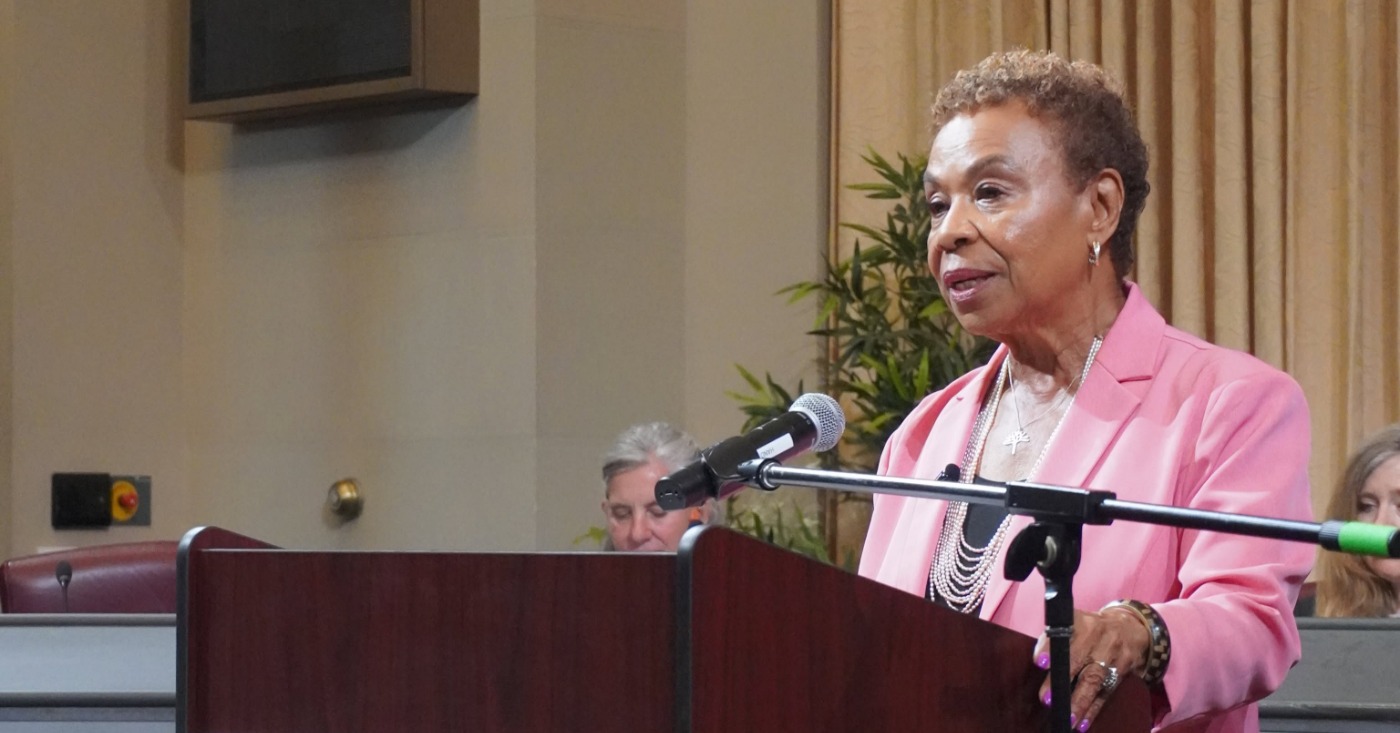
Mayor Barbara Lee, speaking this week to Oakland residents and elected leaders in City Council chambers, delivered the annual mayoral State of the City Address, highlighting the city’s accomplishments as well as the challenges Oakland is facing going forward.
Lee began her remarks praising city workers, who picketed outside City Hall before the meeting, and are currently negotiating with the city for a wage increase and ending understaffing that leaves many departments shorthanded.
“We are working very hard (not) just to get a contract, but to get a fair contract,” she said. “I know that our City Council and myself are working constantly toward that end.”
The mayor also praised Councilmember Carroll Fife for her legislation for a 45-day moratorium on data center construction, which passed unanimously at the council meeting Tuesday following Lee’s presentation.
Speaking bluntly, she said, “Oakland continues to be a city on the move, (but) I want to tell you the truth about the state of our city.”
“We have made real progress, and we still face real challenges.”
She said the city has balanced its budget but has a structural deficit, which is decreasing, and must operate within the context of federal funding cuts.
“Too many Oaklanders are unhoused, too many families are struggling with the cost of living, and too many neighborhoods still need basic services that they deserve, and too many people are living in fear,” Mayor Lee said.
“We’re not sweeping these realities under the rug,” she continued. “We are being intentional and transparent about how we must face these challenges, but we will not ignore our progress.”
Substantial progress includes:
• Bringing crime down;
• Building affordable and deeply affordable housing;
• Cleaning the streets and fixing the roads;
• Helping small businesses.
“We are bringing new investment to Oakland,” she said. “We’re making City Hall work better. There’s more to do, but make no mistake, Oakland is on the move.”
Speaking broadly about the city’s public safety initiatives, she said that crime continues to decline. Burglaries fell by 26%, and violent crime fell by 17%.
In recent years, homicides and shootings have fallen by double digits, and gun violence has dropped by more than 50% in the last 33 months.
“These aren’t just statistics: these are lives. These are families. These are people who never made it home,” Mayor Lee said.
She talked about what to expect now that federal court oversight of the Oakland Police Department ended last week after 23 years. “Ending federal oversight does not mean ending accountability; quite the opposite,” she said. “Accountability and civilian oversight must remain our standard. Community trust must be our standard.”
Mayor Lee also emphasized that Oakland remains a city of refuge.
“We do not work with ICE; we do not cooperate with ICE; our police do not cooperate with ICE; we will not be militarized,” she said.
The mayor also emphasized that investing in youth is a top priority of her administration and should be considered a public safety strategy.
“We advocated for almost $2 million to restore the mayor’s youth summer employment program,” she said. “We connected youth with Oakland businesses to develop skills that will support them for years to come, and that’s a big deal.”
To create a police force that better serves and protects Oakland, the city is working toward the goal of reaching 700 sworn police officers, she said. These steps include recruiting from Oakland, holding academies, reinstituting a cadet program, and increasing foot patrols.
The city also is strengthening other programs, including the Department of Violence Prevention and Ceasefire, she said. “We must have this comprehensive public safety strategy, because we must also prevent violence before it happens.”
Continuing, Lee said public safety is connected to unsanitary conditions in city neighborhoods.
“Illegal dumping is unacceptable, and it’s a moral disgrace,” she said. “No child should have to walk past piles of garbage on their way to school; no senior should have to live next to it; no small business should have to clean it up outside its door.”
She said the city is changing the way it fights illegal dumping, securing a $9.2 million investment to develop a new strategy. “We’re not just cleaning it up; we’re working to stop it before it starts. We have the three E’s – Eradication, enforcement, and education,” she said.
Focusing on the continuing crisis of Oakland’s unhoused residents, she said, “We consider housing a basic human right, and homelessness remains one of Okland’s greatest challenges.”
“There are two things we must do: keep people from becoming unsheltered and help people who are unsheltered get back into housing with services that they need,” Lee said.
Since 2024, homelessness in Oakland has fallen by 20%, she said. In the past year prevention programs helped keep 1,000 families in their homes, and over 1,300 affordable homes opened over the past two years.
Addressing community tensions over encampments, she said, “We should never have to choose between compassion for people experiencing homelessness and the health and safety of our neighborhoods.”
“A strong city has to deliver both,” she said. “That’s the work we’re advancing through Oakland’s new homelessness strategic action plan.”
Featured
Oakland Awarded More than $14 Million in State Funding
Direct state investments in city programs can revitalize Oakland’s commercial corridors and foster economic growth, strengthen community violence prevention strategies, and expand transitional housing, while supporting cherished community spaces, according to a city media statement.

Money will support small businesses, public safety, transitional housing, and community partners
Mayor Barbara Lee recently announced that the City of Oakland and local community partners will receive more than $14 million in direct investments from California’s new 2026-27 state budget.
Securing $4.25 million for city programs and $10 million for local community organizations, these state funds were backed by state Senator Jesse Arreguin and Assemblymembers Mia Bonta and Buffy Wicks, with support from Governor Gavin Newsom.
The goal of securing state and federal funding and bringing in outside resources to address the city’s most pressing needs continues to be a top priority for Lee.
Direct state investments in city programs can revitalize Oakland’s commercial corridors and foster economic growth, strengthen community violence prevention strategies, and expand transitional housing, while supporting cherished community spaces, according to a city media statement.
“Thank you so much to Senator Jesse Arreguin, Assemblymember Mia Bonta, Assemblymember Buffy Wicks, and Gov. Gavin Newsom for investing in Oakland,” Lee said.
“We are fortunate to have strong, dedicated leaders representing Oakland in Sacramento who consistently deliver for our residents and businesses,” she said. “This critical funding directly addresses some of our most pressing challenges, including supporting our small businesses, building vibrant neighborhood corridors, advancing violence intervention, and housing our unsheltered neighbors.”

How the $4.25 million will be spent for city projects:
- $2.5 million will be used for the Facade and Tenant Improvement Grant Program to support small businesses;
- $1 million for the Department of Violence Prevention to enhance staffing and program capacity; and
- $750,000 for the Holland transitional housing facility, providing resources to help unhoused residents.
• How the $10 million for Oakland community groups will be spent:
- $5 million for Children’s Fairyland for essential infrastructure, accessibility, and facility upgrades.;
- $3 million for the Juntos Fruitvale Cultural Arts Center to create a multi-use space for performances, exhibitions, workshops, neighborhood meetings in the Fruitvale neighborhood; and
- $2 million for Samuel Merritt University to grow its nationally recognized Human Trafficking Prevention and Response Initiative.
“State investments in Oakland’s nonprofit and educational organizations highlight their deep value not just to our city, but their importance to the entire state,” said Lee. “Oakland has long served as a hub for inclusive arts and culture and as a community that protects its most vulnerable members.”
Said Arreguin, “This investment is a commitment to Oakland’s health, safety, and future. In partnership with my state colleagues, Mayor Lee, and our community partners, we are strengthening our response to human trafficking and gun violence, to create safer neighborhoods, and improve the quality of life of all Oakland residents.”
“Investing in Oakland means investing in California’s future. I’m proud to be a voice for the beautiful people of Oakland in the State Capitol and to deliver real funding wins that ensure our shared safety, expand housing opportunities, and preserve the artistic and cultural legacy of Oakland,” said Bonta.


WCCUSD Joins Statewide Organic School Food Purchasing Cooperative

Democrats, Community Groups Back Measure EE to Change How Oakland Is Governed

Four Tips to Help You Plan a Holiday “Staycation”

Veterans Housing Project Proposed for South Richmond
PRESS ROOM: Transformative Justice Coalition 2026 Voting Rights Champion Awards Reception ‘Yesterday Is Today: The Battle For Voting Rights

Mayor Lee Delivers 2026 State of the City Address: ‘Oakland Continues to Be on the Move’

Oakland Awarded More than $14 Million in State Funding

Jendayi Arrest Raises Community Concerns Regarding Sheriff’s Chain of Command

Marin County Supes Expand Small Business Options with Home Kitchen Pilot Program

Allen Temple Baptist Church Hosts Free Prostate Cancer Screenings on Oct. 17

AC Transit Labor Unions Back Director Joel Young

Locals Can Get Locally Grown Produce Delivered Through Urban Tilth

‘ICE-Free Marin’ Supporters Press Supervisors as County Drafts Enforcement Restrictions

Oakland Post: Week of October 7 – 13, 2026

Ghana’s Ministry of Foreign Affairs Publishes Global Circle’s Vatican Reparations Call in Special Edition Alongside Heads of State

Jackie Wright Champions Bay Area Stories, Filmmakers and Cultural Institutions

Chef Sharon Lee Blends Culinary Excellence, Education and Empowerment

Misnamed ‘Parent’ PAC Seeks to Influence Oakland School Board Elections

Big City Mayors Ask for “Yes” Vote on Housing Bond Measure; Conservatives Say “No”

Oakland Post: Week of September 2 – 8, 2026

Longtime BWOPA Member Brendalyn Goodall Appointed to California Workforce Development Board

Gov. Newsom Signs Law Shielding Immigration Aid Workers From Doxing Threats

Oakland Post: Week of September 9 – 15, 2026

Richmond Tiny House Village Farm & Garden Set to Open Gates on Sept. 26

Latest Massacre in Haiti Reveals Cruelty U.S. Deportations

‘Passing a Law Isn’t The Finish Line’: California Assembly Evaluates Implementation, Results

OPINION: Nolan Wells’ Death One of Several Signifying Racial Terror Lives on in U.S. South

OPINION: Angie Nixon Will Turn You Into a Democratic Socialist If Donald Trump Hasn’t Already

Poll: Becerra Widens His Lead Over Hilton; Californians Split on Wealth Tax

Mayor Lee Announces $1 Million Kaiser Permanente Grant for Pilot Program to Address Homelessness, Clean Up Public Spaces throughout Oakland

The Conversation With Al McFarlane 6/23/26

Media Monday 6/22/26

LIVE! ASK ALMA! — TUES. 6.23.26 7PM EST

Car Buying Secrets: 4 Hidden Checks Before You Sign!

Is This 550 HP Charger Worth YOUR Money? AutoNetwork Review

Celebrating Juneteenth – Frederick Douglass on education and resistance

LIVE! — ASK ALMA! — TUES. 6.19.26 7PM EST

Hyundai Ioniq 5 Parking, Safety, and 360 View #shorts

2025 Ioniq 5 New Wiper & Powerful Performance! #shorts

Electric SUV Range: Is 259 Miles Enough? #shorts

EV Charging: How Fast Can You Charge an Electric Vehicle? #shorts

Biometric Cooling… Messaging Seats…Come on! 2025 Infiniti QX80 Autograph 4WD

Charged Up: Witness the Magic of a Fully Electric Car! #shorts

Range Rover Sport PHEV Included…: See What’s Inside This Luxury SUV! #shorts

Invisible Hood View: Perfect Parking with X-Ray Vision! #shorts
-
 Economy2 weeks ago
Poll: Becerra Widens His Lead Over Hilton; Californians Split on Wealth Tax
-
 Business3 weeks ago
Mayor Lee Announces $1 Million Kaiser Permanente Grant for Pilot Program to Address Homelessness, Clean Up Public Spaces throughout Oakland
-

 Business2 weeks ago
County Office of Education Says OUSD Finances Are Getting Healthier, Materially Stronger
-

 Uncategorized3 weeks ago
Oakland People’s Arms Embargo Coalition Demands End to Military Shipments Thru Oakland
-

 Activism3 weeks ago
Oakland Post: Week of September 16 – 22, 2026
-

 Community3 weeks ago
Two Looming Threats Every Alameda County Elder Should Know About
-

 Art2 weeks ago
BLACspace Cooperative Invites Bay Area to Experience Oakland’s Black Cultural Ecosystem Through a BLAC Map Tour + Party
-

 Lead Story1 week ago
Zakiya Jendayi Arrested, Locked Out of Home by Sheriff’s Deputies
