
Bay Area
Opinion: Let’s Set the Record Straight: Coal is Already Shipped Through Oakland and It Is Safe


Let’s set the record straight. The Environmental Protection Agency (EPA) has authorized the shipment of millions of tons of coal throughout the Bay Area for years. These shipments include coal cars running through the city of Oakland, through Jack London Square, the Army Base and other rail points. Over the many years that this has occurred, there have been no reported adverse health effects, nor have there been reports of unhealthy levels of coal dust registered on any of the air monitors operating in West Oakland.
For these reasons and many more, I state unequivocally that the Op Ed in the Post on Nov. 7, ‘We Still Object to Coal’, disregards science, the truth and the welfare of the citizens of Oakland! There are no inaccuracies in the “ITS” (Insight Terminal Solutions) Post article of Oct. 31, ‘Bulk Commodity Terminal Operator Agrees to “Oakland Protocol” Phase-in Plan to Ban Coal’. To the contrary, the inaccuracies are in the article by opponents of the multi-commodity bulk terminal.
But you need not take my word for it. Renowned local physicians Dr. Washington Burns and Dr. Geoffrey Watson, who have dedicated their lives to caring for Oakland’s underserved residents, state without equivocation that coal does not pose a health threat to Oakland residents; neither as it is currently shipped and certainly not under the process that will be used by ITS. As well, when the case was brought before the federal court on Oakland’s frivolous argument that coal was dangerous, Ninth Circuit Judge Vincent Chhabria ruled that the City failed to produce “evidence that the proposed coal operations would pose a substantial health or safety danger.”
The new state-of-the-art Oakland Protocol process is safe. ITS will use covered railcars and a fully encapsulated delivery system that eliminates the possibility of coal dust release. The terminal is also good for Oakland and the community. It will bring hundreds of millions of dollars in city revenue and community benefits.
Building the terminal also has the benefit of using coal to eliminate coal. Under the provisions of the 5-3-0 plan, 5 million tons of coal a year would be shipped through the terminal for the first 10 years of operation, and 3 million tons per year for the next 10 years, no more coal would be shipped through the ITS facility for the remainder of the 66- year lease. This would amount to a 92 percent reduction, and eliminate an estimated 900 million tons of coal, that would otherwise legally be allowed to be shipped through the terminal in accordance with the ruling of the federal judge. Coal will help pay the cost to build the terminal, but it will also be eliminated in 20 years.
The opposition author also suggests that shipment in covered cars is dangerous because of the potential for spontaneous combustion. This is nonsense! Rail cars have been covered for decades, enclosing various commodities, including coal. Coal is transported along the Mississippi River in covered containers, and by sea in covered containers without combustion or other danger. The manufacturer that ITS will use, Eco-Fab, has been covering rail cars in Europe since the 1970s without incident. This claim of potential spontaneous combustion, like the safety issue, is made up to advance the world view of coal opponents. It has nothing whatsoever to do with what will happen in Oakland
Failure to issue permits to build a terminal will have devastating legal implications for Oakland. The city will have to repay the state of California over $242 million that the state advanced for development. The city will owe $500 million in damages to California Capital Investment Group for wrongfully denying the development and not issuing the appropriate permits. The terminal, under its signed 66-year lease with the city, has secured all CEQA permits to operate a multi-commodity terminal that can handle upwards of 15 million tons annually, all of which could be coal per our lease if the city forces the owners to go through a long and costly legal challenge. If the city fails to act, it could jeopardize the option of phasing out coal under the 5-3-0 plan.
More to the point however, the City would needlessly lose out on hundreds of high paying jobs, invaluable job training and additional revenue streams that, over the life of the lease, could total hundreds of millions of dollars. These dollars could be earmarked specifically for the City’s most underserved and needy citizens.
Thus, the truth is the risk of perpetuating this fraud by the City of Oakland is stunning. It has been this author’s observation that citizens in Oakland, particularly those who would most benefit and who are most underserved, in fact very much desire to see this terminal built.
See the article by Pastor LJ Jennings, entitled ‘Our Community, Our Voice, We Speak for Us!’ in the Oakland Post.











Activism
Oakland Post: Week of September 16 – 22, 2026
The printed Weekly Edition of the Oakland Post: Week of September 16 – 22, 2026


To enlarge your view of this issue, use the slider, magnifying glass icon or full page icon in the lower right corner of the browser window.

Activism
Oakland Post: Week of September 9 – 15, 2026
The printed Weekly Edition of the Oakland Post: Week of September 9 – 15, 2026

To enlarge your view of this issue, use the slider, magnifying glass icon or full page icon in the lower right corner of the browser window.
Activism
Oakland Post: Week of September 2 – 8, 2026
The printed Weekly Edition of the Oakland Post: Week of September 2 – 8, 2026
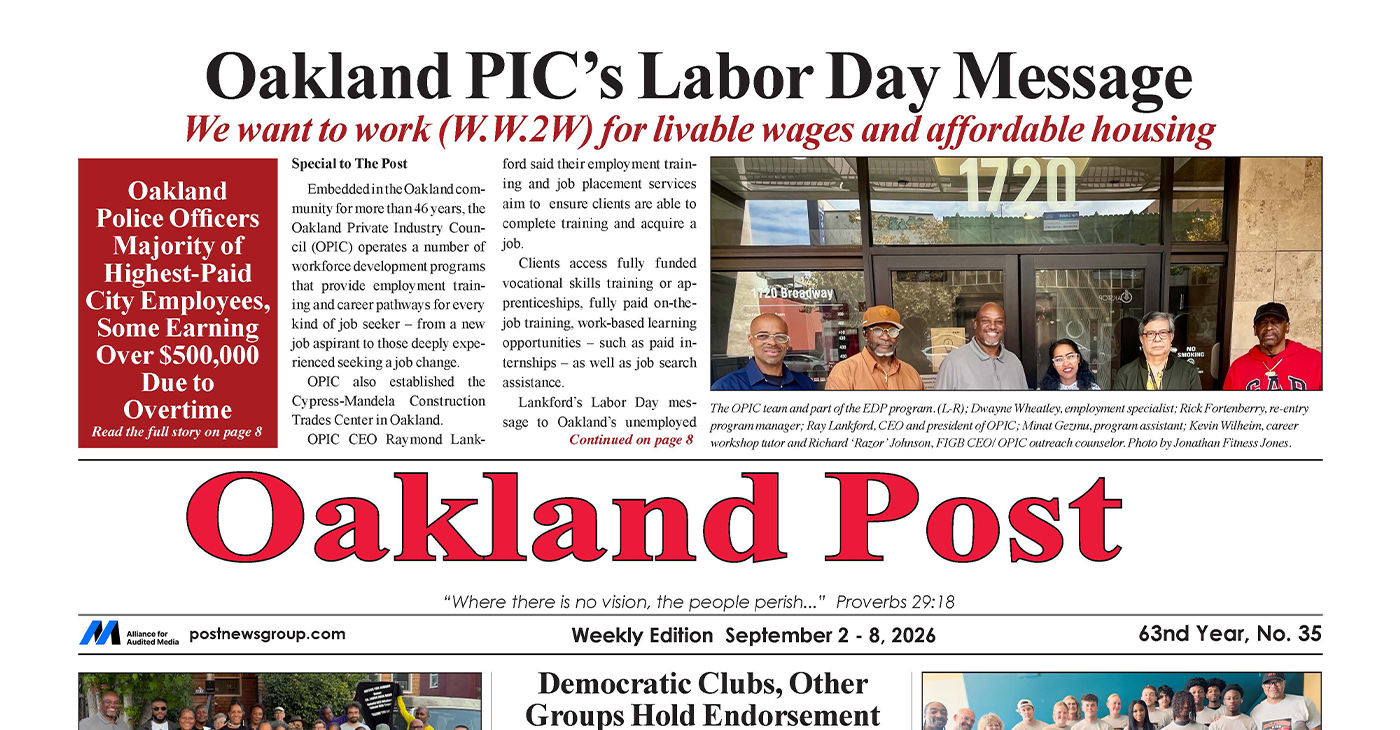
To enlarge your view of this issue, use the slider, magnifying glass icon or full page icon in the lower right corner of the browser window.



Doulas Are Helping Black California Moms Navigate Pregnancy–Even as High Mortality Rates Persist

Newsom Signs Addictive Social Media Law to Protect Kids

On Your November Ballot: Prop 38 Would Allocate $8.4 Billion to Immunology and Immunotherapy Funding

Ask California: Golden State Releases New AI Chatbot

Asm. Isaac Bryan’s Bill Banning California Police From ICE Side Jobs Reaches Newsom’s Desk

Assemblymember LaShae Sharp-Collins’s Bill Would Pause Law Enforcement’s Use of Shock Gloves Pending Study

BOOK REVIEW: ‘Laws of Solomon’ Reveals Tender Heart of Former Child Soldier

OPINION: The New American Fear – From 9-11 to AI

Passing for White, Fighting for Black America: The Courage of Walter White

Oakland People’s Arms Embargo Coalition Demands End to Military Shipments Thru Oakland

Barbara Lee Mourns Gloria Steinem, Remembers a Friendship Rooted in Equality

Event Preview: ‘Fashion v. Fascism’ – A Runway Revolution Is Coming to the Bay Area

Two Looming Threats Every Alameda County Elder Should Know About

Oakland Mayor Reads to Children at Bookout Block Party at Marcus Books Store

Tradition Comes to the Streets in 11th Annual Black-Eyed Pea Festival at the Freedom Farmers Market

Less Affluent School Districts, Including Sacramento City, Face Threat of State Takeover

ESSAY: California Can Close Its Colorectal Cancer Gap

California Hispanic Chambers of Commerce Unveils: ‘Powering the Future’ Theme for 47th Annual Statewide Convention

Four Candidates, Including Incumbent Barbara Lee, Qualify for Oakland Mayor’s Race

Oakland Post: Week of August 12 – 18, 2026

From Blueprint to Breakthrough: Tackling Affordable Housing in Oakland

Oakland Observes Black August with Block Parties, Film Showings, Workshops

COMMENTARY: Why Local School Tax Measure G1 Will Not Be on the November Ballot

Standoff for Justice: Our Homes Are Worth Fighting For

Returning to Its Roots, the Oakland Black-Eyed Pea Festival Partners with the Freedom Farmers Market Sept. 12

Oakland Post: Week of August 26 – September 1, 2026

NPRC Scores First Advocacy Victory: David Shaw Finally Gets His Wish to ‘Go Home’

Frontier Airlines’ Return to Oakland Airport Brings Flights, Jobs and Opportunity

Gubernatorial Candidate Steve Hilton Blasts California New Tire Rules; Newsom Hits Back

Chef Sharon Lee Blends Culinary Excellence, Education and Empowerment

The Conversation With Al McFarlane 6/23/26

Media Monday 6/22/26

LIVE! ASK ALMA! — TUES. 6.23.26 7PM EST

Car Buying Secrets: 4 Hidden Checks Before You Sign!

Is This 550 HP Charger Worth YOUR Money? AutoNetwork Review

Celebrating Juneteenth – Frederick Douglass on education and resistance

LIVE! — ASK ALMA! — TUES. 6.19.26 7PM EST

Hyundai Ioniq 5 Parking, Safety, and 360 View #shorts

2025 Ioniq 5 New Wiper & Powerful Performance! #shorts

Electric SUV Range: Is 259 Miles Enough? #shorts

EV Charging: How Fast Can You Charge an Electric Vehicle? #shorts

Biometric Cooling… Messaging Seats…Come on! 2025 Infiniti QX80 Autograph 4WD

Charged Up: Witness the Magic of a Fully Electric Car! #shorts

Range Rover Sport PHEV Included…: See What’s Inside This Luxury SUV! #shorts

Invisible Hood View: Perfect Parking with X-Ray Vision! #shorts
-
 Commentary4 weeks ago
Standoff for Justice: Our Homes Are Worth Fighting For
-
 Activism4 weeks ago
Oakland Post: Week of August 26 – September 1, 2026
-
 Business4 weeks ago
Frontier Airlines’ Return to Oakland Airport Brings Flights, Jobs and Opportunity
-
 Business4 weeks ago
Gubernatorial Candidate Steve Hilton Blasts California New Tire Rules; Newsom Hits Back
-
 Business4 weeks ago
Chef Sharon Lee Blends Culinary Excellence, Education and Empowerment
-

 Education4 weeks ago
Gov. Newsom’s Latest Appointees Include Sacramento Advocate for Formerly Incarcerated Students; State’s New Tech Chief
-

 Community4 weeks ago
Big City Mayors Ask for “Yes” Vote on Housing Bond Measure; Conservatives Say “No”
-

 Business4 weeks ago
Oakland Coliseum Project Opens Door for Small Businesses to Build Bigger
