
#NNPA BlackPress
IN MEMORIAM: Garth C. Reeves, Sr., Retired Miami Times Publisher, Dies
CHICAGO CRUSADER — Regarded as a titan in the Black Press, Reeves was widely respected in Miami for using his power and influence to advance the agenda of the city’s Black community. After experiencing the pain and humiliation of segregation in parks, schools and the U.S. military, Reeves grew into an uncompromising crusader who smashed racial barriers in some of the most prominent organizations in Miami and the nation.

By Erick Johnson, Chicago Crusader

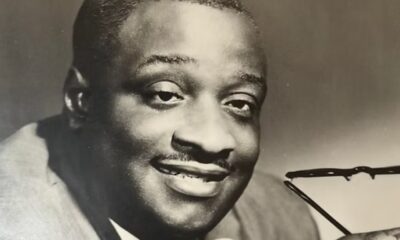
Garth C. Reeves, Sr., The Miami Times’ retired publisher who became the enduring patriarch of a family newspaper dynasty after decades of fighting the political establishment and while guiding the Black community through the city’s racial problems, died on Monday, November 25. He was 100.
Regarded as a titan in the Black Press, Reeves was widely respected in Miami for using his power and influence to advance the agenda of the city’s Black community. After experiencing the pain and humiliation of segregation in parks, schools and the U.S. military, Reeves grew into an uncompromising crusader who smashed racial barriers in some of the most prominent organizations in Miami and the nation.
During his lifetime, Reeves’ newspaper got a police chief fired, ended the career of a a Miami Mayoral, supported a boycott that cost Miami Beach’s tourism industry millions, and unapologetically called riots “protests” or rebellions. He stared down Miami’s political establishment that for decades had been accused of shutting out Blacks in government as Hispanics rose to power in the city’s political and business establishments.

He urged his journalists to write from a Black perspective, one that saw the struggle through a different lens than white newspapers.

His newspaper career spanned at least eight decades. At the height of Reeves’ leadership, The Miami Times earned the name, “The Voice of Miami’s Black Community.” One of the last great Black publishers, Reeves’ death closes a significant chapter in The Miami Times’ illustrious history.
Reeves was born February 12, 1919 in Nassau, Bahamas. That same year, Reeves’ father, Harry Ethelbert Sigismund Reeves, moved to Miami where he founded the Magic Printing Company in Overtown, the city’s historic Black, once-thriving neighborhood near downtown. Harry Ethelbert Sigismund Reeves in 1920 founded the Miami Sun, which closed because of a paper shortage during World War I. In 1923, The Miami Times was founded. Reeves was just four years old.
Garth C. Reeves, Sr. was among many Blacks who attended Miami’s esteemed Booker T. Washington Senior High School, the city’s oldest predominately Black high school that was built when students of color were not accepted at white public schools. Black students at Booker T. were given secondhand text books and football gear that came from white schools.

In 1923, Harry Reeves started The Miami Times at NW 8th Street and 3rd Avenue. It would move four more times in the Overtown neighborhood. When Interstate-95 was built through Overtown, it displaced thousands of Blacks. Many fled north to the Liberty City community, where The Miami Times sits at its present location, 900 NW 54 Street.
In 1940, Reeves graduated from Florida A&M University, a major, historically Black school in Tallahassee, FL. In 1942, Reeves was drafted to serve in the Army during World War II. During an interview in 1999, Reeves recalled a trip on a train to the Pacific coast to go overseas. Despite repeated requests, a white train conductor refused to give Reeves something to eat in spite of him having meal coupons. Reeves went to the military police, who told him to do what the white conductor said, or face being locked up on the train. Reeves was forced to pay for his meal because he could not go into the segregated dining car.
Experiences like those would fuel Reeves’ passion for Black journalism’s role in exposing racial injustices while advocating for the needs of disenfranchised people of color.
After completing his service in 1946, Reeves returned to The Miami Times. By then, Blacks could not sit at segregated diners downtown. Members of the Klu Klux Klan would often parade through Miami’s bustling downtown. Parks and schools did not accept Blacks either and living conditions among Blacks worsened as slums in Overtown increased.
Reeves joined Reverend Theodore Gibson, the president of the local NAACP Chapter and began leading protests for better conditions for Blacks in Miami. Out of 28 beaches, only Virginia Key Beach was open to Blacks. On November 7, 1957, Reeves led a group of seven Black leaders to Crandon Park, a segregated white beach near Miami. Reeves and the men earlier talked to several county commissioners, saying that as taxpayers they had the right to frequent Crandon Park or any segregated beach. Wearing their bathing suits under their clothes, Reeves and the men took off their slacks and went into the water while several police officers watched. Blacks began frequenting other white beaches after the incident.
Blacks were not allowed to play at city-owned golf-courses in the 1940s. But that changed when Reeves and Gibson filed a lawsuit that went all the way to the U.S. Supreme Court. In a landmark case, Rice v. City of Miami, the Supreme Court ruled that the city could not continue accepting tax money to build and maintain golf courses while denying its use to all residents.
In an interview on the History Miami Museum website, Reeves recalled an experience he had when Dr. Martin Luther King came to Miami during the Civil Rights Movement.
“When Martin Luther King came down, I attended some of his meetings. My friend was a good friend of King’s and I used to attend meetings where he would preach to us about nonviolence. I remember talking to Martin a few times and I said, “Martin, you really believe that if I was somewhere and a white guy spat on my face, you think I would walk away from that? I said I’d try and kill that son of a b—-. He said, ‘That’s why you’ve got to try to learn to control yourself.’ I liked him.”
That was Reeves the activist.

Reeves, as the publisher of The Miami Times, was just as fierce. It was the only job Reeves would have throughout his life. He worked his way up the ranks as columnist, reporter, managing editor, and editor. When Reeves’ father died in 1970, Reeves became publisher.
By then The Miami Times had established itself as the Black newspaper of record.
During the 1960s The Miami Times ran a front-page story advocating for the termination of Miami Police Chief Walter Headly, whose Stop and Frisk policy of searching Blacks lit up racial tensions in the city. Headly was eventually fired and the Times readership grew.
When four Miami police officers were acquitted in May, 1980 of killing Arthur McDuffie, a Black salesman, Blacks took to the streets. White newspapers and local television stations described it as a riot. With Reeves at the helm, The Miami Times called the incident a “protest.” When another Miami police officer was acquitted in 1993 for killing two Black motorists in Overtown, The Miami Times called the civil unrest a rebellion.
There were other highlights under Reeves’ leadership at The Miami Times.
In 1985, Mayor Maurice Ferre lost the Black vote and was defeated in his re-election bid after The Miami Times ran a series of editorials criticizing the mayor for firing Howard Gary, Miami’s first Black city manager.
In 1993, Reeves and The Miami Times published editorials and stories supporting a boycott of Miami Beach hotels that cost the tourism industry millions of dollars.
Black leaders accused county leaders of snubbing Nelson Mandela after they withdrew plans to give him a proclamation and key to the city when the anti-apartheid leader publicly expressed his support for Cuban Dictator Fidel Castro.
The National Bar Association and ACLU were among many organizations that did not bring their conventions to Miami Beach in support of the boycott.
The boycott lasted three years and cost the tourism industry between $20 to $50 million. Mandela was given an official proclamation and the hotel industry implemented programs to boost Blacks in its facilities. Miami Beach got its first Black-owned luxury hotel, the Royal Palm Crowne Plaza.
“It was important that we had a communication outlet to get our message out,” said H.T. Smith, a prominent Miami attorney who spearheaded the boycott. “The mainstream media would not give us any coverage. The Miami Times was essential to the boycott’s success. The boycott would not have been successful without The Miami Times. And our friendship grew as a result of this partnership.”
Former Miami Times executive editor Mohamad Hamaludin, who worked for 15 years at the newspaper, said, “Reeves was a fine gentleman. By the time I got to The Miami Times, he and the staff had already established it as a voice for people who didn’t have a voice.”
Reeves was the first Black to serve on the boards of the Miami-Dade College, Barry University, the Greater Miami Chamber of Commerce, and the United Way of Dade County. He also served as organizing chairman of the board for National Industrial Bank, which was the first integrated bank in the State of Florida.
While serving on many of these boards, Reeves pushed them to hire more Blacks when they were reluctant to do so. As a board member of Miami-Dade College, Reeves threatened to lead a vote to stop doing business with the school’s law firm because it resisted his calls to hire Black attorneys in its offices.
Reeves assisted Crusader Publisher Dorothy R. Leavell in bringing the NNPA Annual Convention to Gary in 1983 after Black political power gained a foothold in the Steel City.
“He believed in the Black Press very deeply,” said Leavell who first met Reeves in 1962. “Whatever he did, he was always on the right side of the battle. He remained a forward thinker to the very end. He was truly one of the last of the great Black publishers from the old school in the Black Press.”
Today, The Miami Times is the oldest and largest Black newspaper in the Southeast. For the past two years it has been named Best Black Newspaper by the National Newspaper Publishers Association (NNPA), which represents over 200 Black newspapers across the country. In 2011, NNPA named Reeves Publisher of the Year. In 2017, Reeves was inducted into the National Association of Black Journalists Hall of Fame.
In 2017, Miami recognized Reeves with an honorary street sign at 6 Street and NW 2 Avenue near the Black Archives History and Research Foundation of South Florida where he was a board member.
Reeves was a life member of the National Association for the Advancement of Colored People, Sigma Pi Phi Fraternity, Inc., Omega Psi Phi Fraternity, Inc., and a founding member of the Episcopal Church of the Incarnation in Miami, Florida.
He was awarded honorary doctorate degrees from the University of Miami, Barry University and Florida Memorial University.
For years, Reeves had provided scholarships to aspiring journalism students at his high school alma mater, Booker T. Washington.
Reeves served for 10 years as president of the Amalgamated Publishers Inc. in New York City, which represented over one hundred African American-owned newspapers throughout the United States. He was also elected to serve two terms as president of the National Newspaper Publishers Association.
He retired in 1994 and assumed the role of publisher emeritus but Reeves remained active as a prominent leader in the Black community.
Reeves outlived both of his children. In 1982, Reeves’ son, Garth C. Reeves, Jr., died of colon cancer when just 30 years old. This past September, Reeves’ daughter, Rachel died at 68. His grandson, Garth Basil Reeves now heads the family newspaper dynasty at just 29.
This article originally appeared in The Chicago Crusader.









#NNPA BlackPress
NFL: Week Two Recap | Jalen Hurts did not fold; Caleb Williams exits game with injury
Philadelphia Eagles quarterback Jalen Hurts found Darius Cooper with nine seconds left for the game winning touchdown as his team beat the Tennessee Titans 24-20 in Nashville. Hurts finished the day 26/37 for 264 yards. He threw for two touchdowns and two interceptions. Prior to the final drive, the Eagles ran 25 plays for 45 […]
The post NFL: Week Two Recap | Jalen Hurts did not fold; Caleb Williams exits game with injury appeared first on BlackPressUSA.
Philadelphia Eagles quarterback Jalen Hurts found Darius Cooper with nine seconds left for the game winning touchdown as his team beat the Tennessee Titans 24-20 in Nashville. Hurts finished the day 26/37 for 264 yards. He threw for two touchdowns and two interceptions.
Prior to the final drive, the Eagles ran 25 plays for 45 yards. During the final drive Hurts went 6-8 with 61 passing yards and the touchdown. Titans defensive tackle — and team captain — Jeffery Simmons said this week that the way to defend Jalen Hurts is to make him “play quarterback.”
Hurts said to Simmons after today’s game: “You started that sh**. I had to finish it.”
Running back Saquon Barkley suffered a stinger in the first half but he ultimately finished the game. He had four carries and nine yards and one catch for eleven yards. He will get an MRI for his injury, but admitted to Cameron Wolfe of the NFL Network he was fine.
Caleb Williams leaves game against Vikings with apparent lower-body injury
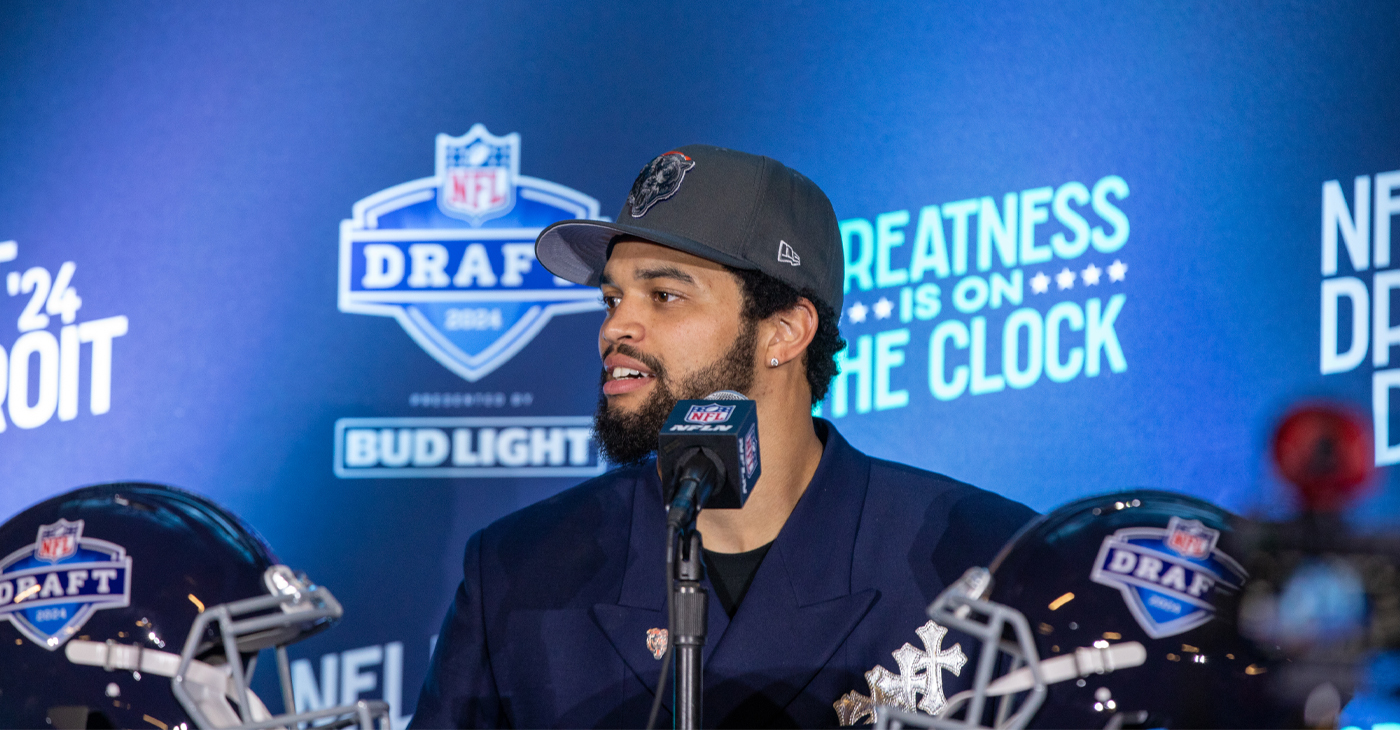
Chicago Bears quarterback Caleb Williams was helped off the field with a right leg injury with 7:42 remaining in the fourth quarter. Williams was down, writhing in pain after scrambling to his left. After departing the injury tent, Williams raised his right fist, acknowledging the crowd while expressing his frustration. Testing will commence on Monday to find out more details about his injury.
“We’ll know tomorrow,” Johnson admitted regarding Williams’ injury. “He’s in good spirits. He’s a team player.”
Williams finished the day with 138 passing yards and one interception.
“I’m actually happy it’s nothing with the knee — that was my first inclination,” Johnson said. “But, a hamstring could be pretty damaging as well. So, we’ll see. We’ll see how bad it is tomorrow and we’ll go from there.”
Bryce Young once again dominated the Falcons
Carolina Panthers quarterback Bryce Young is 5-1 against the Atlanta Falcons and is undefeated at Mercedes-Benz Stadium. Today, Young threw for 287 yards and three touchdowns as he led the Panthers to a 34-3 dismembering of the Atlanta Falcons. Georgia Tech alumnus Darren Waller caught two touchdowns and linebacker Devin Lloyd returned one of his two interceptions for a touchdown.
Cooper Rush started his second straight game for the Falcons and it did not go well. The partisan crowd voiced their displeasure after Rush completed 10/17 passes for 86 yards and two interceptions. Jack Strand entered the game for Rush prompting cheers from the Falcons fans. The rookie threw a pick-six on his first career pass attempt. Strand was the first QB to accomplish that feat since Sam Darnold in 2018 and is the first Falcons player to do that since Brett Favre in 1991. Strand finished the day with 59 passing yards and 16 rushing yards.
According to reports, quarterback Michael Penix, Jr. is expected to make his season debut this Thursday at the Green Bay Packers. His return should help the Falcons. They are the first team since the 2008 Rams to not run any plays in the red zone after the first two games to open a season.
The bright spots for the Falcons today were the Spelman College Jaguarettes performing with the Falcons cheerleaders and Florida A&M’s marching band, The Marching 100, also performed during halftime!
Jayden Daniels gets carted off after apparent arm injury
Washington Commanders quarterback Jayden Daniels appeared to injure his left elbow on the final play of the first half in his game against the Dallas Cowboys. During the play, Daniels got stepped on, braced himself for the fall, and his elbow bent the wrong way. Daniels draped a towel over his head as he exited the field on the cart.
He was later ruled out.
Daniels suffered a dislocated elbow to the same arm during week nine of last season against the Washington Commanders, which led to him being shut down for the remainder of the season.
The post NFL: Week Two Recap | Jalen Hurts did not fold; Caleb Williams exits game with injury appeared first on BlackPressUSA.
#NNPA BlackPress
The Complete Negotiation Framework — Every Stage, Every Tactic, Every Win
Master the complete vehicle-purchase negotiation framework with Roosevelt Gist and Roosevelt. Learn every stage, tactic, and win!
The post The Complete Negotiation Framework — Every Stage, Every Tactic, Every Win appeared first on BlackPressUSA.

Roosevelt Gist and Roosevelt deliver the complete vehicle-purchase negotiation framework in Episode 8 of The Color of Our Money Is Green. This episode covers the three foundations of every effective negotiation, the full seven-stage negotiation sequence with exact language for every stage, and five of the most common dealership tactics with the specific response each one requires.
What You Learn in This Episode:
The three foundations that make every negotiation tactic work
The complete seven-stage car-buying negotiation sequence
Exact language for every stage of the dealership conversation
Five common dealership tactics — the turnover, the four-square, the packed payment, spot delivery, and forced add-ons — and how to counter each one
Why signing preliminary paperwork isn’t the same as signing the final contract
___________________________________________________________________
“The Color of Our Money Is Green: A Buyer’s Guide to What Cars Actually Cost” — stan.store/RGist
____________________________________________________________________
AutoNetwork helps serious car shoppers inspect any new vehicle online before walking into a dealership. I’m Roosevelt — I’ve been reviewing cars and shaping digital car buying and credit union auto leasing since before YouTube car reviews existed.
You’ll find detailed walkaround reviews, POV test drives, and buyer-focused breakdowns covering comfort, space, features, and real-world value.

How to use the channel:
Watch the walkaround of the car you’re considering
Visit AutoNetwork.com for the full review
Check CouponsOffersAndDeals.com for current dealer specials
Walk in already knowing what you want — and what it should cost
 AutoNetwork.com
 CouponsOffersAndDeals.com
Affiliate disclosure: some links earn a small commission at no cost to you and help support the channel. Insta360 is one of those partners.
The post The Complete Negotiation Framework — Every Stage, Every Tactic, Every Win appeared first on BlackPressUSA.
#NNPA BlackPress
Mazda CX-90 Luxury: Heated Seats & Premium Comfort! #shorts
Stay toasty in the CX-90! Plush Nappa leather, heated/ventilated seats, and a memory-equipped heated steering wheel deliver ultimate luxury.
The post Mazda CX-90 Luxury: Heated Seats & Premium Comfort! #shorts appeared first on BlackPressUSA.

Experience ultimate comfort in the CX-90. Nappa leather, heated/ventilated seats, 8-way power adjustments, and memory settings for both front passengers. The heated steering wheel with memory tilt/telescope adds premium convenience.
 Watch the full video: https://youtu.be/EH5A4eQ4ipY
#AutoNetwork
The post Mazda CX-90 Luxury: Heated Seats & Premium Comfort! #shorts appeared first on BlackPressUSA.



Oakland Launches Aerbits Program to Identify, Report Abandoned Trash

Mayor Lee Announces $1 Million Kaiser Permanente Grant for Pilot Program to Address Homelessness, Clean Up Public Spaces throughout Oakland

Alameda County DA Ursula Jones Dickson Says Key to Optimal Use of DA’s Office Is Knowledge

Oakland Post: Week of September 16 – 22, 2026

NFL: Week Two Recap | Jalen Hurts did not fold; Caleb Williams exits game with injury

The Complete Negotiation Framework — Every Stage, Every Tactic, Every Win

Mazda CX-90 Luxury: Heated Seats & Premium Comfort! #shorts

Car Dashboard Glare: Avoid This Distraction! #shorts

Mazda CX-90 Safety: All Driver Assistance Features Explained #shorts

Subaru Outback: 19-Inch Wheels & 8.8″ Ground Clearance! #shorts

Unlock Car Deals: Avoid Hidden Costs & Negotiate Smarter #shorts

Event Preview: ‘Fashion v. Fascism’ – A Runway Revolution Is Coming to the Bay Area

Live from CBC 📱

Live from CBC

5 Easy Car Checks Before You Sign! #shorts

Department of Homeland Security Demands California Secretary of State Shirley N. Weber Scrub Voter Rolls

“The Power to See Threats Sooner”: Gov. Newsom, Safety Officials Showcase California’s Investments in Hi-Tech Wildfire Prevention

California Sen. Padilla Joins Colleagues to Introduce Bill Imposing Term Limits on Supreme Court Justices

Less Affluent School Districts, Including Sacramento City, Face Threat of State Takeover

Car Wash Workers Cope with Lingering Impacts of ICE Raids

ESSAY: California Can Close Its Colorectal Cancer Gap

As Part of Your Back-to- School Checklist, Vaccinate

Oakland ‘Port Serves as a Powerful Engine for Good Jobs and Economic Development

Gov. Newsom Announces $109.6 Million in Funding for 278 Supportive Homes in Bakersfield, Contra Costa, Sacramento and Fresno

California Hispanic Chambers of Commerce Unveils: ‘Powering the Future’ Theme for 47th Annual Statewide Convention

Congresswoman Simon Demands Investigation into Trump’s Abuse of Emergency Powers for Coal Export Terminal in West Oakland

Four Candidates, Including Incumbent Barbara Lee, Qualify for Oakland Mayor’s Race

Oakland Post: Week of August 12 – 18, 2026

From Blueprint to Breakthrough: Tackling Affordable Housing in Oakland

Oakland Observes Black August with Block Parties, Film Showings, Workshops

The Conversation With Al McFarlane 6/23/26

Media Monday 6/22/26

LIVE! ASK ALMA! — TUES. 6.23.26 7PM EST

Car Buying Secrets: 4 Hidden Checks Before You Sign!

Is This 550 HP Charger Worth YOUR Money? AutoNetwork Review

Celebrating Juneteenth – Frederick Douglass on education and resistance

LIVE! — ASK ALMA! — TUES. 6.19.26 7PM EST

Hyundai Ioniq 5 Parking, Safety, and 360 View #shorts

2025 Ioniq 5 New Wiper & Powerful Performance! #shorts

Electric SUV Range: Is 259 Miles Enough? #shorts

EV Charging: How Fast Can You Charge an Electric Vehicle? #shorts

Biometric Cooling… Messaging Seats…Come on! 2025 Infiniti QX80 Autograph 4WD

Charged Up: Witness the Magic of a Fully Electric Car! #shorts

Range Rover Sport PHEV Included…: See What’s Inside This Luxury SUV! #shorts

Invisible Hood View: Perfect Parking with X-Ray Vision! #shorts
-

 Commentary3 weeks ago
Standoff for Justice: Our Homes Are Worth Fighting For
-

 Activism3 weeks ago
Oakland Post: Week of August 26 – September 1, 2026
-

 Business3 weeks ago
Gubernatorial Candidate Steve Hilton Blasts California New Tire Rules; Newsom Hits Back
-

 Business3 weeks ago
Frontier Airlines’ Return to Oakland Airport Brings Flights, Jobs and Opportunity
-

 Business3 weeks ago
Chef Sharon Lee Blends Culinary Excellence, Education and Empowerment
-

 Education3 weeks ago
Gov. Newsom’s Latest Appointees Include Sacramento Advocate for Formerly Incarcerated Students; State’s New Tech Chief
-

 Business3 weeks ago
Oakland Coliseum Project Opens Door for Small Businesses to Build Bigger
-

 Community3 weeks ago
Big City Mayors Ask for “Yes” Vote on Housing Bond Measure; Conservatives Say “No”
