
Bay Area
School District Defends, Community Condemns Arrests of Parents and Teachers at School Board Meeting

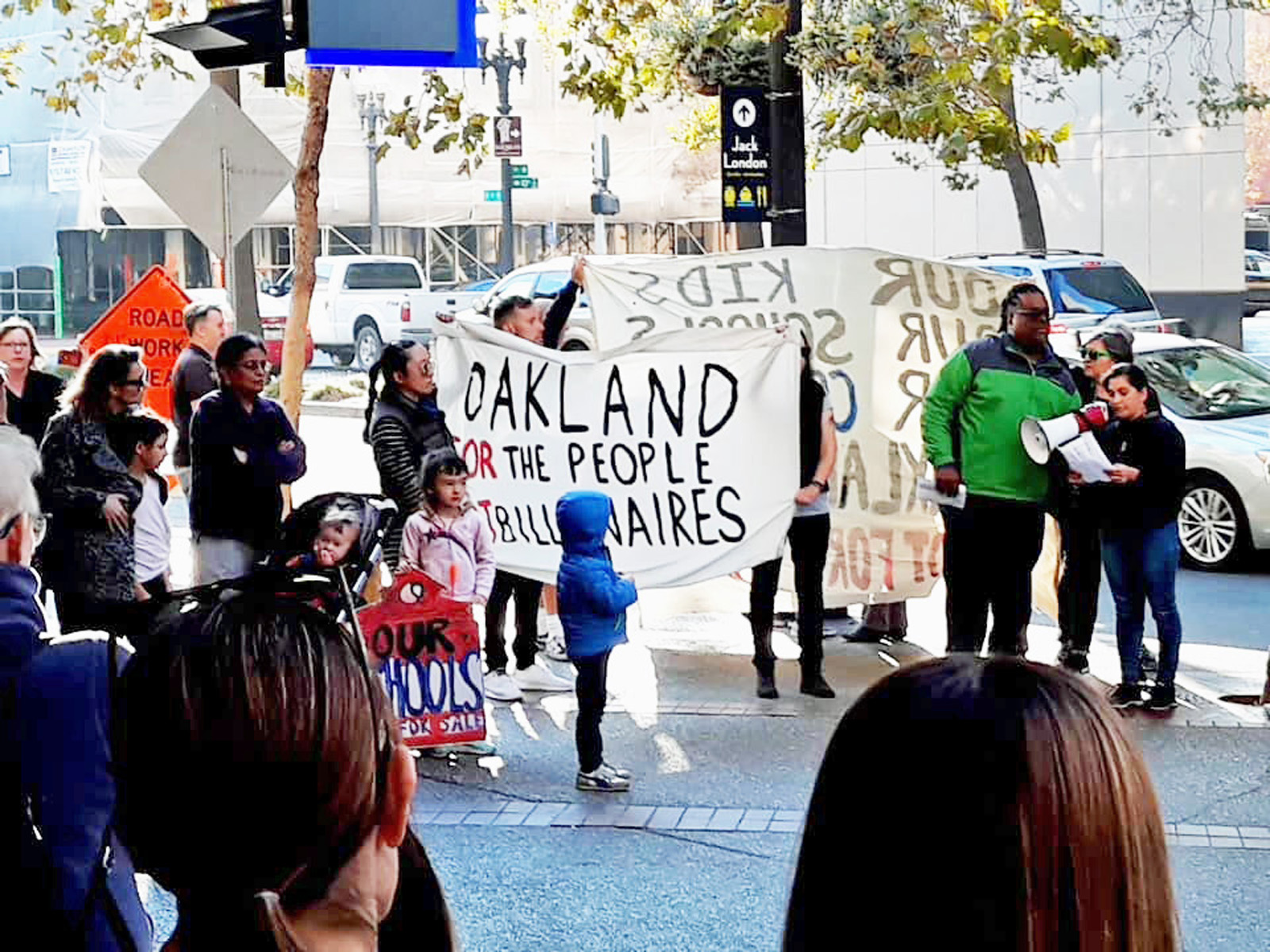
The Board of Education and administration of the Oakland Unified School District (OUSD) are facing a barrage of public criticism after the arrest and injury of six parents and teachers who were protesting at the last school board meeting against the district’s unwillingness to reconsider plans to close or “consolidate” a large number of schools in the coming years.

School officials, speaking at a press conference the day after the arrests, defended the police action as necessary to protect board meetings from disruption to and reaffirmed their commitment to close schools in order to “right size” the district.
Parents and teachers have demonstrated at the previous two school board meetings, forcing the board to move its meetings to a private room without public access. The protests were against school closures that are taking place and the wave of closings that are planned in the next three years. Since 2003, the district has closed 18 schools, 14 of which have become charters. The district has already set up an official school committee to authorize the sale and lease of closed school properties.
Amid huge parent and student protests and a successful school boycott, Roots Academy was closed in early 2019. The board also recently voted to shut down the Kaiser Elementary School campus and Oakland SOL at the end of the 2019 school year. Members of the “Oakland Not for Sale” coalition were ready to commit civil disobedience.
When people arrived at the Oct. 23 board meeting, they saw the board on stage, 29 OUSD police and school security officers stretched in a line in front of the stage and a line of metal police barricades and a line of barricades in front of them. When some parents and teachers attempted to pass through the barricades, they were knocked to the ground and arrested. Some were injured. Five of the arrestees were taken to the OUSD police station at Cole Elementary in West Oakland, cited and released. The sixth arrestee, Kaiser Elementary parent Saru Jayaraman, was taken to a hospital for treatment, cited and released.
Jayaraman, standing on crutches and wearing a leg brace, spoke at a vigil of about 150 teachers and families at the district headquarters in downtown Oakland. There, they opposed school closures and the violent arrests of members of the school community.
“We have gone to three or four school board meetings…with musical instruments, with guitars, with song sheets … and our demands. Those are the weapons we have carried,” she said. And when we walked in on Wednesday with our guitar and our signs and our banners, we were faced with cops who had batons and guns metal barricades — at a public school board meeting with children present. So, I ask you — who is dangerous? The people with signs (who sang) “We shall overcome” or the police who have batons and guns and the school board that directed them to attack us?”
Speaking at the OUSD press conference, District spokesman John Sasaki said, “Going into (Wednesday) night’s meeting, we wanted to be prepared to prevent disruption from happening once again. In an abundance of caution, we decided to protect the Board of Education and staff and to protect the students. We set up a barricade and we had security.”
“Some people began to rush the barrier,” said Sasaki. “For those people on the dais, it wasn’t clear what the goal (of the protesters) was, but it was a highly charged moment. At that point we moved the meeting upstairs and continued. “
OUSD Police Chief Jeff Godown said, “They were there with full intention to commit the crime. You cannot commit the crime. You cannot shut down the meeting.”
Condemning the arrests, California Teachers Association President E. Toby Boyd issued a statement:
“CTA condemns the heinous acts of violence perpetuated Oct. 23 by OUSD police officers against Oakland parents, student and educators who were peacefully protesting proposed school closures. There is no room for these actions in our schools or anywhere in society. We hold responsible the OUSD and supt. Kyla Johnson-Trammell for creating the atmosphere that led to police officers wildly swinging batons at unarmed teachers, parents and student, causing physical injury and emotional distress.”
A statement by Justice 4 Oakland Students (J4OS), a coalition of students, families and teachers, said:
“Using barricades and police violence to silence community voices and harming young people is unacceptable…This is a travesty that the OUSD Board perpetuates and models this use of excessive policing.
“(J4OS) stands against … the OUSD police presence and force ordered by the OUSD Board of Education against students, parents, teachers, and community members who were there to participate in the democratic process, including non-violent protest and disruption. It is our right to speak out and express dissenting opinions and demands in a public forum without the fear of police repression. We demand that the Superintendent and School Board apologize for the barricade created at a pub We demand that you commit to no use of OUSD or OPD Police or barricades at Board Meetings.”








Activism
Oakland Post: Week of September 30 – October 6, 2026
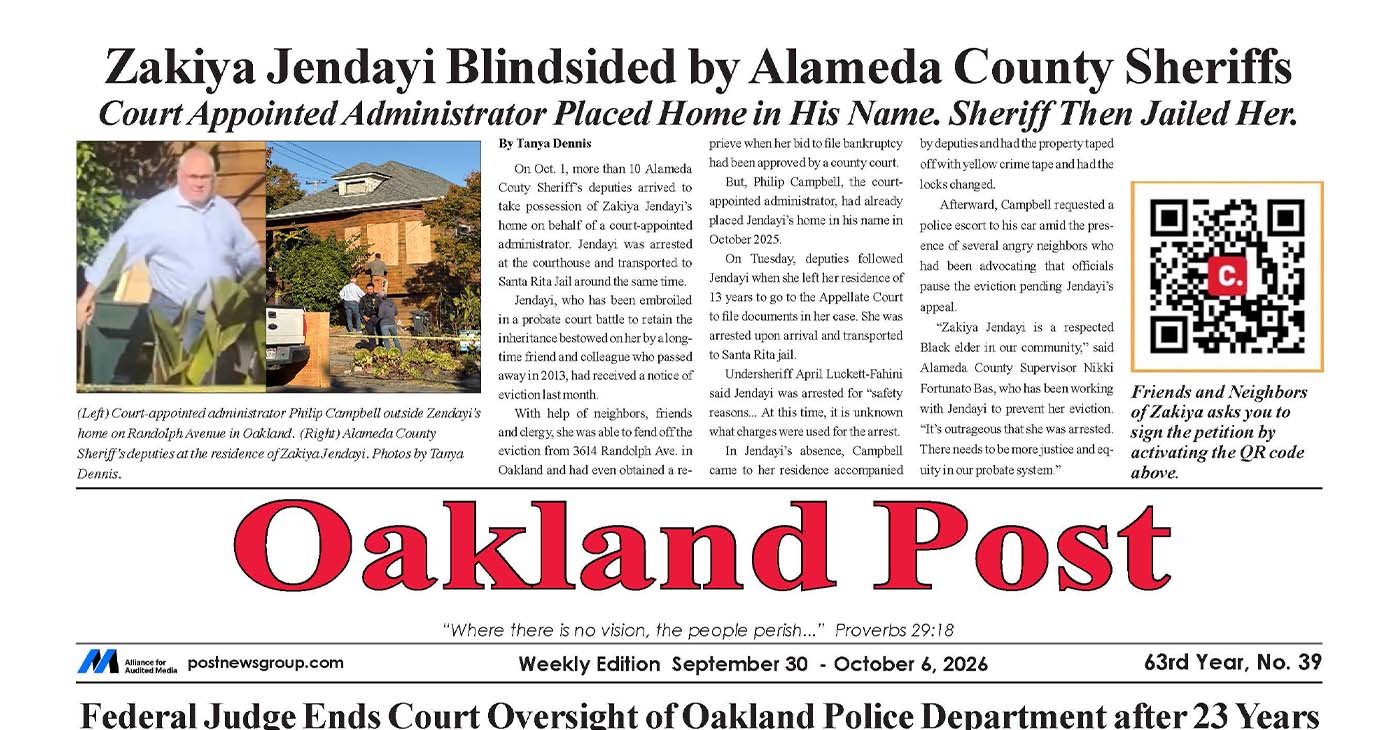
The printed Weekly Edition of the Oakland Post: Week of September 30 – October 6, 2026

To enlarge your view of this issue, use the slider, magnifying glass icon or full page icon in the lower right corner of the browser window.

Activism
Oakland Post: Week of September 23 – 29, 2026
The printed Weekly Edition of the Oakland Post: Week of September 23 – 29, 2026

To enlarge your view of this issue, use the slider, magnifying glass icon or full page icon in the lower right corner of the browser window.
Activism
Oakland Post: Week of September 16 – 22, 2026
The printed Weekly Edition of the Oakland Post: Week of September 16 – 22, 2026

To enlarge your view of this issue, use the slider, magnifying glass icon or full page icon in the lower right corner of the browser window.


Listening as a Lifeline: A Doula’s Witness to Black Maternal Health

New Protections for Ticket Buyers: Gov. Newsom Signs Assemblymember Isaac Bryan’s Bill

‘We Don’t Talk Trash — We Pick Up Trash!’

Zakiya Jendayi Arrested, Locked Out of Home by Sheriff’s Deputies

Oakland Post: Week of September 30 – October 6, 2026

Asm. Corey Jackson Announces Launch of 24-Hour Childcare in His District

IN MEMORIAM: The Rev. Leon “Sonny” Clark, Longtime Orange County Pastor and Community Leader, Dies at 72

Poll: Becerra Widens His Lead Over Hilton; Californians Split on Wealth Tax

From Historic Memories to New Possibilities: Oakland Celebrates Coliseum 60

County Office of Education Says OUSD Finances Are Getting Healthier, Materially Stronger

LIVE FREE Sunday Dinner Brings Faith, Fellowship and Civic Conversation to Oakland

Remembering Chauncey Bailey as Student Journalists Face Threats to Truth-Telling

BLACspace Cooperative Invites Bay Area to Experience Oakland’s Black Cultural Ecosystem Through a BLAC Map Tour + Party

In Wake of Death on Doorstep, Williams Chapel Baptist Church Calls for Better Care, Funding for Unhoused

Oakland Centenarian Nuna McKee Honored!

Standoff for Justice: Our Homes Are Worth Fighting For

Oakland Post: Week of August 26 – September 1, 2026

Frontier Airlines’ Return to Oakland Airport Brings Flights, Jobs and Opportunity

Gubernatorial Candidate Steve Hilton Blasts California New Tire Rules; Newsom Hits Back

Chef Sharon Lee Blends Culinary Excellence, Education and Empowerment

Jackie Wright Champions Bay Area Stories, Filmmakers and Cultural Institutions

Oakland Coliseum Project Opens Door for Small Businesses to Build Bigger

Big City Mayors Ask for “Yes” Vote on Housing Bond Measure; Conservatives Say “No”

Misnamed ‘Parent’ PAC Seeks to Influence Oakland School Board Elections

Gov. Newsom’s Latest Appointees Include Sacramento Advocate for Formerly Incarcerated Students; State’s New Tech Chief

Longtime BWOPA Member Brendalyn Goodall Appointed to California Workforce Development Board

Gov. Newsom Signs Law Shielding Immigration Aid Workers From Doxing Threats

Secretary of State Shirley N. Weber Urges Californians to Vote Early as Voter ID Battle Intensifies

Oakland Post: Week of September 2 – 8, 2026

IN MEMORIAM: Dolly Parton Dead at 80 — How She Built a Legacy of Love and Earned Her Place in Black Culture

The Conversation With Al McFarlane 6/23/26

Media Monday 6/22/26

LIVE! ASK ALMA! — TUES. 6.23.26 7PM EST

Car Buying Secrets: 4 Hidden Checks Before You Sign!

Is This 550 HP Charger Worth YOUR Money? AutoNetwork Review

Celebrating Juneteenth – Frederick Douglass on education and resistance

LIVE! — ASK ALMA! — TUES. 6.19.26 7PM EST

Hyundai Ioniq 5 Parking, Safety, and 360 View #shorts

2025 Ioniq 5 New Wiper & Powerful Performance! #shorts

Electric SUV Range: Is 259 Miles Enough? #shorts

EV Charging: How Fast Can You Charge an Electric Vehicle? #shorts

Biometric Cooling… Messaging Seats…Come on! 2025 Infiniti QX80 Autograph 4WD

Charged Up: Witness the Magic of a Fully Electric Car! #shorts

Range Rover Sport PHEV Included…: See What’s Inside This Luxury SUV! #shorts

Invisible Hood View: Perfect Parking with X-Ray Vision! #shorts
-
 Community3 weeks ago
Misnamed ‘Parent’ PAC Seeks to Influence Oakland School Board Elections
-
 Activism4 weeks ago
Oakland Post: Week of September 2 – 8, 2026
-

 Community3 weeks ago
Richmond Tiny House Village Farm & Garden Set to Open Gates on Sept. 26
-

 Activism3 weeks ago
Oakland Post: Week of September 9 – 15, 2026
-

 Black History3 weeks ago
Latest Massacre in Haiti Reveals Cruelty U.S. Deportations
-

 Black History3 weeks ago
OPINION: Nolan Wells’ Death One of Several Signifying Racial Terror Lives on in U.S. South
-

 Community3 weeks ago
Democratic Clubs Interview Candidates for Oakland School Board
-

 Business2 weeks ago
Mayor Lee Announces $1 Million Kaiser Permanente Grant for Pilot Program to Address Homelessness, Clean Up Public Spaces throughout Oakland
