
Opinion
Opinion: ‘Equal Pay, Equal Pay, Equal Pay’


As the exhausted and thrilled U.S. women’s soccer team celebrated its victory in the finals of the 2019 Women’s World Cup, the cheers of the crowd in the Stade of Lyon soon turned into a chant: “Equal Pay, Equal Pay, Equal Pay.”
Even as they fought their way to the fourth U.S. Women World Cup championship, the U.S. team was waging a battle — in the court of public opinion and the courts of law — for equal treatment in wages, working conditions and investment in the women’s game. And if there is any justice or common sense in the team’s employer, U.S. Soccer, they will be as victorious in the quest for equal pay as they were in their quest for the World Cup.
These are truly American champions. It took immense courage — and no small amount of moxie — to file a class-action lawsuit — joined by all 28 members of the team — alleging gender discrimination by their employer only 93 days before their opening match in the World Cup. This only added immensely to the pressure on them to succeed on the field.
They would be playing for their country, for themselves, but also for all those who will come after them.

One of their leaders — Megan Rapinoe — won the “golden boot” as the top scorer in the World Cup, as well as the Most Valuable Player Award. She accomplished this even while expressing her own values. Trump criticized her for deciding not to sing the national anthem. She announced that she wasn’t interested in going to the White House. Her lavender hair symbolized her celebration of LGBTQ rights.
She naturally became a target of some on the right. She dismissed charges that she was unAmerican: “I’m particularly uniquely and very deeply American. If we want to talk about the ideals we stand for, the song and the anthem, and what we were founded on, I think I’m extremely American.”
She surely got that right. She also had the unified support of her teammates, who praised her as a “warrior” on and off the field, calling it a privilege to be her teammate.
As Christen Press put it, “It’s been beautiful to see her fearlessness as we get to the highest level and the highest stages, that she doesn’t back away, she doesn’t shy, but the opposite: She gets even bigger.”
As did the entire U.S. women’s team. Inspired by the example set by Billie Jean King and Venus Williams in women’s tennis, they took on their employers, criticized FIFA for its unequal treatment of the women’s game, and stood up for equal rights, waging a fight that would benefit their successors if not them.
As Alex Morgan, one of the team’s biggest stars stated, “My hope is that we have equality within football in my career, but I think ultimately it would be good in my lifetime. Even if I don’t reap the benefits, my hope is that the next generation’s sole focus is what it’s meant to be: And that is to play football.”
On Wednesday, the champions were celebrated with a classic Manhattan tickertape parade through the “canyon of heroes” on Broadway. The cheers were deafening; confetti filled the air. Lavender hairdos were seen throughout the crowd. And once more the chant began: “equal pay, equal pay, equal pay.”
Let us all pay tribute to the skill, the courage and the grit of these remarkable young women. They won the cup, even as they waged the fight for justice. They have inspired an entire generation of youngsters who watched their epic play on the field. They have earned the respect of their peers across the world.
Remarkably, the Dutch team posted its own tribute video to the American women before the final game, stating, “You showed us where dedication and ambition can bring you.”
Inspired by the Americans, the level of play is rising across Europe and across the world. And now we must all support them to ensure that they gain justice at home even as they have gained victory abroad.

Activism
Oakland Post: Week of September 9 – 15, 2026
The printed Weekly Edition of the Oakland Post: Week of September 9 – 15, 2026


To enlarge your view of this issue, use the slider, magnifying glass icon or full page icon in the lower right corner of the browser window.

Activism
Oakland Post: Week of September 2 – 8, 2026
The printed Weekly Edition of the Oakland Post: Week of September 2 – 8, 2026
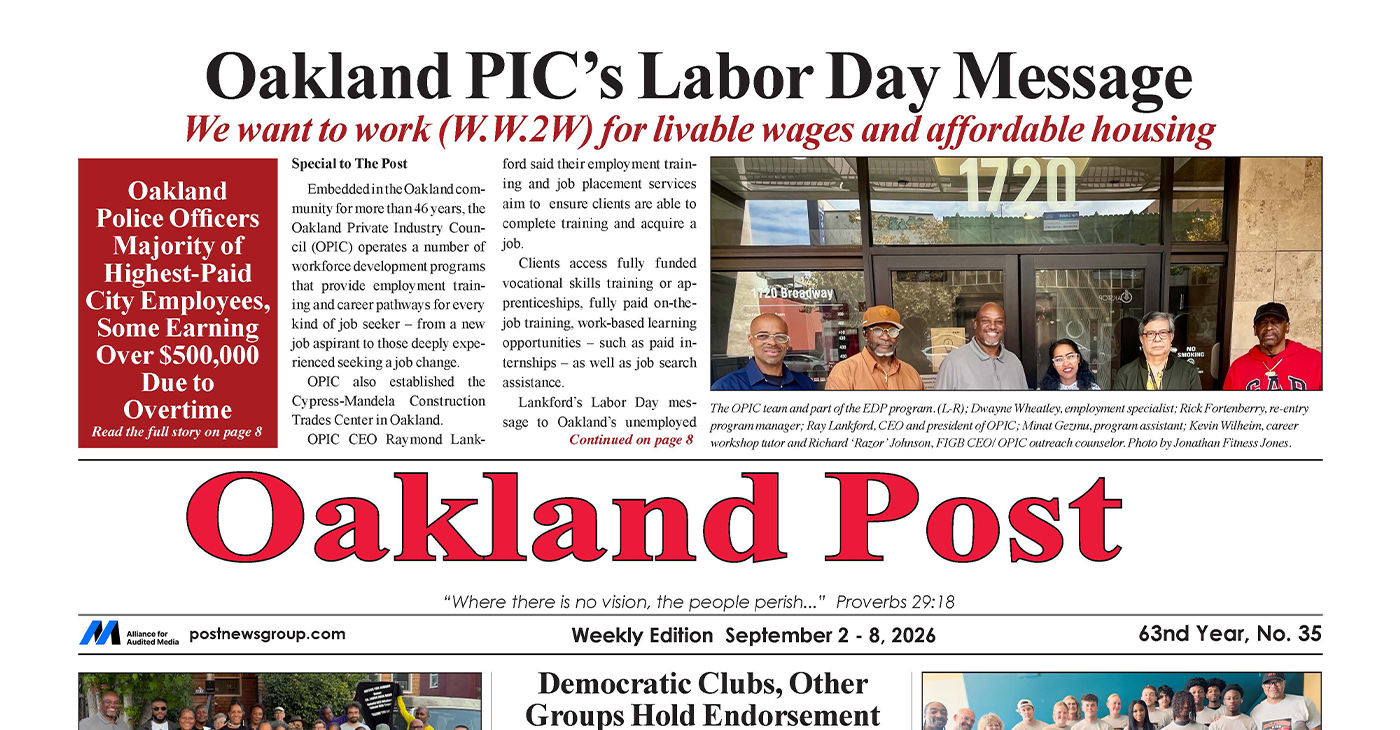
To enlarge your view of this issue, use the slider, magnifying glass icon or full page icon in the lower right corner of the browser window.
Activism
Oakland Post: Week of August 26 – September 1, 2026
The printed Weekly Edition of the Oakland Post: Week of August 26 – September 1, 2026
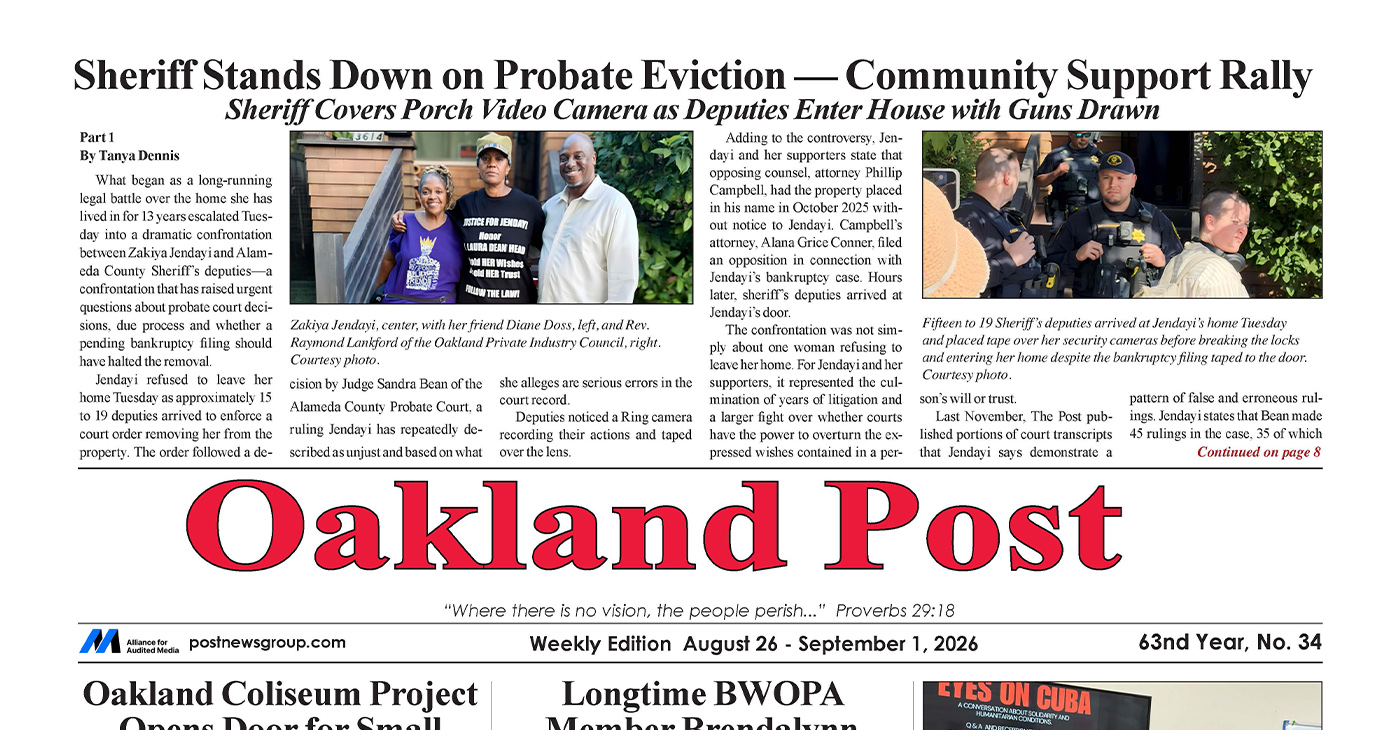
To enlarge your view of this issue, use the slider, magnifying glass icon or full page icon in the lower right corner of the browser window.



Port of Oakland, Army Corps Sign Historic Harbor Design Agreement

Democratic Clubs Interview Candidates for Oakland School Board

Nuna Phillips-McKee Celebrates 100 Years: ‘A Century of Faith, Family and God’s Amazing Grace!’

D.A. Ursula Jones Dickson: Terminix to Pay $3.15 Million Over Illegal Disposal of Pesticides, Customer Records

REPORT: Community Level Policy Is Impacting Homelessness and Drug Abuse in California
OPINION: AI Needs to Know Who Is the Boss
Goldi-Locs and Two (or Three) Bears in the Forest in California Hills

Election Watch 2026: 85% of Eligible Voters in California Are Registered

Don’t Let scammers Crash Your School Year

BOOK REVIEW — Curved Air: A Biography of Sickle Cell Anemia and the Quest to Cure the First Molecular Disease

California’s Legal Cannabis Market Hits $8 Billion as State Touts Progress on Fighting Drugs, Crime

Blacks and Latinos Clash Over LA’s Barrio Run; Mayor Karen Bass Calls for Dialogue Across Racial, Neighborhood Lines

Asm. Smallwood-Cuevas’s Bill Repealing ‘Racist’ CalWORKs ‘Man-in-the-House’ Rule Clears Legislature

Asm. Smallwood-Cuevas’s Bill Repealing ‘Racist’ CalWORKs ‘Man-in-the-House’ Rule Clears Legislature

‘Ready to See These Bills Become Law’: Sen. Weber’s Package of 15 Bills Advance to Gov. Newsom’s Desk

Department of Homeland Security Demands California Secretary of State Shirley N. Weber Scrub Voter Rolls

New Judge Could Decide if Karmelo Anthony Gets a New Trial

“The Power to See Threats Sooner”: Gov. Newsom, Safety Officials Showcase California’s Investments in Hi-Tech Wildfire Prevention

Alpha Kappa Alpha Sorority, Inc. Celebrates New North Atlantic Regional Director

California Sen. Padilla Joins Colleagues to Introduce Bill Imposing Term Limits on Supreme Court Justices

Less Affluent School Districts, Including Sacramento City, Face Threat of State Takeover

Car Wash Workers Cope with Lingering Impacts of ICE Raids

Oakland Post: Week of July 29 – August 4, 2026

How Oakland’s Courtsmith is Scaling its Business and Local Impact

ESSAY: California Can Close Its Colorectal Cancer Gap

Oakland Post: Week of August 5 – 11, 2026

As Part of Your Back-to- School Checklist, Vaccinate

Oakland ‘Port Serves as a Powerful Engine for Good Jobs and Economic Development

Gov. Newsom Signs New Affordable Housing Legislation

Gov. Newsom Announces $109.6 Million in Funding for 278 Supportive Homes in Bakersfield, Contra Costa, Sacramento and Fresno

The Conversation With Al McFarlane 6/23/26

Media Monday 6/22/26

LIVE! ASK ALMA! — TUES. 6.23.26 7PM EST

Car Buying Secrets: 4 Hidden Checks Before You Sign!

Is This 550 HP Charger Worth YOUR Money? AutoNetwork Review

Celebrating Juneteenth – Frederick Douglass on education and resistance

LIVE! — ASK ALMA! — TUES. 6.19.26 7PM EST

Hyundai Ioniq 5 Parking, Safety, and 360 View #shorts

2025 Ioniq 5 New Wiper & Powerful Performance! #shorts

Electric SUV Range: Is 259 Miles Enough? #shorts

EV Charging: How Fast Can You Charge an Electric Vehicle? #shorts

Biometric Cooling… Messaging Seats…Come on! 2025 Infiniti QX80 Autograph 4WD

Charged Up: Witness the Magic of a Fully Electric Car! #shorts

Range Rover Sport PHEV Included…: See What’s Inside This Luxury SUV! #shorts

Invisible Hood View: Perfect Parking with X-Ray Vision! #shorts
-

 Community4 weeks ago
Four Candidates, Including Incumbent Barbara Lee, Qualify for Oakland Mayor’s Race
-

 Commentary2 weeks ago
Standoff for Justice: Our Homes Are Worth Fighting For
-

 Business2 weeks ago
Gubernatorial Candidate Steve Hilton Blasts California New Tire Rules; Newsom Hits Back
-

 Activism2 weeks ago
Oakland Post: Week of August 26 – September 1, 2026
-

 Education2 weeks ago
Gov. Newsom’s Latest Appointees Include Sacramento Advocate for Formerly Incarcerated Students; State’s New Tech Chief
-

 Business2 weeks ago
Frontier Airlines’ Return to Oakland Airport Brings Flights, Jobs and Opportunity
-

 Community2 weeks ago
Big City Mayors Ask for “Yes” Vote on Housing Bond Measure; Conservatives Say “No”
-

 Business2 weeks ago
Oakland Coliseum Project Opens Door for Small Businesses to Build Bigger
