
Opinion
New Year’s Day is Also Emancipation Day

Our nation must fulfill the hopes unleashed by the Emancipation Proclamation
“Then Moses said to the people, ‘Commemorate this day, the day you came out of Egypt, out of the land of slavery, because the Lord brought you out of it with a mighty hand.’” — Exodus: 13:3.
African-American churches across the country, congregants gather to welcome the new year. They sing songs of freedom and overcoming. They testify to how far their faith has brought them and how much faith and courage they will need to face another year.
The tradition is called Watch Night, and it dates back 156 years to when President Abraham Lincoln set forth an essential document of freedom that most Americans have probably never read or thought much about: the Emancipation Proclamation.
The night before the proclamation went into effect on Jan. 1, 1863, free blacks in the North and their enslaved brothers and sisters in the South sat vigil in churches, in shabby slave shacks and in moonlit plantation woods to watch, pray and hope throughout the night to hear news that Lincoln’s promises of freedom had been officially issued and millions of our ancestors were legally free.
The president kept his word — although two more years of slaughter and civil war lay ahead. African-Americans emerged from that long night of waiting and watching with the right to pick up arms and join the military struggle to save the Union as soldiers and aboard “vessels of all sorts.” The proclamation declared that those enslaved in the Confederacy were now “forever free,” and the might of the United States government, “including the military and naval authority thereof, will recognize and maintain the freedom of such persons, and will do no act or acts to repress such persons, or any of them, in any efforts they may make for their actual freedom.”
The proclamation was the most consequential executive order in the history of the United States. It should be celebrated and honored.
For every American who cherishes freedom and democracy, New Year’s Day should mean far more than college bowl games and parades. The nation must revive and reclaim the true meaning and significance of January 1, Emancipation Day.
This January 1 is even more significant in that the year 2019 marks the 400th anniversary of the first documented African slaves’ forced arrival on the shores of the New World that was to become the United States of America. This anniversary year should be a time of commemoration and celebration, reflection — and action — on how far we have come and how far we must still travel to reach the mountaintop.
The journey from slavery to freedom was largely completed in 1865 with the adoption of the 13th Amendment. The march from freedom to equality is far from over.
I spent Christmas morning — as I have for more than 40 years — visiting and praying with the inmates and staff at Cook County Jail, the sprawling warehouse of the poor and dispossessed on the West Side of Chicago. As I looked out over the faces crowded into the jail’s gym, I saw that they were overwhelmingly black and brown.
Although African-Americans make up just 24 percent of the population of Cook County, nearly 74 percent of the jail’s population is black.
This story of inequality was four centuries in the making. It began in August 1619, when some 20 frightened, bewildered and beleaguered Africans arrived in Jamestown, Va., as prizes that had been pirated from Spanish ships on the open seas.
Even as revolutionary Americans rebelled against the British monarchy, declaring all men created equal, the founding fathers at the Constitutional Convention bowed to the South with three slave compromises that still haunt our nation: permitting the international slave trade; counting slaves as three-fifths of a person for congressional representation; and establishing the Electoral College, giving the South congressional representation disproportionate to its voter eligibility.
Yet in the darkness of chattel slavery, the enslaved were able to sustain enough of their humanity to maintain a light of hope for a better day, for freedom and for equality. African- Americans were able to see the dimly lit outlines of a more just social, economic and political order, even during slavery, apartheid and centuries of discrimination. But black people did not wait for freedom to fall from the sky. The Colonial era and beyond bristled with slave rebellions and resistance.
The lies, myths and insanity of white supremacy contaminated the soil and the soul of America. The Academy said African-American minds were inferior. The medical establishment said our bodies were inferior; the church, our morality. The banks determined that we were unworthy for loans or investment. These barriers have yet to be completely broken down. We are free but unequal. Yet still we rise.
History is an unbroken continuity that cannot be denied. Americans should not hide from the past nor engage in an extended exercise of rehashing 400 tragic years. Although there can be no plan for the future without comprehending the past, we cannot go forward while only looking backward.
2019 must be about the vision of a fully equal society.
In the coming year, we must set goals and a timetable for the most profound and in-depth corrective action program in history and show what true equality for all Americans means and looks like.
We must examine how much such repair will cost, what failure to repair has already cost, and the continuing cost to the nation in terms of human and economic underdevelopment if we fail to even the playing field for African-Americans and other people of color.
In 2020, there will be another presidential election. As the candidates campaign in the next two years, they must be challenged to share their vision of what an equal, nondiscriminatory, multiracial, multiethnic, multi-religious and nonsexist society looks like, and how they propose to take us there.
In the meantime, we the people — red, brown, yellow, black and white — must do what African-Americans have done for 400 years, from bondage to emancipation, from lynch mobs to great migrations, from the back of the bus to Rosa Parks, from the Rev. Dr. Martin Luther King Jr. on the balcony of the Lorraine Motel in Memphis to President Barack Obama on the balcony of the White House.
Keep hope alive.
Jesse L. Jackson Sr. (@ RevJJackson) is the founder and president of the Rainbow PUSH Coalition.

Activism
Oakland Post: Week of September 30 – October 6, 2026
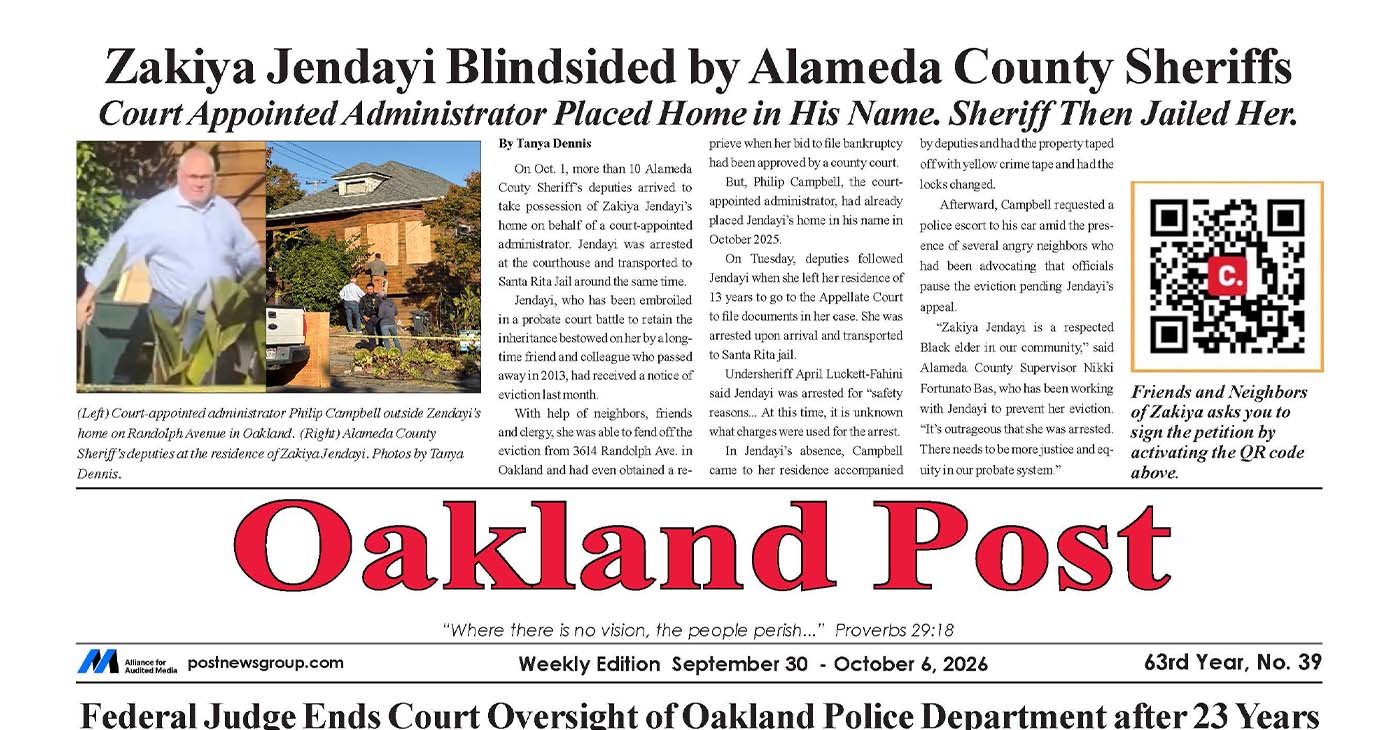
The printed Weekly Edition of the Oakland Post: Week of September 30 – October 6, 2026

To enlarge your view of this issue, use the slider, magnifying glass icon or full page icon in the lower right corner of the browser window.


Activism
Oakland Post: Week of September 23 – 29, 2026
The printed Weekly Edition of the Oakland Post: Week of September 23 – 29, 2026

To enlarge your view of this issue, use the slider, magnifying glass icon or full page icon in the lower right corner of the browser window.
Activism
Oakland Post: Week of September 16 – 22, 2026
The printed Weekly Edition of the Oakland Post: Week of September 16 – 22, 2026

To enlarge your view of this issue, use the slider, magnifying glass icon or full page icon in the lower right corner of the browser window.


OP-ED: Proposition 44 Would Put a Price on Trust

OP-ED: Proposition 40: It’s Time to Play Chess, Not Checkers

Listening as a Lifeline: A Doula’s Witness to Black Maternal Health

New Protections for Ticket Buyers: Gov. Newsom Signs Assemblymember Isaac Bryan’s Bill

‘We Don’t Talk Trash — We Pick Up Trash!’

Zakiya Jendayi Arrested, Locked Out of Home by Sheriff’s Deputies

Oakland Post: Week of September 30 – October 6, 2026

Asm. Corey Jackson Announces Launch of 24-Hour Childcare in His District

IN MEMORIAM: The Rev. Leon “Sonny” Clark, Longtime Orange County Pastor and Community Leader, Dies at 72

Poll: Becerra Widens His Lead Over Hilton; Californians Split on Wealth Tax

From Historic Memories to New Possibilities: Oakland Celebrates Coliseum 60

County Office of Education Says OUSD Finances Are Getting Healthier, Materially Stronger

LIVE FREE Sunday Dinner Brings Faith, Fellowship and Civic Conversation to Oakland

Remembering Chauncey Bailey as Student Journalists Face Threats to Truth-Telling

BLACspace Cooperative Invites Bay Area to Experience Oakland’s Black Cultural Ecosystem Through a BLAC Map Tour + Party

Standoff for Justice: Our Homes Are Worth Fighting For

Oakland Post: Week of August 26 – September 1, 2026

Frontier Airlines’ Return to Oakland Airport Brings Flights, Jobs and Opportunity

Gubernatorial Candidate Steve Hilton Blasts California New Tire Rules; Newsom Hits Back

Chef Sharon Lee Blends Culinary Excellence, Education and Empowerment

Jackie Wright Champions Bay Area Stories, Filmmakers and Cultural Institutions

Misnamed ‘Parent’ PAC Seeks to Influence Oakland School Board Elections

Oakland Coliseum Project Opens Door for Small Businesses to Build Bigger

Big City Mayors Ask for “Yes” Vote on Housing Bond Measure; Conservatives Say “No”

Gov. Newsom’s Latest Appointees Include Sacramento Advocate for Formerly Incarcerated Students; State’s New Tech Chief

Longtime BWOPA Member Brendalyn Goodall Appointed to California Workforce Development Board

Gov. Newsom Signs Law Shielding Immigration Aid Workers From Doxing Threats

Secretary of State Shirley N. Weber Urges Californians to Vote Early as Voter ID Battle Intensifies

Oakland Post: Week of September 2 – 8, 2026

IN MEMORIAM: Dolly Parton Dead at 80 — How She Built a Legacy of Love and Earned Her Place in Black Culture

The Conversation With Al McFarlane 6/23/26

Media Monday 6/22/26

LIVE! ASK ALMA! — TUES. 6.23.26 7PM EST

Car Buying Secrets: 4 Hidden Checks Before You Sign!

Is This 550 HP Charger Worth YOUR Money? AutoNetwork Review

Celebrating Juneteenth – Frederick Douglass on education and resistance

LIVE! — ASK ALMA! — TUES. 6.19.26 7PM EST

Hyundai Ioniq 5 Parking, Safety, and 360 View #shorts

2025 Ioniq 5 New Wiper & Powerful Performance! #shorts

Electric SUV Range: Is 259 Miles Enough? #shorts

EV Charging: How Fast Can You Charge an Electric Vehicle? #shorts

Biometric Cooling… Messaging Seats…Come on! 2025 Infiniti QX80 Autograph 4WD

Charged Up: Witness the Magic of a Fully Electric Car! #shorts

Range Rover Sport PHEV Included…: See What’s Inside This Luxury SUV! #shorts

Invisible Hood View: Perfect Parking with X-Ray Vision! #shorts
-
 Community3 weeks ago
Misnamed ‘Parent’ PAC Seeks to Influence Oakland School Board Elections
-
 Activism4 weeks ago
Oakland Post: Week of September 2 – 8, 2026
-

 Activism3 weeks ago
Oakland Post: Week of September 9 – 15, 2026
-

 Community3 weeks ago
Richmond Tiny House Village Farm & Garden Set to Open Gates on Sept. 26
-

 Black History3 weeks ago
Latest Massacre in Haiti Reveals Cruelty U.S. Deportations
-

 Black History3 weeks ago
OPINION: Nolan Wells’ Death One of Several Signifying Racial Terror Lives on in U.S. South
-

 Business2 weeks ago
Mayor Lee Announces $1 Million Kaiser Permanente Grant for Pilot Program to Address Homelessness, Clean Up Public Spaces throughout Oakland
-

 Community3 weeks ago
Democratic Clubs Interview Candidates for Oakland School Board
