
Opinion
Opinion: State Needs to Help Maintain, Not Close, Oakland Schools

The Oakland school district is considering closing 24 more public schools. Oakland has already closed 15 schools, even though the city population is growing.
An extensive study of public school closures, conducted by the National Education Policy Center, indicates that closing schools in urban communities does not save money and causes the greatest harm to the lowest income students.
Closures do not save money on buildings, because the district may be forced to give the closed facility to a charter school, and the school to which students are transferred often needs renovation to accommodate the transferring students.
Closing schools disrupts the lives of children and drives more students out of the district, resulting in lower enrollment and further budget problems. A 2012 audit of Washington, D.C.’s closure of 23 schools found that the cost of the closures was $39 million, four times what the district was expected to save.
In Oakland, the school closings are especially unfair. Of the 24 threatened schools, all are in the low-income flatland neighborhoods; zero are in the affluent hill area; and zero are charter schools. The 15 schools that were already closed are also in the lower-income areas. When these facts are raised the hand-wringing begins. “We know these are difficult decisions, but…”
These are not difficult decisions. They are wrong and unnecessary decisions. So, who is making them?
In 2003 the state took over the Oakland school district, a step which has since been condemned by many. The district argued that it did not need a loan because it could borrow from its own construction bonds, a step which had been taken by other districts. At the insistence of then-state Sen. Don Perata, the state imposed a $100 million loan which was three times more than the highest estimate of the district deficit.
The power of the elected school board was removed; a series of state administrators had total authority over the funds with no input from anyone in Oakland. Most of the money was spent on items that had nothing to do with the stated purpose of the takeover — correcting the finances. And, by the end of the takeover period, the district’s finances were in worse shape than before the state took control.
Yet the state continued its power over the district through the non-elected, Bakersfield-based Fiscal Crisis Management and Assistance Team and a state trustee. With all this “help,” the district now owes $40 million, which is more than the highest estimate of what Oakland needed in 2003.
There are other ways that the state makes both the financial and educational situation difficult. The state is in charge of who gets to teach. Its nonelected, nearly invisible Commission on Teacher Credentialing increases bureaucratic requirements, tests and fees almost every year, leading to an artificial teacher shortage, particularly of Latino and African American teachers who are least likely to afford the extra time and money required to jump through the ever-expanding series of hoops. A school with a constantly rotating set of temporary teachers is unlikely to be the first choice of parents.
And then there are the charter school laws, which do not allow a district to control how many charters open within its jurisdiction and will not allow districts to close any of them.
The State of California is the fifth largest economy in the world. It has a super-majority of Democrats in its Legislature and a large budget surplus. Yet for 15 years, it has played the role of hostile mortgage-holder to the Oakland schools.
The State of California needs to rescind the remaining debt, help the district maintain rather than close its community schools, and reform the laws that make quality education for non-affluent Californians impossible. We hope that newly elected State Superintendent of Public Instruction Tony Thurmond will take up that task.
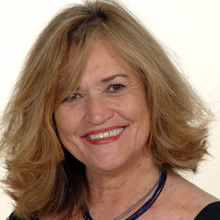
Kitty Kelly Epstein is an education professor and the author of two books about Oakland. This column was first published on Dec. 19 in the San Francisco Chronicle.


Activism
Oakland Post: Week of September 30 – October 6, 2026
The printed Weekly Edition of the Oakland Post: Week of September 30 – October 6, 2026


To enlarge your view of this issue, use the slider, magnifying glass icon or full page icon in the lower right corner of the browser window.


Activism
Oakland Post: Week of September 23 – 29, 2026
The printed Weekly Edition of the Oakland Post: Week of September 23 – 29, 2026
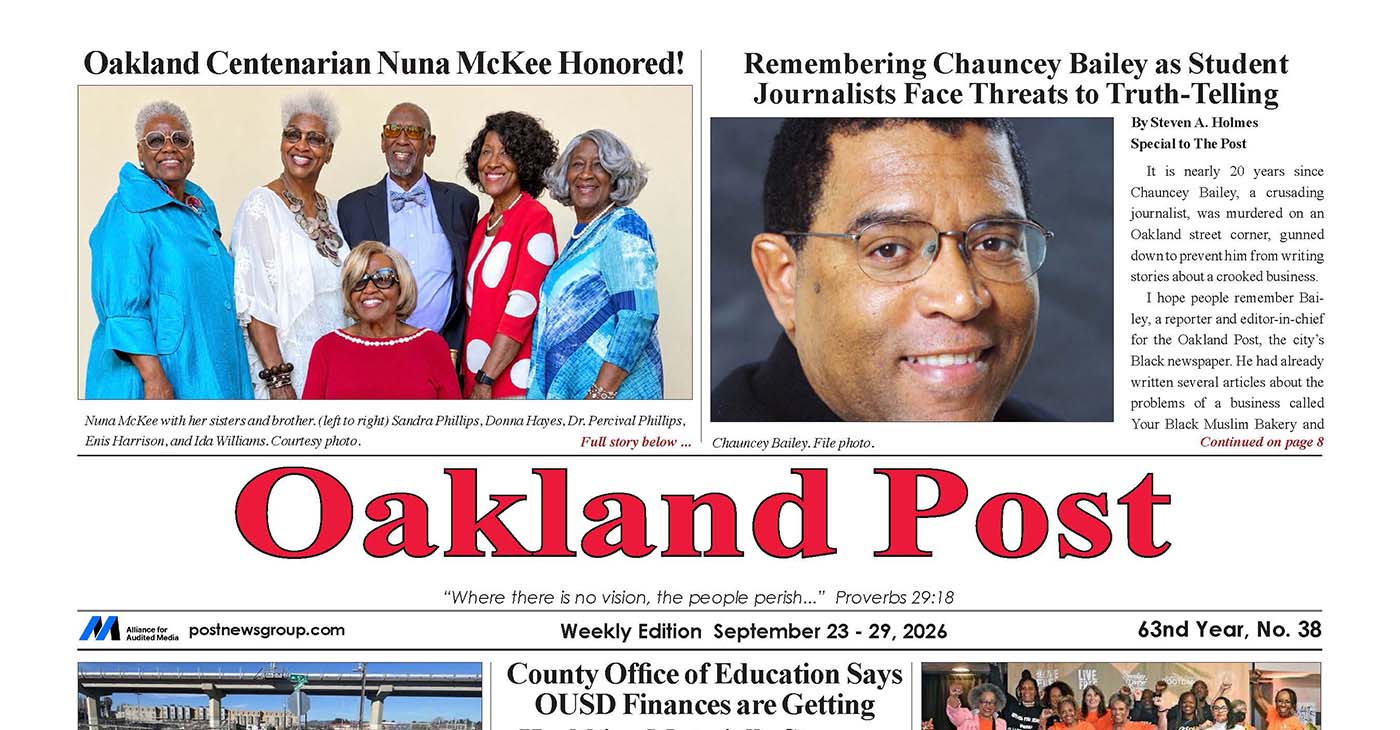
To enlarge your view of this issue, use the slider, magnifying glass icon or full page icon in the lower right corner of the browser window.
Activism
Oakland Post: Week of September 16 – 22, 2026
The printed Weekly Edition of the Oakland Post: Week of September 16 – 22, 2026

To enlarge your view of this issue, use the slider, magnifying glass icon or full page icon in the lower right corner of the browser window.



OP-ED: Proposition 44 Would Put a Price on Trust

OP-ED: Proposition 40: It’s Time to Play Chess, Not Checkers

Listening as a Lifeline: A Doula’s Witness to Black Maternal Health

New Protections for Ticket Buyers: Gov. Newsom Signs Assemblymember Isaac Bryan’s Bill

‘We Don’t Talk Trash — We Pick Up Trash!’

Zakiya Jendayi Arrested, Locked Out of Home by Sheriff’s Deputies

Oakland Post: Week of September 30 – October 6, 2026

Asm. Corey Jackson Announces Launch of 24-Hour Childcare in His District

IN MEMORIAM: The Rev. Leon “Sonny” Clark, Longtime Orange County Pastor and Community Leader, Dies at 72

Poll: Becerra Widens His Lead Over Hilton; Californians Split on Wealth Tax

From Historic Memories to New Possibilities: Oakland Celebrates Coliseum 60

County Office of Education Says OUSD Finances Are Getting Healthier, Materially Stronger

LIVE FREE Sunday Dinner Brings Faith, Fellowship and Civic Conversation to Oakland

Remembering Chauncey Bailey as Student Journalists Face Threats to Truth-Telling

BLACspace Cooperative Invites Bay Area to Experience Oakland’s Black Cultural Ecosystem Through a BLAC Map Tour + Party

Standoff for Justice: Our Homes Are Worth Fighting For

Oakland Post: Week of August 26 – September 1, 2026

Frontier Airlines’ Return to Oakland Airport Brings Flights, Jobs and Opportunity

Gubernatorial Candidate Steve Hilton Blasts California New Tire Rules; Newsom Hits Back

Chef Sharon Lee Blends Culinary Excellence, Education and Empowerment

Jackie Wright Champions Bay Area Stories, Filmmakers and Cultural Institutions

Misnamed ‘Parent’ PAC Seeks to Influence Oakland School Board Elections

Oakland Coliseum Project Opens Door for Small Businesses to Build Bigger

Big City Mayors Ask for “Yes” Vote on Housing Bond Measure; Conservatives Say “No”

Gov. Newsom’s Latest Appointees Include Sacramento Advocate for Formerly Incarcerated Students; State’s New Tech Chief

Longtime BWOPA Member Brendalyn Goodall Appointed to California Workforce Development Board

Gov. Newsom Signs Law Shielding Immigration Aid Workers From Doxing Threats

Secretary of State Shirley N. Weber Urges Californians to Vote Early as Voter ID Battle Intensifies

Oakland Post: Week of September 2 – 8, 2026

IN MEMORIAM: Dolly Parton Dead at 80 — How She Built a Legacy of Love and Earned Her Place in Black Culture

The Conversation With Al McFarlane 6/23/26

Media Monday 6/22/26

LIVE! ASK ALMA! — TUES. 6.23.26 7PM EST

Car Buying Secrets: 4 Hidden Checks Before You Sign!

Is This 550 HP Charger Worth YOUR Money? AutoNetwork Review

Celebrating Juneteenth – Frederick Douglass on education and resistance

LIVE! — ASK ALMA! — TUES. 6.19.26 7PM EST

Hyundai Ioniq 5 Parking, Safety, and 360 View #shorts

2025 Ioniq 5 New Wiper & Powerful Performance! #shorts

Electric SUV Range: Is 259 Miles Enough? #shorts

EV Charging: How Fast Can You Charge an Electric Vehicle? #shorts

Biometric Cooling… Messaging Seats…Come on! 2025 Infiniti QX80 Autograph 4WD

Charged Up: Witness the Magic of a Fully Electric Car! #shorts

Range Rover Sport PHEV Included…: See What’s Inside This Luxury SUV! #shorts

Invisible Hood View: Perfect Parking with X-Ray Vision! #shorts
-
 Community3 weeks ago
Misnamed ‘Parent’ PAC Seeks to Influence Oakland School Board Elections
-
 Activism4 weeks ago
Oakland Post: Week of September 2 – 8, 2026
-

 Activism3 weeks ago
Oakland Post: Week of September 9 – 15, 2026
-

 Community3 weeks ago
Richmond Tiny House Village Farm & Garden Set to Open Gates on Sept. 26
-

 Black History3 weeks ago
Latest Massacre in Haiti Reveals Cruelty U.S. Deportations
-

 Black History3 weeks ago
OPINION: Nolan Wells’ Death One of Several Signifying Racial Terror Lives on in U.S. South
-

 Business2 weeks ago
Mayor Lee Announces $1 Million Kaiser Permanente Grant for Pilot Program to Address Homelessness, Clean Up Public Spaces throughout Oakland
-

 Community3 weeks ago
Democratic Clubs Interview Candidates for Oakland School Board
