
News
Detroit native and Morehouse grad promised to have students loans paid off by billionaire
MICHIGAN COURIER — When recent Morehouse College graduate Kristopher Mathis moves to Chicago July 15 to start as a sales consultant at Amazon, he will not have to worry about student loans. That is because billionaire Robert F. Smith told the all-male Morehouse class of 2019 that he would pay off the student loans for the entire class of 396. The total amount Is estimated at $40 million.

When recent Morehouse College graduate Kristopher Mathis moves to Chicago July 15 to start as a sales consultant at Amazon, he will not have to worry about student loans. That is because billionaire Robert F. Smith told the all-male Morehouse class of 2019 that he would pay off the student loans for the entire class of 396. The total amount Is estimated at $40 million.

Mathis, 21, who hails from the East English Village neighborhood on Detroit’s east side, and graduated from University of Detroit Jesuit High School in 2015, was looking at roughly $57,000 in student loan debt prior to Smith’s commencement speech May 19. Debt that could have taken him years to pay off was gone with 11 words from Smith’s mouth.
“I was shocked, and I had to take a double take,” said Mathis, who graduated cum laude, with a degree in business administration, with a concentration in marketing and a minor in sales. “I honestly couldn’t process what he had just said. Immediately after he said that, my mom texted me and told me to thank him. And that’s just what I did.
“When I was getting my diploma on stage, Mr. Smith was there. I shook his hand and told him that he was a true blessing, not only to myself, but to the other 395 brothers who were in my gradutiaon class.”

In the fall of 2015, 750 males started off as freshmen at Morehouse College, which has produced icons such as Rev. Dr. Martin Luther King Jr., Spike Lee, Julian Bond, Herman Cain, and many others. By graduation day Sunday, only 396 walked across the stage in Atlanta. Mathis believes many students left because they could not afford the $50,000 per year it takes to study at Morehouse College.
“I know I couldn’t 50,000 a year,” said Mathis. “But my first year, I took that leap of faith, understanding that Morehouse was where I wanted to be. I created a plan for how I was going to get things paid for and in the end, God blessed me to where I don’t have to worry about that now, thanks to Mr. Smith and his generosity.”
Finances play a vital part in deciding which college to attend. For Mathis, he took the advice of his Midnight Golf Program mentors and others to get as many scholarships as he could. In the end, he took out a loan to cover part of his $50,000 per year costs for tuition, room and board at Morehouse. He credits that experience with helping him get serious his senior year of high school and is still close with his Midnight Golf friends and mentors.
The Midnight Golf Program was founded in 2001 by Reneé Fluker, a social worker and single mother who noticed the impact golf had on her son’s life. Today, the program serves 250 Detroit area high school seniors annually, participating in a 30-week curriculum to learn the game of golf, build relationships with mentors, and develop life skills required for college and career success. Midnight Golf helps seniors enter college and continues mentoring throughout college and into the graduates’ professional careers.
“Kris is one of our stars of Midnight Golf,” said Winston Coffee, College Liaison and College Success Coach for Midnight Golf. “You could tell early in our program that he was a determined young person and his choice of Morehouse made perfect since. We’ve been proud of his matriculation and watched as he seized opportunities in Atlanta. When we heard about the generous gift to the Morehouse graduates, we were thrilled for Kris and his family.”
Student loan debt has become a national crisis. Over 44 million borrowers owe more than $1.5 billion collectively and the student loan delinquency rate remains relatively high at 11.4 percent. Worse, more than 609,000 people owe more than $200,000 on their student loan, and 1.3 million owe between $100,000 and $150,000. It is a scary reality for many Americans, having to payback money for college they do not have.
For Mathis, he said he was blessed to only owe about $57,000 and not the six figures that others in his class owed prior to Smith’s gift. He comes from a middle-class working family and a large majority of his loans were taken out by his parents under the Parent PLUS loan program. It is not clear what all will be covered under Smith’s promise, but Mathis and his parents, Derrick and Printess, were all smiling after the news.
“A month or two from now, I was expecting to receive a bill from the government for my student loans,” said Mathis. “Now I can save more of my money and begin into invest in things that will make my money work for me. Ultimately, Mr. Smith has put me in a better financial situation, as well as my family.”
Mathis said he is proud to be a Morehouse man now and wants to reciprocate the gift Smith gave to him to future Morehouse graduates, maybe not in terms of money but through mentorship. But first, he wants to see Smith follow through with his own promise.
“I’m very curious to see the terms and conditions of Mr. Smith’s promise. I want to see the fine print,” said Mathis. “I know that he has the means and power to wipeout all the student loans debts and the Parent PLUS loans, but I’m hoping he follows through. That was a big statement to make and I’m looking forward to see how the process will play out.”
Morehouse College provided a statement on Smith’s financial promise. He received an honorary doctorate from Morehouse during the ceremony and had already announced a $1.5 million gift to the school.
“We, at Morehouse College, would like to thank Vista Equity Partners founder, Chairman & CEO Robert F. Smith, our honorary alumnus, for the surprise gift that he offered to the graduating class at Morehouse’s 135th Commencement ceremony. To be free from the financial burden of paying off student loans will be life-changing for the Class of 2019. Our Office of Business and Finance, as well as our Office of Enrollment Management, have been working diligently to calculate the student loan debt and other details of this gift. As soon as we have a final figure, we will share it with our new graduates so that they can continue on the path to careers and top-tier graduate schools student loan debt free.”
This article originally appeared in the Michigan Chronicle.













To enlarge your view of this issue, use the slider, magnifying glass icon or full page icon in the lower right corner of the browser window.
Community
Mayor Barbara Lee Holds Special State of the City Address in Deep East Oakland
In partnership with Rise East and the 40×40 Council, Oakland Mayor Barbara Lee held a special 2026 State of the City East Oakland community conversation on Oct. 14. The purpose of bringing a State of the City address directly to the community was to celebrate East Oakland, highli

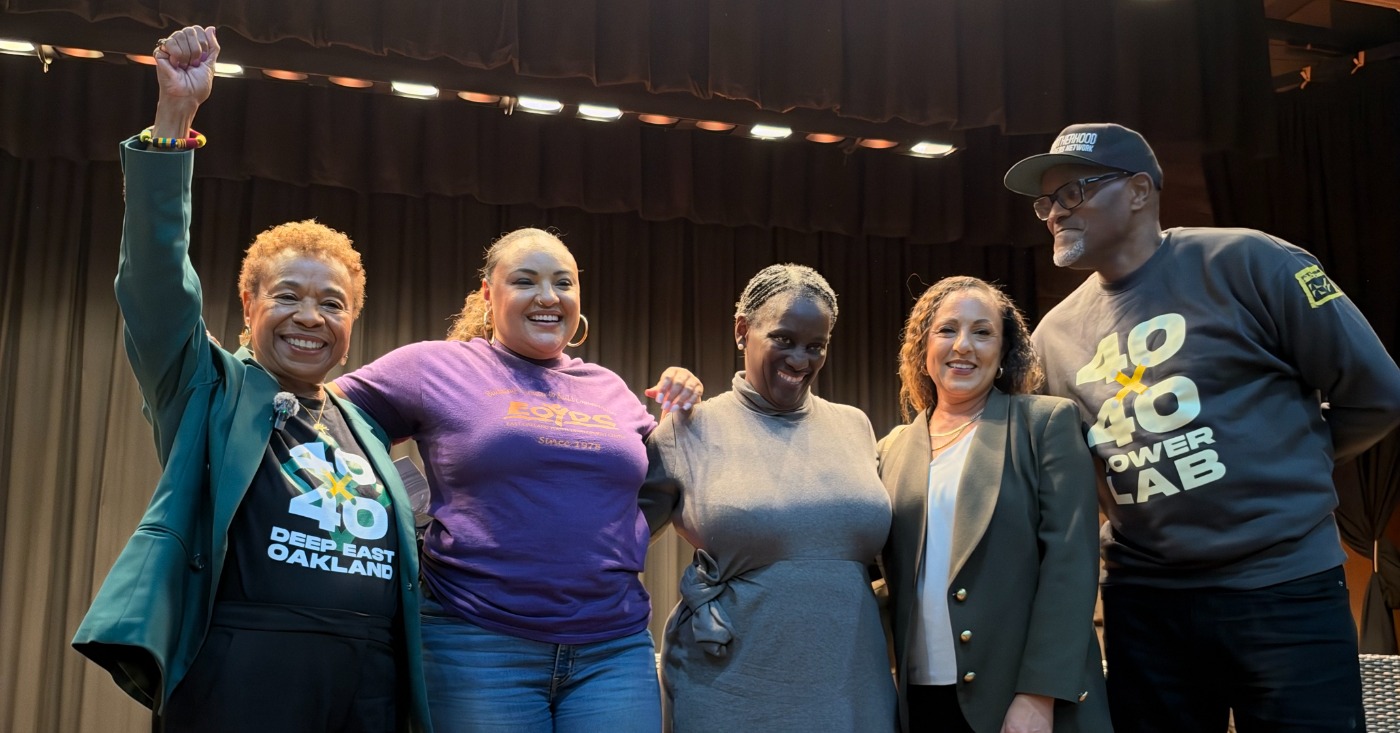
In partnership with Rise East and the 40×40 Council, Oakland Mayor Barbara Lee held a special 2026 State of the City East Oakland community conversation on Oct. 14.
The purpose of bringing a State of the City address directly to the community was to celebrate East Oakland, highlight the work underway, and look ahead to what neighbors, local businesses, youth, funders, community organizations, and partners can accomplish together.
Held at the Roots Community Health/Parker Elementary School Campus at 7929 Ney Ave., the event was emceed by special guest Mark Curry, Oakland native, comedian, and actor.
Lee shared how Rise East and the 40×40 Council have brought together the knowledge, relationships, and resources of people and organizations committed to East Oakland.
Residents bring lived experience, community organizations bring trusted relationships and philanthropy, and businesses bring resources and opportunity, she said, then turned to the government’s role: public investment, services and policy.
But, Lee intoned, City Hall has a responsibility to help connect those efforts.
“I am committed to listening to residents, working across departments and sectors, and helping open doors to opportunity. We must connect neighborhood priorities to the decisions we make about housing, economic development, safety, health and our young people.

City Hall “must be accountable for the results,” Lee said. “The measure of success is what families experience: greater stability, more opportunity and a stronger sense that they belong and have a future here.
“Tonight is an opportunity to listen to the leaders doing this work, learn what is making a difference and identify where we can do more together,” the mayor said.
Lee went on to moderate a ‘fireside chat’ on the theme: Building Oakland’s Future Together — From Neighborhood Investment to Community Empowerment with:
- Selena Wilson, CEO, East Oakland Youth Development Center
- Greg Hodge, CEO, Brotherhood of Elders
- Carolyn “CJ” Johnson, CEO, Black Cultural Zone
- Dr. Noha Aboelata, CEO, Roots Health Center
Mayor Barbara Lee’s media relations department provided this report.

To enlarge your view of this issue, use the slider, magnifying glass icon or full page icon in the lower right corner of the browser window.



Oakland Probate Dispute Raises Questions About Court-Ordered Property Transfer and Missing Notice

‘Raising a Child Shouldn’t Break the Bank’: California Is Helping Families Save on Childcare Costs

Secretary of State Shirley Weber Pushes Back Against DOJ Demands Over California Voter Rolls

Chase Launches Fraud & Scam Prevention Month

U.S. Rep. Simon Secures More Than $1 Million for Public Safety at Mills College at Northeastern University Oakland, Surrounding Neighborhood

COMMENTARY: Valarie Bachelor and Jennfier Brouhard are Excellent School Board Members and Deserve to Be Reelected

Oakland Faith Leaders Gather to Revitalize the Interdenominational Ministerial Alliance of Oakland

Statue of ‘La Catrina,’ a Beloved Symbol of Dia de Los Muertos, Visits Oakland

Oakland Honors 60 Years of the Black Panther Party at the All Power to the People Gala

Fate of Bay Area Public Transit Hinges on Regional Transit Measure

Why AC Transit Director Joel Young is My Choice for AC Transit Board Ward 3

Oakland Post: Week of October 21 – 27, 2026

Mayor Barbara Lee Holds Special State of the City Address in Deep East Oakland

Practitioners of African Traditional Spirituality Offer Ancestral Reverence Ritual Oct. 31

It’s Time to Lose Weight Before the Holidays

Misnamed ‘Parent’ PAC Seeks to Influence Oakland School Board Elections

Listening as a Lifeline: A Doula’s Witness to Black Maternal Health

Poll: Becerra Widens His Lead Over Hilton; Californians Split on Wealth Tax

County Office of Education Says OUSD Finances Are Getting Healthier, Materially Stronger

Oakland Post: Week of September 9 – 15, 2026

Doulas Are Helping Black California Moms Navigate Pregnancy–Even as High Mortality Rates Persist

Zakiya Jendayi Arrested, Locked Out of Home by Sheriff’s Deputies

Mayor Lee Announces $1 Million Kaiser Permanente Grant for Pilot Program to Address Homelessness, Clean Up Public Spaces throughout Oakland

Richmond Tiny House Village Farm & Garden Set to Open Gates on Sept. 26

BLACspace Cooperative Invites Bay Area to Experience Oakland’s Black Cultural Ecosystem Through a BLAC Map Tour + Party

OPINION: Nolan Wells’ Death One of Several Signifying Racial Terror Lives on in U.S. South

Latest Massacre in Haiti Reveals Cruelty U.S. Deportations

Oakland People’s Arms Embargo Coalition Demands End to Military Shipments Thru Oakland

Oakland Post: Week of September 16 – 22, 2026

Democratic Clubs Interview Candidates for Oakland School Board

The Conversation With Al McFarlane 6/23/26

Media Monday 6/22/26

LIVE! ASK ALMA! — TUES. 6.23.26 7PM EST

Car Buying Secrets: 4 Hidden Checks Before You Sign!

Is This 550 HP Charger Worth YOUR Money? AutoNetwork Review

Celebrating Juneteenth – Frederick Douglass on education and resistance

LIVE! — ASK ALMA! — TUES. 6.19.26 7PM EST

Hyundai Ioniq 5 Parking, Safety, and 360 View #shorts

2025 Ioniq 5 New Wiper & Powerful Performance! #shorts

Electric SUV Range: Is 259 Miles Enough? #shorts

EV Charging: How Fast Can You Charge an Electric Vehicle? #shorts

Biometric Cooling… Messaging Seats…Come on! 2025 Infiniti QX80 Autograph 4WD

Charged Up: Witness the Magic of a Fully Electric Car! #shorts

Range Rover Sport PHEV Included…: See What’s Inside This Luxury SUV! #shorts

Invisible Hood View: Perfect Parking with X-Ray Vision! #shorts
-
 Black History3 weeks ago
Listening as a Lifeline: A Doula’s Witness to Black Maternal Health
-
 Economy4 weeks ago
Poll: Becerra Widens His Lead Over Hilton; Californians Split on Wealth Tax
-
 Business4 weeks ago
County Office of Education Says OUSD Finances Are Getting Healthier, Materially Stronger
-
 Lead Story3 weeks ago
Zakiya Jendayi Arrested, Locked Out of Home by Sheriff’s Deputies
-
 Art4 weeks ago
BLACspace Cooperative Invites Bay Area to Experience Oakland’s Black Cultural Ecosystem Through a BLAC Map Tour + Party
-

 Business4 weeks ago
From Historic Memories to New Possibilities: Oakland Celebrates Coliseum 60
-
 Community4 weeks ago
Asm. Corey Jackson Announces Launch of 24-Hour Childcare in His District
-
 Black History4 weeks ago
IN MEMORIAM: The Rev. Leon “Sonny” Clark, Longtime Orange County Pastor and Community Leader, Dies at 72
