
Economics
Perils of Probate

In the early 1900s in the Bay Area, African-American lawyers were unwelcome and faced hostile opposition in the legal community.
It was not until 1943 that the American Bar Association allowed Black Attorneys into their organization, and although local bar associations admitted Blacks, their practice was restricted.
In 1955, the first African-American Bar Association, the Charles Houston Law Club, was formed in the Bay Area by 32 African American lawyers. Many went on to become judges, ambassadors, mayors, county supervisors and successful businessmen.
One of those founders was attorney Hiawatha T. Roberts, an advocate and champion of civil rights causes during the 62 years of his career.
Known for his “solo guerrilla lawyering” tactics, Roberts, guided by G.B. Gipson, of the East Bay Democratic Club and Assemblyman Byron Rumford, fought for the integration of the drug store at 13th and Broadway in Oakland that for years had refused service to Blacks.
Roberts served as general counsel for the United Auto Worker (UAW), obtaining integrated housing for minorities near the Ford plant in Milpitas.
He integrated the realtor organization so that Blacks could become members, assisting Ray Collins’ appointment as president to the Alameda County Board. To assure a fair price for homes, Roberts represented Russell City African American’s facing annexation to the City of Hayward, who previously were offered pennies on the dollar in order to use the property to build houses for white folks.

In 1958, Roberts turned from criminal to civil court practice. From 1956 to the present, he has practiced probate law where he discovered discriminatory practices and a “white male only” policy that has denied him fees of approximately $1 million.
Racial discrimination against him began in 2008 while representing Milburn Fort, who died with a $200,000 Deed of Trust on his condo on Lake Merritt.
Upon Fort’s death, the $200,000 dollar lien was on the property, with no written document it secured. This made transfer of the property or the closing of the estate impossible.
It took 17 years of litigation to find the secret judgment regarding the note on the property.
Judge Marshall Whitley, an African-American seated in Probate court, encouraged Roberts to proceed to litigate the matter to conclusion although the estate had run out of money.
Roberts invested $65,000 of his personal money and incurred fees exceeding $235,000. On the eve of closing the estate, Judge Whitley removed Fort’s son as executor, denying the son access to the property even though his nephew had offered $400,000.
The judge appointed attorney Dwayne Leonard as special administrator, who sold the property for $300,000. He then paid off liens and inferior claims to creditors with the exception of Roberts, who he allowed $11,000 on his claim of over $300,000, a priority claim by law.
“When Black lawyers in Alameda County are representing clients, the judge inevitably appoints a court representative for the estate,” said Roberts.
“ There is a 25 court appointed attorney (on a) list – all white males – and those white administrators often make no effort to represent the desires of family members desiring to keep their property.
“They request exorbitant fees while cutting Black attorney fees 40 percent to 50 percent, which only covers overhead. The end result is a denial of profit.
“I’ve made no money, and this has happened to me at least six times, rendering me insolvent. This is a gross violation of the judge’s discretion to the point that it is illegal.
“At age 89, I am now insolvent, leaving my wife and I to live solely on social security at $2,600 a month, while the court has denied me close to a million dollars in fees over the past 10 years.
“I have sought an audience with probate judges for years regarding this racial injustice to no avail.”


Activism
Oakland Post: Week of September 30 – October 6, 2026
The printed Weekly Edition of the Oakland Post: Week of September 30 – October 6, 2026

To enlarge your view of this issue, use the slider, magnifying glass icon or full page icon in the lower right corner of the browser window.
Activism
Oakland Post: Week of September 23 – 29, 2026
The printed Weekly Edition of the Oakland Post: Week of September 23 – 29, 2026

To enlarge your view of this issue, use the slider, magnifying glass icon or full page icon in the lower right corner of the browser window.
Activism
Oakland Post: Week of September 16 – 22, 2026
The printed Weekly Edition of the Oakland Post: Week of September 16 – 22, 2026
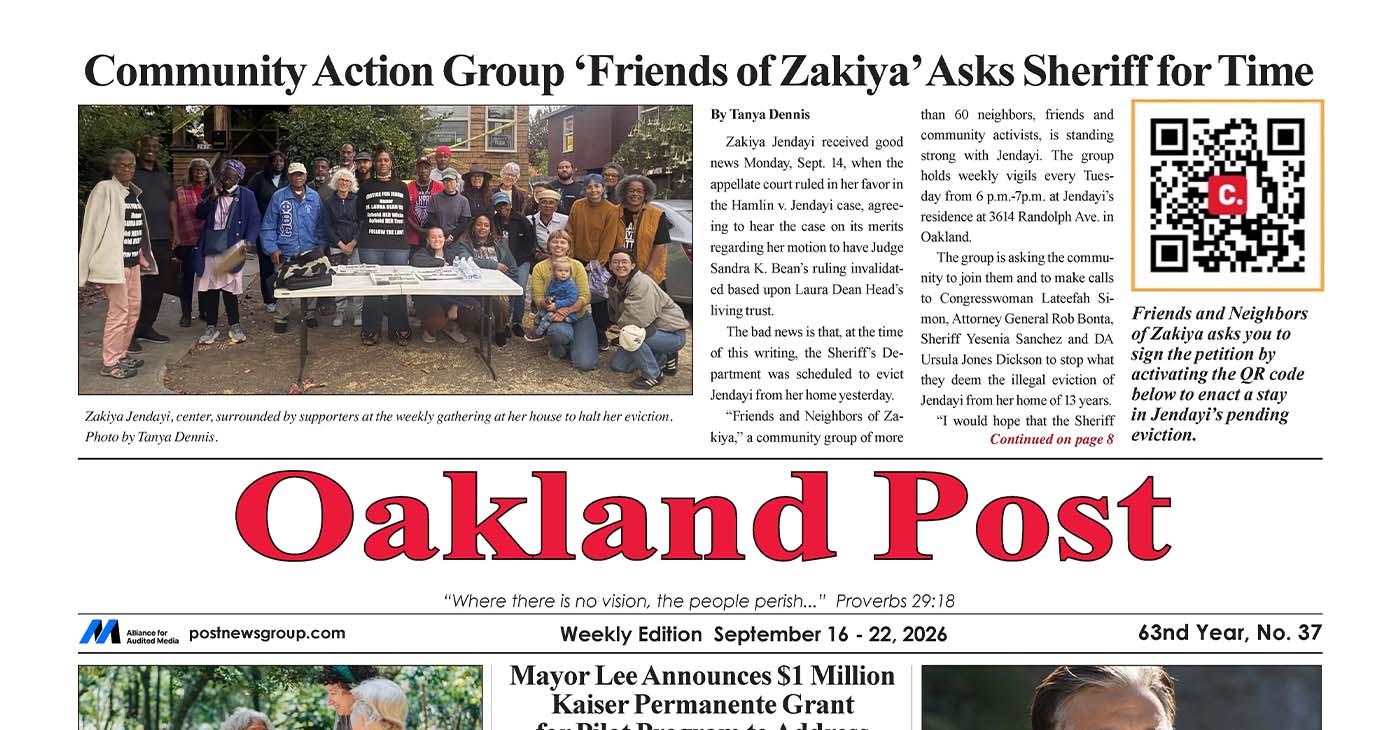
To enlarge your view of this issue, use the slider, magnifying glass icon or full page icon in the lower right corner of the browser window.




OP-ED: Proposition 44 Would Put a Price on Trust

OP-ED: Proposition 40: It’s Time to Play Chess, Not Checkers

Listening as a Lifeline: A Doula’s Witness to Black Maternal Health

New Protections for Ticket Buyers: Gov. Newsom Signs Assemblymember Isaac Bryan’s Bill

‘We Don’t Talk Trash — We Pick Up Trash!’

Zakiya Jendayi Arrested, Locked Out of Home by Sheriff’s Deputies

Oakland Post: Week of September 30 – October 6, 2026

Asm. Corey Jackson Announces Launch of 24-Hour Childcare in His District

IN MEMORIAM: The Rev. Leon “Sonny” Clark, Longtime Orange County Pastor and Community Leader, Dies at 72

Poll: Becerra Widens His Lead Over Hilton; Californians Split on Wealth Tax

From Historic Memories to New Possibilities: Oakland Celebrates Coliseum 60

County Office of Education Says OUSD Finances Are Getting Healthier, Materially Stronger

LIVE FREE Sunday Dinner Brings Faith, Fellowship and Civic Conversation to Oakland

Remembering Chauncey Bailey as Student Journalists Face Threats to Truth-Telling

BLACspace Cooperative Invites Bay Area to Experience Oakland’s Black Cultural Ecosystem Through a BLAC Map Tour + Party

Standoff for Justice: Our Homes Are Worth Fighting For

Oakland Post: Week of August 26 – September 1, 2026

Frontier Airlines’ Return to Oakland Airport Brings Flights, Jobs and Opportunity

Gubernatorial Candidate Steve Hilton Blasts California New Tire Rules; Newsom Hits Back

Chef Sharon Lee Blends Culinary Excellence, Education and Empowerment

Jackie Wright Champions Bay Area Stories, Filmmakers and Cultural Institutions

Misnamed ‘Parent’ PAC Seeks to Influence Oakland School Board Elections

Oakland Coliseum Project Opens Door for Small Businesses to Build Bigger

Big City Mayors Ask for “Yes” Vote on Housing Bond Measure; Conservatives Say “No”

Gov. Newsom’s Latest Appointees Include Sacramento Advocate for Formerly Incarcerated Students; State’s New Tech Chief

Longtime BWOPA Member Brendalyn Goodall Appointed to California Workforce Development Board

Gov. Newsom Signs Law Shielding Immigration Aid Workers From Doxing Threats

Oakland Post: Week of September 2 – 8, 2026

Secretary of State Shirley N. Weber Urges Californians to Vote Early as Voter ID Battle Intensifies

IN MEMORIAM: Dolly Parton Dead at 80 — How She Built a Legacy of Love and Earned Her Place in Black Culture

The Conversation With Al McFarlane 6/23/26

Media Monday 6/22/26

LIVE! ASK ALMA! — TUES. 6.23.26 7PM EST

Car Buying Secrets: 4 Hidden Checks Before You Sign!

Is This 550 HP Charger Worth YOUR Money? AutoNetwork Review

Celebrating Juneteenth – Frederick Douglass on education and resistance

LIVE! — ASK ALMA! — TUES. 6.19.26 7PM EST

Hyundai Ioniq 5 Parking, Safety, and 360 View #shorts

2025 Ioniq 5 New Wiper & Powerful Performance! #shorts

Electric SUV Range: Is 259 Miles Enough? #shorts

EV Charging: How Fast Can You Charge an Electric Vehicle? #shorts

Biometric Cooling… Messaging Seats…Come on! 2025 Infiniti QX80 Autograph 4WD

Charged Up: Witness the Magic of a Fully Electric Car! #shorts

Range Rover Sport PHEV Included…: See What’s Inside This Luxury SUV! #shorts

Invisible Hood View: Perfect Parking with X-Ray Vision! #shorts
-
 Community3 weeks ago
Misnamed ‘Parent’ PAC Seeks to Influence Oakland School Board Elections
-

 Activism3 weeks ago
Oakland Post: Week of September 9 – 15, 2026
-

 Community3 weeks ago
Richmond Tiny House Village Farm & Garden Set to Open Gates on Sept. 26
-

 Black History3 weeks ago
Latest Massacre in Haiti Reveals Cruelty U.S. Deportations
-

 Black History3 weeks ago
OPINION: Nolan Wells’ Death One of Several Signifying Racial Terror Lives on in U.S. South
-

 Business2 weeks ago
Mayor Lee Announces $1 Million Kaiser Permanente Grant for Pilot Program to Address Homelessness, Clean Up Public Spaces throughout Oakland
-

 Community3 weeks ago
Democratic Clubs Interview Candidates for Oakland School Board
-

 Uncategorized3 weeks ago
NBA All-Star Damian Lillard Returns Home for 15th Annual Backpack Giveaway
