
#NNPA BlackPress
Rest in Peace: Local Leaders Step Up to Protect the Sacred Remains of the ‘Sugar Land 95’
NNPA NEWSWIRE — This past week, the Fort Bend ISD (FBISD) Board of Trustees unanimously voted to no longer move forward with any legal actions related to the historic cemetery where the 95 individuals, commonly known as the ‘Sugar Land 95’, were discovered by a contractor back in February of 2018 while working on the initial phase of FBISD’s planned site of the James Reese Career and Technical Center.

By Jeffrey L. Boney, NNPA Newswire Contributor
The arc of the moral universe is bending towards justice for the 95 victims of the unjust and inhumane convict-leasing system in Texas, who were previously lost to history.
This past week, the Fort Bend ISD (FBISD) Board of Trustees unanimously voted to no longer move forward with any legal actions related to the historic cemetery where the 95 individuals, commonly known as the ‘Sugar Land 95’, were discovered by a contractor back in February of 2018 while working on the initial phase of FBISD’s planned site of the James Reese Career and Technical Center. The game changing decision by FBISD came a week after the Fort Bend County Commissioners Court led the way by unanimously voting to work with FBISD to come up with an interlocal agreement to best handle the sacred site where the remains were found.
In a statement released by FBISD Board President Jason Burdine regarding the decision, he states:
“Fort Bend ISD agrees that the ‘Sugar Land 95’ need to be memorialized at the site of discovery. We have embraced the offer made by Fort Bend County to work with us to create an appropriate memorial for the victims of the convict leasing system. We are hopeful and optimistic that by working together with the County these bodies can be reinterred so they can rest in peace. Should we encounter any obstacles to this solution, we will look to the State of Texas, other elected officials, as well as lawmakers, to assist us in finding a solution.
“We appreciate and welcome the County’s recent commitment to work with the District toward a solution that preserves the story and memory of those buried on this historic site. In order to show our good faith and commitment to working toward a comprehensive solution, the District will halt all further court action while we explore all available options with the County.
“The District’s plan to build the portion of the building that is within the cemetery area has been cancelled. We are confident that our partnership with the County will result in a solution that allows the historic cemetery to operate by a legally authorized entity. We look forward to working with local elected officials and community leaders to implement this solution as quickly as possible and keep our promise to honor and educate the public and future generations about the 95 souls who were previously lost to history.”
FBISD had been under serious pressure to halt the construction on the site and work with community leaders to best address the situation. Prior to a coalition of community activists, elected officials and major stakeholders coming together to advocate on behalf of the ‘Sugar Land 95’, all indications were that FBISD was committed to moving forward with their construction plans and were completely disregarding the requests of many in the community.
Newly elected Fort Bend County Judge KP George (D-TX) stated that from his very first day in office, he encouraged Fort Bend County to pursue justice for the ‘Sugar Land 95’ victims.
“I am enthusiastic about the school board’s decision to focus on negotiation as opposed to legal action or construction on the grave sites,” said George. “The community should know that there is still considerable work to be done, and I look forward to making sure that all parties keep justice for the ‘Sugar Land 95’ as their guiding principle.”
U.S. Congressman Al Green (D-TX), who represents constituents in Fort Bend County, joined in with fellow elected officials and community activists to advocate for the ‘Sugar Land 95’ and believes the decision to halt construction was simply the right thing to do.
“I must express my gratitude for the righteous community activists tirelessly working to ensure these 95 bodies are properly memorialized,” said Congressman Green. “It is my honor to advocate for this cause. We have an opportunity to right a wrong. This is an opportunity for us that we will respect the remains of people and treat them with dignity. This is what a great country does. Let’s bring justice to this circumstance.”
The discovery of the remains of the ‘Sugar Land 95’ victims, the majority of who are believed to be former slaves who were a part of the state of Texas’ controversial and inhumane convict-leasing system, could have been unearthed well before the contractor found the remains if people chose to listen to community activist and historian Reginald Moore from the beginning.
Moore, who has served as the caretaker of the Imperial Farm Cemetery in Fort Bend County, constantly tried to inform elected officials, state employees, community leaders and FBISD that those bodies were more than likely buried on the land where they eventually were found.
Moore had always believed the bodies of those former convict-leasing system workers were there, especially because of his experience as a caretaker at historical cemeteries and his work as a correctional officer in the Texas Department of Criminal Justice from 1985 to 1988.
Moore has extensive knowledge about the convict-leasing system, in that he worked in the Beauford H. Jester I and III Units, which is a prison farm located in unincorporated Fort Bend County. The Jester I Farm was the first one built by the state at this site and was known as the Old Harlem Farm. While working at that site, Moore became interested in the history of the prison system and became a major researcher on the subject matter.
After leaving the prison, Moore has continued to serve as a community activist and has sought to highlight and bring awareness to the abuses suffered by prison inmates who were forced to become a part of the Sugar Land convict-leasing system. Moore helped create the Convict Leasing and Labor Project in order to document the abuses of forced labor in the United States, both past and present.
One of the community activists that has been totally engaged and has worked closely with Moore on this issue has been historian Sam Collins. Collins stated that he is thrilled to hear the news about the ‘Sugar Land 95’, but has mixed emotions about the decision by FBISD.
“I am disappointed that Fort Bend ISD stretched this decision out so long,” said Collins. “We expended a great deal of energy and time having to fight. Moving forward, I hope they do not try to capitalize on the remains to recoup the cost they drove up. They should deed the property to the county for one dollar ($1). I look forward to working with the Convict Leasing and Labor Project and Fort Bend County to help educate the public regarding this history.”
Over the past few weeks, State Representative Ron Reynolds of District 27 (D-TX) has filed several bills and resolutions to bring awareness to the travesty of the convict leasing system, and is seeking to ensure there is some reciprocity given to the descendants of those who were subjected to this brutal and inhumane system.
“I am proud to have worked with various committed stakeholders to ensure that Fort Bend ISD did the right thing for the ‘Sugar Land 95’,” said Rep. Reynolds. “Congratulations to ALL the various community activists and elected officials that stepped up to speak truth to power! We are stronger together!”
Rep. Reynolds has filed the following bills and resolutions so far during the 86th Texas Legislative Session:
- Texas House Concurrent Resolution 55, which directs the State Preservation Board to initiate steps to provide for the replacement of the Children of the Confederacy plaque with a plaque to honor victims of the state’s convict leasing system;
- Texas House Bill 2428, which is related to the burial of convict leasing victims and the establishment of a convict leasing victim’s memorial museum to educate the public about the history and after effects of convict leasing in Texas, as well as develop a comprehensive burial treatment plan for the remains of the 95 convict leasing victims;
- Texas House Joint Resolution 87, which proposes a constitutional amendment requiring the payment of reparations to the next of kin of certain victims of the state’s convict leasing system;
- Texas House Bill 2430, which is related to requirements in a lawsuit for the removal of human remains from a cemetery;
- Texas House Bill 2036, which is related to the issuance of permits for the analysis of human remains recovered on state archeological landmarks; and
- Texas House Concurrent Resolution 51, which would create a joint interim committee to study the legacy of convict leasing in Texas.
The National Newspaper Publishers Association (NNPA), a trade group that represents over 200 Black-owned media companies across the U.S., will continue to monitor the status of these bills and resolutions that have been filed in order to see how they will impact the state of Texas and any other states across the country that may have historically identical situations.










#NNPA BlackPress
NFL: Week Two Recap | Jalen Hurts did not fold; Caleb Williams exits game with injury
Philadelphia Eagles quarterback Jalen Hurts found Darius Cooper with nine seconds left for the game winning touchdown as his team beat the Tennessee Titans 24-20 in Nashville. Hurts finished the day 26/37 for 264 yards. He threw for two touchdowns and two interceptions. Prior to the final drive, the Eagles ran 25 plays for 45 […]
The post NFL: Week Two Recap | Jalen Hurts did not fold; Caleb Williams exits game with injury appeared first on BlackPressUSA.
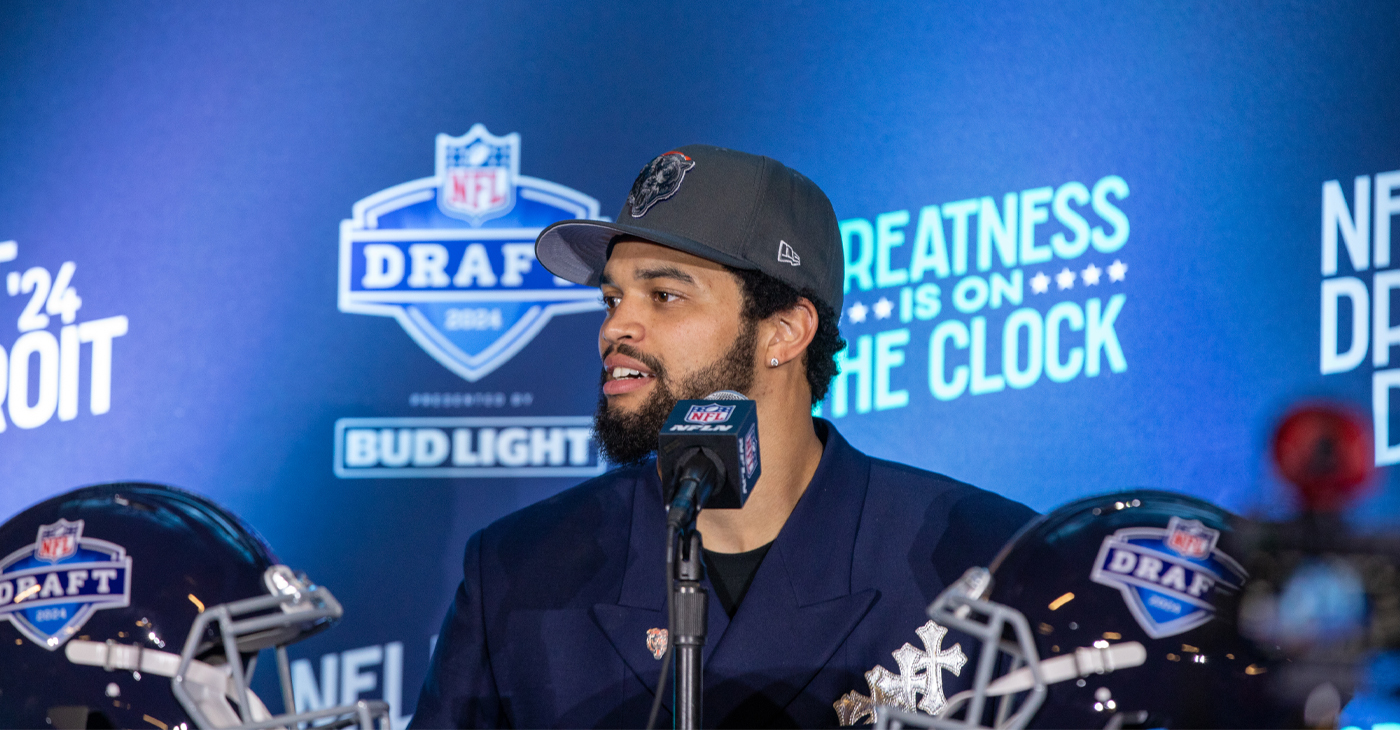
Philadelphia Eagles quarterback Jalen Hurts found Darius Cooper with nine seconds left for the game winning touchdown as his team beat the Tennessee Titans 24-20 in Nashville. Hurts finished the day 26/37 for 264 yards. He threw for two touchdowns and two interceptions.
Prior to the final drive, the Eagles ran 25 plays for 45 yards. During the final drive Hurts went 6-8 with 61 passing yards and the touchdown. Titans defensive tackle — and team captain — Jeffery Simmons said this week that the way to defend Jalen Hurts is to make him “play quarterback.”
Hurts said to Simmons after today’s game: “You started that sh**. I had to finish it.”
Running back Saquon Barkley suffered a stinger in the first half but he ultimately finished the game. He had four carries and nine yards and one catch for eleven yards. He will get an MRI for his injury, but admitted to Cameron Wolfe of the NFL Network he was fine.
Caleb Williams leaves game against Vikings with apparent lower-body injury
Chicago Bears quarterback Caleb Williams was helped off the field with a right leg injury with 7:42 remaining in the fourth quarter. Williams was down, writhing in pain after scrambling to his left. After departing the injury tent, Williams raised his right fist, acknowledging the crowd while expressing his frustration. Testing will commence on Monday to find out more details about his injury.

“We’ll know tomorrow,” Johnson admitted regarding Williams’ injury. “He’s in good spirits. He’s a team player.”
Williams finished the day with 138 passing yards and one interception.
“I’m actually happy it’s nothing with the knee — that was my first inclination,” Johnson said. “But, a hamstring could be pretty damaging as well. So, we’ll see. We’ll see how bad it is tomorrow and we’ll go from there.”
Bryce Young once again dominated the Falcons
Carolina Panthers quarterback Bryce Young is 5-1 against the Atlanta Falcons and is undefeated at Mercedes-Benz Stadium. Today, Young threw for 287 yards and three touchdowns as he led the Panthers to a 34-3 dismembering of the Atlanta Falcons. Georgia Tech alumnus Darren Waller caught two touchdowns and linebacker Devin Lloyd returned one of his two interceptions for a touchdown.
Cooper Rush started his second straight game for the Falcons and it did not go well. The partisan crowd voiced their displeasure after Rush completed 10/17 passes for 86 yards and two interceptions. Jack Strand entered the game for Rush prompting cheers from the Falcons fans. The rookie threw a pick-six on his first career pass attempt. Strand was the first QB to accomplish that feat since Sam Darnold in 2018 and is the first Falcons player to do that since Brett Favre in 1991. Strand finished the day with 59 passing yards and 16 rushing yards.
According to reports, quarterback Michael Penix, Jr. is expected to make his season debut this Thursday at the Green Bay Packers. His return should help the Falcons. They are the first team since the 2008 Rams to not run any plays in the red zone after the first two games to open a season.
The bright spots for the Falcons today were the Spelman College Jaguarettes performing with the Falcons cheerleaders and Florida A&M’s marching band, The Marching 100, also performed during halftime!
Jayden Daniels gets carted off after apparent arm injury
Washington Commanders quarterback Jayden Daniels appeared to injure his left elbow on the final play of the first half in his game against the Dallas Cowboys. During the play, Daniels got stepped on, braced himself for the fall, and his elbow bent the wrong way. Daniels draped a towel over his head as he exited the field on the cart.
He was later ruled out.
Daniels suffered a dislocated elbow to the same arm during week nine of last season against the Washington Commanders, which led to him being shut down for the remainder of the season.
The post NFL: Week Two Recap | Jalen Hurts did not fold; Caleb Williams exits game with injury appeared first on BlackPressUSA.
#NNPA BlackPress
The Complete Negotiation Framework — Every Stage, Every Tactic, Every Win
Master the complete vehicle-purchase negotiation framework with Roosevelt Gist and Roosevelt. Learn every stage, tactic, and win!
The post The Complete Negotiation Framework — Every Stage, Every Tactic, Every Win appeared first on BlackPressUSA.

Roosevelt Gist and Roosevelt deliver the complete vehicle-purchase negotiation framework in Episode 8 of The Color of Our Money Is Green. This episode covers the three foundations of every effective negotiation, the full seven-stage negotiation sequence with exact language for every stage, and five of the most common dealership tactics with the specific response each one requires.
What You Learn in This Episode:
The three foundations that make every negotiation tactic work
The complete seven-stage car-buying negotiation sequence
Exact language for every stage of the dealership conversation
Five common dealership tactics — the turnover, the four-square, the packed payment, spot delivery, and forced add-ons — and how to counter each one
Why signing preliminary paperwork isn’t the same as signing the final contract
___________________________________________________________________
“The Color of Our Money Is Green: A Buyer’s Guide to What Cars Actually Cost” — stan.store/RGist
____________________________________________________________________
AutoNetwork helps serious car shoppers inspect any new vehicle online before walking into a dealership. I’m Roosevelt — I’ve been reviewing cars and shaping digital car buying and credit union auto leasing since before YouTube car reviews existed.
You’ll find detailed walkaround reviews, POV test drives, and buyer-focused breakdowns covering comfort, space, features, and real-world value.

How to use the channel:
Watch the walkaround of the car you’re considering
Visit AutoNetwork.com for the full review
Check CouponsOffersAndDeals.com for current dealer specials
Walk in already knowing what you want — and what it should cost
 AutoNetwork.com
 CouponsOffersAndDeals.com
Affiliate disclosure: some links earn a small commission at no cost to you and help support the channel. Insta360 is one of those partners.
The post The Complete Negotiation Framework — Every Stage, Every Tactic, Every Win appeared first on BlackPressUSA.
#NNPA BlackPress
Mazda CX-90 Luxury: Heated Seats & Premium Comfort! #shorts
Stay toasty in the CX-90! Plush Nappa leather, heated/ventilated seats, and a memory-equipped heated steering wheel deliver ultimate luxury.
The post Mazda CX-90 Luxury: Heated Seats & Premium Comfort! #shorts appeared first on BlackPressUSA.

Experience ultimate comfort in the CX-90. Nappa leather, heated/ventilated seats, 8-way power adjustments, and memory settings for both front passengers. The heated steering wheel with memory tilt/telescope adds premium convenience.
 Watch the full video: https://youtu.be/EH5A4eQ4ipY
#AutoNetwork
The post Mazda CX-90 Luxury: Heated Seats & Premium Comfort! #shorts appeared first on BlackPressUSA.



Asm. Corey Jackson Announces Launch of 24-Hour Childcare in His District

IN MEMORIAM: The Rev. Leon “Sonny” Clark, Longtime Orange County Pastor and Community Leader, Dies at 72

Poll: Becerra Widens His Lead Over Hilton; Californians Split on Wealth Tax

From Historic Memories to New Possibilities: Oakland Celebrates Coliseum 60

County Office of Education Says OUSD Finances Are Getting Healthier, Materially Stronger

LIVE FREE Sunday Dinner Brings Faith, Fellowship and Civic Conversation to Oakland

Remembering Chauncey Bailey as Student Journalists Face Threats to Truth-Telling

BLACspace Cooperative Invites Bay Area to Experience Oakland’s Black Cultural Ecosystem Through a BLAC Map Tour + Party

In Wake of Death on Doorstep, Williams Chapel Baptist Church Calls for Better Care, Funding for Unhoused

Oakland Centenarian Nuna McKee Honored!

Caribbean Nations Produce Action Plan Calling for UK Reparations Over Slavery

Oakland Post: Week of September 23 – 29, 2026

Doulas Are Helping Black California Moms Navigate Pregnancy–Even as High Mortality Rates Persist

Newsom Signs Addictive Social Media Law to Protect Kids

On Your November Ballot: Prop 38 Would Allocate $8.4 Billion to Immunology and Immunotherapy Funding

Less Affluent School Districts, Including Sacramento City, Face Threat of State Takeover

ESSAY: California Can Close Its Colorectal Cancer Gap

California Hispanic Chambers of Commerce Unveils: ‘Powering the Future’ Theme for 47th Annual Statewide Convention

Four Candidates, Including Incumbent Barbara Lee, Qualify for Oakland Mayor’s Race

Oakland Post: Week of August 12 – 18, 2026

From Blueprint to Breakthrough: Tackling Affordable Housing in Oakland

Oakland Observes Black August with Block Parties, Film Showings, Workshops

COMMENTARY: Why Local School Tax Measure G1 Will Not Be on the November Ballot

Standoff for Justice: Our Homes Are Worth Fighting For

Returning to Its Roots, the Oakland Black-Eyed Pea Festival Partners with the Freedom Farmers Market Sept. 12

Oakland Post: Week of August 26 – September 1, 2026

NPRC Scores First Advocacy Victory: David Shaw Finally Gets His Wish to ‘Go Home’

Frontier Airlines’ Return to Oakland Airport Brings Flights, Jobs and Opportunity

Gubernatorial Candidate Steve Hilton Blasts California New Tire Rules; Newsom Hits Back

Chef Sharon Lee Blends Culinary Excellence, Education and Empowerment

The Conversation With Al McFarlane 6/23/26

Media Monday 6/22/26

LIVE! ASK ALMA! — TUES. 6.23.26 7PM EST

Car Buying Secrets: 4 Hidden Checks Before You Sign!

Is This 550 HP Charger Worth YOUR Money? AutoNetwork Review

Celebrating Juneteenth – Frederick Douglass on education and resistance

LIVE! — ASK ALMA! — TUES. 6.19.26 7PM EST

Hyundai Ioniq 5 Parking, Safety, and 360 View #shorts

2025 Ioniq 5 New Wiper & Powerful Performance! #shorts

Electric SUV Range: Is 259 Miles Enough? #shorts

EV Charging: How Fast Can You Charge an Electric Vehicle? #shorts

Biometric Cooling… Messaging Seats…Come on! 2025 Infiniti QX80 Autograph 4WD

Charged Up: Witness the Magic of a Fully Electric Car! #shorts

Range Rover Sport PHEV Included…: See What’s Inside This Luxury SUV! #shorts

Invisible Hood View: Perfect Parking with X-Ray Vision! #shorts
-
 Business4 weeks ago
Frontier Airlines’ Return to Oakland Airport Brings Flights, Jobs and Opportunity
-
 Business4 weeks ago
Gubernatorial Candidate Steve Hilton Blasts California New Tire Rules; Newsom Hits Back
-
 Business4 weeks ago
Chef Sharon Lee Blends Culinary Excellence, Education and Empowerment
-

 Black History4 weeks ago
Jackie Wright Champions Bay Area Stories, Filmmakers and Cultural Institutions
-

 Community4 weeks ago
Big City Mayors Ask for “Yes” Vote on Housing Bond Measure; Conservatives Say “No”
-

 Education4 weeks ago
Gov. Newsom’s Latest Appointees Include Sacramento Advocate for Formerly Incarcerated Students; State’s New Tech Chief
-

 Business4 weeks ago
Oakland Coliseum Project Opens Door for Small Businesses to Build Bigger
-

 Community2 weeks ago
Misnamed ‘Parent’ PAC Seeks to Influence Oakland School Board Elections
