
City Government
Former Foster Youth Sokhom Mao Is Making a Difference

By Victor Valle, CSC.
Sokhom Mao shows me the 11th floor of Oakland City Hall, where he chairs meetings for the Citizen’s Police Review Board, an entity that works between community members and police officers to ensure police accountability and improve police services.
“For me, being raised on the lower end of the economic ladder, and now being the chairman of the Citizen’s Police Review Board on the 11th floor, really tells a tale,” said Mao.
Onlyabout 15 years ago, Mao was in the foster care system, jumping from group homes to transitional housing. Now, at 27, he is running for Oakland City Council, and hoping to use his years of policy and advocacy experience to take lead of the same area he was raised in.
Mao is the child of two Cambodian refugees who made their way to Oakland, Calif. His mother passed away when he was nine and his father, who was physically abusive to his mother and struggled with alcoholism, was left as the sole guardian for Mao and his five other siblings.
“My father would leave us alone at home with no food. Sometimes, there wasn’t even hot water or electricity,” said Mao of living under his father’s care. “That’s when social services were called.”
That all changed after Mao told his middle school counselor about the issues he was dealing with at home. For a couple of months, Mao and the rest of his siblings were split apart. After some time, four of Mao’s siblings were placed into kinship care with his aunt. Mao and his brother Sokha were forced to stay in a group home because of delayed paperwork.
After bouncing around between group homes, his father and his aunt, who also became abusive, Mao moved into the Bay Area Youth Center’s Real Alternatives for Adolescents (RAFA) while his younger siblings remained with his aunt.
“It was there they taught me how to be independent,” he said. “And it was there where I got the guidance I needed to apply for colleges.”
Mao applied to a handful of California State University schools, but eventually landed at San Francisco State University to pursue a degree in criminal justice. At the time of his acceptance in 2005, the university was just starting their Guardian Scholars Program, which helps former foster youth navigate higher education through support and resources.
This marked the beginning of his work in advocacy.
“I went to one of the focus groups they had and met with the executive director at the time,” said Mao. “There we had the chance to structure, design and really shape the program.”
Through the Guardian Scholars Program, Mao was able to effectively navigate higher education which, he notes, is a difficult task for anyone, and especially foster youth.
Mao moved back to Oakland during in his third year at San Francisco State University. Upon doing so, he got an apartment and took in his two younger siblings who were still living with his aunt.
“I was going to school full time, working part time, and had to worry about registering my little brother who was in eighth grade for school,” said Mao. “I met with his teachers, made sure he did his homework and everything.”
It wasn’t long until Mao was able to get his other, older siblings into the same apartment complex, and until most of the family was reunited.
Mao was also a member of the California Youth Connection from high school through his graduation from San Francisco State University and afterward. He got a job at The Stuart Foundation after college, where he worked on initiatives looking to improve higher education access for foster youth. He also worked for the California Social Work Education Center, where he developed curriculum and training for social workers all across California.
“I like to say I made a full 360 within the system,” he said. “I was a client of the system, I was an advocate, and then I became the person who developed the same curriculum I was going through just a couple of years before.”
In 2010, Mao was called upon by Daniel Heimpel, executive director of Fostering Media Connections, to go to the state capitol where he met with President Pro Tempore of the California Senate, Darrell Steinberg and Speaker of the California State Assembly, Assemblyman John Perez to urge support of Assembly Bill 12 (AB12), a 2010 bill that extended foster care services from 18 to 21. And then, in 2012, Mao became vice president for the California Youth Connection board of directors.
Now Mao is moving beyond topics that relate just to foster care, and looking to grapple with citywide issues in District 2 of Oakland’s City Council.
“The foster care system is not a silo to the foster care community, it is the root cause of many problems we encounter as a community,” said Mao. “I started advocating for foster care issues, and that leads into things such as education and juvenile justice.”
Five other candidates are running for the area that covers parts of Grand Lake, Ivy Hill, Highland Terrace, and other parts of Oakland.
“For a child to have been raised in public housing, in the public welfare system, in public education both K-12 and then after, no one can say they are more a product of the public system,” Mao said. “I’m a public child. I know this city, and I know how to serve it.”
The Chronicle of Social Change (CSC) is an online periodical covering juvenile justice, child welfare and other industries that should be strengthening youth and families. The CSC is run by Fostering Media Connections, a San Francisco-based organization that uses journalism and media to drive public and political will behind policy and practice to improve the well being of children experiencing foster care.
For more information, visit www.fosteringmediaconnections.org.










Activism
Oakland Post: Week of September 30 – October 6, 2026
The printed Weekly Edition of the Oakland Post: Week of September 30 – October 6, 2026
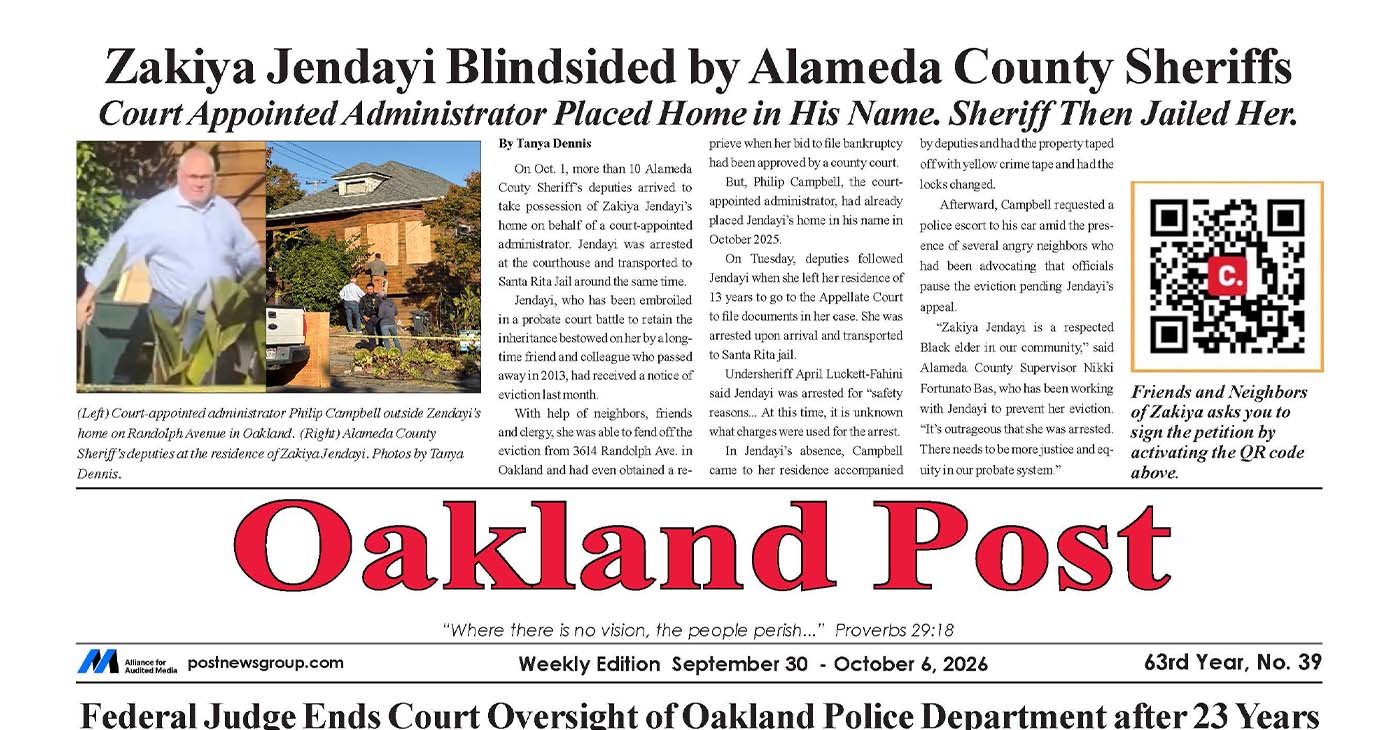
To enlarge your view of this issue, use the slider, magnifying glass icon or full page icon in the lower right corner of the browser window.
Activism
Oakland Post: Week of September 23 – 29, 2026
The printed Weekly Edition of the Oakland Post: Week of September 23 – 29, 2026

To enlarge your view of this issue, use the slider, magnifying glass icon or full page icon in the lower right corner of the browser window.
Activism
Oakland Post: Week of September 16 – 22, 2026
The printed Weekly Edition of the Oakland Post: Week of September 16 – 22, 2026

To enlarge your view of this issue, use the slider, magnifying glass icon or full page icon in the lower right corner of the browser window.


Listening as a Lifeline: A Doula’s Witness to Black Maternal Health

New Protections for Ticket Buyers: Gov. Newsom Signs Assemblymember Isaac Bryan’s Bill

‘We Don’t Talk Trash — We Pick Up Trash!’

Zakiya Jendayi Arrested, Locked Out of Home by Sheriff’s Deputies

Oakland Post: Week of September 30 – October 6, 2026

Asm. Corey Jackson Announces Launch of 24-Hour Childcare in His District

IN MEMORIAM: The Rev. Leon “Sonny” Clark, Longtime Orange County Pastor and Community Leader, Dies at 72

Poll: Becerra Widens His Lead Over Hilton; Californians Split on Wealth Tax

From Historic Memories to New Possibilities: Oakland Celebrates Coliseum 60

County Office of Education Says OUSD Finances Are Getting Healthier, Materially Stronger

LIVE FREE Sunday Dinner Brings Faith, Fellowship and Civic Conversation to Oakland

Remembering Chauncey Bailey as Student Journalists Face Threats to Truth-Telling

BLACspace Cooperative Invites Bay Area to Experience Oakland’s Black Cultural Ecosystem Through a BLAC Map Tour + Party

In Wake of Death on Doorstep, Williams Chapel Baptist Church Calls for Better Care, Funding for Unhoused

Oakland Centenarian Nuna McKee Honored!

Standoff for Justice: Our Homes Are Worth Fighting For

Oakland Post: Week of August 26 – September 1, 2026

Frontier Airlines’ Return to Oakland Airport Brings Flights, Jobs and Opportunity

Gubernatorial Candidate Steve Hilton Blasts California New Tire Rules; Newsom Hits Back

Chef Sharon Lee Blends Culinary Excellence, Education and Empowerment

Jackie Wright Champions Bay Area Stories, Filmmakers and Cultural Institutions

Misnamed ‘Parent’ PAC Seeks to Influence Oakland School Board Elections

Oakland Coliseum Project Opens Door for Small Businesses to Build Bigger

Big City Mayors Ask for “Yes” Vote on Housing Bond Measure; Conservatives Say “No”

Gov. Newsom’s Latest Appointees Include Sacramento Advocate for Formerly Incarcerated Students; State’s New Tech Chief

Longtime BWOPA Member Brendalyn Goodall Appointed to California Workforce Development Board

Gov. Newsom Signs Law Shielding Immigration Aid Workers From Doxing Threats

Secretary of State Shirley N. Weber Urges Californians to Vote Early as Voter ID Battle Intensifies

Oakland Post: Week of September 2 – 8, 2026

IN MEMORIAM: Dolly Parton Dead at 80 — How She Built a Legacy of Love and Earned Her Place in Black Culture

The Conversation With Al McFarlane 6/23/26

Media Monday 6/22/26

LIVE! ASK ALMA! — TUES. 6.23.26 7PM EST

Car Buying Secrets: 4 Hidden Checks Before You Sign!

Is This 550 HP Charger Worth YOUR Money? AutoNetwork Review

Celebrating Juneteenth – Frederick Douglass on education and resistance

LIVE! — ASK ALMA! — TUES. 6.19.26 7PM EST

Hyundai Ioniq 5 Parking, Safety, and 360 View #shorts

2025 Ioniq 5 New Wiper & Powerful Performance! #shorts

Electric SUV Range: Is 259 Miles Enough? #shorts

EV Charging: How Fast Can You Charge an Electric Vehicle? #shorts

Biometric Cooling… Messaging Seats…Come on! 2025 Infiniti QX80 Autograph 4WD

Charged Up: Witness the Magic of a Fully Electric Car! #shorts

Range Rover Sport PHEV Included…: See What’s Inside This Luxury SUV! #shorts

Invisible Hood View: Perfect Parking with X-Ray Vision! #shorts
-
 Community3 weeks ago
Misnamed ‘Parent’ PAC Seeks to Influence Oakland School Board Elections
-
 Activism4 weeks ago
Oakland Post: Week of September 2 – 8, 2026
-

 Community3 weeks ago
Richmond Tiny House Village Farm & Garden Set to Open Gates on Sept. 26
-

 Activism3 weeks ago
Oakland Post: Week of September 9 – 15, 2026
-

 Black History3 weeks ago
Latest Massacre in Haiti Reveals Cruelty U.S. Deportations
-

 Black History3 weeks ago
OPINION: Nolan Wells’ Death One of Several Signifying Racial Terror Lives on in U.S. South
-

 Community3 weeks ago
Democratic Clubs Interview Candidates for Oakland School Board
-

 Business2 weeks ago
Mayor Lee Announces $1 Million Kaiser Permanente Grant for Pilot Program to Address Homelessness, Clean Up Public Spaces throughout Oakland
