
Opinion
OP-ED: It Takes a Little Courage to Stop a lot of Disrespect

A good pair of jeans, are a good pair of jeans. So why have I preferred Levi’s over other brands? I am all San Francisco and have viewed Levi Strauss & Co. the same way for years.
In addition, this inventor of jeans, which first began manufacturing its iconic brand in 1853 San Francisco has an established reputation on social issues. Recently, I discovered another reason to be proud to wear Levi’s. Mr. Strauss died in 1902, however, the 1906 San Francisco earthquake and fire destroyed everything he worked to build. In the spirit of its founder, the company continued to pay its displaced workers.
Today, I start to stop, a lot of the disrespect of Blacks in San Francisco by questioning Levi Strauss & Co. values and vision. As a San Franciscan resident since 1960, the naming rights deal Levi’s signed with the 49ers worth $220 million over 20 years for the new Santa Clara 49ers stadium has me asking; where do the company’s values and vision appear in this deal?
Levi Strauss & Co. website’s “Values and vision” statement:
“Empathy — walking in other people’s shoes…”
“Originality — being authentic and innovative…”
“Integrity — doing the right thing…”
“Courage — standing up for what we believe…”
The 49ers took a $1.3 billion dollar stadium project out of a struggling Black community where Candlestick Park is located. Then asked and received from city officials an option out of the team’s 2015 year $ 6 million lease, for the mere upfront fee of $1 million. I can imagine Mr. Strauss telling current Levi’s CEO Chip Bergh, “Walking in other people’s shoes was never intended to be used to step on anyone.”
According to published reports, the $1.3 billion 49er stadium built by Turner/Devcon has offered only 1.6% of its contracts to minority contractors. 70% of the players that generate most of the team’s revenue are Black. Being authentic and innovative; Mr. Strauss who reportedly had no prejudice in him would not have hidden behind Prop. 209; which Turner/Devcon has done to justify the selecting of its sub-contractors.
The delays by the 49ers to improve the area closest to Candlestick Park, a blighted housing project called “Alice Griffith Housing” for fear that it would interfere with the team’s season activities is reprehensible. Doing the right thing as Mr. Strauss was known for meant he would have reached out to the community, not the 49ers.
Six months after NFL commissioner, Roger Goodell vowed, in a June 15, 2011 letter that the NFL “Supports communities that support us”, the NFL loaned the 49ers $200 million to move out of the struggling community the 49ers called home for more than 40 of the team’s 67 years in the city. I could be wrong but I think Mr. Strauss would have had the courage to stand up to the NFL and say, “You broke your promise”?
Any sports team should have the right to go wherever they feel they can make the most profit. However, breaking every rule of respect in leaving should not be tolerated. Did Levi Strauss & Co. co-signed the move by putting aside its founder’s values and vision in a deal to hitch its wagon to the San Francisco 49ers?
Due to my expanding waste line, I am currently wearing jeans that don’t fit me. Don’t worry, out of respect for myself and America, I promise, no sagging. Nevertheless, in protest of this blatant disrespect of a struggling Black community, I will be wearing my current small collection of jeans until the 2016 Super Bowl, which will be hosted by the city of San Francisco.
In all honesty only one pair are Levi’s but I plan to donate them all to charity; in accordance to Levi Strauss & Co. stated policy.
Struggling communities across America; where many past and present NFL players got their start, should rise up. With a dignified approach, tell current CEO of Levi’s “These Jeans don’t fit.” And if Mr. Bergh ignores our complaint, began a donation drive designed to stop the Super Bowl from being a comfortable fit for a city that shows little or no respect for its struggling Black community.
Send postcards to:
CEO Chip Bergh
Levi Strauss & Co.
1155 Battery Street
San Francisco, CA 94111
This an editorial and does not express the opinions and/or thoughts of the Post Newspaper Group.





Activism
Oakland Post: Week of September 23 – 29, 2026
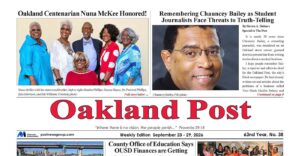
The printed Weekly Edition of the Oakland Post: Week of September 23 – 29, 2026

To enlarge your view of this issue, use the slider, magnifying glass icon or full page icon in the lower right corner of the browser window.
Activism
Oakland Post: Week of September 16 – 22, 2026
The printed Weekly Edition of the Oakland Post: Week of September 16 – 22, 2026

To enlarge your view of this issue, use the slider, magnifying glass icon or full page icon in the lower right corner of the browser window.
Activism
Oakland Post: Week of September 9 – 15, 2026
The printed Weekly Edition of the Oakland Post: Week of September 9 – 15, 2026

To enlarge your view of this issue, use the slider, magnifying glass icon or full page icon in the lower right corner of the browser window.


Asm. Corey Jackson Announces Launch of 24-Hour Childcare in His District

IN MEMORIAM: The Rev. Leon “Sonny” Clark, Longtime Orange County Pastor and Community Leader, Dies at 72

Poll: Becerra Widens His Lead Over Hilton; Californians Split on Wealth Tax

From Historic Memories to New Possibilities: Oakland Celebrates Coliseum 60

County Office of Education Says OUSD Finances Are Getting Healthier, Materially Stronger

LIVE FREE Sunday Dinner Brings Faith, Fellowship and Civic Conversation to Oakland

Remembering Chauncey Bailey as Student Journalists Face Threats to Truth-Telling

BLACspace Cooperative Invites Bay Area to Experience Oakland’s Black Cultural Ecosystem Through a BLAC Map Tour + Party

In Wake of Death on Doorstep, Williams Chapel Baptist Church Calls for Better Care, Funding for Unhoused

Oakland Centenarian Nuna McKee Honored!

Caribbean Nations Produce Action Plan Calling for UK Reparations Over Slavery

Oakland Post: Week of September 23 – 29, 2026

Doulas Are Helping Black California Moms Navigate Pregnancy–Even as High Mortality Rates Persist

Newsom Signs Addictive Social Media Law to Protect Kids

On Your November Ballot: Prop 38 Would Allocate $8.4 Billion to Immunology and Immunotherapy Funding

Standoff for Justice: Our Homes Are Worth Fighting For

Oakland Post: Week of August 26 – September 1, 2026

Frontier Airlines’ Return to Oakland Airport Brings Flights, Jobs and Opportunity

Gubernatorial Candidate Steve Hilton Blasts California New Tire Rules; Newsom Hits Back

Chef Sharon Lee Blends Culinary Excellence, Education and Empowerment

Jackie Wright Champions Bay Area Stories, Filmmakers and Cultural Institutions

Big City Mayors Ask for “Yes” Vote on Housing Bond Measure; Conservatives Say “No”

Oakland Coliseum Project Opens Door for Small Businesses to Build Bigger

Gov. Newsom’s Latest Appointees Include Sacramento Advocate for Formerly Incarcerated Students; State’s New Tech Chief

Misnamed ‘Parent’ PAC Seeks to Influence Oakland School Board Elections

Longtime BWOPA Member Brendalyn Goodall Appointed to California Workforce Development Board

Gov. Newsom Signs Law Shielding Immigration Aid Workers From Doxing Threats

Secretary of State Shirley N. Weber Urges Californians to Vote Early as Voter ID Battle Intensifies

From Palestine to Oakland: Seeds for Liberation Examines Shared Struggles for Freedom

IN MEMORIAM: Dolly Parton Dead at 80 — How She Built a Legacy of Love and Earned Her Place in Black Culture

The Conversation With Al McFarlane 6/23/26

Media Monday 6/22/26

LIVE! ASK ALMA! — TUES. 6.23.26 7PM EST

Car Buying Secrets: 4 Hidden Checks Before You Sign!

Is This 550 HP Charger Worth YOUR Money? AutoNetwork Review

Celebrating Juneteenth – Frederick Douglass on education and resistance

LIVE! — ASK ALMA! — TUES. 6.19.26 7PM EST

Hyundai Ioniq 5 Parking, Safety, and 360 View #shorts

2025 Ioniq 5 New Wiper & Powerful Performance! #shorts

Electric SUV Range: Is 259 Miles Enough? #shorts

EV Charging: How Fast Can You Charge an Electric Vehicle? #shorts

Biometric Cooling… Messaging Seats…Come on! 2025 Infiniti QX80 Autograph 4WD

Charged Up: Witness the Magic of a Fully Electric Car! #shorts

Range Rover Sport PHEV Included…: See What’s Inside This Luxury SUV! #shorts

Invisible Hood View: Perfect Parking with X-Ray Vision! #shorts
-
 Community3 weeks ago
Misnamed ‘Parent’ PAC Seeks to Influence Oakland School Board Elections
-

 Activism4 weeks ago
Oakland Post: Week of September 2 – 8, 2026
-

 Community3 weeks ago
Richmond Tiny House Village Farm & Garden Set to Open Gates on Sept. 26
-

 Activism3 weeks ago
Oakland Post: Week of September 9 – 15, 2026
-

 Black History3 weeks ago
Latest Massacre in Haiti Reveals Cruelty U.S. Deportations
-

 Black History3 weeks ago
OPINION: Nolan Wells’ Death One of Several Signifying Racial Terror Lives on in U.S. South
-

 Community3 weeks ago
Democratic Clubs Interview Candidates for Oakland School Board
-

 Business2 weeks ago
Mayor Lee Announces $1 Million Kaiser Permanente Grant for Pilot Program to Address Homelessness, Clean Up Public Spaces throughout Oakland
