
Activism
“Two things can be true at once.” An Afro-Latina Voter Weighs in on Identity and Politics
“As a Puerto Rican I do not feel spoken to in discussions about Latino voters… which is ironic because we are one of the few Latino communities who are also simultaneously American,” Ortiz-Cedeño says. Puerto Ricans born in Puerto Rico, a U.S. territory, have American citizenship by birth but they do not have the right to vote for president if they live on the island. “I think that we miss out on a really interesting opportunity to have a nuanced conversation by ignoring this huge Latino population that is indigenously American.”
By Magaly Muñoz
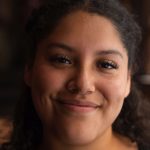
On a sunny afternoon at Los Cilantros Restaurant in Berkeley, California, Keyanna Ortiz-Cedeño, a 27-year-old Afro-Latina with tight curly hair and deep brown skin, stares down at her carne asada tacos, “I’ve definitely eaten more tortillas than plantains over the course of my life,” says Cedeño, who spent her childhood in South Texas, among predominantly Mexican-American Latinos. As she eats, she reflects on the views that American politicians have of Latino voters.
“As a Puerto Rican I do not feel spoken to in discussions about Latino voters… which is ironic because we are one of the few Latino communities who are also simultaneously American,” Ortiz-Cedeño says. Puerto Ricans born in Puerto Rico, a U.S. territory, have American citizenship by birth but they do not have the right to vote for president if they live on the island. “I think that we miss out on a really interesting opportunity to have a nuanced conversation by ignoring this huge Latino population that is indigenously American.”
Ortiz-Cedeño, an urban planner who is focused on disaster resilience, homelessness and economic prosperity for people of color, says that political conversations around Latinos tend to shift towards immigration, “I think this ties back into the ways that our perception of ‘Latino’ tends to be Mexican and Central American because so much of our conversation about Latinos is deeply rooted in what’s happening on the border,” she says. “I don’t think that the Afro-Latino vote is frequently considered when we’re talking about the Latino vote in the United States.”


Primarily surrounded by Mexican-Americans while growing up in South Texas, Keyanna participated in many Chicano cultured events, such as being a dama in several quinceñeras. Courtesy photo.
As Ortiz-Cedeño sifts through childhood photos of her as a happy teen dancing with the Mexican ballet folklorico group in high school and as a dama in quinceñeras, she reflects on growing up in South Texas, an area with a large population of white and Mexican-Americans. The Black population was small, and within it, the Afro-Latino population was practically nonexistent.
“It was interesting to try to have conversations with other Latinos in the community because I think that there was a combination of both willful ignorance and a sort of ill intent and effort to try and deny my experience as a Latino,” she says. “There are a lot of folks in Latin America who experience a lot of cognitive dissonance when they think about the existence of Black Latinos in Latin America.
Ortiz-Cedeño comments on the long history of anti-Blackness in Latin America. “Throughout Latin America, we have a really insidious history with erasing Blackness and I think that that has been carried into the Latino American culture and experience,” she says. “People will tell you, race doesn’t exist in Latin America, like we’re all Dominicans, we’re all Puerto Ricans, we’re all Cubans, we’re all Mexicans. If you were to go to the spaces with where people are from and look at who is experiencing the most acute violence, the most acute poverty, the most acute political oppression and marginalization, those people are usually darker. And that’s not by accident, it’s by design.”
Because of the lack of diversity in her Gulf Coast town, as a teenager, despite being the only Spanish-speaker at her job in Walmart, Latinos refused to ask for her help in Spanish.
“Even if monolingual [Spanish-speaking] people would have to speak with me, then they were trying to speak English, even though they could not speak English, versus engaging with me as a Latina,” she says.
“I think that the perception of Latinos in the United States is of a light brown person with long, wavy or straight hair. The perfect amount of curves and the perfect combination of Indigenous and white genes. And very rarely will people also consider that maybe they also have a sprinkle of Blackness in them as well,” she says. “Over 90% of the slave trade went to the Caribbean and Latin America.”
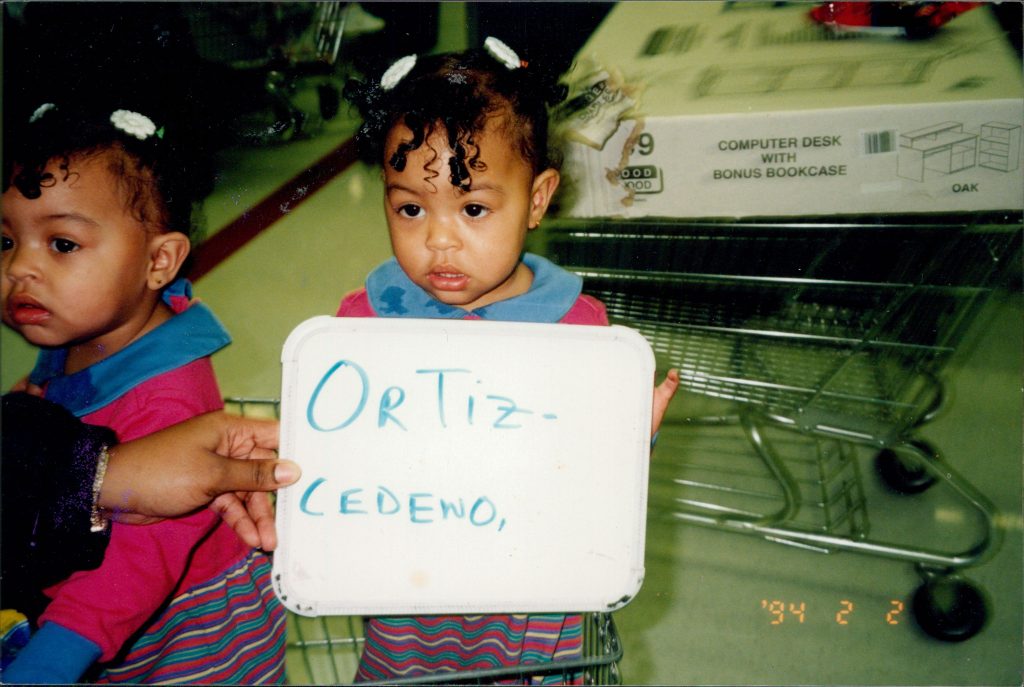
Keyanna as a toddler, holding a whiteboard up with her last name, Ortiz-Cedeño, on it. Courtesy photo.
Ortiz-Cedeño remembers when a Cuban family moved in next door to her in Texas. The teen daughter had blue-eyes, blonde hair and only spoke Spanish, which caused neighboring Latinos to take pause because she didn’t fit the Latino “look” they were used to.
“People didn’t have an option to try and negate her [Latino] identity because they had to acknowledge her for everything that she was,” Ortiz-Cedeño says.
Later on, the girl’s cousins, a Black, Spanish-speaking Cuban family, came into town and again locals were forced to reckon with the fact that not all Latinos fit a certain criteria.
“I think it forced everybody to have to confront a reality that they knew in the back of their mind but didn’t want to acknowledge at the forefront,” Ortiz-Cedeño says.
Having gone through these experiences as an Afro-Latina, Ortiz-Cedeño says it’s easy for her to understand Kamala Harris’ mixed Indian and Jamaican heritage, “It comes really naturally to accept that she is both Indian and Black. Two things can exist at the same time,” she says. “I had a long term partner for about seven years who was South Indian, from the same state as Kamala Harris, so if we had had a kid, they would look like [Harris],” Ortiz-Cedeño jokingly shares.
She says she can relate to having to walk the road of people only wanting to see Harris as a Black American. The talking point about [Harris] not being Indian or not being Black, just deciding to be Black, is really disingenuous and cheap,” she says.
Ortiz-Cedeño believes that the Harris campaign has not capitalized on the vice president’s mixed identity, which could be vital in bringing together different communities to understand each other on a new level and allow for improvements on America’s racial dynamics.
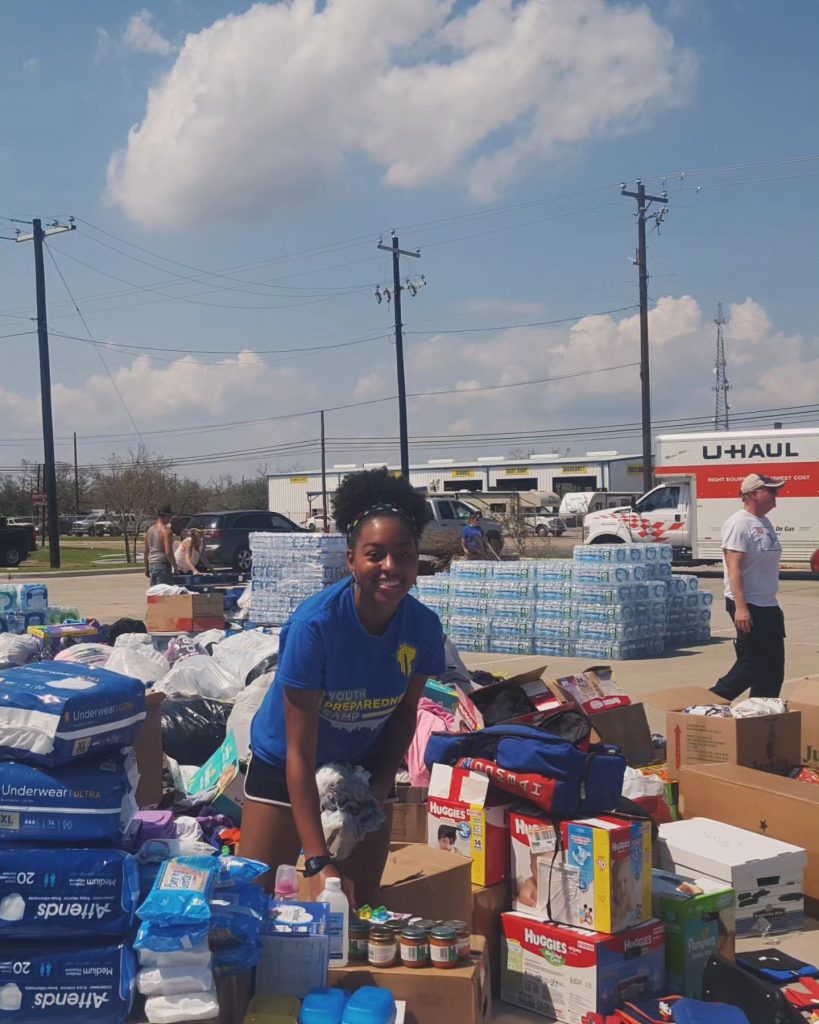
Keyanna co-managed a recovery center with her mother after Hurricane Harvey. They packed essentials, such as diapers, food, and water for families in need. Courtesy photo.
As she rushes into a Berkeley Urban Planning Commission meeting straight out of Ashby BART station, Ortiz-Cedeño explains her love for talking about all things infrastructure, homelessness, and healthcare access. The topics can be dry for many, she admits, but in the end, she gets to address long-standing systemic issues that often hinder opportunities for growth for people of color.
Having lived through the effects of Hurricane Katrina as a child, with the flooding and mass migration of Louisiana residents into Texas, Ortiz-Cedeño was radicalized into issues of displacement, emergency mitigation, and housing at nine years old.
“I remember my principal had to carry her students on her shoulders and swim us home because so many parents were trying to drive in and get their kids from school [due to] the flooding that was pushing their cars away,” she recalls.
Her family relocated to Houston soon after Katrina, only to be met with a deadly Hurricane Rita. They wound up in a mega-shelter, where Ortiz-Cedeño says she heard survivors stories of the unstable conditions in New Orleans and beyond, which got her wondering about urban planning, a term she wasn’t familiar with at the time.
“I think that when you put people in the context of the things that were happening in this country around [these hurricanes], a lot of us started to really think seriously about who gets to make decisions about the urban environment,” she adds.
Watching the heavy displacement of disaster survivors, hearing stories of her Navy veteran father’s chronic homelessness, and her own mother’s work and activism with homeless communities in the non–profit sector put her on the path to progressive politics and solutions, she says. After attending college on the East Coast- where she says she was finally recognized as a Puerto Rican- and working in housing, economic development, and public policy, she returned to California to earn a Master’s in City Regional Planning from UC Berkeley.
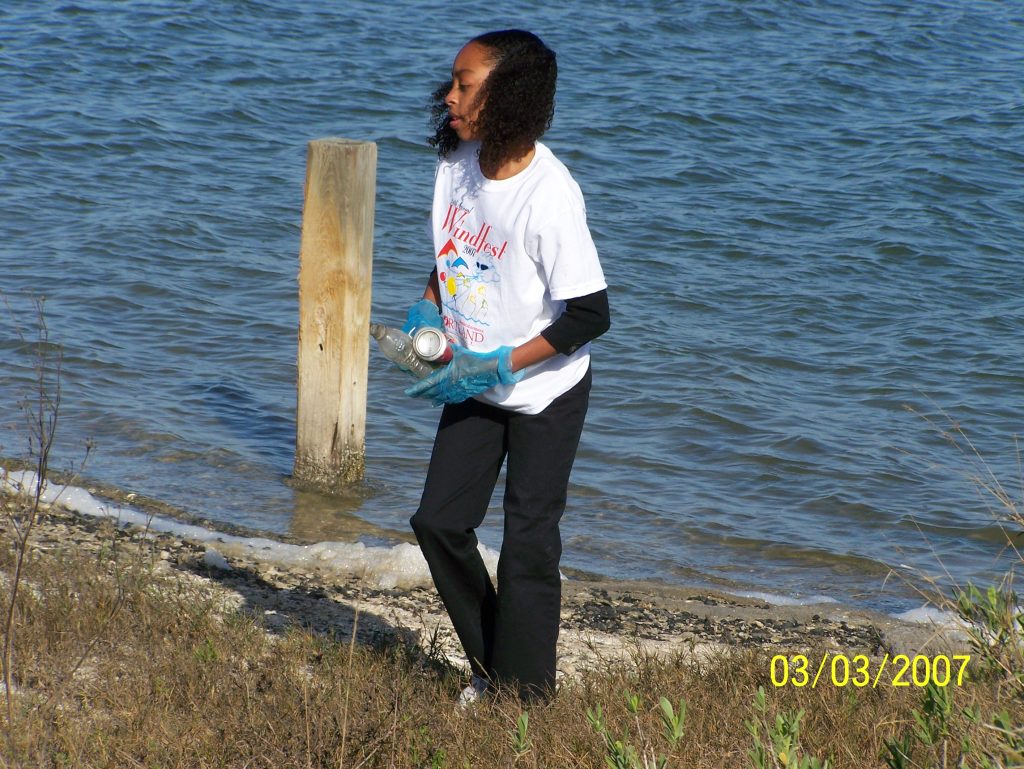
Young Keyanna volunteering at a beach clean up. Activism and giving back to her community has always been a key part of her upbringing. Courtesy photo.
Her vast interest in the urban success of underserved communities even took her abroad to Israel and Palestine when she was an undergraduate college student. “I’ve seen the border with Gaza, I’ve had homestays with farmers in the West Bank,” she says. “For me personally, Palestine is an issue that is really close to the heart.”
“I have a very intimate understanding of the conflict and I’m very disturbed by the way in which the [Democratic] party has not been willing to engage in what I would perceive to be a thoughtful enough conversation about the conflict,” Ortiz-Cedeño says. “The issue of Palestine is going to be one of those that is a make or break issue for her. It has not been one that has been taken seriously enough by the party.”
Ortiz-Cedeño is not under the illusion that one candidate will address every policy issue she wants to see tackled by the president. But she believes it’s better than what former President Donald Trump has to offer.
“Trump has made it very clear what his intentions are with Palestine, and what his relationship is with [Benjamin] Netanyahu,” Ortiz-Cedeño says. “I understand the political strategy that many people are trying to engage in by withholding their vote, but I would also encourage them to re-engage in the political process.”
Casting her vote for Harris is a decision grounded in calculation rather than outright support. “I think I can vote in this election in order to have harm reduction… because I have deep care and concern for other communities that are going to be impacted by a Trump presidency,” Ortiz-Cedeño says.
She also hopes that American politicians will consider the nuance and perspective that Afro-Latinos bring to the table when it comes to politics, policy, and race in America, “When we don’t think expansively about who is Latino in the United States, the breadth of Latino experiences in the United States, we miss an opportunity to capture how diverse Latinos interests are politically.”
This story was reported in collaboration with PBS VOCES: Latino Vote 2024.








Activism
Oakland Post: Week of March 18 – 24, 2026
The printed Weekly Edition of the Oakland Post: Week of March 18 – 24, 2026

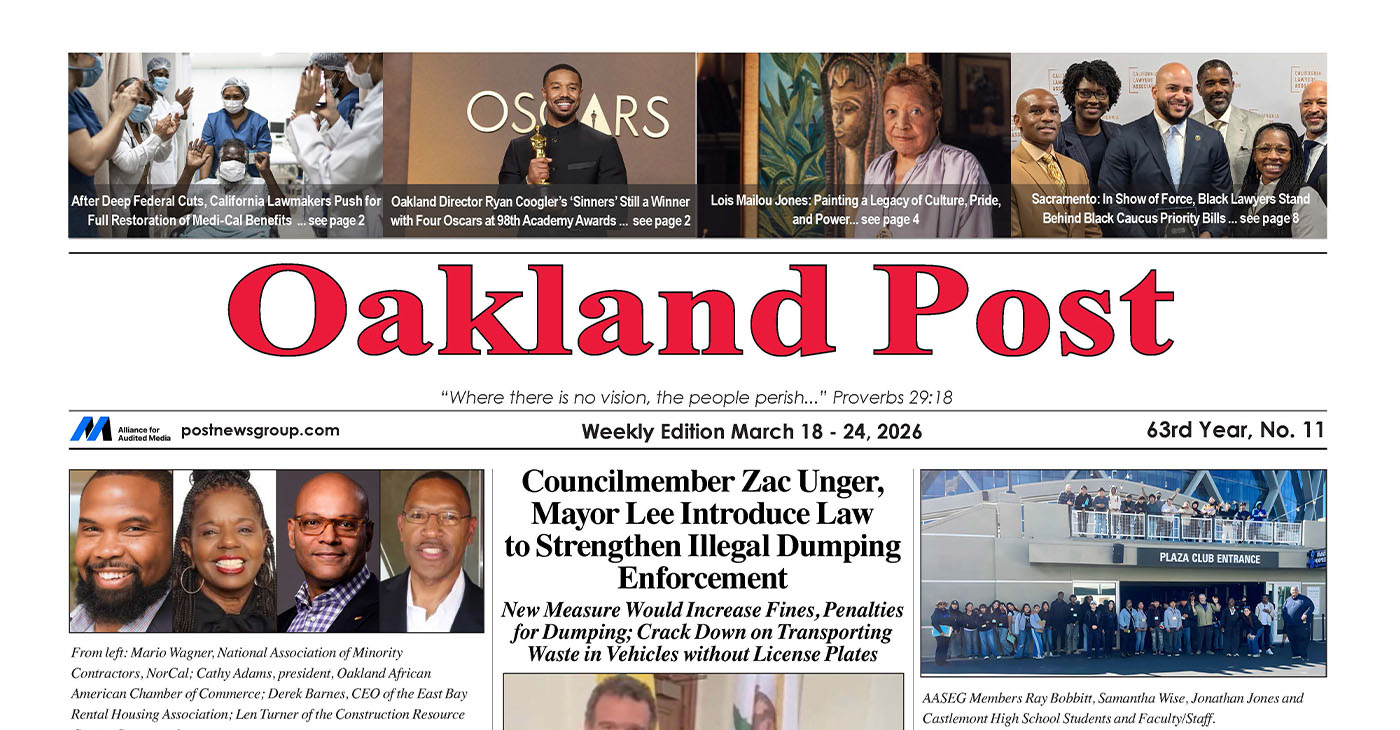
To enlarge your view of this issue, use the slider, magnifying glass icon or full page icon in the lower right corner of the browser window.

Activism
Oakland Post: Week of March 11 -17, 2026
The printed Weekly Edition of the Oakland Post: Week of March 11 – 17, 2026
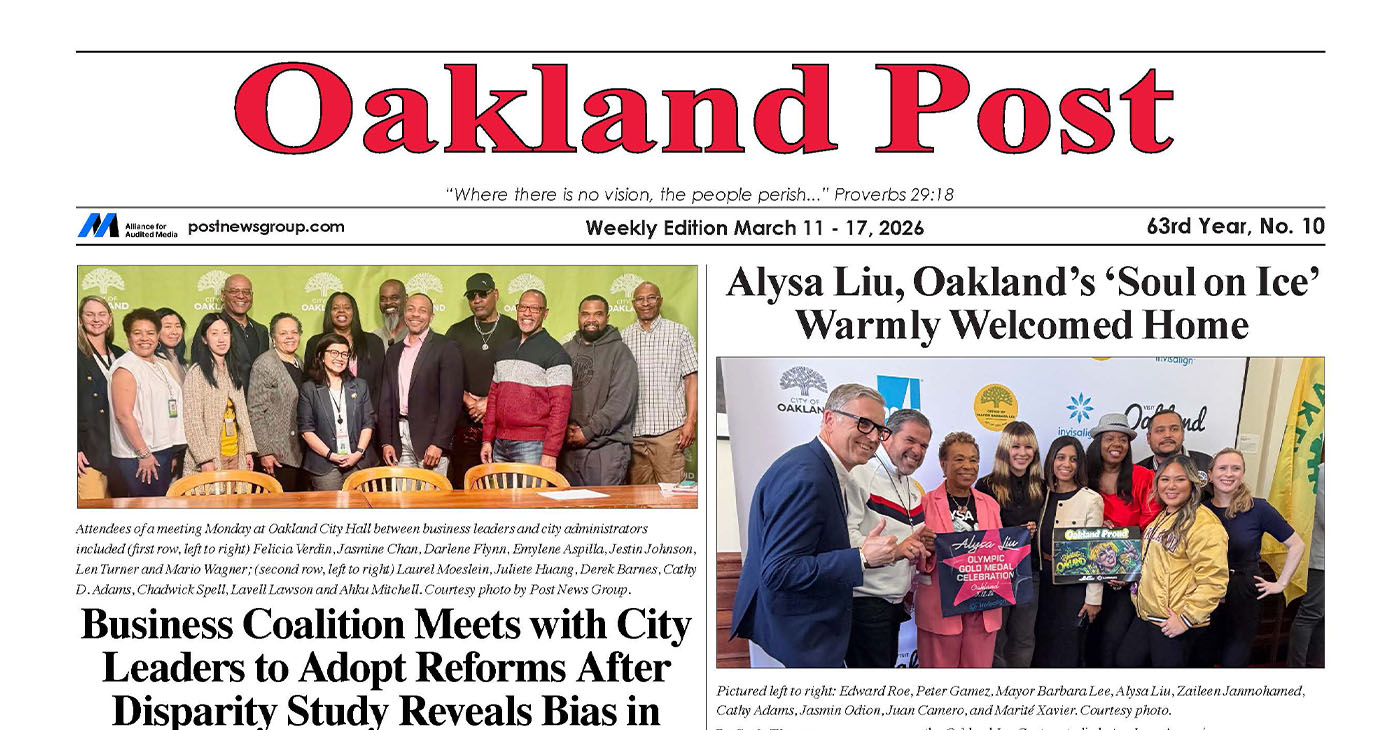
To enlarge your view of this issue, use the slider, magnifying glass icon or full page icon in the lower right corner of the browser window.
Activism
Oakland Post: Week of March 4 – 10, 2026
The printed Weekly Edition of the Oakland Post: Week of March 4 – 10, 2026
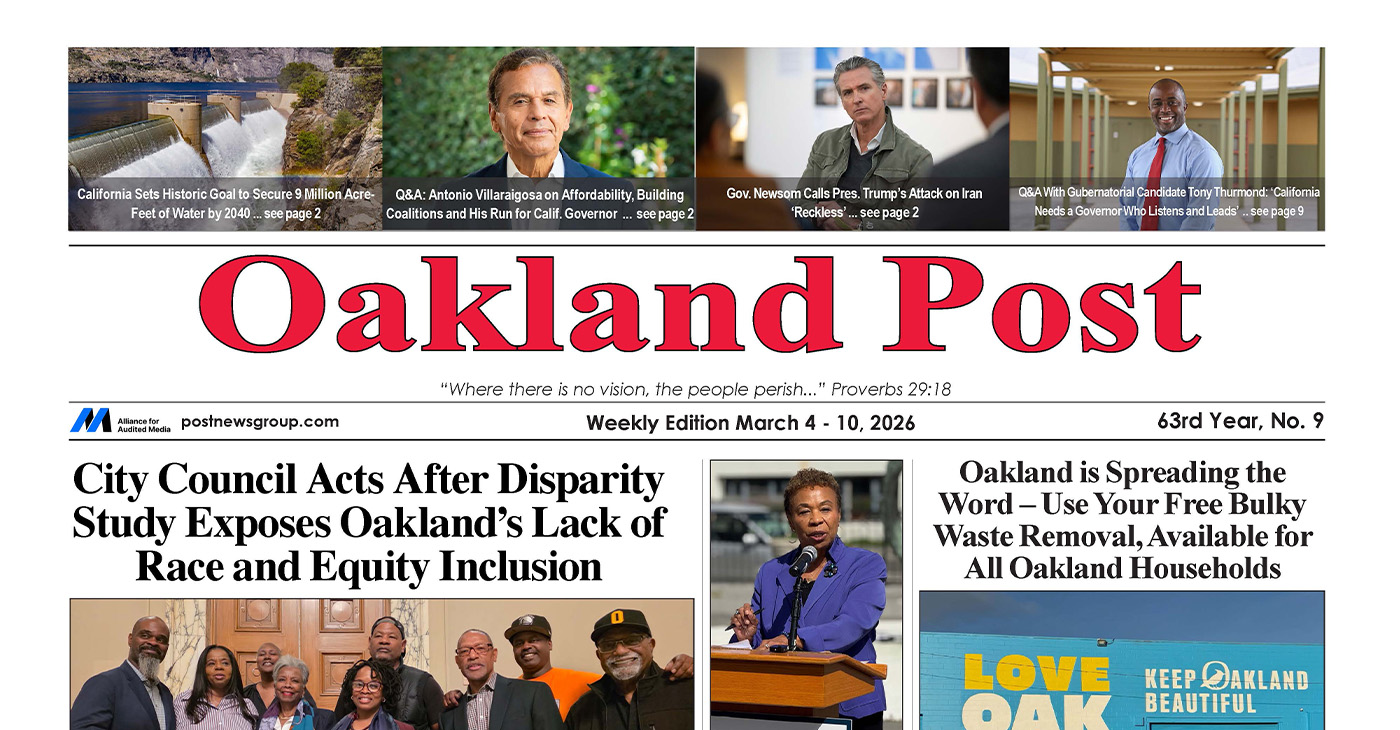
To enlarge your view of this issue, use the slider, magnifying glass icon or full page icon in the lower right corner of the browser window.


WORK FROM HOME
Home-based business with potential monthly income of $10K+ per month. A proven training system and website provided to maximize business effectiveness. Perfect job to earn side and primary income. Contact Lynne for more details: Lynne4npusa@gmail.com 800-334-0540


Black Artists in America, Installation Three Wraps at the Dixon Gallery and Gardens

Grief, Advocacy, and Education: A Counselor Reflects on Black Maternal Health

Future of Florida’s Black History Museum in Limbo

New Research Shows the Many Benefits of Early Learning

South Hampton K-8 Students Among Top 10 Finalists for Samsung’s ‘Solve for Tomorrow’ Competition

Cuba: No Negotiation with US on the President or Political System

Brooklyn Academy of Music Names Jamaican-Born Tamara McCaw as President

Trinidad & Tobego – U.S. Launches WhatsApp Channel for American Citizens in the Country

Oakland Post: Week of March 18 – 24, 2026

AI Innovation vs. Ethics and Environmental Impact

AI, Web3, and Digital Reparations

What If You Owned Your AI Agent?

Season 7, Episode 3 – January Reporter’s Roundtable 📱

Season 7, Episode 3 – January Reporter’s Roundtable

AI, Media, and Power | Part 2, Real-World Impacts and Tradeoffs

Book Review: Books on Black History and Black Life for Kids

California Launches Study on Mileage Tax to Potentially Replace Gas Tax as Republicans Push Back

Community Celebrates Turner Group Construction Company as Collins Drive Becomes Turner Group Drive

Discrimination in City Contracts

COMMENTARY: The Biases We Don’t See — Preventing AI-Driven Inequality in Health Care

Black History Events in the East Bay

Post Newspaper Invites NNPA to Join Nationwide Probate Reform Initiative

Art of the African Diaspora Celebrates Legacy and Community at Richmond Art Center

New Bill, the RIDER Safety Act, Would Support Transit Ambassadors and Safety on Public Transit

COMMENTARY: The National Protest Must Be Accompanied with Our Votes

Oakland Post: Week of February 4 – 10, 2026

Oakland Post: Week of February 11 – 17, 2026

Dorothy Lee Bolden: Uniting Domestic Workers

After Don Lemon’s Arrest, Black Officials Raise Concerns About Independent Black Media

Reflecting on Black History Milestones in Birmingham AL

Hyundai Ioniq 5 Parking, Safety, and 360 View #shorts

2025 Ioniq 5 New Wiper & Powerful Performance! #shorts

Electric SUV Range: Is 259 Miles Enough? #shorts

EV Charging: How Fast Can You Charge an Electric Vehicle? #shorts

Biometric Cooling… Messaging Seats…Come on! 2025 Infiniti QX80 Autograph 4WD

Charged Up: Witness the Magic of a Fully Electric Car! #shorts

Range Rover Sport PHEV Included…: See What’s Inside This Luxury SUV! #shorts

Invisible Hood View: Perfect Parking with X-Ray Vision! #shorts

AI Is Reshaping Black Healthcare: Promise, Peril, and the Push for Improved Results in California

ESSAY: Technology and Medicine, a Primary Care Point of View

Sanctuary Cities

The RESISTANCE – FREEDOM NOW

STATE OF THE PEOPLE: Freddie

ECONOMIC BOYCOTT DAY!!!!!

I told You So
-
 #NNPA BlackPress4 weeks ago
Reflecting on Black History Milestones in Birmingham AL
-
 #NNPA BlackPress4 weeks ago
PRESS ROOM: NBA Hall of Fame Nominee Terry Cummings Joins 100 Black Men of DeKalb County to Launch Victory & Values Initiative
-

 #NNPA BlackPress4 weeks ago
U.S. manufacturing rebounds – how foundry services are adapting to rising demand
-
 Activism4 weeks ago
Oakland Post: Week of February 25 – March 3, 2026
-
 #NNPA BlackPress4 weeks ago
Trump’s MAGA Allies are Creating Executive Order Plan to Steal the 2026 Midterms
-

 #NNPA BlackPress4 weeks ago
OP-ED: One Hundred Years of Black Workers Telling the Truth
-

 #NNPA BlackPress4 weeks ago
Advancements in solar technology that are changing the way we power the world
-
 #NNPA BlackPress4 weeks ago
PRESS ROOM: Civil Rights TV Launches in Selma as the World’s First 24/7 Civil Rights Television Network
