Activism
Open E.A.R.S. for Change Continues to Inspire Asian-Black Unity Through Annual Celebration
Destiny Arts Center youth dance group performed on stage at the Lunar New Year x Black History Month event at the Oakland Asian Cultural Center at 388 Ninth St., Suite 290. Photo by Peter Jew.

By Anka Lee
Post Intern
Featuring lion dance, hip-hop dance and more, the third annual Lunar New Year Black History Month drew a multiracial and multi-ethnic crowd to the Oakland Asian Cultural Center on Feb. 1.
Perhaps unique in the U.S., this deliberately bicultural celebration honored diversity in both communities.
The celebration grew out of a time of significant tension between the Asian and Black communities during the pandemic when anti-Asian hate was prominent and appeared in a lot of media coverage. In those news stories, members of the Black community were frequently and untruthfully portrayed as the primary aggressors.
In response to this rift between communities, the Oakland Asian Cultural Center (OACC) started the Open E.A.R.S. for Change initiative (Engage, Activate and Rise up Series), which was created with the intention to build stronger relationships between the Asian and Black communities in Oakland.
According to Saly Lee, the executive director of OACC, the bicultural celebration began with holding a series of community conversations to bridge cultural gaps and get input on what could be done. It took 18 months, but the first gathering in 2023 drew 1,200 people and the second was 1,800.

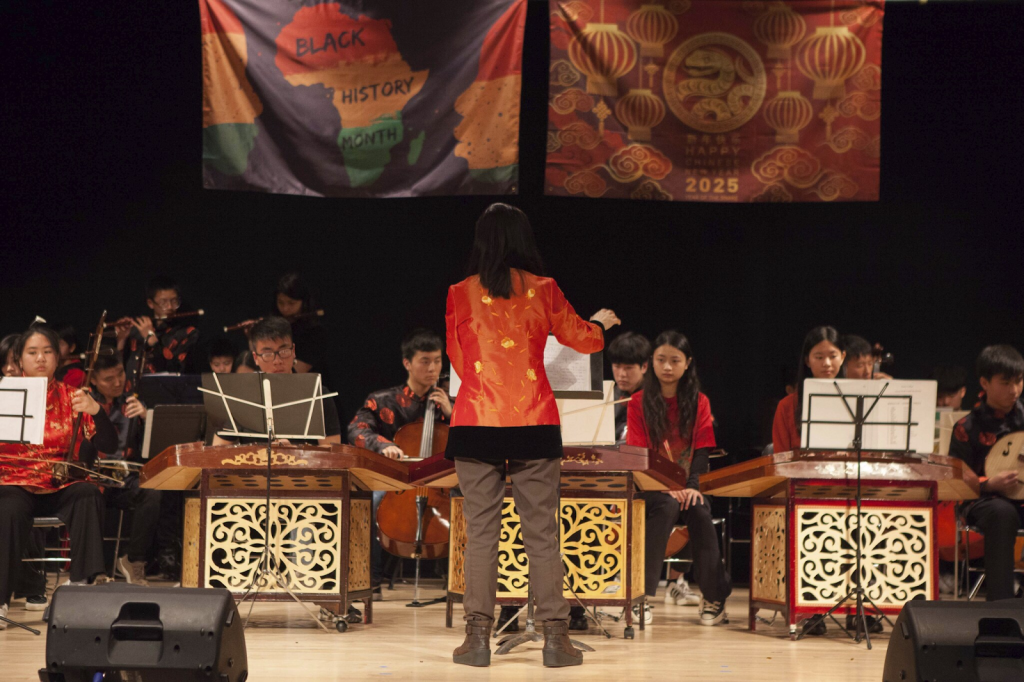
Great Wall Youth Orchestra performed with traditional Chinese instruments at the Lunar New Year x Black History Month event at the Oakland Asian Cultural Center at 388 Ninth St., Suite 290. Photo by Peter Jew.
Voices of a Dream, along with Dimensions Dance Theatre and Destiny Arts Center were among the African American performers. The participating Asian groups were diverse—with Filipino rapper Amihan, the Great Wall Youth Orchestra, Korean drumming, and Filipino martial arts.
The children’s story-telling activity was also bicultural, cohosted by Marcus Books, a historic Black independent bookstore, and Eastwind Books, which now exists online.
In an interview, the organizers of Open E.A.R.S. for Change discussed the event and their future goals to encourage Asian-Black unity. Lee called the Lunar New Year x Black History Month Community Celebration “the anchor event” that brings the communities together every year. She wants to organize more such cross-cultural events, though on a smaller scale, like hosting a local author for a speaking engagement.
As younger generations tend to be more involved in activism and advocacy, OACC hopes the celebration will also encourage older generations to join in. “Historically, this program was geared towards the Chinese community,” Lee said. That had made it easier for older generations to attend, but now “the focus has shifted… [there are] more family units and multicultural audiences.”
Although more diversity means more reach and engagement from different communities in Oakland, it also means there is still much work to be done. Emily Grover, the OACC Program and Communications Coordinator, emphasized that they are “trying to improve language access in other programs,” one example being more translation options similar to the ones provided by the exhibition.
OACC works closely with refugee and immigrant communities to support them and provide resources in multiple Asian languages. Despite some accessibility concerns, they are confident more opportunities will arise as long as they persevere and continue to spread the word. “Programs are largely free,” said Director of Programs & Exhibitions Indra Mungal. She added, “and we invite the public to check out the classes and spaces available to be rented here.”
Lee wanted to stress that regardless of language barriers, these programs are created to contribute to a more diverse society: “Even if the language changes, our work will not change.”
For more information, visit www.oacc.cc

