Alameda County
Last City Council Meeting of the Year Ends on Sour Note with Big Budget Cuts
In a five to one vote, with Councilmembers Carroll Fife and Janani Ramachandran excused, the council passed a plan aimed at balancing the $130 million deficit the city is facing. Noel Gallo voted against the plan, previously citing concerns over public safety cuts, while Nikki Fortunato-Bas, Treva Reid, Rebecca Kaplan, Kevin Jenkins, and Dan Kalb voted in agreement with the plan.

By Magaly Muñoz
In the last lengthy Tuesday meeting of the Oakland City Council for 2024, residents expressed strong opposition to the much needed budget cuts before a change in leadership was finalized with the certification of election results.
In a five to one vote, with Councilmembers Carroll Fife and Janani Ramachandran excused, the council passed a plan aimed at balancing the $130 million deficit the city is facing. Noel Gallo voted against the plan, previously citing concerns over public safety cuts, while Nikki Fortunato-Bas, Treva Reid, Rebecca Kaplan, Kevin Jenkins, and Dan Kalb voted in agreement with the plan.
Oakland police and fire departments, the ambassador program, and city arts and culture will all see significant cuts over the course of two phases.
Phase 1 will eliminate two police academies, brown out two fire stations, eliminate the ambassador program, and reduce police overtime by nearly $25 million. These, with several other cuts across departments, aim to save the city $60 million. In addition, the council simultaneously approved to transfer restricted funds into its general purpose fund, amounting to over $40 million.
Phase 2 includes additional fire station brownouts and the elimination of 91 jobs, aiming to recover almost $16 million in order to balance the rest of the budget.

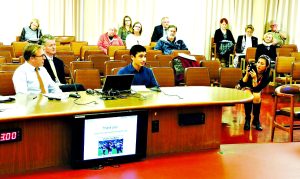
Several organizations and residents spoke out at the meeting in hopes of swaying the council to not make cuts to their programs.
East Oakland Senior Center volunteers and members, and homeless advocates, filled the plaza just outside of City Hall with rallies to show their disapproval of the new budget plan. Senior residents told the council to “remember that you’ll get old too” and that disturbing their resources will only bring problems for an already struggling community.
While city staff announced that there would not be complete cuts to senior center facilities, there would be significant reductions to staff and possibly inter-program services down the line.
Exiting council member and interim mayor Bas told the public that she is still hopeful that the one-time $125 million Coliseum sale deal will proceed in the near future so that the city would not have to continue with drastic cuts. The deal was intended to save the city for fiscal year 2024-25, but a hold up at the county level has paused any progress and therefore millions of dollars in funds Oakland desperately needs.
The Coliseum sale has been a contentious one. Residents and city leaders were originally against using the deal as a way to balance the budget, citing doubts about the sellers, the African American Sports and Entertainment Group’s (AASEG), ability to complete the deal. Council members Reid, Ramachandran, and Gallo have called several emergency meetings to understand where the first installments of the sale are, with little to no answers.
Bas added that as the new Alameda County Supervisor for D5, a position she starts in a few weeks, she will do everything in her power to push the Coliseum sale along.
The city is also considering a sales tax measure to put on the special election ballot on April 15, 2025, which will also serve as an election to fill the now vacant D2 and mayor positions. The tax increase would raise approximately $29 million annually for Oakland, allowing the city to gain much-needed revenue for the next two-year budget.
The council will discuss the possible sales tax measure on January 9.
