
Black History
Gov. Gavin Newsom’s Cynical Bypass of Barbara Lee to Fill Dianne Feinstein’s Senate Seat
A friend of mine who writes for the New York Times recently called me “cynical, but insightful.” I took it as a compliment, though I’d rather be known as trusting, loving, caring, and giving, of course. But cynicism is probably the best lens in which to view the announcement of the new U.S. Senator representing California. And maybe even all of national politics these days.

By Emil Guillermo
A friend of mine who writes for the New York Times recently called me “cynical, but insightful.” I took it as a compliment, though I’d rather be known as trusting, loving, caring, and giving, of course.
But cynicism is probably the best lens in which to view the announcement of the new U.S. Senator representing California. And maybe even all of national politics these days.
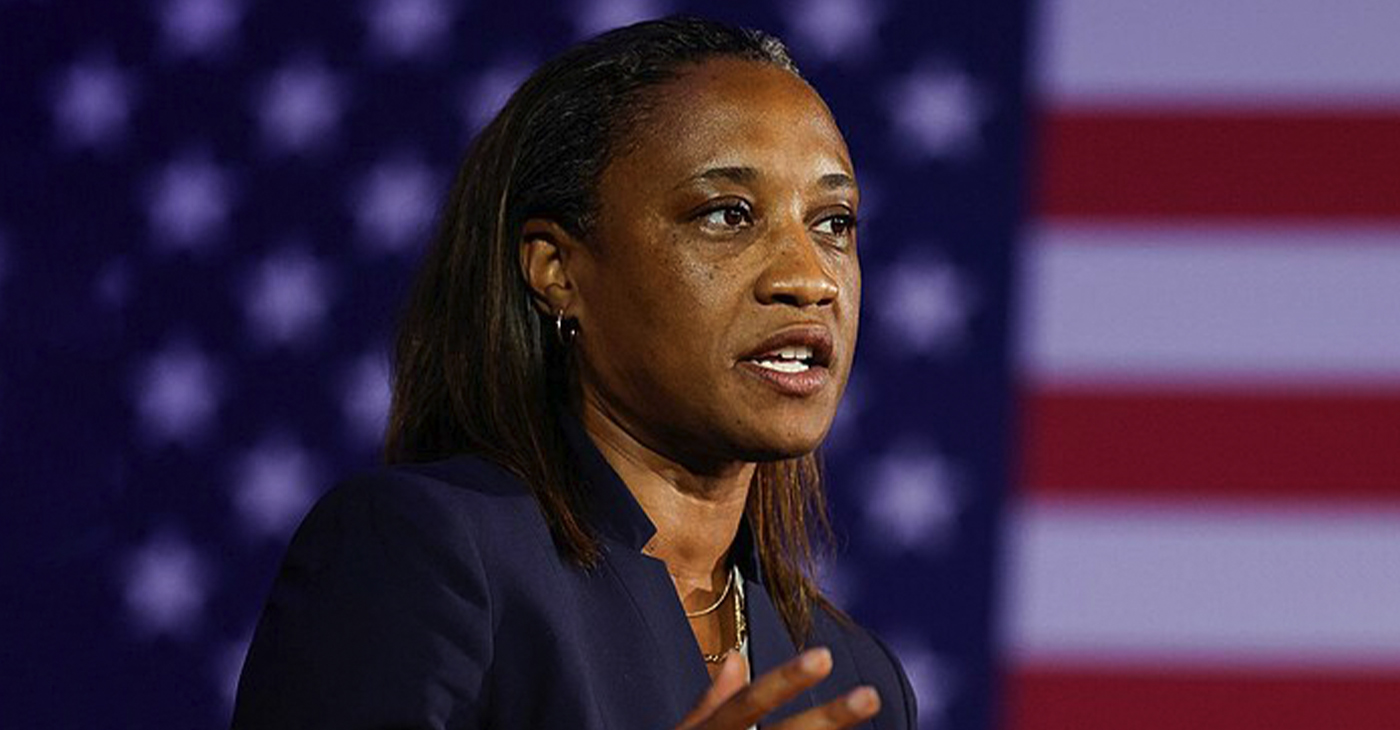
Gov. Gavin Newsom’s appointment of Laphonza Butler to replace the great California Sen. Dianne Feinstein who passed away last week, was the best choice for him.
Just not for Californians and certainly not for the nation.
No knock against Butler, the president of Emily’s List, and an experienced political operative. But Newsom used her to bail him out of a bind of his own making.
After he filled the vacated Senate seat of Kamala Harris in 2021 with a Latinx male, Alex Padilla, he vowed his next appointee would be a Black female.
All good. But earlier this year, when Feinstein announced she would not run again, no less than three Democrats jumped in the ring.
Rep. Adam Schiff, of impeachment fame, was the implied favorite of Feinstein. Then there was Rep. Katie Porter, a darling of the left. The only Black female to announce her candidacy was the revered former chair of the Congressional Black Caucus, Rep. Barbara Lee, also known for being the only member of Congress to refuse to authorize military action in Afghanistan in 2001. She’s a progressive to be reckoned with.
And, of course, of the three announced candidates, Lee was the only one who could fulfill Newsom’s promise. She’s a formidable Black legislator who knows how Congress works from the inside out. Lee would have been a senator who would hit the ground running.
Oakland’s Barbara Lee was the best choice for California and the nation.
She just wasn’t, as I said, the best choice for Gavin Newsom.
The best choice for Gavin Newsom was…. Laphonza Butler.
Butler is like an H.R. choice that avoids any possible pushback. Who’s going to argue about an African American lesbian who is also a former union leader for nurses and caretakers?
Butler is a political godsend for Newsom.
Instead of being forced to choose between the three announced Democratic candidates for the Feinstein seat, Newsom simply had to find the best Black woman to fulfill his promise.
He didn’t even need the best person for the job.
Butler hasn’t been an elected official. She hasn’t passed legislation. She is political, yes. She’s also served as a member of the University of California Board of Regents, despite having no experience in higher education. But she learned on the job, and that’s what she’ll do in the Senate.
Reports say Butler’s appointment was not a “caretaker” position. She’s not just filling out Feinstein’s time and then stepping back down. Butler will be senator and can run again in 2024– as an incumbent.
And that was Newsom’s formidable gift to Butler. She would be a sitting senator, appointed by the governor.
Picking Butler also garners loyalty and fealty to Newsom for as long as necessary. It is Newsom’s enduring benefit to have birthed a lifelong ally personally placed in the Senate.
Genius move by Newsom? Certainly, the Butler pick served Newsom much more than the people of California.
Instead of making a choice that would show leadership as well as integrity by choosing Barbara Lee, Newsom did what was best for him.
It’s disappointing. I’ve known Newsom since his days as a San Francisco supervisor. As he terms out as governor, his star is rising the last few months as a Biden surrogate. But Newsom always seems to try too hard to get it right. Like his hair. Like choosing Butler.
A little too calculated, political, … and cynical.
Of course, Newsom’s filling of the Feinstein vacancy isn’t even the most newsworthy one this week.
In an historic vote, the Republican Party, led by just eight MAGA extremists ousted its own House Speaker Kevin McCarthy of Bakersfield.
Now the Republicans are leaderless in the House, while the head of the party, the former president Donald Trump, is on trial in New York for fraud. The Republicans are in chaos.
And the Democrats? At least, they look orderly with Newsom’s cynical pick of Laphonza Butler.
FEINSTEIN’S PASSING
Regular readers know I have been a vocal proponent against what I perceived as an ageist reaction to Feinstein remaining her Senate seat. I simply thought she earned the right to leave politics on her own terms.
I was aware of all the stories about her mental fitness the last few years. But to the very end, she managed to fulfill her duties and serve the people of California well. Remember, the Senate is all about seniority. That is the open secret about the Senate. And now, with her passing, how many people can even name the state’s two senators without resorting to Google?
Because of seniority, Feinstein had more power in her pinky finger. And now all of that that is lost.
As a reporter covering Feinstein over the years, I will never forget the times she stepped out of our journalist/politician roles to simply acknowledge me as a person and human being. It was a kindness you don’t expect. But she knew I wasn’t just some badgering guy with a microphone.
And then there was the time we shared a stage at San Francisco’s Lowell High School commencement in the 1980s. I spoke before her as the graduate who became the local TV journalist who made good.
My speech was memorable and funny as I used a toilet plunger as a prop. At least, I thought it was funny. If I lost a segment of the audience, Feinstein knew how to win them all back.
She was like a cheerleader for democracy, full of life, and in minutes had the whole auditorium at her beck and call. To see a moment of Feinstein’s charismatic power, years before her ascent to the Senate was an honor to witness.
Emil Guillermo is a journalist and commentator. See his micro-talk show on YouTube@emilamok1, Facebook, and X, formerly twitter@emilamok











Activism
Oakland Post: Week of April 1 – 7, 2026
The printed Weekly Edition of the Oakland Post: Week of April 1 – 7, 2026
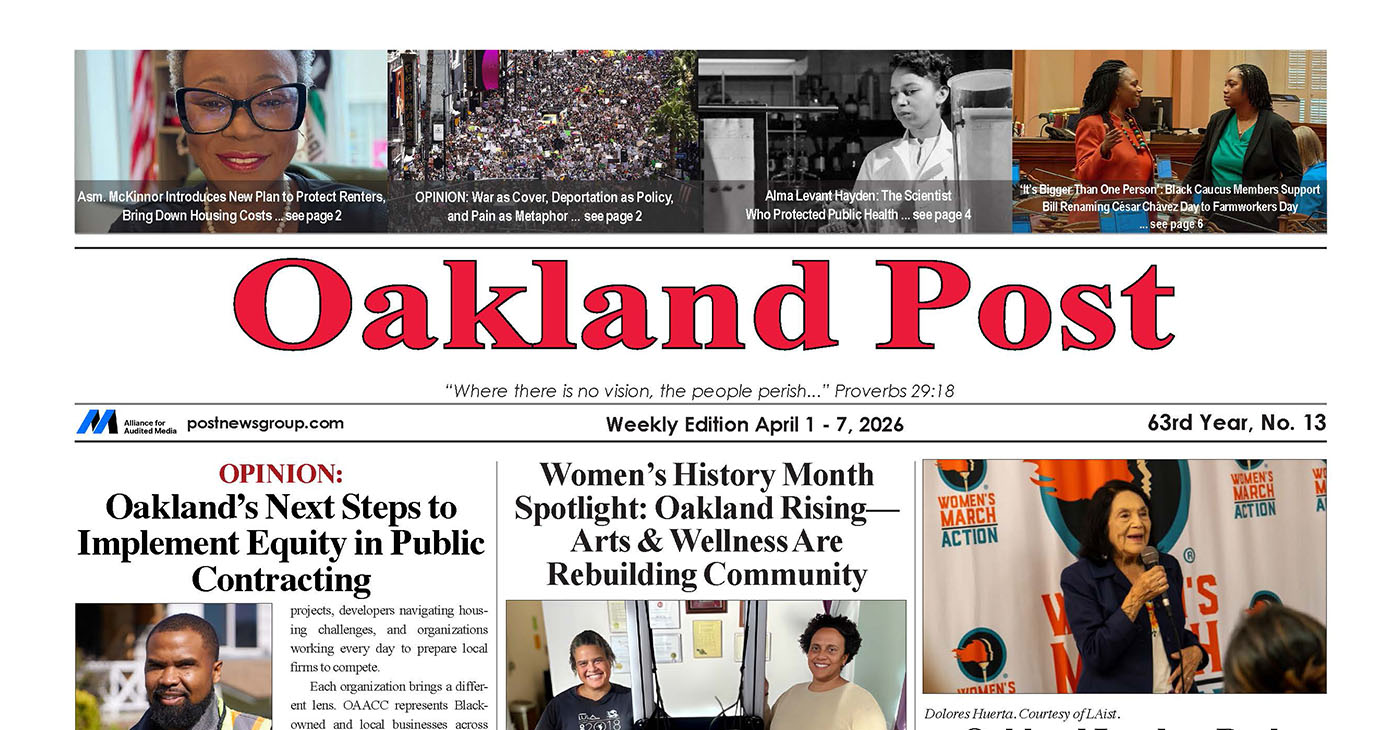
To enlarge your view of this issue, use the slider, magnifying glass icon or full page icon in the lower right corner of the browser window.
Activism
Oakland Post: Week of March 18 – 24, 2026
The printed Weekly Edition of the Oakland Post: Week of March 18 – 24, 2026

To enlarge your view of this issue, use the slider, magnifying glass icon or full page icon in the lower right corner of the browser window.
Activism
Oakland Post: Week of March 11 -17, 2026
The printed Weekly Edition of the Oakland Post: Week of March 11 – 17, 2026
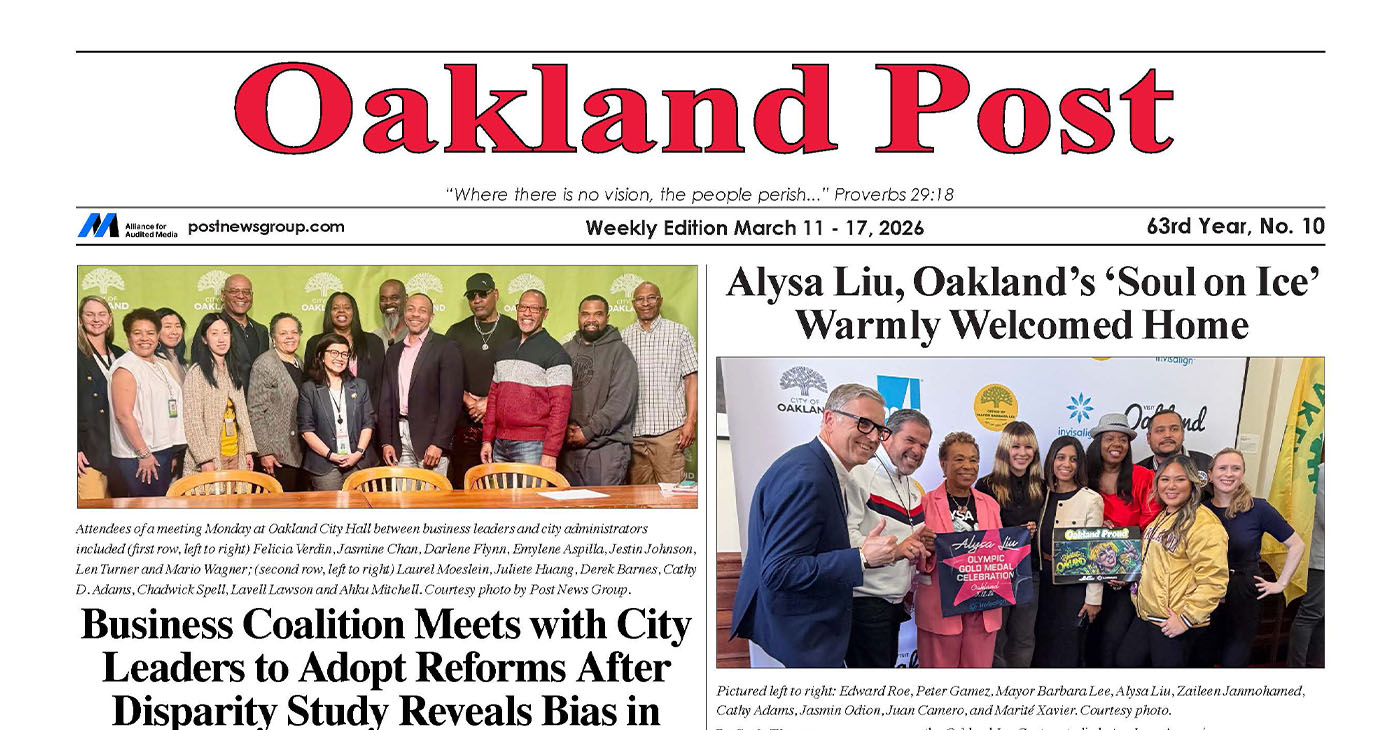
To enlarge your view of this issue, use the slider, magnifying glass icon or full page icon in the lower right corner of the browser window.


WORK FROM HOME
Home-based business with potential monthly income of $10K+ per month. A proven training system and website provided to maximize business effectiveness. Perfect job to earn side and primary income. Contact Lynne for more details: Lynne4npusa@gmail.com 800-334-0540


Oakland Post: Week of April 1 – 7, 2026

Black Artists in America, Installation Three Wraps at the Dixon Gallery and Gardens

Grief, Advocacy, and Education: A Counselor Reflects on Black Maternal Health

Future of Florida’s Black History Museum in Limbo

New Research Shows the Many Benefits of Early Learning

South Hampton K-8 Students Among Top 10 Finalists for Samsung’s ‘Solve for Tomorrow’ Competition

Cuba: No Negotiation with US on the President or Political System

Brooklyn Academy of Music Names Jamaican-Born Tamara McCaw as President

Trinidad & Tobego – U.S. Launches WhatsApp Channel for American Citizens in the Country

Oakland Post: Week of March 18 – 24, 2026

AI Innovation vs. Ethics and Environmental Impact

AI, Web3, and Digital Reparations

What If You Owned Your AI Agent?

Season 7, Episode 3 – January Reporter’s Roundtable 📱

Season 7, Episode 3 – January Reporter’s Roundtable

Reflecting on Black History Milestones in Birmingham AL

Oakland Post: Week of February 25 – March 3, 2026

PRESS ROOM: NBA Hall of Fame Nominee Terry Cummings Joins 100 Black Men of DeKalb County to Launch Victory & Values Initiative

Oakland Post: Week of March 4 – 10, 2026

Trump’s MAGA Allies are Creating Executive Order Plan to Steal the 2026 Midterms

U.S. manufacturing rebounds – how foundry services are adapting to rising demand

Poll Shows Support for Policies That Help Families Afford Child Care

OP-ED: One Hundred Years of Black Workers Telling the Truth

Oakland Post: Week of March 11 -17, 2026

Advancements in solar technology that are changing the way we power the world
Oakland Post: Week of March 18 – 24, 2026

Woman’s Search for Family’s Roots Leads to Ancestor John T. Ward – A Successful Entrepreneur and Conductor on the Underground Railroad

COMMENTARY: Women of Color Shape Our Past and Future

PRESS ROOM: Civil Rights TV Launches in Selma as the World’s First 24/7 Civil Rights Television Network

Financial Wellness and Mental Health: Managing Money Stress in College

Hyundai Ioniq 5 Parking, Safety, and 360 View #shorts

2025 Ioniq 5 New Wiper & Powerful Performance! #shorts

Electric SUV Range: Is 259 Miles Enough? #shorts

EV Charging: How Fast Can You Charge an Electric Vehicle? #shorts

Biometric Cooling… Messaging Seats…Come on! 2025 Infiniti QX80 Autograph 4WD

Charged Up: Witness the Magic of a Fully Electric Car! #shorts

Range Rover Sport PHEV Included…: See What’s Inside This Luxury SUV! #shorts

Invisible Hood View: Perfect Parking with X-Ray Vision! #shorts

AI Is Reshaping Black Healthcare: Promise, Peril, and the Push for Improved Results in California

ESSAY: Technology and Medicine, a Primary Care Point of View

Sanctuary Cities

The RESISTANCE – FREEDOM NOW

STATE OF THE PEOPLE: Freddie

ECONOMIC BOYCOTT DAY!!!!!

I told You So
-
 Activism3 weeks ago
Oakland Post: Week of March 11 -17, 2026
-
 Activism2 weeks ago
Oakland Post: Week of March 18 – 24, 2026
-
 #NNPA BlackPress4 weeks ago
Woman’s Search for Family’s Roots Leads to Ancestor John T. Ward – A Successful Entrepreneur and Conductor on the Underground Railroad
-
 #NNPA BlackPress4 weeks ago
COMMENTARY: Women of Color Shape Our Past and Future
-
 Advice3 weeks ago
Financial Wellness and Mental Health: Managing Money Stress in College
-

 #NNPA BlackPress4 weeks ago
Advocates Raise Alarm Over ICE Operation, MOU and Detention Risks in Baltimore County
-

 #NNPA BlackPress4 weeks ago
Pete Buttigieg to Join Mayor Randall Woodfin for Community Town Hall in Birmingham
-
 #NNPA BlackPress2 weeks ago
Brooklyn Academy of Music Names Jamaican-Born Tamara McCaw as President
