
Activism
CA Reparations Task Force LA Meeting’s Public Comments Get Heated
“Reparations are designed to repair and heal the damages done to Africans for 400 years who [suffered] through Jim Crow [laws],” California Secretary of State Shirley Weber who authored the task force legislation, Assembly Bill (AB) 3121 in 2020 while serving in the Assembly, said last January. “Reparations are for those who are descendants of slavery. Their ties are permanently severed from their homeland and their ability to return to Africa is almost impossible. We are truly Americans.”

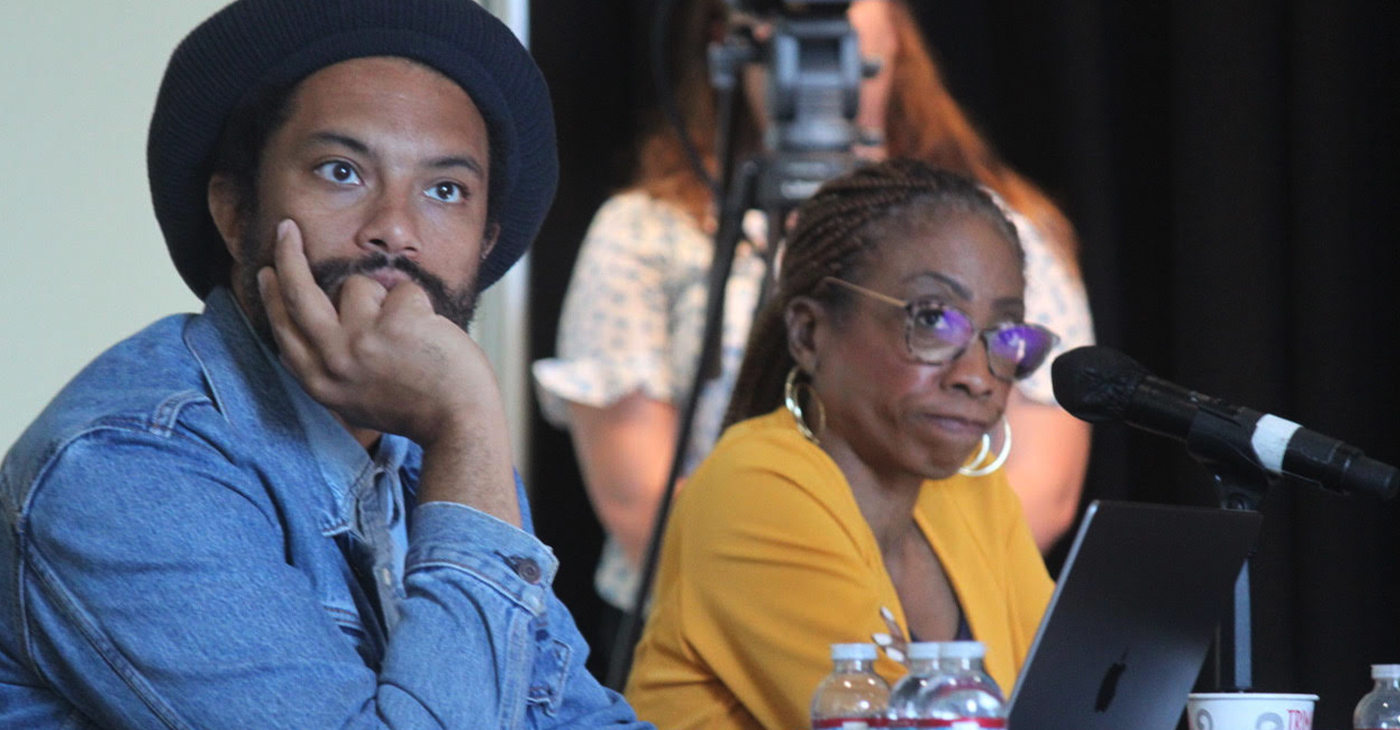
Antonio Ray Harvey | California Black Media
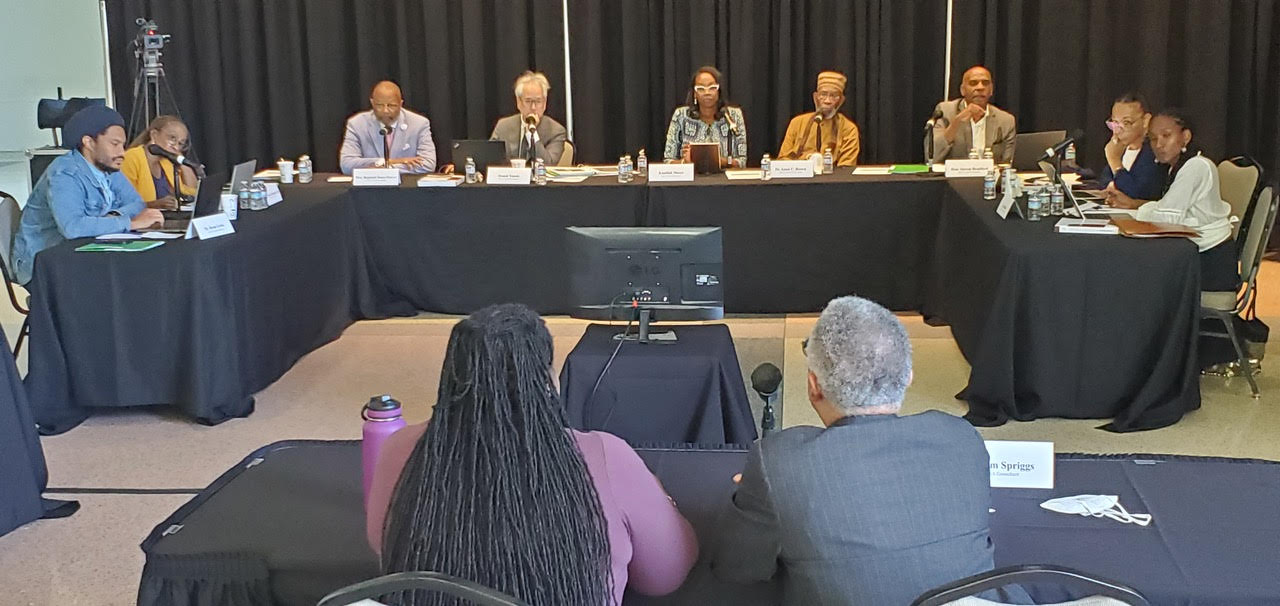
LOS ANGELES – The nine member California Task Force to Study and Develop Reparations Proposals for African Americans convened in Los Angeles at the California Science Center for its tenth meeting on Sept. 23 and Sept. 24.
The meeting opened with comments from the public with speakers passionately delivering their views on what reparations should look like.
Many focused their comments and opinions on who should and should not receive reparations. The opposing views created tension among those in the audience on an issue that the task force resolved months ago.
“I think it’s a good thing. We have a lot of passion in our community and reparations speak to the core of what makes Black Americans. I wouldn’t expect any less,” said Chad Brown, a member of the National Assembly of American Slavery Descendants (NAASDLA) and Coalition of a Just and Equitable California (CJEC).
“This is the process. I expect a lot of passion. It’s passion directed at finding solutions,” Brown told California Black Media.
The temperature in the room rose when Kevin Cosney, associate director of the California Black Power Network (CBPN), addressed the task force members and said that a majority of the members made a “problematic” decision in excluding people such as Africans enslaved in the Caribbean, Native Americans, and persons from the continent of Africa.
“We encourage this task force to be transparent, bold, gracious, expansive, and unified in its work of diverse opinions,” Cosney told the task force. “The fact that you prematurely rushed on eligibility is problematic and disrespects the community’s voice. We would like you to reconsider and take this into account.”
Cosney’s CBPN and Brown’s CJEC are two of seven “anchor organizations,” selected across the state to host “community listening sessions” in conjunction with the task force.
The nonprofit California Black Power Network describes itself as a “growing, united ecosystem of Black empowering grassroots organizations” collaboration to change the lived conditions of Black Californians “by dismantling systemic and anti-Black racism.”
CJEC is a state-wide coalition of organizations, associations, and community members united for reparations for the descendants of enslaved Black American men and women.
California Secretary of State Shirley Weber who authored the task force legislation, Assembly Bill (AB) 3121 in 2020 while serving in the Assembly, has taken the position that compensation should be limited to African Americans who are descendants of Africans enslaved in the United States.
“Reparations are designed to repair and heal the damages done to Africans for 400 years who [suffered] through Jim Crow [laws],” Weber said last January. “Reparations are for those who are descendants of slavery. Their ties are permanently severed from their homeland and their ability to return to Africa is almost impossible. We are truly Americans.”
Last March the task force voted 5-4 that lineage will determine who will be eligible for reparations over race.
Task Force chairperson Kamilah Moore, vice-chair Amos Brown, pastor of Third Baptist Church in San Francisco, and president of his local NAACP branch; University of California-Berkeley professor Jovan Scott Lewis; San Diego City Councilwoman Monica Montgomery-Steppe, and Sen. Steven Bradford (D-Gardena) voted in approval of lineage.
Eligibility is determined by an individual being African American, “the descendant of a [person enslaved as chattel] or the descendant of a free-Black person living in the United States prior to the end of the 19th century,” Moore said.
Attorney Don Tamaki, Assemblymember Reggie Jones-Sawyer (D-Los Angeles), Los Angeles-based attorney Lisa Holder, and Loyola-Marymount professor Cheryl Grills, voted in favor of race.
AB 3121 established the task force with a “special consideration” of those who are descendants of persons enslaved in the United States. Starting with the Atlantic Slave Trade, chattel slavery was sanctioned in the U.S. from 1619 to 1865.
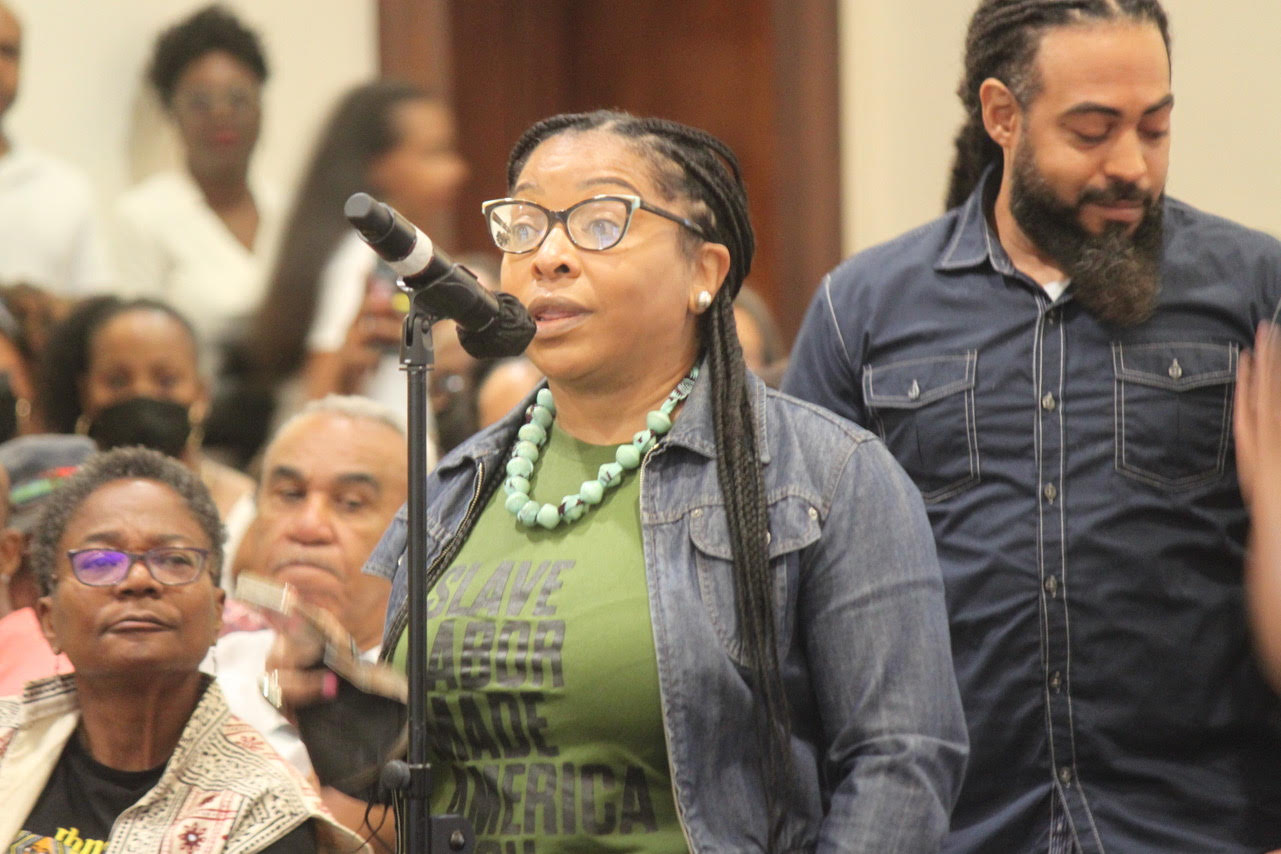
“We agree that there should be special consideration for those that trace their lineage back to Slavery,” Cosney said. “But we also know and understand that the system of white supremacy affects everyone who is Black on this planet and in this country.”
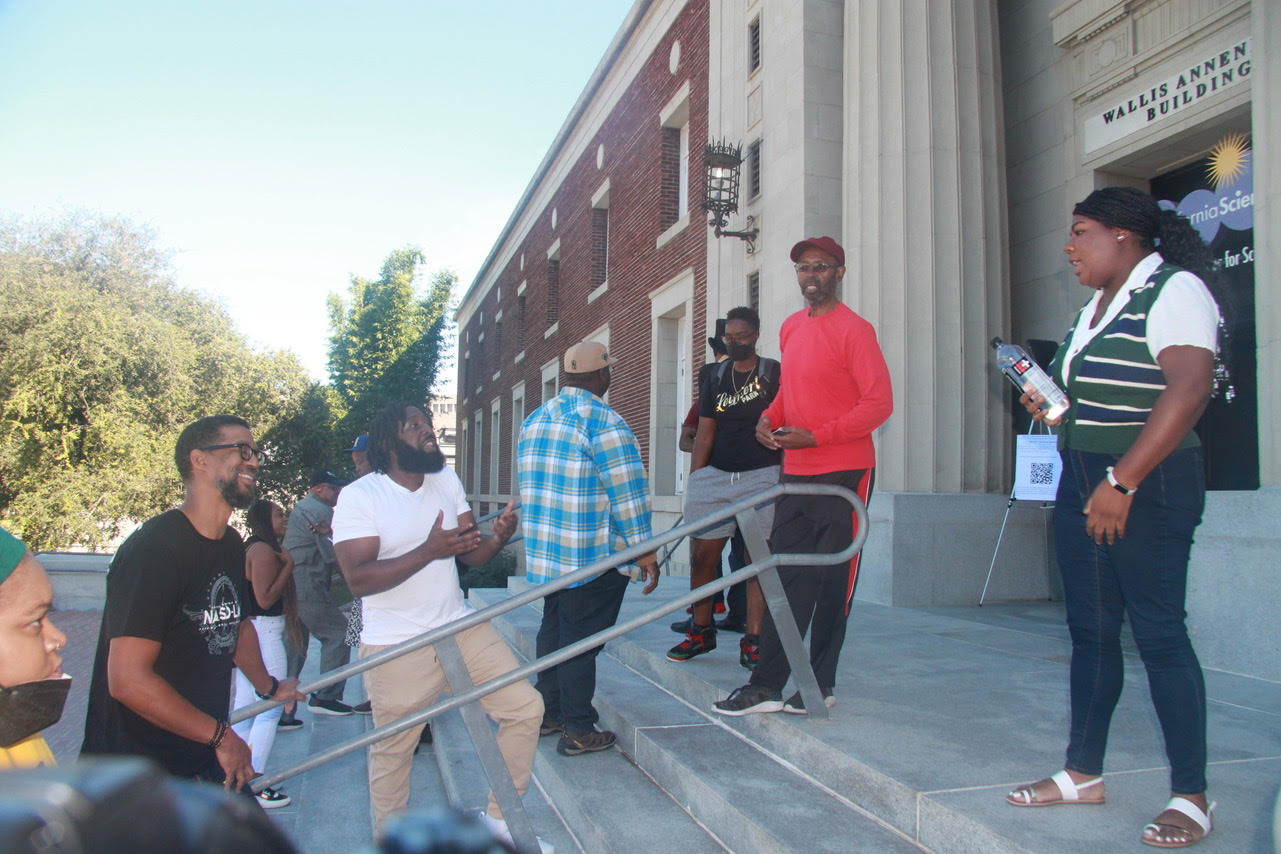
Members from CJEC and CBPN moved their heated discussion outside of the facility after making their comments. But, the conversations cooled off with smiles and gestures of mutual respect for opinions.
Brown said the eligibility issue is settled but he is not at odds with debating the merits of the decision of the task force. He “stands on” the fact that Black families were impacted by slavery and “those families, descendants, are owed reparations.”
“Reparations are not something that is a cure. It is not something meant to change the minds of people,” Brown said. “Reparations are meant to repair a special community that has been impacted by slavery, Jim Crow, convict leasing, mass incarcerations, and the throughline of slave ships and chains.”
The next Task Force in-person meeting is scheduled for Oakland in December 2022 followed by San Diego in January 2023 and Sacramento in February 2023.










Activism
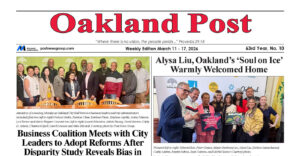
Oakland Post: Week of March 11 -17, 2026
The printed Weekly Edition of the Oakland Post: Week of March 11 – 17, 2026
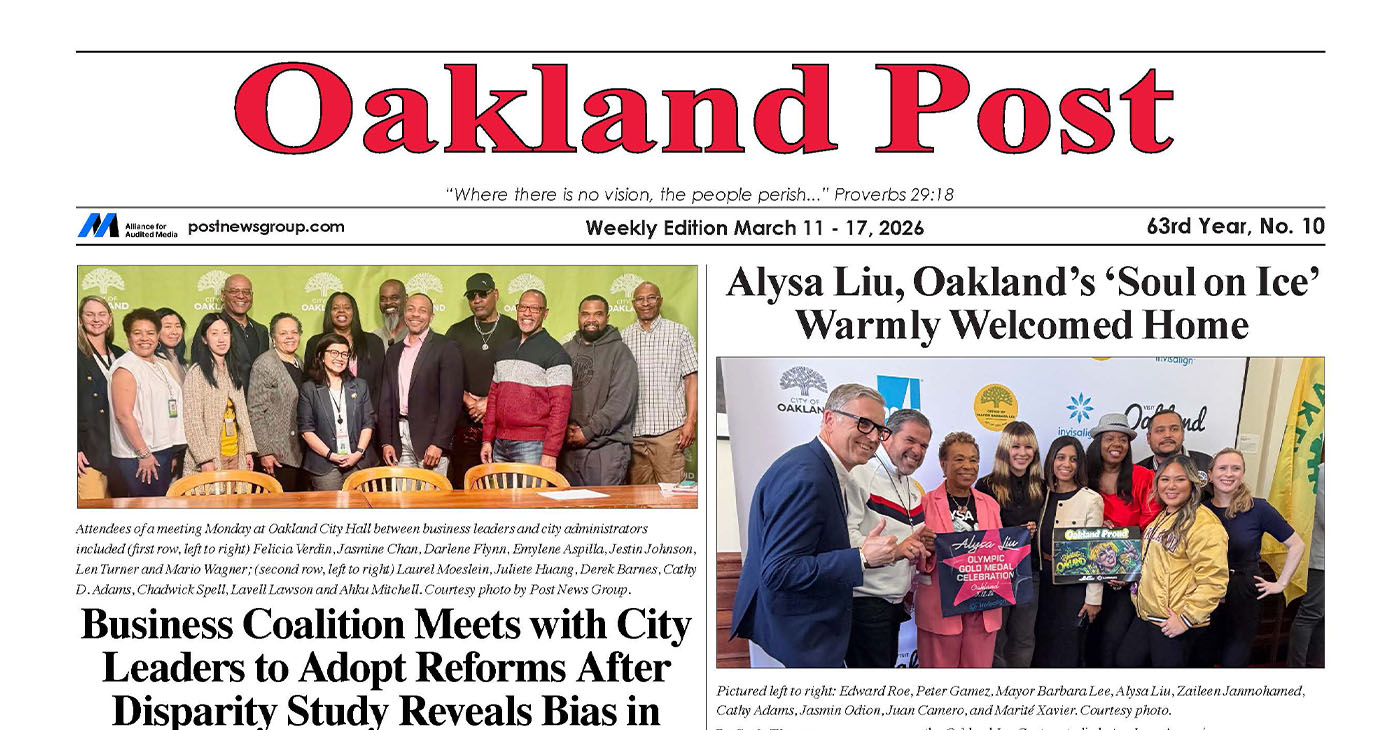
To enlarge your view of this issue, use the slider, magnifying glass icon or full page icon in the lower right corner of the browser window.
Activism
Oakland Post: Week of March 4 – 10, 2026
The printed Weekly Edition of the Oakland Post: Week of March 4 – 10, 2026
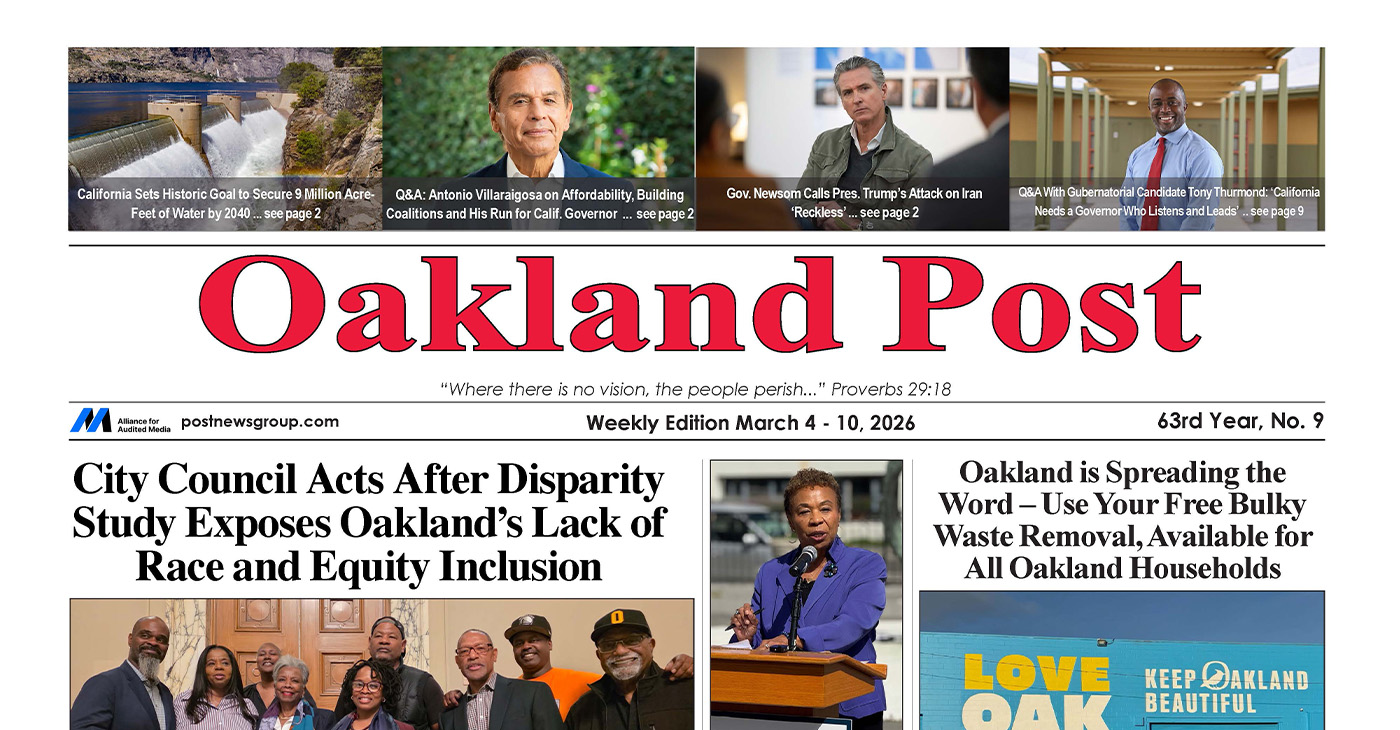
To enlarge your view of this issue, use the slider, magnifying glass icon or full page icon in the lower right corner of the browser window.
Activism
Oakland Post: Week of February 25 – March 3, 2026
The printed Weekly Edition of the Oakland Post: Week of – February 25 – March 3, 2026
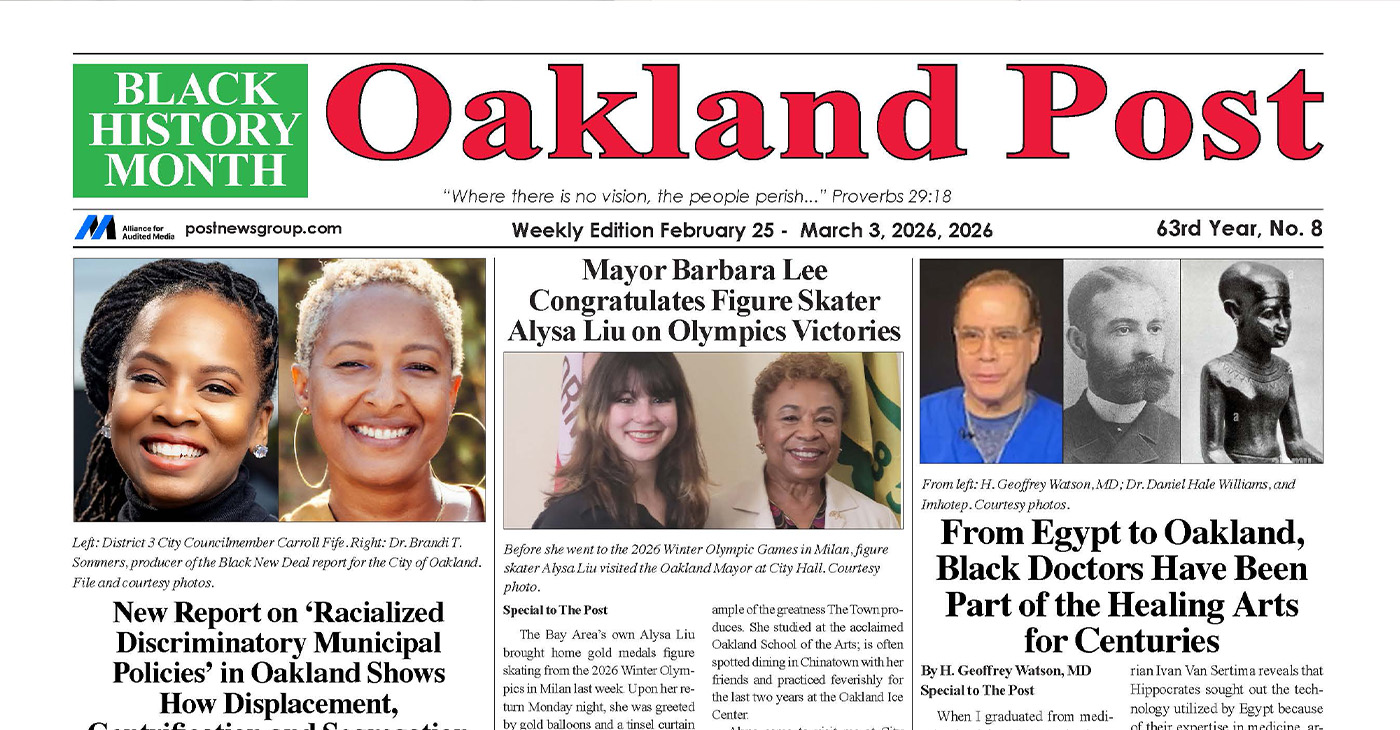
To enlarge your view of this issue, use the slider, magnifying glass icon or full page icon in the lower right corner of the browser window.
WORK FROM HOME
Home-based business with potential monthly income of $10K+ per month. A proven training system and website provided to maximize business effectiveness. Perfect job to earn side and primary income. Contact Lynne for more details: Lynne4npusa@gmail.com 800-334-0540


Financial Wellness and Mental Health: Managing Money Stress in College

Oakland Post: Week of March 11 -17, 2026

Women & Wealth: Tips for Navigating Your Lifelong Financial Journey

COMMENTARY: Women of Color Shape Our Past and Future

Woman’s Search for Family’s Roots Leads to Ancestor John T. Ward – A Successful Entrepreneur and Conductor on the Underground Railroad

Advocates Raise Alarm Over ICE Operation, MOU and Detention Risks in Baltimore County

Pete Buttigieg to Join Mayor Randall Woodfin for Community Town Hall in Birmingham

WATCH: Week One – NNPA’s “Leadership Matters” Video Series

Oakland Post: Week of March 4 – 10, 2026

OP-ED: NNPA Launches 2026 “Leadership Matters” Video Series

PRESS ROOM: PMG and Cranbrook Horizons-Upward Bound Launch Journey Fellowship Cohort 2

Los Angeles Summit Brings Together Leaders to Tackle Poverty and Affordability

Civil Rights TV Launches 24/7 Network Focused on Black History, Education and Equity

REVIEW: The Ultimate Hot Girl Summer Getaway: Sunseeker Resort Florida

COMMENTARY: How You Stop a Prescription Medicine is as Important as How You Start

Book Review: Books on Black History and Black Life for Kids

Community Celebrates Turner Group Construction Company as Collins Drive Becomes Turner Group Drive

Discrimination in City Contracts

California Launches Study on Mileage Tax to Potentially Replace Gas Tax as Republicans Push Back

COMMENTARY: The Biases We Don’t See — Preventing AI-Driven Inequality in Health Care

Black History Events in the East Bay

Post Newspaper Invites NNPA to Join Nationwide Probate Reform Initiative

Art of the African Diaspora Celebrates Legacy and Community at Richmond Art Center

New Bill, the RIDER Safety Act, Would Support Transit Ambassadors and Safety on Public Transit

COMMENTARY: The National Protest Must Be Accompanied with Our Votes

Oakland Post: Week of February 4 – 10, 2026

Oakland Post: Week of February 11 – 17, 2026

Dorothy Lee Bolden: Uniting Domestic Workers

After Don Lemon’s Arrest, Black Officials Raise Concerns About Independent Black Media

Reflecting on Black History Milestones in Birmingham AL

Hyundai Ioniq 5 Parking, Safety, and 360 View #shorts

2025 Ioniq 5 New Wiper & Powerful Performance! #shorts

Electric SUV Range: Is 259 Miles Enough? #shorts

EV Charging: How Fast Can You Charge an Electric Vehicle? #shorts

Biometric Cooling… Messaging Seats…Come on! 2025 Infiniti QX80 Autograph 4WD

Charged Up: Witness the Magic of a Fully Electric Car! #shorts

Range Rover Sport PHEV Included…: See What’s Inside This Luxury SUV! #shorts

Invisible Hood View: Perfect Parking with X-Ray Vision! #shorts

AI Is Reshaping Black Healthcare: Promise, Peril, and the Push for Improved Results in California

ESSAY: Technology and Medicine, a Primary Care Point of View

Sanctuary Cities

The RESISTANCE – FREEDOM NOW

STATE OF THE PEOPLE: Freddie

ECONOMIC BOYCOTT DAY!!!!!

I told You So
-
 #NNPA BlackPress3 weeks ago
Reflecting on Black History Milestones in Birmingham AL
-
 #NNPA BlackPress3 weeks ago
PRESS ROOM: NBA Hall of Fame Nominee Terry Cummings Joins 100 Black Men of DeKalb County to Launch Victory & Values Initiative
-

 #NNPA BlackPress4 weeks ago
U.S. manufacturing rebounds – how foundry services are adapting to rising demand
-

 #NNPA BlackPress4 weeks ago
OP-ED: One Hundred Years of Black Workers Telling the Truth
-
 Activism3 weeks ago
Oakland Post: Week of February 25 – March 3, 2026
-

 #NNPA BlackPress4 weeks ago
Advancements in solar technology that are changing the way we power the world
-
 #NNPA BlackPress3 weeks ago
Trump’s MAGA Allies are Creating Executive Order Plan to Steal the 2026 Midterms
-
 #NNPA BlackPress4 weeks ago
PRESS ROOM: Civil Rights TV Launches in Selma as the World’s First 24/7 Civil Rights Television Network
