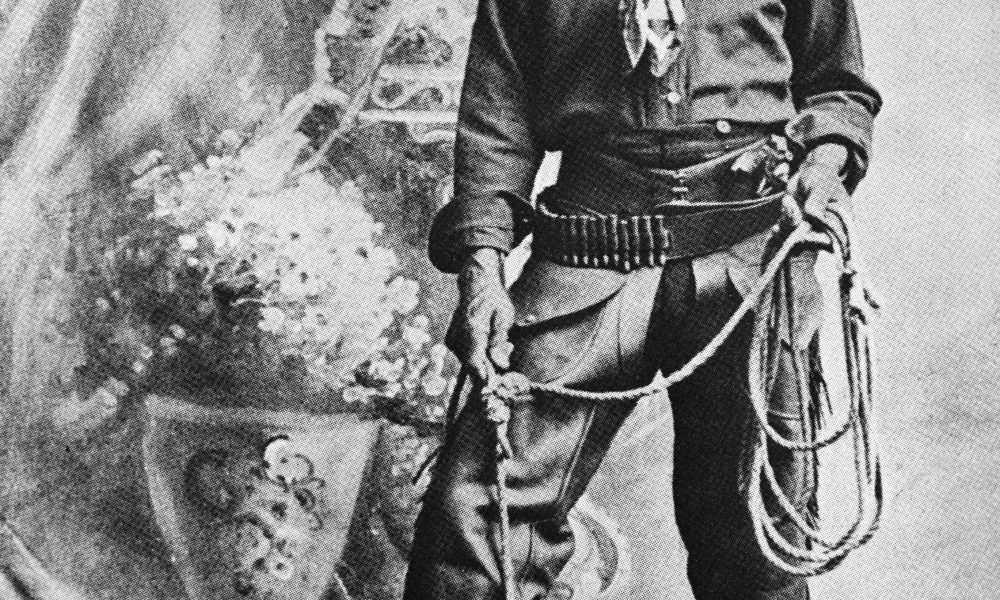
Historians estimate that one in four cowboys was Black, yet little is known about their lives and adventures in the Wild West.
The cowboy lifestyle evolved in Texas. White Americans hungry for cheap land had moved into the state’s Spanish (later Mexican) territory during the first half of the 19th century. The Mexican government opposed slavery, but Americans needed slave labor to establish cotton farms and cattle ranches. Once the Civil War reached Texas, many white Texans began to fight alongside their brethren in the East. The slaves were left to maintain the land and cattle herds.
It was this independence that pushed the slaves to develop their skills of cattle tending. Unbeknownst to everyone, this would render them invaluable to the Texas cattle industry in the post-war era. And some, including Nat Love (1854–1921), would become champion cowboys.
Born a slave on a plantation near Nashville, Tenn., Love had grown fond of riding wild horses.
“We did not dare to put the bridle on them as we were afraid the boss might surprise us, and we would not be quick enough to get off,” he wrote in his memoir. “Our mode of procedure was to drive one at a time in the barn, get in a stall, then after much difficulty I would manage to get on its back … I held on to his mane and stuck to him like a leech … then I would get my ten cents.”
Love also wrote that he’d broken in “a dozen colts in this way without the boss discovering the favor I was undoubtedly doing him.” And the so-called favor would evolve into a career.
It was his knack for handling wild horses that won Love a place with a prominent cowboy outfit that took part in the cattle drives up the Chisholm Trail from Texas to Montana. Within a short time, he had become a champion rider and roper.
In 1876 he was dubbed “Deadwood Dick.” During a cowboy tournament in Deadwood City, S.D., he succeeded in roping, tying, bridling, saddling, and mounting a wild stallion in nine minutes. He also became a champion rifleman by placing 14 out of 14 shots in the center of a target at 250 yards.
The cowboy way of life began to come to an end by the close of the 1880s. Railroad tracks had been laid across the western ranges and covered wagons crowded the plains. But Love was determined it was not the end of his ambitions. He left the range and took on a job as a Pullman porter around 1890. This opportunity, he felt, would offer him the degree of independence to which he’d become accustomed.
Love, according to historians Philip Durham and Everett L. Jones, felt that “Pullman service offered a challenge to an ambitious man,” and that “it was still exciting to ride across the great mountains and wide plains, even if one had to do it for tips.”
Love died in Los Angeles in 1921.


Tamara Shiloh
Tamara Shiloh has published the first two books in her historical fiction chapter book series,
Just Imagine…What If There Were No Black People in the World is about African American inventors, scientists and other notable Black people in history. The two books are
Jaxon’s Magical Adventure with Black Inventors and Scientists and
Jaxon and Kevin’s Black History Trip Downtown. Tamara Shiloh has also written a book a picture book for Scholastic,
Cameron Teaches Black History, that will be available in June, 2022.
Tamara Shiloh’s other writing experiences include: writing the Black History column for the Post Newspaper in the Bay area, Creator and Instruction of the black History Class for Educators a professional development class for teachers and her non-profit offers a free Black History literacy/STEM/Podcast class for kids 3d – 8th grade which also includes the Let’s Go Learn Reading and Essence and tutorial program. She is also the owner of the Multicultural Bookstore and Gifts, in Richmond, California,
Previously in her early life she was the /Editor-in-Chief of
Desert Diamonds Magazine, highlighting the accomplishments of minority women in Nevada; assisting with the creation, design and writing of a Los Angeles-based, herbal magazine entitled
Herbal Essence; editorial contribution to
Homes of Color; Editor-in-Chief of
Black Insight Magazine, the first digital, interactive magazine for African Americans; profile creations for sports figures on the now defunct PublicFigure.com; newsletters for various businesses and organizations; and her own Las Vegas community newsletter,
Tween Time News, a monthly publication highlighting music entertainment in the various venues of Las Vegas.
She is a member of:
- Society of Children’s Book Writers and Illustrators (SCBWI)
- Richmond Chamber of Commerce
- Point Richmond Business Association
- National Association of Professional Women (NAPW)
- Independent Book Publishers Association (IPBA)
- California Writers Club-Berkeley & Marin
- Richmond CA Kiwanis
- Richmond CA Rotary
- Bay Area Girls Club
Tamara Shiloh, a native of Northern California, has two adult children, one grandson and four great-grand sons. She resides in Point Richmond, CA with her husband, Ernest.
www.multiculturalbookstore.com