Employment
Black Contractors Call the City of Oakland’s Proposed Project Labor Agreement a Form of Modern-Day Slavery!

The City of Oakland held a workshop Aug. 10 at the West Oakland Youth Center. to seek input on the potential impacts of a proposed citywide Project Labor Agreement (PLA), which is attached to a proposed, Surplus Land Ordinance.
The discussion also included a Community Workforce Agreement.


Darlene Flynn
Darlene Flynn, director of the City’s Race and Equity Department, provided a statistical analysis of the current landscape in the city and Junious Williams was the moderator.
Unlike the previous workshop held in East Oakland, union representatives were noticeably absent. But Brigitte J. Cook, chief of staff for Council Member Lynette Gibson McElhaney was present to witness an audience of predominantly Black contractors who were opposed the concept of a blanket PLA.
Willie McGary, a 30-year Black contractor and owner of Hercules Builders, said, “(A) Project Labor Agreement is a form of modern-day slavery. Just like crop sharing unions, they force you to pay union dues and give you nothing in return. If you don’t pay, they boycott your business and make it difficult for you to get work.”
The workshop created 25 recommendations to the City Council for action prior to adoption of a Project Labor Agreement.
City staff assured participants that their concerns would be relayed to the full Council and not altered.
The Black contractors requested an education meeting with City Council members.


Monsa Nitoto
“A policy decision of this magnitude deserves the Council’s full participation, not lip service. This issue is just as important as the homeless crisis,” said Monsa Nitoto, executive director of the Workforce Collaborative.
When the late Ray Dones set up the National Association of Minority Contractors in the 1960s, there were 350 Black construction firms in Oakland. Now there are less than 100. Black contractors are on a path to extinction.
Community Activist Gene Hazzard said, “It is a falsehood that Oakland Blacks are not skilled enough to get work in the construction industry. These white general contractors import workers from outside Oakland and put them up in local hotels and claim them as Oakland residents.


Gene Hazard
“With the office of Contract Compliance having one person to monitor 80+ projects, no one verifies compliance of local hire. You look at the 15 plus large projects in Downtown Oakland with large cranes, and you will see none of them have Black contractor participation. A majority have no Black workers on the job site.”
Jonathan Dumas, employment services supervisor of the city’s Contracts and Compliance department, stated, “The (City) cannot require local hire or local business participation on privately financed projects”.
Louis Summerhill, a 25-year electrical contractor, said, “(Union) policies are designed to discriminate against Black contractors and Black workers.
“The unions have by design moved all their certified, state-approved apprenticeship training programs out of Oakland. They have set up training programs in Pleasanton, Fairfield, Benicia, Sacramento, Concord and San Jose; locations that are difficult for Oakland residents to access.
“I believe that unless and until unions agree and demonstrate an adjustment to their policies and practices, we should not give them the privilege of having a dedicated Project Labor Agreement on City-sponsored projects.”
Jabari Herbert, Focon Construction, a 20-year Black general contractor, said, “The only way

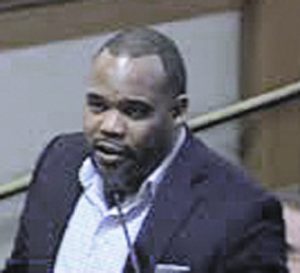
Jabari Herbert
to address this issue of developers and general contractors not being inclusive of local and minority participation on privately financed projects is by amending the Building Permit code to require any project which requires a conditional or unconditional use permit by the Oakland Planning Commission, to comply with the City of Oakland’s 50 percent resident, and local hire requirement.
“There are three ways this can be done; 1) voluntarily by the applicant for the permit, 2) by direction of the City Council, and 3) by Oakland ballot approval”.
He further stated, “In addition, developers and prime contractors should be fined a substantial amount for non-compliance with local hire goals. If they choose to pay a minimal fee for noncompliance, they should be barred from future city contracts.”.


Bernida Reagan
Bernida Reagan, an executive with Merriwether and Williams Insurance Services, stated, “Black contractors need help because they cannot get the performance bonds required to work on Public Works projects. There needs to be a technical assistance provision in the proposed Project Labor Agreement to address this barrier for small, minority and woman owned businesses.”
Currently, the City issues less than 5 percent of its contracts to African American businesses. The City is conducting a voter-mandated Disparity Study to identify areas of discrimination and potential recommendations to remedy the disparities. The Surplus Lands policy should not be adopted prior to the release of this very important Disparity Study.
The third and final community engagement workshop will be held on Monday, Aug. 19 at the San Antonio Senior Center, 3301 E. 12th St. in Oakland from 7 p.m. to 9 p.m.

