Activism
Beautiful Bus Tour of Atlanta Neighborhoods Ends at National Center for Civil and Human Rights
I got to experience what it would have been like sitting at a lunch counter as a Black person and enduring racial slurs just because I asked to be served a cup of coffee. Even though I knew what to expect by sitting at this faux diner counter with headphones on, it was dehumanizing and frightening, to say the least.

By Navdeep K. Jassal, Post News Group Ambassador
In my first week in Atlanta, I took a city bus tour to get better acquainted with the city.
I really noticed how green it is with large trees growing abundantly everywhere.
Besides ‘Sweet Auburn’ Avenue, tour highlights included riding through the Buckhead neighborhood and to see Georgia Gov. Brian Kemp’s mansion. As many know, Kemp is a Republican who opposes mask mandates and getting vaccinated.
The beauty of this was seeing another mansion across the street with a gigantic mask in the yard, encouraging responsible mask-wearing to protect oneself and their fellow Americans noting it’s patriotic. It was a glorious sight for my eyes and gave me a good chuckle, too!
We drove around Centennial Olympic Park, a 22-acre greenspace that serves as Georgia’s legacy of the 1996 Summer Olympic Games. Next to the park is the incredible National Center for Civil and Human Rights which is a museum and cultural institution that connects the U.S. Civil Rights Movement to human rights challenges today.

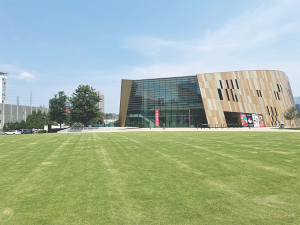
The National Center for Civil and Human Rights in Atlanta, Georgia.
There, I got to experience what it would have been like sitting at a lunch counter as a Black person and enduring racial slurs just because I asked to be served a cup of coffee. Even though I knew what to expect by sitting at this faux diner counter with headphones on, it was dehumanizing and frightening, to say the least.
My co-volunteer at the Food Ministry at First Presbyterian of Oakland and co-Publisher of the Oakland Post, Mrs. Gay Plair Cobb, had shared stories with me about travelling to Atlanta during that era in the 1960s and sitting at these counters, trying to get served and being completely ignored.
In one of the magnificent displays, I read personal stories from some of the original Freedom Riders. I imagined the bravery and courage these college-aged African Americans had to challenge segregation on bus terminals and buses that travelled interstate. This was such a powerful moment in history, that there were buses being set on fire to stop integration from happening!
I perused the personal papers and items of Dr. Martin Luther King, Jr. This collection represents much of Morehouse alumnus Martin Luther King, Jr.’s life and work spanning from 1944 to 1968. There was a remarkable multi-media display on his “I’ve Been to the Mountaintop” speech made during a rally for Memphis sanitation workers who were striking for better pay. It was one of his most powerful speeches and alluded to the numerous threats on his life and eerily forecasting his death, which occurred the next day.
Prior to visiting Atlanta, I spoke with Mr. Paul Cobb, co-Publisher of the Oakland Post, and he told me about how close he had come to getting a ride from Mrs. Viola Liuzzo one night to get a hot shower and food.
Liuzzo, a white housewife and mother of five from Detroit, felt compelled to take action during these demonstrations and drove down to help in Selma. A few nights later, as she was driving with Leroy Moton, a Black teenager, she was murdered by members of the KKK. Astonishingly, Moton survived because he pretended to be dead when the Klansmen looked into the vehicle. There was a posterboard dedicated to her courage on the walls of the museum.
There was an outstanding temporary exhibit on the Rosenwald schools. Mr. Julius Rosenwald and Mr. Booker T. Washington forged one of the earliest collaborations between Jews and African Americans to create schools throughout the nation for Black children who had no access to publicly funded education.
From 1912 to 1937, the Rosenwald schools program built 4,978 schools for African American children across 15 Southern and border states. Hundreds of thousands of students walked through these doorways. I am one of the many interfaith lay people who believe in the inherent worth and dignity for all. This exhibit made my eyes well up with how great humanity that collaborates for what is right can look.
The museum also covers contemporary issues such as white supremacy, international human trafficking, and LGBTQI policies.

