
Activism
Gov. Newsom Signs Sen. Steve Bradford’s Ebony Alert Bill into Law
Black women and girls are at increased risk of being harmed and sex trafficked. A recent report on human trafficking incidents across the country also found that 40% of sex trafficking victims were identified as Black women. The county of Los Angeles reported that 92% of girls in the juvenile justice system identified as victims of sex trafficking are Black, according to the Congressional Black Caucus.


By Antonio Ray Harvey | California Black Media
Gov. Gavin Newsom signed the “Ebony Alert” bill to help locate missing Black youth and Black women in the state of California, on Oct. 8.
Senate Bill (SB) 673, authored by Sen. Steven Bradford (D-Inglewood), provides a notification system to address the often ignored or lack of attention given to Black children and young Black women who are missing in California.
“I am signing Senate Bill 673,” Newsom said in a statement. “I thank the Legislature for highlighting this important issue, addressing well-documented disproportionality in the number of children of color who go missing every year.”
SB 673 authorizes a law enforcement agency to request that an Ebony Alert be activated if that agency determines that it would be an effective tool in the investigation of a missing Black youth or a young Black woman between the ages of 12 and 25 years.

The U.S. population is 14% Black. Black children are disproportionately classified as “runaways” in comparison to their white counterparts who are classified as “missing” and, therefore, many Black children do not receive the Amber Alert.
“It’s very important to have the Ebony Alert because far too often when Black women and children go missing there is little to no publicity which hinders the effort to find them,” said Kellie Todd Griffin, CA Black Women’s Collective Empowerment Institute.
“I applaud Senator Bradford for bringing this forward and the Governor for signing the Ebony Act into law. Now we have to be diligent to ensure it is implemented effectively into practice.”
According to the Black and Missing Foundation Inc. (BAMFI), 38% of children reported missing in the U.S. are Black. BAMFI is a non-profit organization whose mission is to bring awareness to missing persons of color. It provides resources and tools to missing persons’ families and friends and educates the minority community about personal safety.
AMBER – the moniker that stands for America’s Missing: Broadcast Emergency Response – was created as a legacy to 9-year-old Amber Hagerman, who was kidnapped and murdered while riding her bicycle in Arlington, Texas.
Similar to Amber Alert, California has an existing law that authorizes the issuance and coordination of a “Silver Alert” relating to a person who is 65 years of age or older, developmentally disabled, or cognitively impaired who is reported missing.
The “Feather Alert,” relating to an endangered Indigenous person who has been reported missing under unexplained or suspicious circumstances, is also on the books.
Newsom did note “broader concerns” he had with SB 673 and expressed them to Bradford. His administration questioned standards in the bill and stated that they “do not align with the criteria in existing alerts,” specifically the Amber Alert, Endangered Missing Advisory, Feather Alert, and Silver Alert.
“Our emergency alert system is dependent on people not being fatigued by it and thus ignoring it,” the Governor wrote. “Our challenge is to achieve balance between the imperative to notify the public quickly in cases of missing persons or dangerous situations, but to not desensitize that same public outcry by sending too many notifications.”
Black women and girls are at increased risk of being harmed and sex trafficked. A recent report on human trafficking incidents across the country also found that 40% of sex trafficking victims were identified as Black women. The county of Los Angeles reported that 92% of girls in the juvenile justice system identified as victims of sex trafficking are Black, according to the Congressional Black Caucus.
‘“When someone who is missing is incorrectly listed as a runaway, they basically vanish a second time,” Bradford said in a statement after he introduced the bill on the Senate floor in March. “They vanish from the police detectives’ workload. They vanish from the headlines. In many ways, no one even knows they are missing. How can we find someone and bring them home safely when no one is really looking for them,” Bradford stated.
Earlier this year, community advocates in Oakland announced a “state of emergency” in response to 10 attempted abductions and kidnappings of Black girls and women.
Oakland City Councilmember Treva Reid of District 7, announced in May that of the 1,500 missing person cases reported in the city, 400 were Black women. In 2022 alone, 20% of missing cases went unsolved.
Reid supports SB 673. On May 30, the Oakland City Council unanimously voted in favor of her resolution endorsing the alert system statewide.
“A troubling number of our daughters, sisters, aunts, and mothers go missing throughout our community and they must be protected and safe in our city,” Reid stated. “It is critical that state and local jurisdictions have access to the best enforcement tools and resources to swiftly respond to the crisis of kidnappings and attempted abductions in Oakland and across California.”












Activism
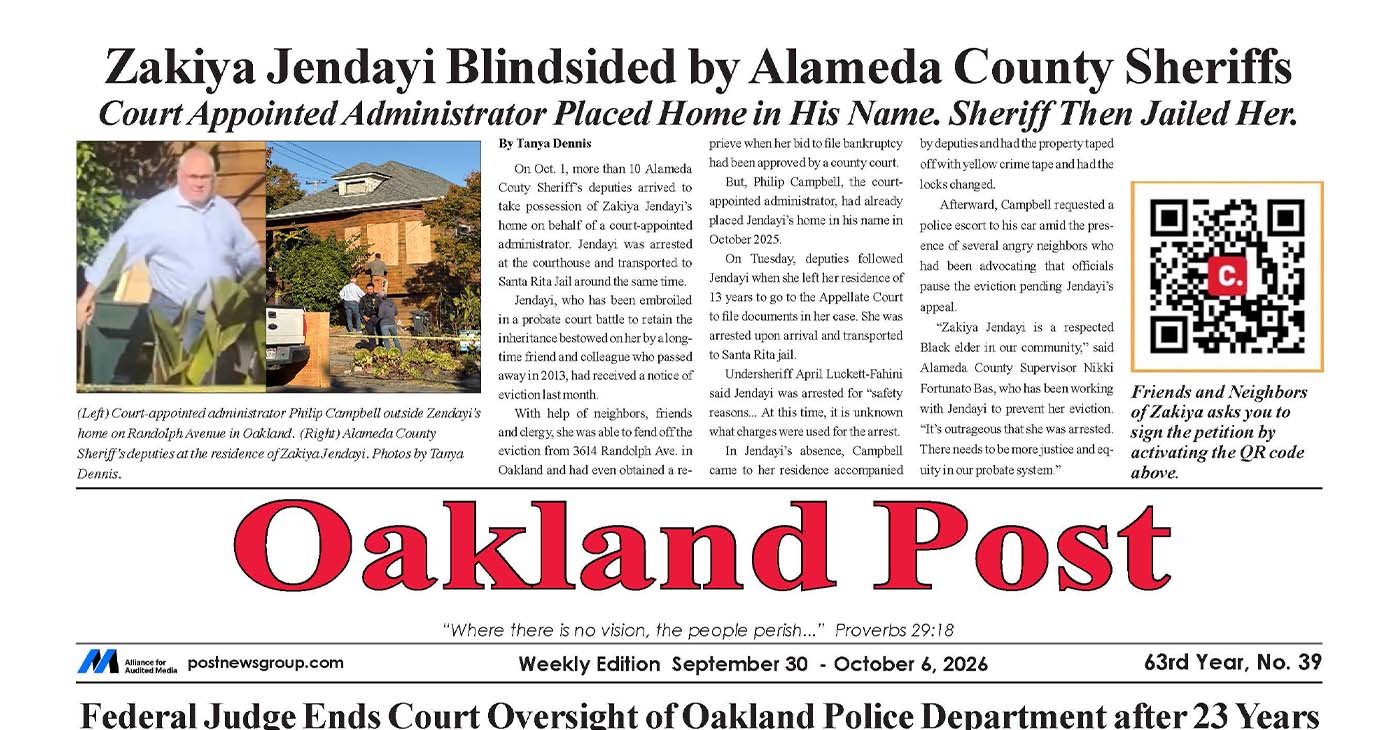
Oakland Post: Week of September 30 – October 6, 2026
The printed Weekly Edition of the Oakland Post: Week of September 30 – October 6, 2026
To enlarge your view of this issue, use the slider, magnifying glass icon or full page icon in the lower right corner of the browser window.
Activism
Oakland Post: Week of September 23 – 29, 2026
The printed Weekly Edition of the Oakland Post: Week of September 23 – 29, 2026

To enlarge your view of this issue, use the slider, magnifying glass icon or full page icon in the lower right corner of the browser window.
Activism
Oakland Post: Week of September 16 – 22, 2026
The printed Weekly Edition of the Oakland Post: Week of September 16 – 22, 2026

To enlarge your view of this issue, use the slider, magnifying glass icon or full page icon in the lower right corner of the browser window.


OP-ED: Proposition 44 Would Put a Price on Trust

OP-ED: Proposition 40: It’s Time to Play Chess, Not Checkers

Listening as a Lifeline: A Doula’s Witness to Black Maternal Health

New Protections for Ticket Buyers: Gov. Newsom Signs Assemblymember Isaac Bryan’s Bill

‘We Don’t Talk Trash — We Pick Up Trash!’

Zakiya Jendayi Arrested, Locked Out of Home by Sheriff’s Deputies

Oakland Post: Week of September 30 – October 6, 2026

Asm. Corey Jackson Announces Launch of 24-Hour Childcare in His District

IN MEMORIAM: The Rev. Leon “Sonny” Clark, Longtime Orange County Pastor and Community Leader, Dies at 72

Poll: Becerra Widens His Lead Over Hilton; Californians Split on Wealth Tax

From Historic Memories to New Possibilities: Oakland Celebrates Coliseum 60

County Office of Education Says OUSD Finances Are Getting Healthier, Materially Stronger

LIVE FREE Sunday Dinner Brings Faith, Fellowship and Civic Conversation to Oakland

Remembering Chauncey Bailey as Student Journalists Face Threats to Truth-Telling

BLACspace Cooperative Invites Bay Area to Experience Oakland’s Black Cultural Ecosystem Through a BLAC Map Tour + Party

Standoff for Justice: Our Homes Are Worth Fighting For

Oakland Post: Week of August 26 – September 1, 2026

Frontier Airlines’ Return to Oakland Airport Brings Flights, Jobs and Opportunity

Gubernatorial Candidate Steve Hilton Blasts California New Tire Rules; Newsom Hits Back

Chef Sharon Lee Blends Culinary Excellence, Education and Empowerment

Jackie Wright Champions Bay Area Stories, Filmmakers and Cultural Institutions

Misnamed ‘Parent’ PAC Seeks to Influence Oakland School Board Elections

Oakland Coliseum Project Opens Door for Small Businesses to Build Bigger

Gov. Newsom’s Latest Appointees Include Sacramento Advocate for Formerly Incarcerated Students; State’s New Tech Chief

Big City Mayors Ask for “Yes” Vote on Housing Bond Measure; Conservatives Say “No”

Longtime BWOPA Member Brendalyn Goodall Appointed to California Workforce Development Board

Oakland Post: Week of September 2 – 8, 2026

Gov. Newsom Signs Law Shielding Immigration Aid Workers From Doxing Threats

Secretary of State Shirley N. Weber Urges Californians to Vote Early as Voter ID Battle Intensifies

IN MEMORIAM: Dolly Parton Dead at 80 — How She Built a Legacy of Love and Earned Her Place in Black Culture

The Conversation With Al McFarlane 6/23/26

Media Monday 6/22/26

LIVE! ASK ALMA! — TUES. 6.23.26 7PM EST

Car Buying Secrets: 4 Hidden Checks Before You Sign!

Is This 550 HP Charger Worth YOUR Money? AutoNetwork Review

Celebrating Juneteenth – Frederick Douglass on education and resistance

LIVE! — ASK ALMA! — TUES. 6.19.26 7PM EST

Hyundai Ioniq 5 Parking, Safety, and 360 View #shorts

2025 Ioniq 5 New Wiper & Powerful Performance! #shorts

Electric SUV Range: Is 259 Miles Enough? #shorts

EV Charging: How Fast Can You Charge an Electric Vehicle? #shorts

Biometric Cooling… Messaging Seats…Come on! 2025 Infiniti QX80 Autograph 4WD

Charged Up: Witness the Magic of a Fully Electric Car! #shorts

Range Rover Sport PHEV Included…: See What’s Inside This Luxury SUV! #shorts

Invisible Hood View: Perfect Parking with X-Ray Vision! #shorts
-
 Community4 weeks ago
Misnamed ‘Parent’ PAC Seeks to Influence Oakland School Board Elections
-

 Activism4 weeks ago
Oakland Post: Week of September 9 – 15, 2026
-

 Community4 weeks ago
Richmond Tiny House Village Farm & Garden Set to Open Gates on Sept. 26
-

 Black History4 weeks ago
Latest Massacre in Haiti Reveals Cruelty U.S. Deportations
-

 Black History4 weeks ago
OPINION: Nolan Wells’ Death One of Several Signifying Racial Terror Lives on in U.S. South
-

 Business3 weeks ago
Mayor Lee Announces $1 Million Kaiser Permanente Grant for Pilot Program to Address Homelessness, Clean Up Public Spaces throughout Oakland
-

 Community4 weeks ago
Democratic Clubs Interview Candidates for Oakland School Board
-
 Uncategorized3 weeks ago
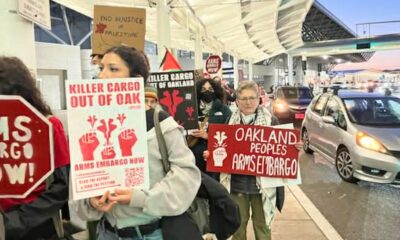
Oakland People’s Arms Embargo Coalition Demands End to Military Shipments Thru Oakland
