
Education
Oakland Teachers take on The State

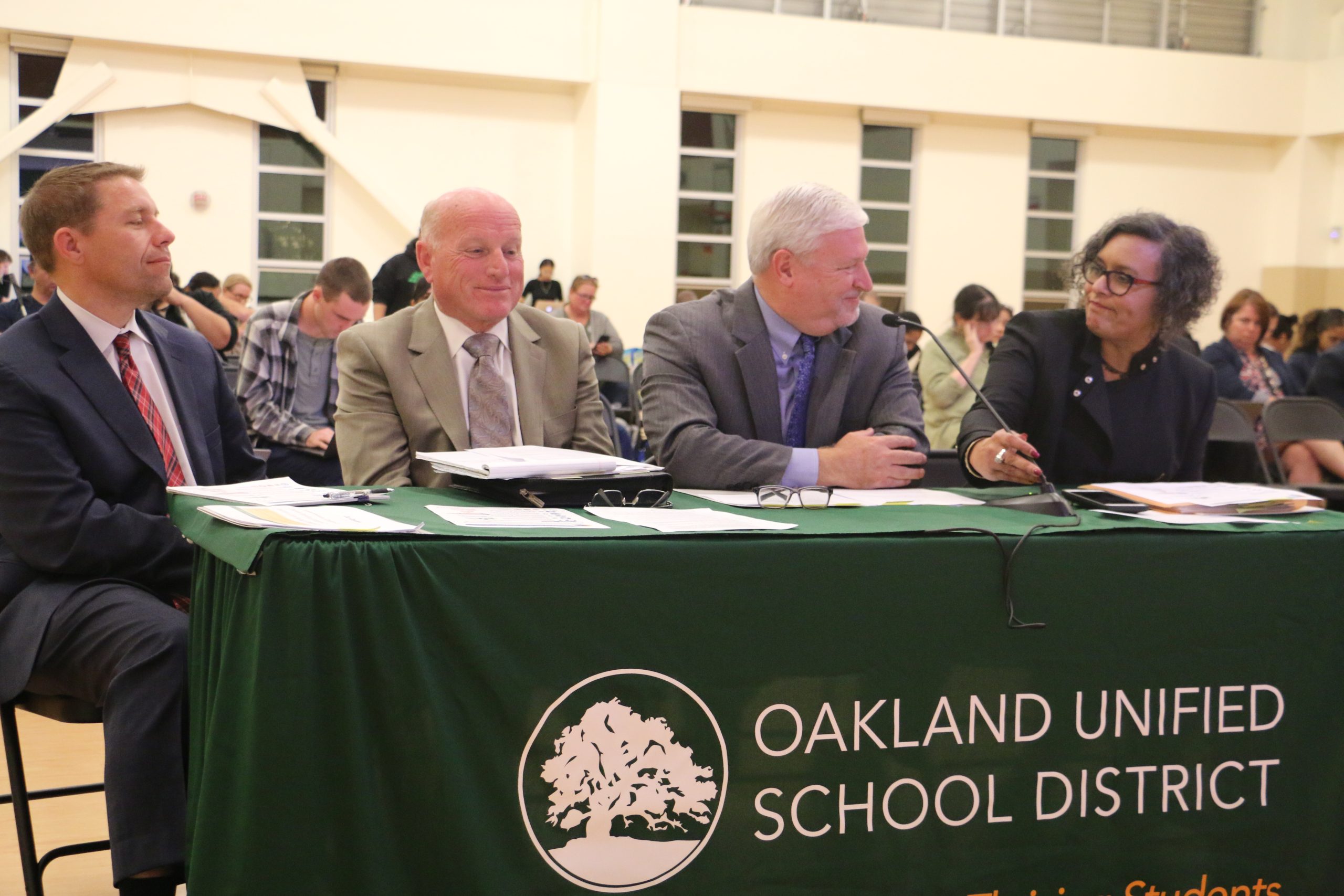
Standing behind the scenes of the battle between Oakland’s school district and its 3,000 teachers are State representatives controlling the district and enforcing drastic budget cuts.
The officials who control the Oakland Unified School District (OUSD) on behalf of the State of California mostly operate behind the scenes, meeting in private with school board members and district staff.
But this week, the overseers came out publicly in defense of the state’s austerity program for OUSD, as they sought to counter the enormous resistance of striking Oakland teachers, backed by the solid support of students, parents, community, churches and city leaders, fighting for higher teacher salaries, more counselors and nurses, smaller class sizes and a halt to school closures.
“Under my authority as the Fiscal Oversight Trustee for OUSD, I will stay and/or rescind any agreement that would put the District in financial distress. A 12 percent salary increase would do just that. What the District has on the table now is what the District can afford,” said (State) Fiscal Oversight Trustee Chris Learned in a press statement released by OUSD last Sunday.
Where did the trustee come from, and where did he get the authority to say what he said?

A little history: while OUSD was under receivership (2003-2009), the district was not allowed to hire a superintendent, and the power of the board was suspended. The district did eventually hire a superintendent, and restore the school board. However, what came next was not local control, but modified state control.
“(Since 2008), OUSD began operating with two governing boards responsible for policy—the state Department of Education and the locally elected Oakland Board of Education,” according to the district’s website. A state trustee was appointed with power to nullify district financial decisions.
Rather than serving as an independent outside evaluator, the state forced a $100 million bailout loan on the district in 2003 and spent the money with no local input—a debt which costs OUSD $6 million a year until 2026. The state was in control while a spending spree during the administration of pro-privatization Supt. Antwan Wilson almost bankrupted the district.
The reality of the state’s current authority over Oakland schools, going back to 2003, was presented last October during a rare joint public appearance at a school board meeting of the officials who are in charge of Oakland schools: California Deputy Superintendent of Public Instruction Nick Schweizer, Trustee Chris Learned, Fiscal Crisis Management and Assistance Team (FCMAT) CEO Michael Fine, and Alameda County Superintendent of Schools Karen Monroe.
The officials came to Oakland to explain the meaning of AB 1840, a new law backed by then Gov. Jerry Brown that would give more power to FCMAT (pronounced FICK-MAT) and Alameda County. They spoke about collaboration and teamwork, while demanding Oakland close schools and cut $30 million from its operating budget.
FCMAT is an independent nonprofit based in Bakersfield, funded by the State and representing the State’s authority in districts throughout California. FCMAT was directly involved in the passage of AB 1840.
Speaking bluntly, FCMAT CEO Fine said the district has no choice but to make budget cuts and close schools.
“If you failed at this, the county superintendent would come in and govern the district,” Fine said. ”The county supt. already has the authority that, if you don’t do what’s right, to impose a functioning budget on you.”
“We do this every day, guide districts through this every day. It is ultimately less painful to make your decisions as early as possible,” he said. “Cutting three dollars today rather than a dollar today, a dollar tomorrow and a dollar (later)…allows the district to get to its new norm much quicker.”
Fine said that the school district has “struggled for many years” to close schools, based on a formula for the appropriate number of students for the square footage of classroom space.
“That is one of the specific conditions in 1840,” he said. “1840 says that we are going to partner with you so that you can implement these plans in a timely fashion and buy a little bit of time, and it is just a little bit of time, so you can incorporate good decisions.”
While saying the district’s sole responsibility is to “close the gap” and end its “deficit,” Fine admitted closing schools does not save money. “When everything is said and done, the actual dollar savings are relatively small—you don’t see the savings,” he said.
Fine said that over the course of 27 years, he has had a lot of experience closing schools. “I’ve had to close some….lease some…sell some and exchange some for other properties. It’s a long and difficult process,” he said.
He also emphasized the importance of the budget cuts. “You’ve made a very public commitment to a set of reductions that total about $30 million….If you stop at $15 million, you do not achieve the benchmark…It is your job to figure out the details.”
County Supt. of Schools Monroe explained that under the implementation of AB 1840, she is working closely with FCMAT. Trustee Chris Learned now reports to her office, rather than the state.
Calling the budget cuts a team effort with the district, she explained that her office—the Alameda County Office of Education—and FCMAT will “confer and agree on the operating deficit and the next steps that are part of the legislation.
“If we see that those budget balancing strategies are not being implemented, then we will have to impose strategies,” she said.
In the midst of the ongoing Oakland teachers strike, following on the heels of the successful strike of Los Angeles teachers, new opportunities are now opening up to change the state’s long-term policies of underfunding public education and enforcing austerity on individual school districts.
One sign of that movement occurred Monday when State Supt. of Instruction Tony Thurmond intervened in the Oakland strike, joining teachers and district representatives at the bargaining table in an attempt to close the deep divisions between the parties.
Further, as community awareness grows about the role of the state in this strike, many are looking to the local state legislative delegation—Senator Nancy Skinner and Assemblymembers Rob Bonta and Buffy Wicks—to muster support in Sacramento for a more positive direction, one that embraces the needs of Oakland teachers, students and community.









Community
Democratic Clubs Interview Candidates for Oakland School Board
OAKLAND POST — For the first time, the interviews were jointly sponsored by the John George Democratic Club, Wellstone Democratic Renewal Club, Oakland East Bay Democratic Club, Black Women Organized for Political Action (BWOPA), Niagara Democratic Club, Block by Block Organizing Network and Oakland African American Chamber of Commerce.


Local Democratic clubs and community organizations interviewed candidates running for Oakland school board in the November elections, including incumbents Jennifer Brouhard in District 2, Mike Hutchinson in District 4 and Valarie Bachelor in District 6.
For the first time, the interviews were jointly sponsored by the John George Democratic Club, Wellstone Democratic Renewal Club, Oakland East Bay Democratic Club, Black Women Organized for Political Action (BWOPA), Niagara Democratic Club, Block by Block Organizing Network and Oakland African American Chamber of Commerce.
The Democratic clubs interviewed only registered Democrats.
John George and Wellstone endorsed Brouhard and Bachelor. Neither endorsed Hutchinson.
In District 4, Wellstone ranked Sylvia Pfeiffer Williams first and Kathryn Camp second. John George ranked Camp first and Williams second.
Hutchinson, an Oakland native and Oakland public schools graduate, highlighted his record.
“I was in board leadership and chaired the Budget and Finance Committee,” he said. “We passed balanced budgets and paid off the state loan early, which allowed us to finally leave state receivership after 22 years.”

Hutchinson said the district faces a financial crisis requiring changes in board leadership and district policies.
“We need a different majority so we can get back on track, end school closures, and manage our resources better,” he said.
Williams taught adult education in Oakland for 18 years.
Williams said her philosophy “comes from the disability justice world, to center the needs of the most vulnerable. When we center the needs of the most vulnerable, we create environments, systems, and learning experiences in which everyone can thrive.”
Williams framed potential school closures as an equity issue.
“Are we thinking about closing schools up in the hills?” she asked. “Or are we thinking about closing schools where communities are in crisis right now?”
Camp, a Bay Area native and Oakland resident of 25 years, has a son in second grade.
“Our kids are only getting one shot at a great education, and I’m running to bring pragmatic, student-centered leadership that restores trust, builds responsibility, and delivers results for every child,” she said.
On her website, Camp pledged accountability and transparency. “As a proud OUSD parent, I know our schools need more than promises – they need fiscal responsibility, equity, and meaningful action guided by long-term strategy,” she said.
“That means protecting classrooms, supporting teachers, using resources wisely, and making decisions that reflect clear priorities and real accountability,” said Camp. “It also means bringing people together and providing the kind of steady leadership that can navigate complex systems, ask hard questions, and stay grounded in what matters most: student outcomes, thriving schools, and a district that works for the communities it serves.”
Wellstone’s Education Committee said it opposed Hutchinson because he frequently challenged the board majority and superintendent.
“He also claims that the teachers’ contract is illegal that a grand jury should be called. He is not endorsed by the teachers’ union; he has been disruptive and non-collaborative at meetings,” and he has been absent 26% of the time, the committee said.
“He claims that the teachers’ contract is illegal and that a grand jury should be called,” the committee said. “He takes individual credit for accomplishments, including paying the state loan, when in fact these changes came from the work of the entire board, or were the result of following through on policy.”
Next week: District 6 school board candidates.

Business
Don’t Let scammers Crash Your School Year
OAKLAND POST — Buy from official and trusted retailers whenever possible, double check website URLs for misspellings or other red flags, and make sure the site uses https://. Be wary of deals that seem too good to be true as well. Avoid clicking links in unsolicited emails or text messages, including fake “missed delivery” notifications that often lead to fraudulent websites or malware.

Today’s students and young adults are true digital natives, having grown up online, learning to navigate digital spaces as a normal part of daily life. As they transition to college, they turn to digital platforms and social media for everything from apartment hunting and job searches to shopping, banking and talking with friends.
That familiarity, however, can create a false sense of security, making younger adults just as much of a target for fraud and scams as older individuals. According to the FBI’s Internet Crime Report, Americans ages 20–29 reported more than $500 million to internet-crime losses in 2025.
As scammers become more sophisticated, including using AI, students need to be more vigilant than ever about fraud and scams. Understanding the most common ones can help you avoid becoming a victim.
Common Scams Targeting Students
Online shopping and marketplace scams
Whether you’re furnishing a dorm, moving into an apartment or buying textbooks, online deals and secondhand marketplaces can help you save money while also creating more opportunities for scammers.
Buy from official and trusted retailers whenever possible, double check website URLs for misspellings or other red flags, and make sure the site uses https://. Be wary of deals that seem too good to be true as well. Avoid clicking links in unsolicited emails or text messages, including fake “missed delivery” notifications that often lead to fraudulent websites or malware.
Before making a purchase, read seller reviews and ratings. If you’re buying locally, meet in a safe public place and inspect the item before paying.
Job scams
As students return to school this fall, some may be looking for part-time jobs or internships. Scammers target students with fake jobs offering high salaries, flexible schedules or jobs you can do from your residence hall, apartment or home.
If you receive a job offer by text, email, or direct message – be cautious, especially if you never applied to work at that company. Always use well-known job boards and then apply directly through the company’s official website.
Also, if an employer asks you to pay upfront for training, equipment, background checks or application fees, it may be a sign of a scam. Legitimate companies will never charge you to get a job. They also won’t send you money and then ask you to return a portion of it.
Rental and housing scams
Scammers know student housing is in high demand. They’ll often post fake apartment listings or copy legitimate ones to trick potential renters into sending money for a deposit.
Rental prices that seem unusually low should raise a red flag. Use a reverse image search to see if photos of the property appear on a different website or in a different location. Research unfamiliar property managers or housing websites before sending money, and avoid paying deposits through wire transfers, gift cards or peer-to-peer payment apps.
Double check the address, read online reviews of the property management company and schedule a tour of the house or apartment before signing a lease or sending a deposit. That way, you’ll know the listing and location is real.
The influence of AI
Thanks to artificial intelligence, scammers can now create cloned voices and deepfake videos, along with fraudulent emails, text messages and even websites and apps that look real. These AI tools let scammers impersonate family members, employers, banks, law enforcement, delivery companies and trusted brands to get you to send money or share personal information.
How to protect yourself
No matter what type of scam you encounter, a few simple habits can go a long way toward reducing your risk:
- Limit the personal information you share online and make social media profiles private whenever possible. This can help reduce the information scammers can use to target you, guess your security questions or attempt to access your financial accounts.
- When you’re making a payment, use more protected methods, such as credit and debit cards, which generally offer stronger consumer protections than wire transfers, gift cards or peer-to-peer payment apps. Treat peer-to-peer payments, such as Zelle, like cash — once the money is sent, it’s often difficult to recover.
- Scammers can spoof phone numbers to make calls look like they’re coming from your bank, law enforcement or another trusted organization. Don’t automatically trust your caller ID – if you get a call demanding immediate action or claiming there’s a problem with your account, hang up and call back directly using a verified phone number. Banks will never call and ask you for account information, tell you to transfer money to ‘protect’ it or pressure you to act immediately.
- Don’t click links or download attachments from unexpected emails or text messages and avoid accessing your financial accounts or making online purchases on public Wi-Fi, where savvy cybercriminals can gain access to your login credentials.
- Perhaps most importantly, slow down. Back-to-school season brings a flurry of financial decisions and scammers know students are looking for deals. They often create a false sense of urgency to try to pressure people into making quick decisions. Taking a few extra minutes to verify information can make the difference.
The bottom line
Whether you’re shopping for school supplies, searching for a job or signing your first lease if you’re entering college, your status as a student can make you a prime target for scammers.
Stay skeptical of unsolicited offers, verify before you pay or share personal information, and slow down when something feels rushed. Those simple habits can help protect your money, your identity and your peace of mind throughout the school year from scams and fraud.
For more financial health tips, visit chase.com/scamproof.
For informational/educational purposes only: Views and strategies described in this article or provided via links may not be appropriate for everyone and are not intended as specific advice/recommendation for any business. Information has been obtained from sources believed to be reliable, but JPMorgan Chase & Co. or its affiliates and/or subsidiaries do not warrant its completeness or accuracy. The material is not intended to provide legal, tax, or financial advice or to indicate the availability or suitability of any JPMorgan Chase Bank, N.A. product or service. You should carefully consider your needs and objectives before making any decisions and consult the appropriate professional(s). Outlooks and past performance are not guarantees of future results. JPMorgan Chase & Co. and its affiliates are not responsible for, and do not provide or endorse third party products, services, or other content.
Deposit products provided by JPMorgan Chase Bank, N.A. Member FDIC. Equal Opportunity Lender.
© 2026 JPMorgan Chase & Co.
Books
Tarsha Jordan’s Bonita the Bumble Bee Brings STEAM Learning to Life
OAKLAND POST — In “Bonita The Bumble Bee and the Quarantine,” Jordan helped young readers process the uncertainty and isolation surrounding the COVID-19 pandemic. In a later book about returning to school, Bonita guided children through changing routines, expectations and emotions. Designed to promote social-emotional development and mental health awareness, the book was made available in English, Spanish, and Mandarin.

For educator, childcare provider and children’s author Tarsha Jordan, Bonita the Bumble Bee is much more than a colorful storybook character. The cheerful bee has become a teaching tool, a comforting friend and a creative way for children to explore their emotions, navigate life changes and discover the world around them.
Jordan’s inspiration for Bonita grew from her lifelong commitment to children and education. With more than 30 years of experience as an educator and administrator, she operates Kindergarten Readiness Academy, a licensed family childcare program in Oakland’s Longfellow neighborhood. The academy prepares young children socially, emotionally and academically for school.
Her firsthand experience has given Jordan a deep understanding of how children communicate, what captures their attention, and how stories can open conversations young readers may not otherwise know how to begin.
Jordan describes her mission as developing lifelong learners who love reading while introducing children to relatable characters. Bonita fulfills that mission by addressing real-life experiences in language children can understand.
In “Bonita The Bumble Bee and the Quarantine,” Jordan helped young readers process the uncertainty and isolation surrounding the COVID-19 pandemic. In a later book about returning to school, Bonita guided children through changing routines, expectations and emotions. Designed to promote social-emotional development and mental health awareness, editions were made available in English, Spanish and Mandarin.
Bonita’s impact becomes even more immediate when children meet the character in person. Jordan recently hosted a Mommy and Me children’s tea party at Bay Street Emeryville, where Bonita buzzed around the event, greeted young guests and brought the literary character to life.
“The children can interact with the character, experience the excitement of seeing a familiar literary friend come to life and develop an even stronger connection with reading,” Jordan said.
For children of color, that connection carries another important dimension: representation. Children benefit from seeing themselves reflected in books, educational environments, imaginative characters and the people creating those stories.
Jordan also believes Bonita expands children’s imaginations and encourages them to envision new possibilities.
“When children of color see authors that look like them creating books, building educational programs and bringing original characters into their communities, they are exposed to the possibilities beyond the story itself,” Jordan said. “They can begin to imagine themselves as writers, educators, entrepreneurs, artists and creators.”
Founded to introduce STEAM, (science, technology, engineering, the arts and mathematics) to children in transitional kindergarten through third grade, Bonita The Bumble Bee also addresses neurodivergent behaviors.
Known to young learners as “Teacher Tarsha,” Jordan combines Bonita’s whimsical personality with hands-on experiments and activities for children ages 3 to 8. The experiences promote early literacy, strengthen problem-solving skills and give children tools for managing their emotional health.
Jordan holds master’s degrees in education and public administration and is pursuing a doctorate in education. Her academic preparation and extensive classroom experience help her create programs that are both engaging and developmentally meaningful.
“We’re hoping to take Bonita to the next level and welcome new partnerships,” Jordan said.
Visit BonitaTheBumbleBee.com



Port of Oakland, Army Corps Sign Historic Harbor Design Agreement

Democratic Clubs Interview Candidates for Oakland School Board

Nuna Phillips-McKee Celebrates 100 Years: ‘A Century of Faith, Family and God’s Amazing Grace!’

D.A. Ursula Jones Dickson: Terminix to Pay $3.15 Million Over Illegal Disposal of Pesticides, Customer Records

REPORT: Community Level Policy Is Impacting Homelessness and Drug Abuse in California

OPINION: AI Needs to Know Who Is the Boss
Goldi-Locs and Two (or Three) Bears in the Forest in California Hills

Election Watch 2026: 85% of Eligible Voters in California Are Registered

Don’t Let scammers Crash Your School Year

BOOK REVIEW — Curved Air: A Biography of Sickle Cell Anemia and the Quest to Cure the First Molecular Disease

California’s Legal Cannabis Market Hits $8 Billion as State Touts Progress on Fighting Drugs, Crime

Blacks and Latinos Clash Over LA’s Barrio Run; Mayor Karen Bass Calls for Dialogue Across Racial, Neighborhood Lines

Asm. Smallwood-Cuevas’s Bill Repealing ‘Racist’ CalWORKs ‘Man-in-the-House’ Rule Clears Legislature

Asm. Smallwood-Cuevas’s Bill Repealing ‘Racist’ CalWORKs ‘Man-in-the-House’ Rule Clears Legislature

‘Ready to See These Bills Become Law’: Sen. Weber’s Package of 15 Bills Advance to Gov. Newsom’s Desk

Department of Homeland Security Demands California Secretary of State Shirley N. Weber Scrub Voter Rolls

“The Power to See Threats Sooner”: Gov. Newsom, Safety Officials Showcase California’s Investments in Hi-Tech Wildfire Prevention

Alpha Kappa Alpha Sorority, Inc. Celebrates New North Atlantic Regional Director

California Sen. Padilla Joins Colleagues to Introduce Bill Imposing Term Limits on Supreme Court Justices

Less Affluent School Districts, Including Sacramento City, Face Threat of State Takeover

Car Wash Workers Cope with Lingering Impacts of ICE Raids

ESSAY: California Can Close Its Colorectal Cancer Gap

Oakland Post: Week of August 5 – 11, 2026

As Part of Your Back-to- School Checklist, Vaccinate

Oakland ‘Port Serves as a Powerful Engine for Good Jobs and Economic Development

Gov. Newsom Signs New Affordable Housing Legislation

Gov. Newsom Announces $109.6 Million in Funding for 278 Supportive Homes in Bakersfield, Contra Costa, Sacramento and Fresno

California Hispanic Chambers of Commerce Unveils: ‘Powering the Future’ Theme for 47th Annual Statewide Convention

Closing the Gap: What the Data and Frontline Experiences Reveal About Cancer in Black California

Congresswoman Simon Demands Investigation into Trump’s Abuse of Emergency Powers for Coal Export Terminal in West Oakland

The Conversation With Al McFarlane 6/23/26

Media Monday 6/22/26

LIVE! ASK ALMA! — TUES. 6.23.26 7PM EST

Car Buying Secrets: 4 Hidden Checks Before You Sign!

Is This 550 HP Charger Worth YOUR Money? AutoNetwork Review

Celebrating Juneteenth – Frederick Douglass on education and resistance

LIVE! — ASK ALMA! — TUES. 6.19.26 7PM EST

Hyundai Ioniq 5 Parking, Safety, and 360 View #shorts

2025 Ioniq 5 New Wiper & Powerful Performance! #shorts

Electric SUV Range: Is 259 Miles Enough? #shorts

EV Charging: How Fast Can You Charge an Electric Vehicle? #shorts

Biometric Cooling… Messaging Seats…Come on! 2025 Infiniti QX80 Autograph 4WD

Charged Up: Witness the Magic of a Fully Electric Car! #shorts

Range Rover Sport PHEV Included…: See What’s Inside This Luxury SUV! #shorts

Invisible Hood View: Perfect Parking with X-Ray Vision! #shorts
-

 Commentary2 weeks ago
Standoff for Justice: Our Homes Are Worth Fighting For
-

 Business2 weeks ago
Gubernatorial Candidate Steve Hilton Blasts California New Tire Rules; Newsom Hits Back
-

 Activism2 weeks ago
Oakland Post: Week of August 26 – September 1, 2026
-

 Education2 weeks ago
Gov. Newsom’s Latest Appointees Include Sacramento Advocate for Formerly Incarcerated Students; State’s New Tech Chief
-

 Business2 weeks ago
Frontier Airlines’ Return to Oakland Airport Brings Flights, Jobs and Opportunity
-

 Business2 weeks ago
Chef Sharon Lee Blends Culinary Excellence, Education and Empowerment
-

 Business2 weeks ago
Oakland Coliseum Project Opens Door for Small Businesses to Build Bigger
-

 Community2 weeks ago
Big City Mayors Ask for “Yes” Vote on Housing Bond Measure; Conservatives Say “No”
