
Commentary
COMMENTARY: When they take our Black boys
NEW PITTSBURGH COURIER — Growing up in America can be a very risky business for Black males. Too many—perhaps a majority—of young Black males get mentally “scarred” from a court system that targets them for eternal struggle. It’s called the United States Penal System. It can be a very evil system designed to target Blacks and keep them under control. Why? Perhaps it is a method of keeping economic control of a population. People with criminal records normally cannot find economic success in our society. A criminal record equates to designed failure and poverty.

By Harry C. Alford & Kay DeBow
Growing up in America can be a very risky business for Black males. Too many—perhaps a majority—of young Black males get mentally “scarred” from a court system that targets them for eternal struggle. It’s called the United States Penal System. It can be a very evil system designed to target Blacks and keep them under control. Why? Perhaps it is a method of keeping economic control of a population. People with criminal records normally cannot find economic success in our society. A criminal record equates to designed failure and poverty.
As we evolve America has been improving in how it treats its minority population. President Trump has taken a leadership position in Penal Reform. This is a very big “game changer” in the social arena of our culture. We should embrace it and allow it to flourish and succeed. A prosecution process that leads to no cure or rehabilitation is perpetual hell for offenders. They are doomed to fail at rehabilitation and become “lost” in a societal “wilderness.”
A great book about this is written by Dr. Jawanza Kunjufu and is entitled “Countering the Conspiracy to Destroy Black Boys.” We highly recommend this book for all parents. It is important for Black parents to be alert to the fact that one of the components of early Black slavery was to break up the family unit. The system did this by attacking the male component of any Black family or group. The effects of this multi-century old practice still linger on in American society. In fact, not just America but wherever people of color live in a society that is majority White—Brazil, Columbia, Puerto Rico, England, Italy, wherever. Times are improving. We are getting closer to justice but still have a long way to go.

One of the best things Harry’s mother, Christine Brown Alford, ever did for him was to have him feel the evilness of segregation. She would send him to Jim Crow Louisiana to spend summer with his relatives. She wanted him to know his “roots” and to be able to compare the opportunities afforded by integration versus the “roadblocks erected in the name of segregation. They were two of the best summers a young Black boy could have. My cousins and friends were genuine people with good hearts. Despite the segregated facilities and “evil White people” who despised the appearance of us within their environment, life was good. We just had to stay away from “them”. The friendships that were made were meant to last a normal lifetime. Unbeknownst to us, many of us would not live a normal lifetime. The summers of skinny dipping, jug fishing, snake hunting, horseback riding, etc. are fond memories now—never to return.
Decades later, his parents retired and left California to return to lovely rural Bossier Parish, Louisiana. During one visit Harry sat with his cousin and asked for an update on what the “fellas” were now doing. “How is John Roy”, he asked. His reply: “He stole a car and got into a car chase with the state police. He ran the car into a tree and was killed.” Next question: “What is ‘Po (Napoleon) doing?” His reply: “Po got into a fight in a Ft. Worth bar and was shot dead.” Next question: “What about Linnell?” His reply: “Linnell tried to rob a drug store and was shot dead by the police.” One more time: “we hear Webster (world class sprinter for Southern University) was now with the Los Angeles Police Department.” His reply: “You heard about that Ramparts dirty cops’ scandal?” “Well, Webster was caught up in it. He is now sitting in the wrong side of a police cell.”
It went on and on. Ninety percent of Harry’s male Southern childhood friends had ill-fated futures waiting for them. That racist, Jim Crow society was there to catch them. It seems the big difference between them and Harry was a father looking over him demanding discipline. Without a loving father, a Black male has a slim chance for success. Without a loving male figure, a Black boy is prey for a system that is designed to catch him and scar him for life. It is a matter of economic domination. According to the Census Bureau, “The percentage of White children under 18 who live with both parents almost doubles that of Black children, according to the data. While 74.3 percent of all White children below the age of 18 live with both parents, only 38.7 percent of Black minors can say the same. A father’s absence leads to anti-social behavior.
As an example, the state of California has built more prisons in the last 30 years than colleges. Those prisons are predominantly filled with Blacks and Hispanics. It doesn’t take “rocket science” to figure this game out. Success is so hard to attain without a strong family unit. Don’t let them take your Black boys.
(Harry Alford is the co-founder, president/CEO of the National Black Chamber of Commerce ®. Kay DeBow is the co-founder, executive vice president of the Chamber.)
Like us at https://www.facebook.com/pages/New-Pittsburgh-Courier/143866755628836?ref=hl
Follow @NewPghCourier on Twitter https://twitter.com/NewPghCourier
This article originally appeared in the New Pittsburgh Courier.










Books
BOOK REVIEW: ‘Laws of Solomon’ Reveals Tender Heart of Former Child Soldier
The monsters that came to him early in his sleep were the easy ones. It was the later demons that stole Solomon Nangobi’s sleep, the spirits of all the people he killed when he was a child soldier in Uganda, and when he was a fixer in New York as an adult. Their ghosts called to him with urgent voices, though he left that life behind long ago.


Author: Eriq La Salle, Copyright: c.2026, Publisher: Poisoned Pen Press, SRP: $18.99, Page Count: 304 pages
Finally, after so much work, you’ve left your past behind.
That’s what you tell yourself: what’s done is done and you can’t undo history. It’s over. You try not to think about last month, last year, a decade back because what does it matter? As in the new novel, “Laws of Solomon” by Eriq La Salle, remembering is too full of pain.
The monsters that came to him early in his sleep were the easy ones. It was the later demons that stole Solomon Nangobi’s sleep, the spirits of all the people he killed when he was a child soldier in Uganda, and when he was a fixer in New York as an adult. Their ghosts called to him with urgent voices, though he left that life behind long ago.
Now, his days were filled working the soil in gardens near Malibu, and he loved the quiet life.
Still, he kept his guns.
And he was glad: when Solomon recognized two Zeta gunmen stalking a well-dressed man, woman, and child through the gardens, he couldn’t walk away. He stopped the gangsters with bullets, but not before the adults and their bodyguards were dead. The child, an 8-year-old boy named Gaby, was safe, but Gaby couldn’t tell Solomon what was going on.
What became quickly certain, however, was that Solomon was now Gaby’s guardian, and the Zeta crime boss wanted them dead, too.
When he was the same age as Gaby, Solomon saw unspeakable things, the murder of his parents, the destruction of his homeland, and the atrocities that Uganda dictator Idi Amin’s soldiers committed. He learned to kill, he observed, and he was hardened, understanding as a small boy that revenge was often necessary and needed, and that blood would shed at those times.
But Gaby was pure, an innocent, a child.
Solomon reached out to his contacts to try to get the boy to safety, but being a contact of a marked man was likewise a dangerous thing: the monsters outside were worse than the ones inside him.
Two words for you: ‘Whoo weee.’ That’s what you’re going to say when you close the back cover of “Laws of Solomon,” knowing that you’ve just been taken on a wild up-and-down, around-and-round ride.
La Salle makes it impossible not to like Solomon, an African man who has, over time, lost nearly everything dear to him and who has no faith in much of anything. Readers get that part of the story eventually, and there’s historical authenticity in some of it, but we never really get to know Solomon, which makes the book feel dark and dangerous. Along the way, we meet and get to know his helpers, which buoys Solomon’s chase to find safety for the boy, and your heart won’t stop pounding.
Keep in mind that this is a thriller partially set in 1970s Uganda, so expect lots of violence but don’t expect a lot of people to live. If you’re up for that, find “Laws of Solomon.” You won’t be able to leave it behind.

Commentary
OPINION: The New American Fear – From 9-11 to AI
The terrorists didn’t invent American racism, xenophobia or political paranoia. We shouldn’t give 19 hijackers that much credit. But after 9/11, America built an enormous security structure around fear. Surveillance expanded. Wars followed. Congress created the Department of Homeland Security. TSA transformed airports. Immigration enforcement was reorganized and ICE was created.

I was quiet about 9/11 until this week, when terrorism got an upgrade.
Artificial intelligence.
I have taken 9/11 seriously every year. Twenty-five years later, I was all “feeled out.”
I’ve gone to Ground Zero. I’ve written about the dead, the survivors, the first responders and those who survived that day only to become sick years later.
But this isn’t another column about where we were.
It’s about what America became.
For me, September 11, 2001, marks the beginning of a New America. Not the diverse, multicultural America I hoped was emerging.
This is the America that fear built.
I was 3,000 miles away in the Bay Area watching CNBC.
Then the planes hit.
The markets shut down.
And something else opened.
Fear.
At first, fear brought us together. We had a common enemy and, briefly, rediscovered a common good.
But fear is a terrible foundation for democracy.
The person we feared was initially the terrorist.
Then the Muslim.
Then the Arab.
Then the Sikh mistaken for an Arab.
Then the immigrant. The undocumented. The person at the border.
The category continues to expand.
Maybe that’s the real 25-year story of 9/11.
We went from finding common ground to looking for flaws that prove somebody doesn’t belong.
The terrorists didn’t invent American racism, xenophobia or political paranoia. We shouldn’t give 19 hijackers that much credit.
But after 9/11, America built an enormous security structure around fear.
Surveillance expanded. Wars followed. Congress created the Department of Homeland Security. TSA transformed airports. Immigration enforcement was reorganized and ICE was created.
Temporary emergency became permanent infrastructure.
Recently, Anthropic researcher Jacob Coxon quit his job and warned that people building advanced AI genuinely believe it could kill humanity by the end of this decade.
He walked away two months before his Anthropic equity vested.
That’s credibility.
President Trump has taken a different view. On Sept. 14 he called fears of AI destroying humanity a “HOAX” and declared, “WHOEVER WINS AI, WINS!” He said the only guardrail AI needs is a “STRONG AND SMART (High IQ!) PRESIDENT.”
We have built the threat.
We finance it. We feed it our words, photographs, voices, art and knowledge. We invite it into our homes and carry it in our pockets.
Americans are confronting something genuinely frightening.
AI could eliminate or transform jobs. And its increasingly powerful systems raise questions even some of their creators say they cannot fully answer.
So, the question what do we do with fear without surrendering our common humanity.
That requires real leadership and oversight from Congress, if not the president.
Trump insists Iran can’t have a nuclear weapon. But on AI, his emphasis is winning the race, especially against China.
That’s the trap.
Fear of China becomes the argument for going full speed ahead.
Twenty-five years after 9/11, we have another chance to get fear right.
Be smart enough to know what to be afraid of.
And make sure we stay in control of the tech.
We’ve got to be smarter than the machines.
About the Author
Emil Amok Guillermo is an award-winning journalist, commentator and comic monologist. He hosts a micro-talk show on YouTube. See him at Comedy Day at Robin Williams Meadow in San Francisco’s Golden Gate Park, on Sept. 20, around 2:45 p.m. Free.
Commentary
Barbara Lee Mourns Gloria Steinem, Remembers a Friendship Rooted in Equality
Steinem became one of the country’s most recognizable advocates for women’s rights, reproductive alternatives and political representation. Lee said one of the most persistent inequities confronting Black women was inadequate access to reproductive healthcare, an issue Lee addressed throughout her years in the California Legislature and Congress.
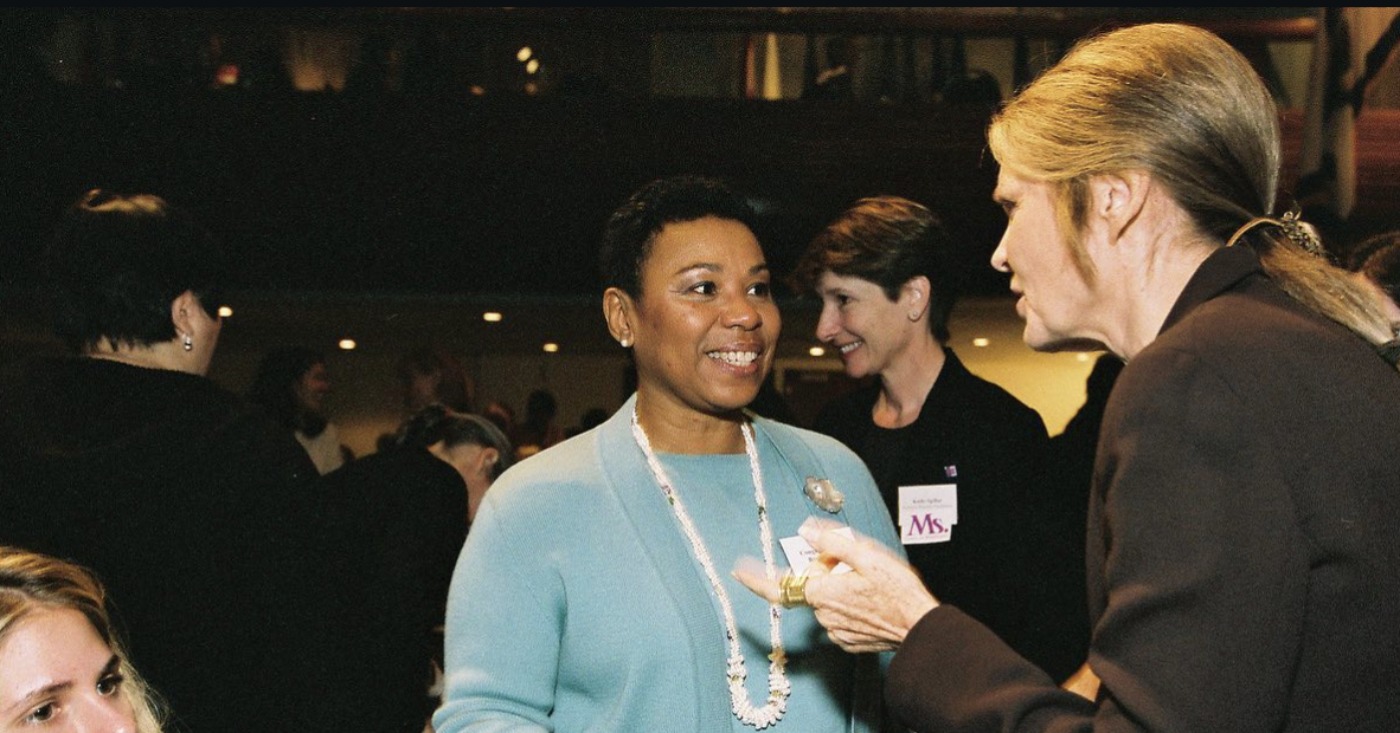
Oakland Mayor Barbara Lee is mourning the death of her longtime friend Gloria Steinem, remembering the feminist icon as a devoted ally who understood that the struggles for racial justice and gender equality were inseparable.
Steinem died Sept. 2 in New York City at the age of 92. A pioneering journalist, author and political activist, she spent more than six decades advocating for women’s equality and reproductive choices. She also co-founded Ms. magazine and the National Women’s Political Caucus.
“I called her recently and could hear the weakness in her voice,” Lee said. “She was also very fragile at my New York event, but she remained supportive.”
The friendship between Lee and Steinem grew from their connections to the late U.S. Rep. Shirley Chisholm, the first Black woman elected to Congress and the first Black candidate to seek a major political party’s presidential nomination.
Chisholm was Lee’s mentor and inspired her to enter politics. Lee worked on Chisholm’s historic 1972 presidential campaign and served as one of her delegates at the Democratic National Convention.
According to Lee, Chisholm helped Steinem deepen her understanding of racial inclusion and recognize that the women’s movement could not succeed without addressing the experiences of Black women and other women of color.
“Gloria really understood what racial equity was about as a white woman and knew the value of building coalitions,” Lee said.
Steinem became one of the country’s most recognizable advocates for women’s rights, reproductive alternatives and political representation. Lee said one of the most persistent inequities confronting Black women was inadequate access to reproductive healthcare, an issue Lee addressed throughout her years in the California Legislature and Congress.
Lee considered Steinem a genuine ally who recognized the intersections of race, gender, healthcare and economic opportunity. Steinem also understood the importance of elevating women into leadership positions and encouraging them to claim their rightful places at decision-making tables.
Their relationship extended beyond politics and public advocacy. Lee recalled joining Steinem and her husband for dinner in Manhattan Beach with Lee’s son, Tony.
“It was beautiful to see how she could be a wonderful wife, feminine and be a strong woman,” Lee said.
Tony Lee also had a professional connection to Steinem through the rerelease of “The Road to Galveston,” the 1996 television film he wrote about the life of his grandmother, Mildred Parish Massey. The film starred Cicely Tyson.
“My son’s tribute to Gloria on Facebook is very touching,” Lee said.
Lee expressed profound heartbreak over losing her friend and gratitude for Steinem’s support throughout her political career, including during reelection campaigns.
As Lee continues carrying forward the lessons of Chisholm and Steinem, she has also helped encourage a new generation of women leaders, including U.S. Reps. Lateefah Simon and Jasmine Crockett.



Doulas Are Helping Black California Moms Navigate Pregnancy–Even as High Mortality Rates Persist

Newsom Signs Addictive Social Media Law to Protect Kids

On Your November Ballot: Prop 38 Would Allocate $8.4 Billion to Immunology and Immunotherapy Funding

Ask California: Golden State Releases New AI Chatbot

Asm. Isaac Bryan’s Bill Banning California Police From ICE Side Jobs Reaches Newsom’s Desk

Assemblymember LaShae Sharp-Collins’s Bill Would Pause Law Enforcement’s Use of Shock Gloves Pending Study

BOOK REVIEW: ‘Laws of Solomon’ Reveals Tender Heart of Former Child Soldier

OPINION: The New American Fear – From 9-11 to AI

Passing for White, Fighting for Black America: The Courage of Walter White

Oakland People’s Arms Embargo Coalition Demands End to Military Shipments Thru Oakland

Barbara Lee Mourns Gloria Steinem, Remembers a Friendship Rooted in Equality

Event Preview: ‘Fashion v. Fascism’ – A Runway Revolution Is Coming to the Bay Area

Two Looming Threats Every Alameda County Elder Should Know About

Oakland Mayor Reads to Children at Bookout Block Party at Marcus Books Store

Tradition Comes to the Streets in 11th Annual Black-Eyed Pea Festival at the Freedom Farmers Market

Less Affluent School Districts, Including Sacramento City, Face Threat of State Takeover

ESSAY: California Can Close Its Colorectal Cancer Gap

California Hispanic Chambers of Commerce Unveils: ‘Powering the Future’ Theme for 47th Annual Statewide Convention

Four Candidates, Including Incumbent Barbara Lee, Qualify for Oakland Mayor’s Race

Oakland Post: Week of August 12 – 18, 2026

From Blueprint to Breakthrough: Tackling Affordable Housing in Oakland

Oakland Observes Black August with Block Parties, Film Showings, Workshops

COMMENTARY: Why Local School Tax Measure G1 Will Not Be on the November Ballot

Standoff for Justice: Our Homes Are Worth Fighting For

Returning to Its Roots, the Oakland Black-Eyed Pea Festival Partners with the Freedom Farmers Market Sept. 12

Oakland Post: Week of August 26 – September 1, 2026

NPRC Scores First Advocacy Victory: David Shaw Finally Gets His Wish to ‘Go Home’

Frontier Airlines’ Return to Oakland Airport Brings Flights, Jobs and Opportunity

Gubernatorial Candidate Steve Hilton Blasts California New Tire Rules; Newsom Hits Back

Chef Sharon Lee Blends Culinary Excellence, Education and Empowerment

The Conversation With Al McFarlane 6/23/26

Media Monday 6/22/26

LIVE! ASK ALMA! — TUES. 6.23.26 7PM EST

Car Buying Secrets: 4 Hidden Checks Before You Sign!

Is This 550 HP Charger Worth YOUR Money? AutoNetwork Review

Celebrating Juneteenth – Frederick Douglass on education and resistance

LIVE! — ASK ALMA! — TUES. 6.19.26 7PM EST

Hyundai Ioniq 5 Parking, Safety, and 360 View #shorts

2025 Ioniq 5 New Wiper & Powerful Performance! #shorts

Electric SUV Range: Is 259 Miles Enough? #shorts

EV Charging: How Fast Can You Charge an Electric Vehicle? #shorts

Biometric Cooling… Messaging Seats…Come on! 2025 Infiniti QX80 Autograph 4WD

Charged Up: Witness the Magic of a Fully Electric Car! #shorts

Range Rover Sport PHEV Included…: See What’s Inside This Luxury SUV! #shorts

Invisible Hood View: Perfect Parking with X-Ray Vision! #shorts
-
 Commentary4 weeks ago
Standoff for Justice: Our Homes Are Worth Fighting For
-
 Activism4 weeks ago
Oakland Post: Week of August 26 – September 1, 2026
-
 Business4 weeks ago
Frontier Airlines’ Return to Oakland Airport Brings Flights, Jobs and Opportunity
-
 Business4 weeks ago
Gubernatorial Candidate Steve Hilton Blasts California New Tire Rules; Newsom Hits Back
-
 Business4 weeks ago
Chef Sharon Lee Blends Culinary Excellence, Education and Empowerment
-

 Community4 weeks ago
Big City Mayors Ask for “Yes” Vote on Housing Bond Measure; Conservatives Say “No”
-

 Black History4 weeks ago
Jackie Wright Champions Bay Area Stories, Filmmakers and Cultural Institutions
-

 Education4 weeks ago
Gov. Newsom’s Latest Appointees Include Sacramento Advocate for Formerly Incarcerated Students; State’s New Tech Chief

2 Comments