
Business
Why McDonald’s is Still a Powerhouse, Despite Troubles


This Thursday, Jan. 15, 2015, file photo, shows a McDonald’s fast food restaurant sign in Chicago. McDonalds has been hurt by diners who want something different. Sales have been struggling for more than two years and the company seems trapped in a cycle of bad headlines that likely wont end soon. Despite troubles, McDonalds is still a powerhouse. (AP Photo/Nam Y. Huh, File)
CANDICE CHOI, AP Food Industry Writer
NEW YORK (AP) — McDonald’s sales have been sputtering for more than two years and the company seems trapped in a cycle of bad headlines that likely won’t end soon.
Its quarterly earnings results on Wednesday aren’t expected to be pretty either, and there’s a chance its dominance will continue to wane as newer players keep coming onto the scene.

But don’t write the obituary just yet. McDonald’s has many strengths that the rivals biting at its heels can only envy, including Ronald McDonald’s worldwide recognition. The Golden Arches will need to put them to good use to remain the world’s largest restaurant chain.
Here are six reasons why McDonald’s is nowhere close to death’s door for now.
___
MASSIVE REACH
McDonald’s has more than 14,300 locations in the U.S. and that ubiquity continues to make it a default option for many. Burrito chain Chipotle is in growth mode but still only a fraction of that size, with around 1,800 locations. (Shake Shack, whose stock offering earlier this year garnered lots of attention, has fewer than 40.)
Because of its recent struggles, McDonald’s plans to slow its growth to its lowest level in five years. But “slow” is relative: It still plans to add 600 to 700 restaurants around the world this year, on top of the more than 36,200 it already has.
Chipotle said it plans to open up to 205 new stores this year, mostly in the U.S.
___
MARKETING POWER
McDonald’s has enormous marketing muscle, in large part because its franchisees are required to contribute at least 4 percent of their sales to advertising.
Based on the $31.1 billion in sales U.S. franchisees saw last year, that would translate to at least $1.24 billion in advertising money.
That huge bucket of money is split in two ways. Some goes to national advertising and focuses on burnishing the brand. The rest goes to regional advertising and focuses more on promotions to drive customers to stores.
Advertising doesn’t have to be expensive to be effective, of course. But McDonald’s deep pockets give it a clear advantage.
___
PRINTING MONEY
The recent sales decline in the U.S. is squeezing franchisees, who still have to pay for fixed costs like labor and electricity.
But McDonald’s restaurants continue to generate a lot more cash than their peers. In 2014, the average McDonald’s restaurant raked in $2.5 million in sales, according to industry tracker Technomic. Wendy’s restaurants pulled in an average of $1.6 million, while Burger King pulled in $1.2 million.
A big reason for the difference: the popularity of McDonald’s breakfast.
Average annual sales for Shake Shack are higher at $4.6 million, Technomic said. That’s in part because Shake Shack is concentrated in New York City, where volumes tend to be higher. The average Chipotle generates roughly the same sales volume as McDonald’s even without breakfast, in part because of its fast-moving line and higher prices.
___
UNLOCKING BREAKFAST
Fans of McDonald’s breakfast have long called on the chain to offer it past 10:30 a.m. McDonald’s is finally giving the idea a serious try with a test of an all-day breakfast menu in San Diego.
It’s just one way McDonald’s might bring more customers into its stores and may signal the company’s willingness to take bigger risks.
Big companies tend to be cautious about change, and McDonald’s in particular is known for its methodical decision-making. But executives may pick up the pace to avoid becoming outdated.
___
NEW LEADERSHIP
McDonald’s CEO Steve Easterbrook stepped into his role just last month and said he wants to make McDonald’s a “modern, progressive burger company.” In a meet-and-greet with analysts, he also referred to himself as an “internal activist,” according to Sara Senatore, a Bernstein analyst.
Another new executive is Mike Andres, who became president of the U.S. division in October. He started as a manager for his family-owned McDonald’s, and has served in a variety of leadership roles at the company.
(Side note: Andres’ father was a pilot for Ray Kroc, who built McDonald’s into a fast-food giant.)
___
MCDONALD’S HAS BEEN HERE BEFORE
The troubles McDonald’s is facing are partly the result of a shifting industry, with many smaller players posing a challenge to the big guys. If that trend keeps up, McDonald’s may not be able to save itself.
At the same time, it’s easy to forget that McDonald’s has had rough patches before — and pulled out of them.
Consider the expanded menu and focus on value that former CEO Jim Skinner used to turn around business. It isn’t an ancient example; Skinner’s tenure was from 2004 to 2012, the last few years of which were some of McDonald’s strongest.
____
Follow Candice Choi at www.twitter.com/candicechoi
Copyright 2015 The Associated Press. All rights reserved. This material may not be published, broadcast, rewritten or redistributed.





Activism
Oakland Post: Week of March 18 – 24, 2026
The printed Weekly Edition of the Oakland Post: Week of March 18 – 24, 2026

To enlarge your view of this issue, use the slider, magnifying glass icon or full page icon in the lower right corner of the browser window.
Advice
Financial Wellness and Mental Health: Managing Money Stress in College
While everyone’s financial situation is unique, several common sources of stress have the potential to strain your financial health. These include financial and economic uncertainty, existing debts, unexpected expenses, and mental or physical health changes. Financial stress may differ from situation to situation, but understanding the factors contributing to yours may help you begin to craft a plan for your unique circumstances.

Sponsored by JPMorganChase
As a college student, managing financial responsibilities can be stressful.
If you’ve found yourself staying up late thinking about your finances or just feeling anxious overall about your financial future, you’re not alone. In one survey, 78% of college students who reported financial stress had negative impacts on their mental health, and 59% considered dropping out. While finances can impact overall stress, taking steps to manage your finances can support your mental, emotional and physical well-being.
When it comes to money, the sources of stress may look different for each student, but identifying the underlying causes and setting goals accordingly may help you feel more confident about your financial future.
Consider these strategies to help improve your financial wellness and reduce stress.
Understand what causes financial stress
While everyone’s financial situation is unique, several common sources of stress have the potential to strain your financial health. These include financial and economic uncertainty, existing debts, unexpected expenses, and mental or physical health changes. Financial stress may differ from situation to situation, but understanding the factors contributing to yours may help you begin to craft a plan for your unique circumstances.
2. Determine your financial priorities
Start by reflecting on your financial priorities. For students this often includes paying for school or paying off student loans, studying abroad, saving for spring break, building an emergency fund, paying down credit card debt or buying a car. Name the milestones that are most important to you, and plan accordingly.
3. Create a plan and stick to it

While setting actionable goals starts you on the journey to better financial health, it’s essential to craft a plan to follow through. Identifying and committing to a savings plan may give you a greater sense of control over your finances, which may help reduce your stress. Creating and sticking to a budget allows you to better track where your money is going so you may spend less and save more.
4. Pay down debt
Many students have some form of debt and want to make progress toward reducing their debt obligations. One option is the debt avalanche method, which focuses on paying off your debt with the highest interest rate first, then moving on to the debt with the next-highest interest rate. Another is the debt snowball method, which builds momentum by paying off your smallest debt balance, and then working your way up to the largest amounts.
5. Build your financial resilience
Some financial stress may be inevitable, but building financial resilience may allow you to overcome obstacles more easily. The more you learn about managing your money, for instance, the more prepared you’ll feel if the unexpected happens. Growing your emergency savings also may increase resilience since you’ll be more financially prepared to cover unexpected expenses or pay your living expenses.
6. Seek help and support
Many colleges have resources to help students experiencing financial stress, like financial literacy courses or funds that provide some assistance for students in need. Talk to your admissions counselor or advisor about your concerns, and they can direct you to sources of support. Your school’s counseling center can also be a great resource for mental health assistance if you’re struggling with financial stress.
The bottom line
Financial stress can affect college students’ health and wellbeing, but it doesn’t have to derail your dreams. Setting smart financial goals and developing simple plans to achieve them may help ease your stress. Revisit and adjust your plan as needed to ensure it continues to work for you, and seek additional support on campus as needed to help keep you on track.
JPMorgan Chase Bank, N.A. Member FDIC
© 2026 JPMorgan Chase & Co.
Activism
Oakland Post: Week of March 11 -17, 2026
The printed Weekly Edition of the Oakland Post: Week of March 11 – 17, 2026
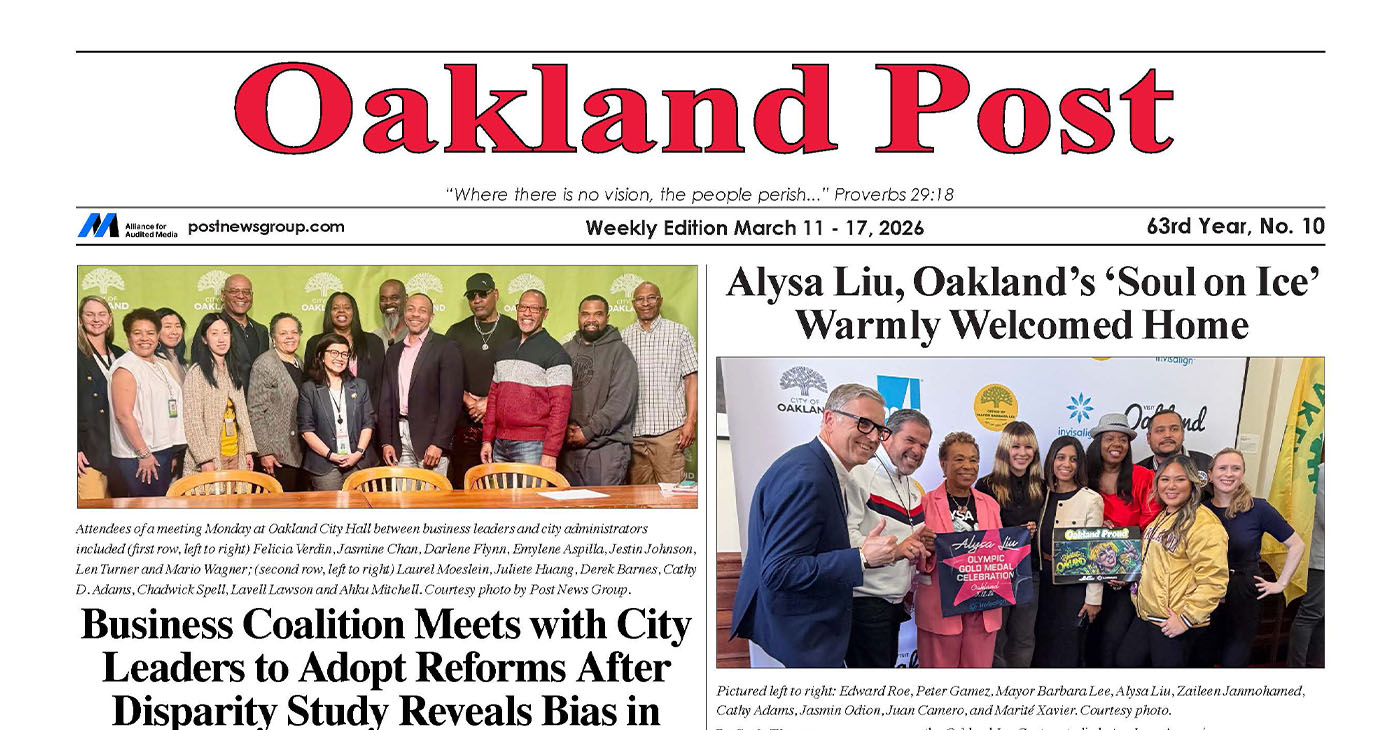
To enlarge your view of this issue, use the slider, magnifying glass icon or full page icon in the lower right corner of the browser window.


WORK FROM HOME
Home-based business with potential monthly income of $10K+ per month. A proven training system and website provided to maximize business effectiveness. Perfect job to earn side and primary income. Contact Lynne for more details: Lynne4npusa@gmail.com 800-334-0540


Black Artists in America, Installation Three Wraps at the Dixon Gallery and Gardens

Grief, Advocacy, and Education: A Counselor Reflects on Black Maternal Health

Future of Florida’s Black History Museum in Limbo

New Research Shows the Many Benefits of Early Learning

South Hampton K-8 Students Among Top 10 Finalists for Samsung’s ‘Solve for Tomorrow’ Competition

Cuba: No Negotiation with US on the President or Political System

Brooklyn Academy of Music Names Jamaican-Born Tamara McCaw as President

Trinidad & Tobego – U.S. Launches WhatsApp Channel for American Citizens in the Country

Oakland Post: Week of March 18 – 24, 2026

AI Innovation vs. Ethics and Environmental Impact

AI, Web3, and Digital Reparations

What If You Owned Your AI Agent?

Season 7, Episode 3 – January Reporter’s Roundtable 📱

Season 7, Episode 3 – January Reporter’s Roundtable

AI, Media, and Power | Part 2, Real-World Impacts and Tradeoffs

Oakland Post: Week of February 11 – 17, 2026

Reflecting on Black History Milestones in Birmingham AL

CITY OF SAN LEANDRO STATE OF CALIFORNIA PUBLIC WORKS DEPARTMENT ENGINEERING DIVISION NOTICE TO BIDDERS FOR ANNUAL STREET OVERLAY/REHABILITATION 2019-21 – PHASE III

Oakland Post: Week of February 18 – 24, 2026

PRESS ROOM: NBA Hall of Fame Nominee Terry Cummings Joins 100 Black Men of DeKalb County to Launch Victory & Values Initiative

Oakland Post: Week of February 25 – March 3, 2026

Trump’s MAGA Allies are Creating Executive Order Plan to Steal the 2026 Midterms

U.S. manufacturing rebounds – how foundry services are adapting to rising demand

OP-ED: One Hundred Years of Black Workers Telling the Truth

Advancements in solar technology that are changing the way we power the world

Chase Oakland Community Center Hosts Alley-Oop Accelerator Building Community and Opportunity for Bay Area Entrepreneurs

Poll Shows Support for Policies That Help Families Afford Child Care

Oakland Post: Week of March 4 – 10, 2026

PRESS ROOM: Civil Rights TV Launches in Selma as the World’s First 24/7 Civil Rights Television Network

Ghana Mourns a Son of the African World

Hyundai Ioniq 5 Parking, Safety, and 360 View #shorts

2025 Ioniq 5 New Wiper & Powerful Performance! #shorts

Electric SUV Range: Is 259 Miles Enough? #shorts

EV Charging: How Fast Can You Charge an Electric Vehicle? #shorts

Biometric Cooling… Messaging Seats…Come on! 2025 Infiniti QX80 Autograph 4WD

Charged Up: Witness the Magic of a Fully Electric Car! #shorts

Range Rover Sport PHEV Included…: See What’s Inside This Luxury SUV! #shorts

Invisible Hood View: Perfect Parking with X-Ray Vision! #shorts

AI Is Reshaping Black Healthcare: Promise, Peril, and the Push for Improved Results in California

ESSAY: Technology and Medicine, a Primary Care Point of View

Sanctuary Cities

The RESISTANCE – FREEDOM NOW

STATE OF THE PEOPLE: Freddie

ECONOMIC BOYCOTT DAY!!!!!

I told You So
-
 #NNPA BlackPress4 weeks ago
Poll Shows Support for Policies That Help Families Afford Child Care
-
 Activism4 weeks ago
Oakland Post: Week of March 4 – 10, 2026
-

 #NNPA BlackPress3 weeks ago
Woman’s Search for Family’s Roots Leads to Ancestor John T. Ward – A Successful Entrepreneur and Conductor on the Underground Railroad
-

 #NNPA BlackPress4 weeks ago
OP-ED: NNPA Launches 2026 “Leadership Matters” Video Series
-

 #NNPA BlackPress3 weeks ago
Advocates Raise Alarm Over ICE Operation, MOU and Detention Risks in Baltimore County
-

 #NNPA BlackPress3 weeks ago
COMMENTARY: Women of Color Shape Our Past and Future
-

 #NNPA BlackPress3 weeks ago
Pete Buttigieg to Join Mayor Randall Woodfin for Community Town Hall in Birmingham
-

 Activism2 weeks ago
Oakland Post: Week of March 11 -17, 2026
