
Activism
Silicon Valley congressman tackles Black maternal mortalities
The legislative package consists of a dozen bills aiming to prevent maternal mortalities. It would provide funding for further research, increase telehealth services for those in underserved communities and establish grants to help diversify the perinatal workforce, including doulas and midwives. It would also invest in community-based health organizations that work to promote equity and improve maternal health outcomes.


Washington, D.C.—Charles Johnson said he quickly notified hospital staff when his wife’s catheter turned pink with blood. His wife, Kira Johnson, had just given birth to their second son during a scheduled cesarean section at Cedars-Sinai Medical Center in Los Angeles.
Staff examined his wife and ordered a CT scan, he said, but hours passed and no one performed the procedure.
“My wife was shivering uncontrollably because she was losing so much blood,” said Johnson, who was speaking during a recent congressional hearing examining the high rate of maternal mortality among Black women. “… I was begging and pleading, please do something, help her.”
But Johnson told legislators his wife didn’t receive proper medical attention for 10 hours—and by then it was too late. Kira, a Black woman, died from massive internal bleeding.
“It was not my wife’s race that was a risk factor; she did everything right,” said Johnson. “It was racism that was the risk factor.”
Black mothers in the U.S. are about three times more likely than white mothers to die from childbirth-related causes, according to the Centers for Disease Control and Prevention. They further experience higher rates of miscarriage and infant loss. Native Americans are also more likely to die from pregnancy-related causes than white women.
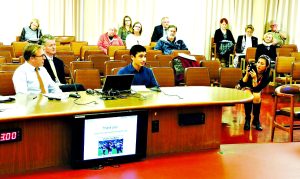
Several medical experts testified before the House Committee on Oversight and Reform last week and urged lawmakers to address this growing crisis. Other witnesses, like Johnson and Rep. Cori Bush (D-Missouri), shared their personal experiences.
In an interview with San José Spotlight, Rep. Ro Khanna (D-Fremont) said all the testimonies were deeply moving.
“I knew about the issue from a statistics perspective and a theoretical perspective, but the hearing brought home to me how much this impacts black women’s lives,” he said. “It’s not even a class issue. It affects people who are members of Congress.”
The congressman, who co-sponsored the Black Maternal Health Momnibus Act of 2021, said its passage is crucial.
The legislative package consists of a dozen bills aiming to prevent maternal mortalities. It would provide funding for further research, increase telehealth services for those in underserved communities and establish grants to help diversify the perinatal workforce, including doulas and midwives. It would also invest in community-based health organizations that work to promote equity and improve maternal health outcomes.
“It’s something that I’m passionate about,” said Khanna, who sits on the committee. “I have been a lead sponsor on the bill and I’m going to do everything I can to make sure we get this into law.”
More than 200 organizations have endorsed the bill, including the NAACP, Johnson & Johnson and the American College of Obstetricians and Gynecologists (ACOG).
Dr. Tamika Auguste, who submitted a written testimony to the committee on behalf of the ACOG, told legislators many health disparities are linked to systemic inequities in income, housing or education. But she explained that wasn’t the full story.
“Although some inequities diminish after taking these factors into account, many remain because of factors at the patient, health care system and practitioner level,” she wrote. “Racism and implicit bias on the part of health care professionals contributes to racial and ethnic disparities in health outcomes.”
When it comes to maternal health, the U.S. lags behind other similarly developed nations. The CDC found approximately 700 women die each year as a result ofpregnancy or delivery.
Although the national maternal mortality rate has risen in recent decades, California has worked to reverse that trend. The state saw maternal mortality decline by 55% between 2006 to 2013, according to the California Maternal Quality Care Collaborative.
Rev. Jeff Moore, the president of the San Jose/Silicon Valley NAACP, said a push to improve maternal health care is long overdue. The death rate of Black women during pregnancy is striking, he said, and far more work needs to be done to protect mothers and babies.
“We need to have more black and brown doctors, more doctors who look like them and specialize in this type of treatment,” he said. “More of an effort needs to be made to teach and train black physicians to be in these communities.”
Czarina Bowers would also love to see more diversity among the doulas and midwives in the South Bay area. Bowers, the co-founder of Silicon Valley Doulas, is a certified doula and lactation counselor.
“That would be fantastic for the diverse community that we live in,” she said.
Bowers added she has seen racial biases “in action” while working as a doula.
“We have had clients who told providers they were in pain and they were not believed,” she said. “As a doula, I had to step in and say, ‘Hey, there’s something wrong here and this needs attention.’”
Although it’s important to examine data while working to find solutions, Johnson reminded legislators last week that there are people and families behind those numbers.
“There is no statistic that can quantify what it is like to tell an 18-month old that his mommy is never coming home,” he said.
Kira, who died in 2016, was an entrepreneur who ran marathons and spoke five languages. Her husband said she had a sunny personality and was thrilled to learn she was expecting a second child. Johnson said their kids would grow up without a mother because his wife gave birth in a country that didn’t value her.
“We must and we can do better,” he said.
Contact Katie King at KatieKingSJS@gmail.com or follow @KatieKingCST on Twitter.













Activism
Oakland Post: Week of March 18 – 24, 2026
The printed Weekly Edition of the Oakland Post: Week of March 18 – 24, 2026

To enlarge your view of this issue, use the slider, magnifying glass icon or full page icon in the lower right corner of the browser window.

Activism
Oakland Post: Week of March 11 -17, 2026
The printed Weekly Edition of the Oakland Post: Week of March 11 – 17, 2026
To enlarge your view of this issue, use the slider, magnifying glass icon or full page icon in the lower right corner of the browser window.
Activism
Oakland Post: Week of March 4 – 10, 2026
The printed Weekly Edition of the Oakland Post: Week of March 4 – 10, 2026
To enlarge your view of this issue, use the slider, magnifying glass icon or full page icon in the lower right corner of the browser window.

WORK FROM HOME
Home-based business with potential monthly income of $10K+ per month. A proven training system and website provided to maximize business effectiveness. Perfect job to earn side and primary income. Contact Lynne for more details: Lynne4npusa@gmail.com 800-334-0540


Black Artists in America, Installation Three Wraps at the Dixon Gallery and Gardens

Grief, Advocacy, and Education: A Counselor Reflects on Black Maternal Health

Future of Florida’s Black History Museum in Limbo

New Research Shows the Many Benefits of Early Learning

South Hampton K-8 Students Among Top 10 Finalists for Samsung’s ‘Solve for Tomorrow’ Competition

Cuba: No Negotiation with US on the President or Political System

Brooklyn Academy of Music Names Jamaican-Born Tamara McCaw as President

Trinidad & Tobego – U.S. Launches WhatsApp Channel for American Citizens in the Country

Oakland Post: Week of March 18 – 24, 2026

AI Innovation vs. Ethics and Environmental Impact

AI, Web3, and Digital Reparations

What If You Owned Your AI Agent?

Season 7, Episode 3 – January Reporter’s Roundtable 📱

Season 7, Episode 3 – January Reporter’s Roundtable

AI, Media, and Power | Part 2, Real-World Impacts and Tradeoffs

Reflecting on Black History Milestones in Birmingham AL

CITY OF SAN LEANDRO STATE OF CALIFORNIA PUBLIC WORKS DEPARTMENT ENGINEERING DIVISION NOTICE TO BIDDERS FOR ANNUAL STREET OVERLAY/REHABILITATION 2019-21 – PHASE III

Oakland Post: Week of February 18 – 24, 2026

Oakland Post: Week of February 25 – March 3, 2026

PRESS ROOM: NBA Hall of Fame Nominee Terry Cummings Joins 100 Black Men of DeKalb County to Launch Victory & Values Initiative

Trump’s MAGA Allies are Creating Executive Order Plan to Steal the 2026 Midterms

U.S. manufacturing rebounds – how foundry services are adapting to rising demand

Chase Oakland Community Center Hosts Alley-Oop Accelerator Building Community and Opportunity for Bay Area Entrepreneurs

Oakland Post: Week of March 4 – 10, 2026

OP-ED: One Hundred Years of Black Workers Telling the Truth

Poll Shows Support for Policies That Help Families Afford Child Care

Advancements in solar technology that are changing the way we power the world

PRESS ROOM: Civil Rights TV Launches in Selma as the World’s First 24/7 Civil Rights Television Network

Woman’s Search for Family’s Roots Leads to Ancestor John T. Ward – A Successful Entrepreneur and Conductor on the Underground Railroad

Ghana Mourns a Son of the African World

Hyundai Ioniq 5 Parking, Safety, and 360 View #shorts

2025 Ioniq 5 New Wiper & Powerful Performance! #shorts

Electric SUV Range: Is 259 Miles Enough? #shorts

EV Charging: How Fast Can You Charge an Electric Vehicle? #shorts

Biometric Cooling… Messaging Seats…Come on! 2025 Infiniti QX80 Autograph 4WD

Charged Up: Witness the Magic of a Fully Electric Car! #shorts

Range Rover Sport PHEV Included…: See What’s Inside This Luxury SUV! #shorts

Invisible Hood View: Perfect Parking with X-Ray Vision! #shorts

AI Is Reshaping Black Healthcare: Promise, Peril, and the Push for Improved Results in California

ESSAY: Technology and Medicine, a Primary Care Point of View

Sanctuary Cities

The RESISTANCE – FREEDOM NOW

STATE OF THE PEOPLE: Freddie

ECONOMIC BOYCOTT DAY!!!!!

I told You So
-
 Activism4 weeks ago
Oakland Post: Week of March 4 – 10, 2026
-
 #NNPA BlackPress3 weeks ago
Woman’s Search for Family’s Roots Leads to Ancestor John T. Ward – A Successful Entrepreneur and Conductor on the Underground Railroad
-

 #NNPA BlackPress4 weeks ago
OP-ED: NNPA Launches 2026 “Leadership Matters” Video Series
-

 #NNPA BlackPress3 weeks ago
Advocates Raise Alarm Over ICE Operation, MOU and Detention Risks in Baltimore County
-

 #NNPA BlackPress3 weeks ago
COMMENTARY: Women of Color Shape Our Past and Future
-

 #NNPA BlackPress3 weeks ago
Pete Buttigieg to Join Mayor Randall Woodfin for Community Town Hall in Birmingham
-
 Activism2 weeks ago
Oakland Post: Week of March 11 -17, 2026
-

 Advice2 weeks ago
Financial Wellness and Mental Health: Managing Money Stress in College
