
Bay Area
S.F. Mayor London Breed Urges Religious Congregations to Do Their Part to Deter COVID-19

At her Wednesday press conference updating the public on COVID-19, San Francisco Mayor London Breed took a moment to wistfully recall the Easter Sundays of her childhood: the new church outfits, the egg hunts, good food and family gatherings.
But the first mayor in the U.S. to issue shelter-in-place orders for a metropolis of nearly 900,000 people, an action that is credited for the city’s comparatively low infection rate and resulting illness and death rates, emphasized that now was not time to be complacent and this included staying home from Easter services, Passover observances and later in the month, Ramadan.
Addressing churches and their members, Breed said “I know how hard it’s going to be to stay home and not go to church.”
“There are other ways to celebrate,” she said, such as online services. “Pastors and priests can also reach out to members by telephone” and instruct lay people to connect with the isolated, needy and vulnerable.
Mayor Breed went on to reference a church in Mt. Vernon, Wash., where a choir practiced on March 10, 2020. Even though they practiced safe distancing, at least 28 of the 45 members became sick with COVID-19 and two died.
“I am asking leaders of the religious community to impress on your members to stay at home,” she said.
Compared to national hot spots like New York and New Orleans, San Francisco’s statistics are encouraging: As of Wednesday, 5,994 people had been tested and of those, 676 had the virus and 10 people have died.
After the mayor cleaned the lectern with a sanitary wipe, San Francisco Interfaith Council President Michael Pappas came to the podium and confessed that he had feared resistance at first but as far as he knew all of the city’s “800 congregations of faith” were complying with the order and praised Breed’s leadership. The S.F.I.C. has been reaching out by telephone to congregants who are the most vulnerable and providing links to services on their web site.
San Francisco’s Third Baptist Church, under the leadership of Rev. Amos Brown, is complying with the order.
Brown thinks that Third Baptist is only doing what it has done since its founding in 1852, which is to provide help for African Americans who suffered and continue to suffer under white supremacy. H.E.L.P., Brown said is simple, practical and aspirational. ‘H’ stands for hope as opposed to fear and damnation, ‘E’ for enlightenment, including the value of science and history, especially the history of previous plagues and pandemics. ‘L’ is for love, which commands “us to love God, and love our neighbor as ourselves,” which, in practical terms, exhorts us to ‘P’ act with the power to change a situation, in this case to behave responsibly in preventing the spread of the virus based on fact.
Third Baptist had already had remote viewing for church services available before the order, and now all of them are online. Technology allows members to continue their tithes and contributions via credit card.
A contemporary of Rev. Jesse Jackson and Rev. Dr. Martin Luther King, Jr., Brown was one of the 3% of churches that supported the Civil Rights Movement in the U.S. at the time and promoted service to the community. Many other churches, he said, are on the fire-and-brimstone tip, encouraging salvation for the individual.
Brown would not have members needlessly sacrifice themselves to come to worship, though volunteers continue to provide food for their vulnerable seniors.
But he is worried about the people he sees flouting the shelter-in-place order sharing bottles outside nearby liquor stores and young people who don’t seem to understand that they can pass the disease on to their elders without even being aware they are infected.
Across the bay in East Oakland, the renowned Allen Temple Baptist Church, where U.S. Rep. Barbara Lee is a member, immediately complied with Alameda County’s shutdown order on March 17, 2020, closing their East Oakland campus but continuing to provide online Sunday worship, Bible study and Sunday school.
The church is also a veritable one-stop shop with a web page providing advice for young people, sources for food and directions for financial and psychological help.
And if that weren’t enough, one of the members is selling face coverings to comply with the recent Centers for Disease Control directive to cover one’s face when out and about.
But in the Bible Belt across the South where many states either don’t have or were slow to implement shelter-in-place orders, many Christians, especially Black Christians, may be more inclined to trust God and Jesus than other authorities like the government or scientists.
And they have good reason: Still in the living memory of Black Southerners is the Tuskegee experiment where Black men were infected with syphilis instead of the health injection they believed they were receiving. And, even now, government is failing the Black residents of Wisconsin, largely Democratic, who, despite a shelter-in-place order were denied a delay in the election date or absentee ballots and forced by the U.S. Supreme Court to go to polling places to vote on April 7, 2020, potentially endangering their health and spreading the virus.
Resistance to the order is not even so far from home. In Lodi, near California’s state capital, Pastor Jon Duncan of Cross Culture Christian Center continued to hold services despite Gov. Gavin Newsom’s directive. “First amendment rights are not suspended by the virus,” he said.
But his landlord, Bethel Open Bible Church, changed the locks and prevented Duncan from holding Palm Sunday services there.
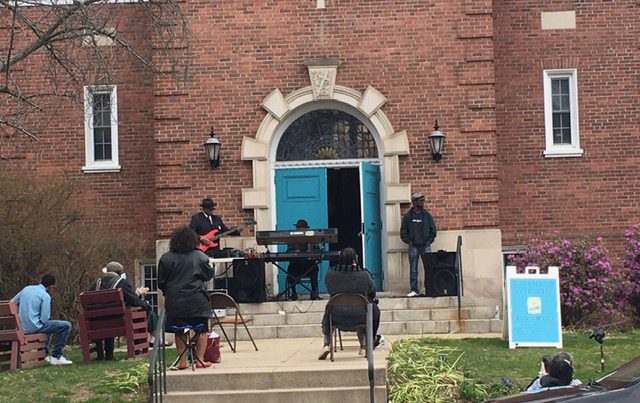
Across the country in Hartford, Conn., Pastor Derrick C. Holloway, Jr. of First Calvary Church had no problem with the order, which was that no more than 10 people could gather in one place. The doors to the church home for his small flock of 48 were locked on Palm Sunday so they gathered on the doorstep, maintaining the appropriate distance of six feet apart.
They were observed by a reporter, Mark Pazniokas, who happened to ride by on his bicycle. The music and the pastor’s voice was arresting for passers-by on foot and in cars, whose occupants parked at a safe distance to listen. “May I have a palm frond, please” asked a woman in one car who was wearing a surgical mask. One was given to her.
Their actions showed they accepted the science but at the same time hungered for tradition, a hunger for prayer in a group setting and its assurances. So they did what so many Black people of faith have done in times of trouble, from the slave ship to the brush arbor, to the storefront churches and regal cathedrals, they took the time to pray.
Mark Pazniokas of the Connecticut Times-Mirror contributed to this report.


Activism
Oakland Post: Week of March 18 – 24, 2026
The printed Weekly Edition of the Oakland Post: Week of March 18 – 24, 2026


To enlarge your view of this issue, use the slider, magnifying glass icon or full page icon in the lower right corner of the browser window.

Activism
Oakland Post: Week of March 11 -17, 2026
The printed Weekly Edition of the Oakland Post: Week of March 11 – 17, 2026
To enlarge your view of this issue, use the slider, magnifying glass icon or full page icon in the lower right corner of the browser window.
Activism
Oakland Post: Week of March 4 – 10, 2026
The printed Weekly Edition of the Oakland Post: Week of March 4 – 10, 2026

To enlarge your view of this issue, use the slider, magnifying glass icon or full page icon in the lower right corner of the browser window.

WORK FROM HOME
Home-based business with potential monthly income of $10K+ per month. A proven training system and website provided to maximize business effectiveness. Perfect job to earn side and primary income. Contact Lynne for more details: Lynne4npusa@gmail.com 800-334-0540


Black Artists in America, Installation Three Wraps at the Dixon Gallery and Gardens

Grief, Advocacy, and Education: A Counselor Reflects on Black Maternal Health

Future of Florida’s Black History Museum in Limbo

New Research Shows the Many Benefits of Early Learning

South Hampton K-8 Students Among Top 10 Finalists for Samsung’s ‘Solve for Tomorrow’ Competition

Cuba: No Negotiation with US on the President or Political System

Brooklyn Academy of Music Names Jamaican-Born Tamara McCaw as President

Trinidad & Tobego – U.S. Launches WhatsApp Channel for American Citizens in the Country

Oakland Post: Week of March 18 – 24, 2026

AI Innovation vs. Ethics and Environmental Impact

AI, Web3, and Digital Reparations

What If You Owned Your AI Agent?

Season 7, Episode 3 – January Reporter’s Roundtable 📱

Season 7, Episode 3 – January Reporter’s Roundtable

AI, Media, and Power | Part 2, Real-World Impacts and Tradeoffs

Oakland Post: Week of February 11 – 17, 2026

Reflecting on Black History Milestones in Birmingham AL

Rising Optimism Among Small And Middle Market Business Leaders Suggests Growth for California

CITY OF SAN LEANDRO STATE OF CALIFORNIA PUBLIC WORKS DEPARTMENT ENGINEERING DIVISION NOTICE TO BIDDERS FOR ANNUAL STREET OVERLAY/REHABILITATION 2019-21 – PHASE III

Oakland Post: Week of February 18 – 24, 2026

PRESS ROOM: NBA Hall of Fame Nominee Terry Cummings Joins 100 Black Men of DeKalb County to Launch Victory & Values Initiative

Oakland Post: Week of February 25 – March 3, 2026

Trump’s MAGA Allies are Creating Executive Order Plan to Steal the 2026 Midterms

U.S. manufacturing rebounds – how foundry services are adapting to rising demand

OP-ED: One Hundred Years of Black Workers Telling the Truth

Advancements in solar technology that are changing the way we power the world

Chase Oakland Community Center Hosts Alley-Oop Accelerator Building Community and Opportunity for Bay Area Entrepreneurs

Poll Shows Support for Policies That Help Families Afford Child Care

PRESS ROOM: Civil Rights TV Launches in Selma as the World’s First 24/7 Civil Rights Television Network

Oakland Post: Week of March 4 – 10, 2026

Hyundai Ioniq 5 Parking, Safety, and 360 View #shorts

2025 Ioniq 5 New Wiper & Powerful Performance! #shorts

Electric SUV Range: Is 259 Miles Enough? #shorts

EV Charging: How Fast Can You Charge an Electric Vehicle? #shorts

Biometric Cooling… Messaging Seats…Come on! 2025 Infiniti QX80 Autograph 4WD

Charged Up: Witness the Magic of a Fully Electric Car! #shorts

Range Rover Sport PHEV Included…: See What’s Inside This Luxury SUV! #shorts

Invisible Hood View: Perfect Parking with X-Ray Vision! #shorts

AI Is Reshaping Black Healthcare: Promise, Peril, and the Push for Improved Results in California

ESSAY: Technology and Medicine, a Primary Care Point of View

Sanctuary Cities

The RESISTANCE – FREEDOM NOW

STATE OF THE PEOPLE: Freddie

ECONOMIC BOYCOTT DAY!!!!!

I told You So

-
 Activism4 weeks ago
Oakland Post: Week of February 25 – March 3, 2026
-
 #NNPA BlackPress4 weeks ago
Poll Shows Support for Policies That Help Families Afford Child Care
-
 Activism3 weeks ago
Oakland Post: Week of March 4 – 10, 2026
-

 #NNPA BlackPress3 weeks ago
Woman’s Search for Family’s Roots Leads to Ancestor John T. Ward – A Successful Entrepreneur and Conductor on the Underground Railroad
-

 #NNPA BlackPress3 weeks ago
OP-ED: NNPA Launches 2026 “Leadership Matters” Video Series
-

 #NNPA BlackPress3 weeks ago
Advocates Raise Alarm Over ICE Operation, MOU and Detention Risks in Baltimore County
-

 #NNPA BlackPress3 weeks ago
COMMENTARY: Women of Color Shape Our Past and Future
-

 #NNPA BlackPress3 weeks ago
Pete Buttigieg to Join Mayor Randall Woodfin for Community Town Hall in Birmingham
