
City Government
Clergy Warn of Dangers of Coal

Dozens of Bay Area faith leaders, including representatives of Baptist, Jewish, Roman Catholic and Episcopal communities, gathered at the steps of City Hall on Tuesday, rallying against the prospect of transporting millions of tons of coal through Oakland to be shipped out of the former Army Base.
On Tuesday, the Oakland City Council was scheduled to vote on the approval of a $208,000 contract with a private consulting firm to analyze the potential health and safety impacts that exporting coal would have on adjacent communities in West Oakland.
The item was eventually pulled from the agenda.
Speaking at a City Hall press conference, pastors, rabbis and environmental activists from various congregations and local organizations spoke of the wide ranging opposition to exporting the fossil fuel out of a city that already experiences abnormally high levels of environment-induced asthma and cancer.
According to a new poll released by the Sierra Club, 76 percent of Oakland voters say they oppose the shipment of coal through the city, including 57 percent who oppose it “strongly.”
Speakers at the rally included Rev. Chauncey Mathews of Corinthian Baptist Church, Rev. Laurie Manning of Skyline United Church of Christ, Rev. Curtis Robinson of Faith Baptist Church, Rabbi David Cooper of Kehilla Community Synagogue, Rev. Ben Daniel of Montclair Presbyterian Church, Rev. Daniel Buford of Allen Temple Baptist Church and Rev. Dr. Kwasi Thornell of St. Augustine’s Episcopal Church.

The faith leaders and their supporters were joined by the Sierra Club, Interfaith Power and Light and United Native Americans, Inc.
Expressing support for the No Coal in Oakland campaign at the council meeting at City Hall Tuesday evening were Bishop Frank Pinkard Jr. of Evergreen Missionary Baptist Church, Minister Keith Muhammad of the Nation of Islam, Theo Williams of the SambaFunk! drummers and Rev. Dr. Jim Hopkins of Lakeshore Baptist Church.
“There is a long history of poor urban communities being poisoned by environmental waste, and we’re not going to let that happen any longer,” said Rev. Buford of Allen Temple Baptist Church.
“Black people are usually the canaries in the mine shafts of institutional racism,” said Buford. “The things that kill us first will kill you next.”
Rev. Manning of Skyline United Church of Christ linked the potential health impacts of shipping coal through Oakland to the ongoing health crisis in Flint, Michigan, which has predominantly affected children of color and subsequently led to discoveries of hazardous levels of lead in many other city water supplies across the country.
Community members lined up at the City Council meeting to speak for and against the possibility of coal being one of the commodities to be shipped out of the former Army Base development.
A group of Black clergy members from the Ecumenical Economic Empowerment Council (EEEC) told the council that the project would create an important economic boost for the city and would specifically supply jobs to Oakland’s Black communities. The pastors came with a group of people from Men in Valor Academy, which helps formerly incarcerated men acquire job skills.
Members of EEEC were upset that the council had pulled the vote to outsource a health and safety analysis to the private consultant Environmental Science Associates because it would further delay the project from advancing.
“Why are we delaying?” said Pastor Kevin Barnes of the Abyssian Missionary Baptist Church. “Some of these young men really want to take care of their families if they had a good job, and this is the economic caboose that’s going to give it to our young men.”

Pastor Kevin Barnes
“People are talking about how this issue is dividing the Black clergy. The Black clergy is not divided, we have different opinions about stuff,” said Barnes. “Some of us want people to get jobs, some of us could care less.”
In an interview with the Post, Bishop Pinkard of Evergreen Missionary Baptist Church said he is skeptical that these jobs would go to people in Oakland first or that jobs would be restricted to those most in need.
“What kind of safeguard do they have in place so that the already polluted environment will not become more polluted in Oakland, effecting the health of our children,” said Pinkard. “We have to think long term as related to the health of our people.”
According to Derrick Muhammad of the longshore workers’ union in Oakland, ILWU Local 10, the idea that the project would supply jobs to unemployed and formerly incarcerated people is “disingenuous.”
“Trade organizations in this area do not have a practice of recruiting in Black neighborhoods,” said Muhammad, who opposes the coal terminal along with the longshore union. “And if you are not already a member of a union, how then would you ever get a job on a project that is a union project?”
“You are not going to get these jobs, you’re not going to get employed. Period,” said Muhammad.
To the relief of many anticoal campaigners, the council item was pulled from the agenda at the request of Councilmember Rebecca Kaplan so that city staff might be able to consider additional suggestions and information.
The City Council is scheduled to return with an update on the coal issue in their first meeting in April.
Post publisher Paul Cobb recognizes that there are clergy on both sides of the issue and will offer to cover both sides of the issue when information is provided.






Activism
Oakland Post: Week of March 18 – 24, 2026
The printed Weekly Edition of the Oakland Post: Week of March 18 – 24, 2026

To enlarge your view of this issue, use the slider, magnifying glass icon or full page icon in the lower right corner of the browser window.
Activism
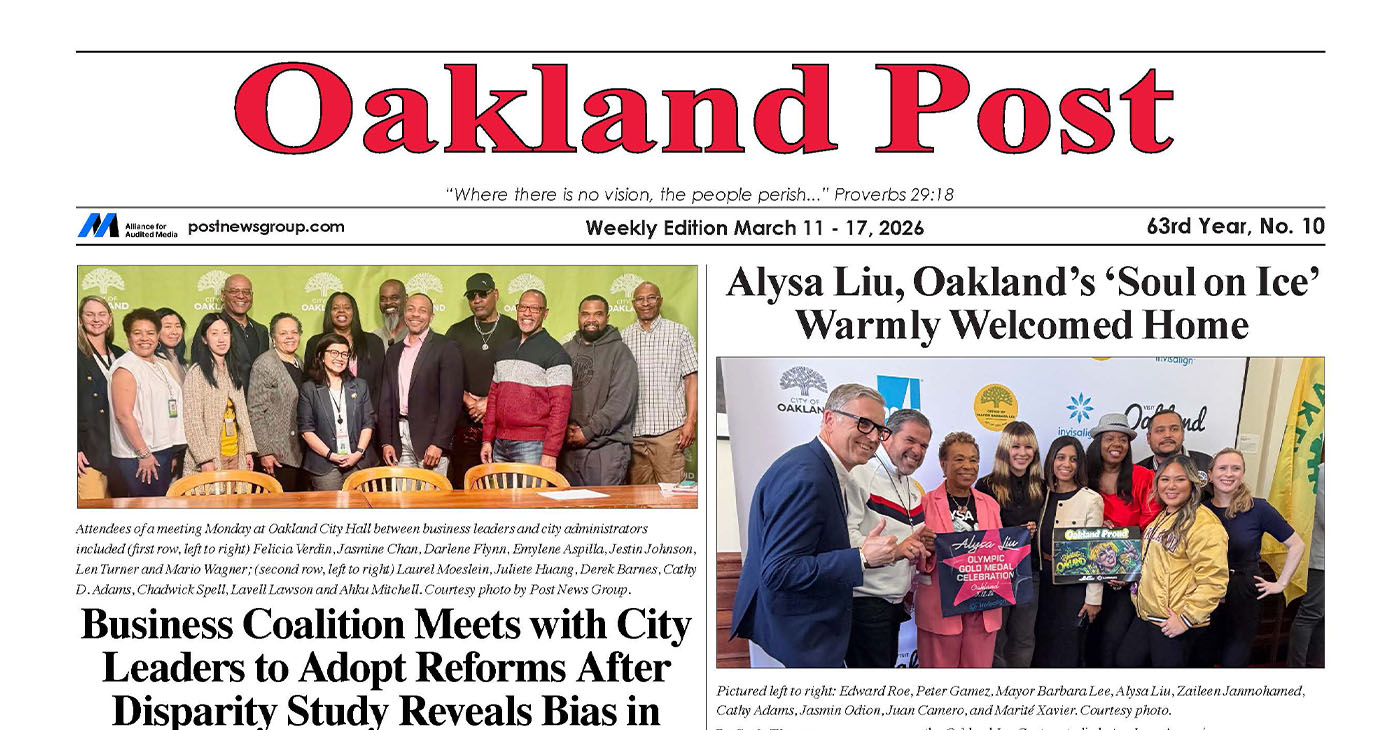
Oakland Post: Week of March 11 -17, 2026
The printed Weekly Edition of the Oakland Post: Week of March 11 – 17, 2026
To enlarge your view of this issue, use the slider, magnifying glass icon or full page icon in the lower right corner of the browser window.
Activism
Oakland Post: Week of March 4 – 10, 2026
The printed Weekly Edition of the Oakland Post: Week of March 4 – 10, 2026

To enlarge your view of this issue, use the slider, magnifying glass icon or full page icon in the lower right corner of the browser window.


WORK FROM HOME
Home-based business with potential monthly income of $10K+ per month. A proven training system and website provided to maximize business effectiveness. Perfect job to earn side and primary income. Contact Lynne for more details: Lynne4npusa@gmail.com 800-334-0540


Black Artists in America, Installation Three Wraps at the Dixon Gallery and Gardens

Grief, Advocacy, and Education: A Counselor Reflects on Black Maternal Health

Future of Florida’s Black History Museum in Limbo

New Research Shows the Many Benefits of Early Learning

South Hampton K-8 Students Among Top 10 Finalists for Samsung’s ‘Solve for Tomorrow’ Competition

Cuba: No Negotiation with US on the President or Political System

Brooklyn Academy of Music Names Jamaican-Born Tamara McCaw as President

Trinidad & Tobego – U.S. Launches WhatsApp Channel for American Citizens in the Country

Oakland Post: Week of March 18 – 24, 2026

AI Innovation vs. Ethics and Environmental Impact

AI, Web3, and Digital Reparations

What If You Owned Your AI Agent?

Season 7, Episode 3 – January Reporter’s Roundtable 📱

Season 7, Episode 3 – January Reporter’s Roundtable

AI, Media, and Power | Part 2, Real-World Impacts and Tradeoffs

Reflecting on Black History Milestones in Birmingham AL

CITY OF SAN LEANDRO STATE OF CALIFORNIA PUBLIC WORKS DEPARTMENT ENGINEERING DIVISION NOTICE TO BIDDERS FOR ANNUAL STREET OVERLAY/REHABILITATION 2019-21 – PHASE III

Oakland Post: Week of February 18 – 24, 2026

Oakland Post: Week of February 25 – March 3, 2026

PRESS ROOM: NBA Hall of Fame Nominee Terry Cummings Joins 100 Black Men of DeKalb County to Launch Victory & Values Initiative

Trump’s MAGA Allies are Creating Executive Order Plan to Steal the 2026 Midterms

U.S. manufacturing rebounds – how foundry services are adapting to rising demand

Oakland Post: Week of March 4 – 10, 2026

Chase Oakland Community Center Hosts Alley-Oop Accelerator Building Community and Opportunity for Bay Area Entrepreneurs

Poll Shows Support for Policies That Help Families Afford Child Care

OP-ED: One Hundred Years of Black Workers Telling the Truth

Advancements in solar technology that are changing the way we power the world

Woman’s Search for Family’s Roots Leads to Ancestor John T. Ward – A Successful Entrepreneur and Conductor on the Underground Railroad

PRESS ROOM: Civil Rights TV Launches in Selma as the World’s First 24/7 Civil Rights Television Network

COMMENTARY: Women of Color Shape Our Past and Future

Hyundai Ioniq 5 Parking, Safety, and 360 View #shorts

2025 Ioniq 5 New Wiper & Powerful Performance! #shorts

Electric SUV Range: Is 259 Miles Enough? #shorts

EV Charging: How Fast Can You Charge an Electric Vehicle? #shorts

Biometric Cooling… Messaging Seats…Come on! 2025 Infiniti QX80 Autograph 4WD

Charged Up: Witness the Magic of a Fully Electric Car! #shorts

Range Rover Sport PHEV Included…: See What’s Inside This Luxury SUV! #shorts

Invisible Hood View: Perfect Parking with X-Ray Vision! #shorts

AI Is Reshaping Black Healthcare: Promise, Peril, and the Push for Improved Results in California

ESSAY: Technology and Medicine, a Primary Care Point of View

Sanctuary Cities

The RESISTANCE – FREEDOM NOW

STATE OF THE PEOPLE: Freddie

ECONOMIC BOYCOTT DAY!!!!!

I told You So
-
 Activism4 weeks ago
Oakland Post: Week of March 4 – 10, 2026
-
 #NNPA BlackPress4 weeks ago
Woman’s Search for Family’s Roots Leads to Ancestor John T. Ward – A Successful Entrepreneur and Conductor on the Underground Railroad
-
 #NNPA BlackPress4 weeks ago
COMMENTARY: Women of Color Shape Our Past and Future
-

 #NNPA BlackPress4 weeks ago
OP-ED: NNPA Launches 2026 “Leadership Matters” Video Series
-
 Activism2 weeks ago
Oakland Post: Week of March 11 -17, 2026
-

 #NNPA BlackPress4 weeks ago
Advocates Raise Alarm Over ICE Operation, MOU and Detention Risks in Baltimore County
-

 #NNPA BlackPress4 weeks ago
Pete Buttigieg to Join Mayor Randall Woodfin for Community Town Hall in Birmingham
-

 Advice2 weeks ago
Financial Wellness and Mental Health: Managing Money Stress in College
