
Activism
UC Academics Picket Campuses in Largest Strike of the Year
The post-doctoral scholars, teaching assistants and associate instructors, graduate student researchers, and academic researchers are represented by the United Auto Workers union in contract negotiations with the UC system. Bargaining between the disputing parties has been ongoing for months, and while UC officials recently called for a third-party mediator to address remaining issues, they are continuing to negotiate without one.

By Maxim Elramsisy | California Black Media
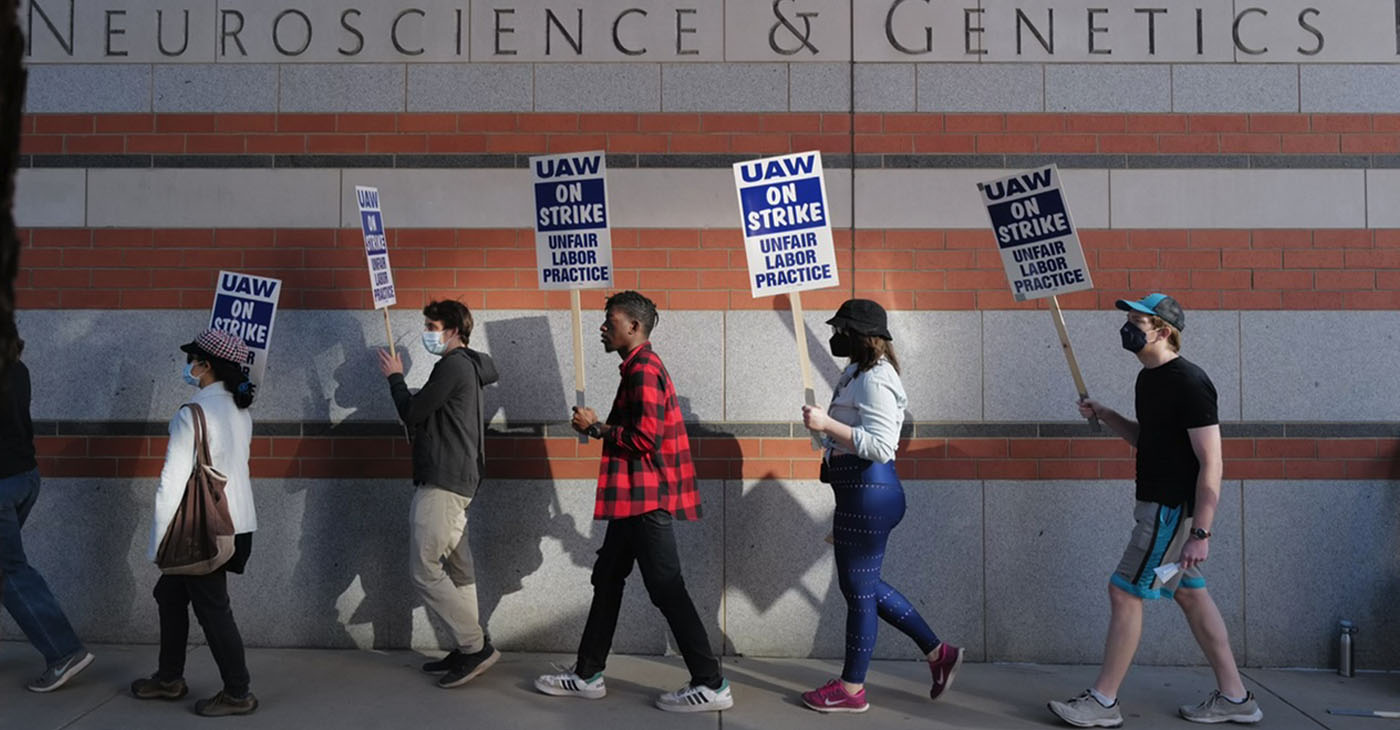
Around 48,000 academic workers at all 10 University of California (UC) campuses went on strike Nov. 14, shutting down classrooms and research laboratories in the largest employee walkout at any academic institution in history.
The post-doctoral scholars, teaching assistants and associate instructors, graduate student researchers, and academic researchers are represented by the United Auto Workers union in contract negotiations with the UC system.
Bargaining between the disputing parties has been ongoing for months, and while UC officials recently called for a third-party mediator to address remaining issues, they are continuing to negotiate without one.
“When I was working in the lab, I worked 50-60 hours per week, and the salary was so low that every month I really had to think about if I would make it through the month,” said Neil Sweeny, president of UAW 5810, which is representing the striking UC employees. “I have two small children and my partner was a full-time student. We lived in campus family housing, and we went to the campus foodbank every month to make sure that we had food. This was while my research was bringing in millions of dollars in research funding for the University.”

The workers are demanding better pay and benefits, including wage increases tied to housing costs. Housing costs in California are among the highest in the country, especially in the Los Angeles and San Francisco metropolitan areas.
Aside from UC campuses located in the state’s biggest cities, many of the research university system’s campuses are in parts of the state that have relatively high costs of living, like Berkeley, San Diego and the Westside of Los Angeles.
“UC’s pay falls below all their self-identified peer institutions, including Harvard, Stanford, Yale and even public schools like the University of Michigan where living costs are far less,” the union said in a press release on Nov. 17.
UC maintains that “on average, UC rents systemwide are 20-25% below market rates, with some campuses providing even deeper discounts. UC has offered wage increases for all UAW members which would further help them meet their housing needs.”
The aggrieved employees paint a different picture.
“Being a TA pays for tuition but there is no way I can support myself in this city with what they pay,” said Victor E., a PhD. student and teacher’s assistant on strike at UCLA. “With teaching, my own coursework, and my research, there isn’t really any time to pick up another job. This has resulted in me taking out loans just to live and eat here. This shouldn’t be the case. With the amount of work the university gets out of its graduate students, postdocs, and others, a living wage is a small ask…A number one ranked public university should be doing no less and certainly much, much more.”
Another priority for the workers is transportation costs. The cost of gasoline has gone up around the world and according to a statewide survey conducted by The Public Policy Institute of California, an independent and non-partisan research firm, 43% of Californians including half of lower-income residents worry every day about the high cost of gasoline and the increasing unaffordability of various modes of transportation.
The union wants UC to cover regional transit passes, and additional subsidies and incentives for taking public transit or bikes to work.
Recently, UC has offered to pay campus fees to extend “existing student-funded transit discounts,” to UAW members.
Although agreements have yet to be announced, on Nov. 17 the UAW reported that “parties made progress on issues related to Parking and Transit, Appointment Notification, and Paid Time Off.”
There continues to be a large gap between the salary asks and the UC proposals. On Nov. 18, a UAW statement said, “UC made another economic proposal to Academic Researchers containing 4.5% raises that do not match the rate of inflation.”
However, they did report progress in some other areas. “We have reached agreement on a few issues — such as health benefits improvements for Postdocs — which, while important, are not the major ones dividing the parties.”
As final examinations approach for students in the UC system, so does uncertainty. “UAW remains ready to meet for round-the-clock negotiations, but UC has not agreed to schedule sessions for the weekend,” a UAW release said. “Workers will be back on the strike lines Monday morning.”
Students, faculty and elected officials are showing support for the strikers. Some professors are cancelling classes, and some students are electing to walk out. California State Assembly Speaker Anthony Rendon tweeted “Academic workers are essential to the success of all of our @UofCalifornia campuses. The UC must continue to bargain in good faith to reach an agreement with the @UAW.”











Activism
Oakland Post: Week of March 18 – 24, 2026
The printed Weekly Edition of the Oakland Post: Week of March 18 – 24, 2026

To enlarge your view of this issue, use the slider, magnifying glass icon or full page icon in the lower right corner of the browser window.
Activism
Oakland Post: Week of March 11 -17, 2026
The printed Weekly Edition of the Oakland Post: Week of March 11 – 17, 2026
To enlarge your view of this issue, use the slider, magnifying glass icon or full page icon in the lower right corner of the browser window.
Activism
Oakland Post: Week of March 4 – 10, 2026
The printed Weekly Edition of the Oakland Post: Week of March 4 – 10, 2026

To enlarge your view of this issue, use the slider, magnifying glass icon or full page icon in the lower right corner of the browser window.


WORK FROM HOME
Home-based business with potential monthly income of $10K+ per month. A proven training system and website provided to maximize business effectiveness. Perfect job to earn side and primary income. Contact Lynne for more details: Lynne4npusa@gmail.com 800-334-0540


Black Artists in America, Installation Three Wraps at the Dixon Gallery and Gardens

Grief, Advocacy, and Education: A Counselor Reflects on Black Maternal Health

Future of Florida’s Black History Museum in Limbo

New Research Shows the Many Benefits of Early Learning

South Hampton K-8 Students Among Top 10 Finalists for Samsung’s ‘Solve for Tomorrow’ Competition

Cuba: No Negotiation with US on the President or Political System

Brooklyn Academy of Music Names Jamaican-Born Tamara McCaw as President

Trinidad & Tobego – U.S. Launches WhatsApp Channel for American Citizens in the Country

Oakland Post: Week of March 18 – 24, 2026

AI Innovation vs. Ethics and Environmental Impact

AI, Web3, and Digital Reparations

What If You Owned Your AI Agent?

Season 7, Episode 3 – January Reporter’s Roundtable 📱

Season 7, Episode 3 – January Reporter’s Roundtable

AI, Media, and Power | Part 2, Real-World Impacts and Tradeoffs

Oakland Post: Week of February 11 – 17, 2026

Reflecting on Black History Milestones in Birmingham AL

Rising Optimism Among Small And Middle Market Business Leaders Suggests Growth for California

CITY OF SAN LEANDRO STATE OF CALIFORNIA PUBLIC WORKS DEPARTMENT ENGINEERING DIVISION NOTICE TO BIDDERS FOR ANNUAL STREET OVERLAY/REHABILITATION 2019-21 – PHASE III

Oakland Post: Week of February 18 – 24, 2026

PRESS ROOM: NBA Hall of Fame Nominee Terry Cummings Joins 100 Black Men of DeKalb County to Launch Victory & Values Initiative

Oakland Post: Week of February 25 – March 3, 2026

Trump’s MAGA Allies are Creating Executive Order Plan to Steal the 2026 Midterms

U.S. manufacturing rebounds – how foundry services are adapting to rising demand

OP-ED: One Hundred Years of Black Workers Telling the Truth

Advancements in solar technology that are changing the way we power the world

Chase Oakland Community Center Hosts Alley-Oop Accelerator Building Community and Opportunity for Bay Area Entrepreneurs

Poll Shows Support for Policies That Help Families Afford Child Care

PRESS ROOM: Civil Rights TV Launches in Selma as the World’s First 24/7 Civil Rights Television Network

Oakland Post: Week of March 4 – 10, 2026

Hyundai Ioniq 5 Parking, Safety, and 360 View #shorts

2025 Ioniq 5 New Wiper & Powerful Performance! #shorts

Electric SUV Range: Is 259 Miles Enough? #shorts

EV Charging: How Fast Can You Charge an Electric Vehicle? #shorts

Biometric Cooling… Messaging Seats…Come on! 2025 Infiniti QX80 Autograph 4WD

Charged Up: Witness the Magic of a Fully Electric Car! #shorts

Range Rover Sport PHEV Included…: See What’s Inside This Luxury SUV! #shorts

Invisible Hood View: Perfect Parking with X-Ray Vision! #shorts

AI Is Reshaping Black Healthcare: Promise, Peril, and the Push for Improved Results in California

ESSAY: Technology and Medicine, a Primary Care Point of View

Sanctuary Cities

The RESISTANCE – FREEDOM NOW

STATE OF THE PEOPLE: Freddie

ECONOMIC BOYCOTT DAY!!!!!

I told You So
-
 Activism4 weeks ago
Oakland Post: Week of February 25 – March 3, 2026
-
 #NNPA BlackPress4 weeks ago
Poll Shows Support for Policies That Help Families Afford Child Care
-
 Activism3 weeks ago
Oakland Post: Week of March 4 – 10, 2026
-

 #NNPA BlackPress3 weeks ago
Woman’s Search for Family’s Roots Leads to Ancestor John T. Ward – A Successful Entrepreneur and Conductor on the Underground Railroad
-

 #NNPA BlackPress3 weeks ago
OP-ED: NNPA Launches 2026 “Leadership Matters” Video Series
-

 #NNPA BlackPress3 weeks ago
Advocates Raise Alarm Over ICE Operation, MOU and Detention Risks in Baltimore County
-

 #NNPA BlackPress3 weeks ago
COMMENTARY: Women of Color Shape Our Past and Future
-

 #NNPA BlackPress3 weeks ago
Pete Buttigieg to Join Mayor Randall Woodfin for Community Town Hall in Birmingham
