
National
Sheriff, Lawyer Dispute Whether 73-Year-Old Deputy Qualified


Sheriff Stanley Glanz speaks during a news conference about the reserve deputy Robert Bates’ shooting of Eric Harris on Monday, April 20, 2015. Glanz said he doesn’t believe training records were falsified for a volunteer deputy who said he confused his handgun for his stun gun before fatally shooting Harris this month. (Mike Simons/Tulsa World via AP)
KELLY P. KISSEL, Associated Press
SEAN MURPHY, Associated Press
OKLAHOMA CITY (AP) — The Tulsa County volunteer deputy who shot and killed a suspect after mistaking his handgun for a stun gun was using an unauthorized weapon when he fired the fatal shot, lawyers for the dead man’s family said Monday.
In separate news conferences, the county sheriff and lawyers for the man killed by 73-year-old Robert Bates disagreed on whether the reserve officer should have been on the streets with a badge and a gun.
Sheriff Stanley Glanz said Bates, his longtime insurance agent, had been properly trained and passed annual firearms certifications required by the state.
Dan Smolen, a lawyer for Harris’ family, said the Tulsa County Sheriff’s Office violated a number of its internal policies by letting Bates carry his personal handgun after training at the range on another weapon. Smolen also said the department failed to keep a permanent record of Bates’ training, a violation of local policies.
Records Bates released during the weekend showed that the volunteer officer was trained on a .45, not the weapon used in Harris’ death.
“None of those that are approved by the sheriff’s office own policies include a .357 Smith and Wesson,” Smolen said, while reviewing department records for reporters.
“Firearms training is a critical piece of this story. None of the records produced by the Tulsa County Sheriff’s Office or Mr. Bates’ attorney, whoever produced them, indicate that he was ever certified with a .357 revolver,” Smolen said.
Harris died after running from a sting operation involving illegal gun sales. Bates, who has been charged with second-degree manslaughter, has said that he confused his handgun with his stun gun following a short chase.
The sheriff said it was proper to have Bates on the scene with eight other officers during an investigation into illegal gun sales.
“Mr. Bates has been to the range several times and is qualified, and that is documented,” the sheriff said.
Smolen reviewed documents Bates released showing passing scores at the shooting range, though some efforts were marked below the 72 percent passing grade.
Using a slideshow, he said Tulsa sheriff’s department policies require that guns used on-duty be the same as those used at the range, unless an officer is off-duty before being called to respond.
State law enforcement training standards do not require that the weapons be the same, but do allow counties and local police to set their own guidelines.
Under those same state standards, once people are certified as law officers they remain authorized to work as long as they maintain weapons skills and aren’t de-certified for reasons as varied as being convicted of major crimes or involuntarily committed to a mental health facility.
“Whether they are hired by a particular department or meet that department’s requirements … that is up to the individual department, not CLEET,” said James Wilson, the general counsel for the Council on Law Enforcement Education and Training. “If the Tulsa County Sheriff’s Office wants to commission them, that’s their business, as long as they’re certified.”
Bates, who sold his insurance business for $6 million in 1999, was trained to be a Tulsa Police Department patrolman in 1964 but left in 1965. He was out of law enforcement for 35 years, returning for volunteer work in Florida in 2000-01 — doing ride-alongs — before joining the Tulsa County force in 2008 and making a number of donations to the agency. He also was Glanz’ campaign manager during the 2012 election.
There was no record of why Bates left the Tulsa Police Department. The agency said it destroys old personnel files after five years.
Glanz’ office has said it, too, cannot find all of Bates’ records. Monday, Glanz said some of those records could have been destroyed under a new state law that allows agencies to throw away old records after seven years.
“I don’t doubt for a second that they can’t find these records,” said Sen. Brian Crain, a Republican from Tulsa who sponsored the bill. “It’s a bureaucracy, and with any bureaucracy you’re going to lose track of some records.” He said he couldn’t recall if it was Glanz or the state Sheriffs Association that asked for the bill.
Glanz, the local sheriff since 1989, was on the Commission of Accreditation for Law Enforcement Agencies from 2000 to 2005 and said he believed that age standards may be considered in response to Harris’ death.
“We follow the national standards. I think that we will be reviewing the national standards for our reserves and age may be an element of that,” Glanz said.
But Craig Hartley, CALEA’s executive director, said Monday no one has asked for a review, and any mandatory retirement age might not survive a federal court challenge under equal employment laws.
Glanz also said Monday that action will be taken against two deputies at the scene, including one caught on video cursing at Harris as he lay dying. The sheriff said both have received threats and have been reassigned.
“We will review what those officers did and will take some administrative action,” the sheriff said, but didn’t provide specifics.
The FBI said Monday it had concluded that a civil rights investigation into Harris’ death was not warranted “at this time.”
The Tulsa World newspaper, citing unidentified sources, has reported that some of Bates’ supervisors were told to certify him after he failed to meet some qualifications. Bates released his records Saturday in an effort to refute that claim.
The reporter and editor on the Tulsa World story have resigned “to pursue other opportunities,” the newspaper said on its website. Another reporter also leaving the paper said the departure had been in the works for weeks, even before Bates shot Harris.
“We always intended to give notice this week,” said former World reporter Cary Aspinwall, who is married to an AP reporter. “This all happened before he shot the guy.”
___
Kissel reported from Little Rock, Arkansas. Associated Press writers Justin Juozapavicius in Tulsa and Allen Reed in Little Rock contributed to this report.
Copyright 2015 The Associated Press. All rights reserved. This material may not be published, broadcast, rewritten or redistributed.









Activism
Oakland Post: Week of April 8 – 14, 2026
The printed Weekly Edition of the Oakland Post: Week of April 8 – 14, 2026

To enlarge your view of this issue, use the slider, magnifying glass icon or full page icon in the lower right corner of the browser window.
Activism
Oakland Post: Week of April 1 – 7, 2026
The printed Weekly Edition of the Oakland Post: Week of April 1 – 7, 2026

To enlarge your view of this issue, use the slider, magnifying glass icon or full page icon in the lower right corner of the browser window.
#NNPA BlackPress
Black Artists in America, Installation Three Wraps at the Dixon Gallery and Gardens
TRI-STATE DEFENDER — With 50+ paintings, sculptures and assemblages, the exhibit features artists like Varnette Honeywood from Los Angeles, whose pieces appeared in Bill Coby’s private collection (before they were auctioned off) and on “The Cosby Show.” Also included are works by Alonzo Davis, another Los Angeles artist who opened one of the first galleries there where Black Artists could exhibit.

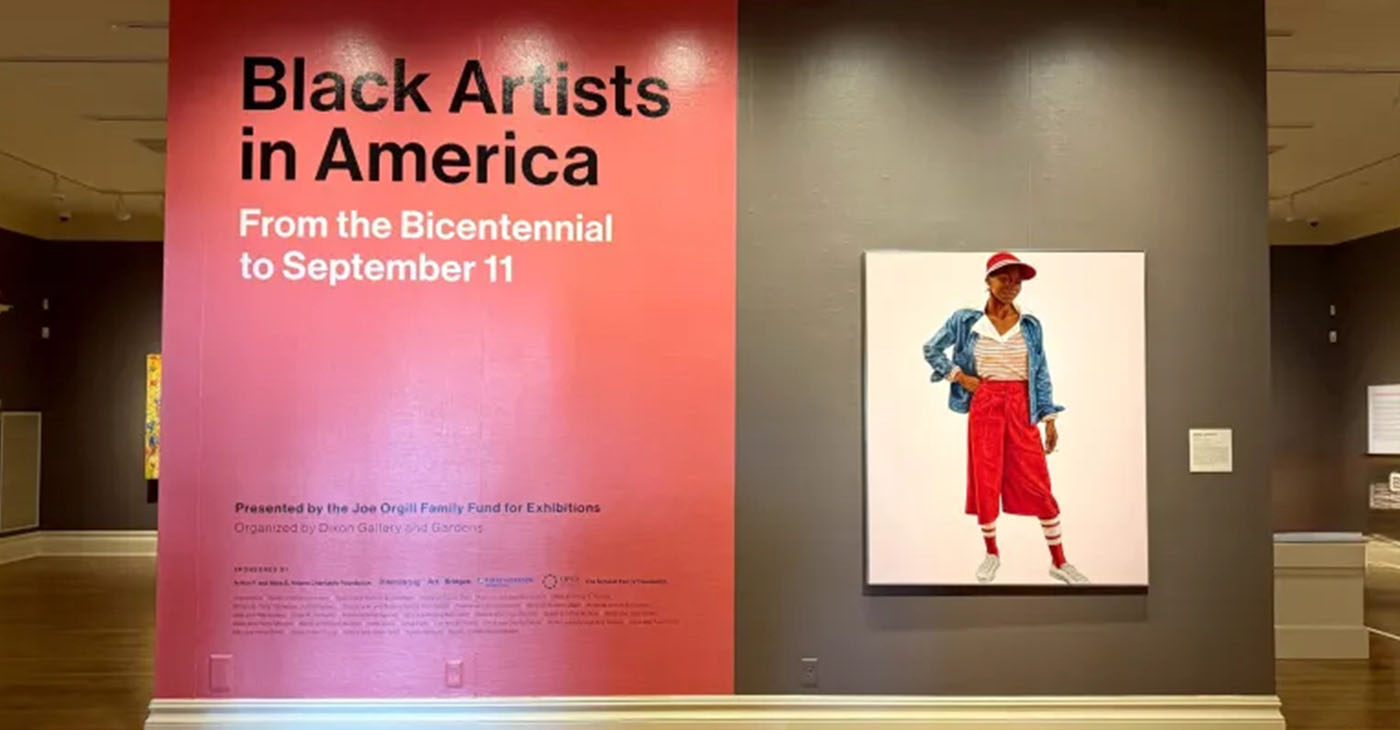
By Candace A. Gray | Tri-State Defender
The tulips gleefully greet those who enter the gates at the Dixon Gallery & Gardens on an almost spring day. More than 650,000 bulbs of various hues are currently on display. And they are truly breathtaking.
Inside the gallery, and equally as breathtaking, is the “Black Artists in America, From the Bicentennial to September 11” exhibit, which runs through Sunday, March 29. This is the third installment of a three-part series that started years ago and illustrates part of the Black experience through visual arts in the 20th century.
“This story picks up where part two left off,’’ said Kevin Sharp, the Linda W. and S. Herbert Rhea director for the Dixon. “This era is when we really start to see the emergence of these important Black artists’ agency and freedom shine through. They start to say and express what they want to, and it was a really beautiful time.”
With 50+ paintings, sculptures and assemblages, the exhibit features artists like Varnette Honeywood from Los Angeles, whose pieces appeared in Bill Coby’s private collection (before they were auctioned off) and on “The Cosby Show.” Also included are works by Alonzo Davis, another Los Angeles artist who opened one of the first galleries there where Black Artists could exhibit.
“Though [Davis] was from LA, he actually lived in Memphis for a decade,” said Sharp. “He was a dean at Memphis College of Art, and later opened the first gallery in New York owned and operated by black curators.”
Another featured artist is former NFL player, Ernie Barnes. His work is distinctive. Where have you seen one of his most popular paintings, Sugar Shack? On the end scene and credits of the hit show “Good Times.” His piece Saturday Night, Durham, North Carolina, 1974 is in this collection.
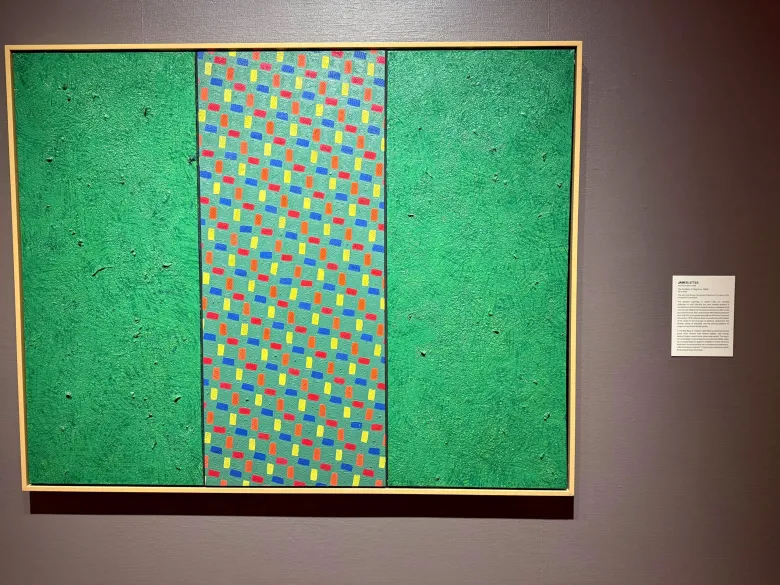
Memphis native James Little’s “The War Baby: The Triptych” is among more than 50 works featured in “Black Artists in America, From the Bicentennial to September 11” at the Dixon Gallery & Gardens, the final installment of a three-part series highlighting the impact and evolution of Black artists through 2011.
The exhibit features other artists with Memphis ties, including abstract painter James Little, who was raised in a segregated Memphis and attended Memphis Academy of Art (before it was Memphis College of Art). He later moved to New York, became a teacher and an internationally acclaimed fixture in the art world in 2022 when he was named a Whitney Biennial selected artist at the Whitney Museum of American Art in New York.
Other artists like Romare Bearden, who had a Southern experience but lived up North, were featured in all three installments.
“During this period of time, he was a major figure,” said Sharp. “He wrote one of the first books on the history of African American art during a time when there were more Black academics, art teachers, more Black everything!”
Speaking of Black educators, Sharp said the head curator behind this tri-part series and Dixon’s partner in the arts is Earnestine Jenkins, Ph.D., an art history professor at the University of Memphis, who also earned a Master of Arts degree from Memphis State University (now UofM). “We began working with Dr. Jenkins in 2018,” he said.
Sharp explained that it takes a team of curators, registrars, counterparts at other museums, and more, about three years to assemble an exhibit like this. It came together quite seamlessly, he added. Each room conjured up more jaw-dropping “wows” than the one before it. Each piece worked with the others to tell the story of Black people and their collective experience during this time period.
One of the last artists about whom Sharp shared information was Bettye Saar, who will turn 100 years old this year. She’s been working in Los Angeles for 80 years and is finally getting her due. Her medium is collages or assemblages, and an incredible work of hers is on display. She’s married to an artist and has two daughters, also artists.
The exhibit catalogue bears some of these artists’ stories, among other scholarly information.
The exhibit, presented by the Joe Orgill Family Fund for Exhibitions, is culturally and colorfully rich. It is a must see and admission to the Dixon is free.
Visit https://www.dixon.org/ to learn more.
Fun Facts: An original James Little design lives in the flooring of the basketball court at Tom Lee Park, and he makes and mixes his own paint colors.


WORK FROM HOME
Home-based business with potential monthly income of $10K+ per month. A proven training system and website provided to maximize business effectiveness. Perfect job to earn side and primary income. Contact Lynne for more details: Lynne4npusa@gmail.com 800-334-0540


Oakland Post: Week of April 8 – 14, 2026

Oakland Post: Week of April 1 – 7, 2026

Black Artists in America, Installation Three Wraps at the Dixon Gallery and Gardens

Grief, Advocacy, and Education: A Counselor Reflects on Black Maternal Health

Future of Florida’s Black History Museum in Limbo

New Research Shows the Many Benefits of Early Learning

South Hampton K-8 Students Among Top 10 Finalists for Samsung’s ‘Solve for Tomorrow’ Competition

Cuba: No Negotiation with US on the President or Political System

Brooklyn Academy of Music Names Jamaican-Born Tamara McCaw as President

Trinidad & Tobego – U.S. Launches WhatsApp Channel for American Citizens in the Country

Oakland Post: Week of March 18 – 24, 2026

AI Innovation vs. Ethics and Environmental Impact

AI, Web3, and Digital Reparations

What If You Owned Your AI Agent?

Season 7, Episode 3 – January Reporter’s Roundtable 📱

Reflecting on Black History Milestones in Birmingham AL

Oakland Post: Week of February 25 – March 3, 2026

Oakland Post: Week of March 4 – 10, 2026

PRESS ROOM: NBA Hall of Fame Nominee Terry Cummings Joins 100 Black Men of DeKalb County to Launch Victory & Values Initiative

Trump’s MAGA Allies are Creating Executive Order Plan to Steal the 2026 Midterms

U.S. manufacturing rebounds – how foundry services are adapting to rising demand

Poll Shows Support for Policies That Help Families Afford Child Care

Oakland Post: Week of March 11 -17, 2026
Oakland Post: Week of March 18 – 24, 2026

OP-ED: One Hundred Years of Black Workers Telling the Truth

Advancements in solar technology that are changing the way we power the world

Financial Wellness and Mental Health: Managing Money Stress in College

Woman’s Search for Family’s Roots Leads to Ancestor John T. Ward – A Successful Entrepreneur and Conductor on the Underground Railroad

COMMENTARY: Women of Color Shape Our Past and Future

PRESS ROOM: Civil Rights TV Launches in Selma as the World’s First 24/7 Civil Rights Television Network

Hyundai Ioniq 5 Parking, Safety, and 360 View #shorts

2025 Ioniq 5 New Wiper & Powerful Performance! #shorts

Electric SUV Range: Is 259 Miles Enough? #shorts

EV Charging: How Fast Can You Charge an Electric Vehicle? #shorts

Biometric Cooling… Messaging Seats…Come on! 2025 Infiniti QX80 Autograph 4WD

Charged Up: Witness the Magic of a Fully Electric Car! #shorts

Range Rover Sport PHEV Included…: See What’s Inside This Luxury SUV! #shorts

Invisible Hood View: Perfect Parking with X-Ray Vision! #shorts

AI Is Reshaping Black Healthcare: Promise, Peril, and the Push for Improved Results in California

ESSAY: Technology and Medicine, a Primary Care Point of View

Sanctuary Cities

The RESISTANCE – FREEDOM NOW

STATE OF THE PEOPLE: Freddie

ECONOMIC BOYCOTT DAY!!!!!

I told You So
-
 Activism3 weeks ago
Oakland Post: Week of March 11 -17, 2026
-
 Activism3 weeks ago
Oakland Post: Week of March 18 – 24, 2026
-
 Advice3 weeks ago
Financial Wellness and Mental Health: Managing Money Stress in College
-
 #NNPA BlackPress3 weeks ago
Brooklyn Academy of Music Names Jamaican-Born Tamara McCaw as President
-
 #NNPA BlackPress2 weeks ago
Grief, Advocacy, and Education: A Counselor Reflects on Black Maternal Health
-
 #NNPA BlackPress2 weeks ago
New Research Shows the Many Benefits of Early Learning
-
 #NNPA BlackPress2 weeks ago
Black Artists in America, Installation Three Wraps at the Dixon Gallery and Gardens
-

 Advice4 weeks ago
Women & Wealth: Tips for Navigating Your Lifelong Financial Journey
